



Boží muka (Úvalno) Wayside shrine
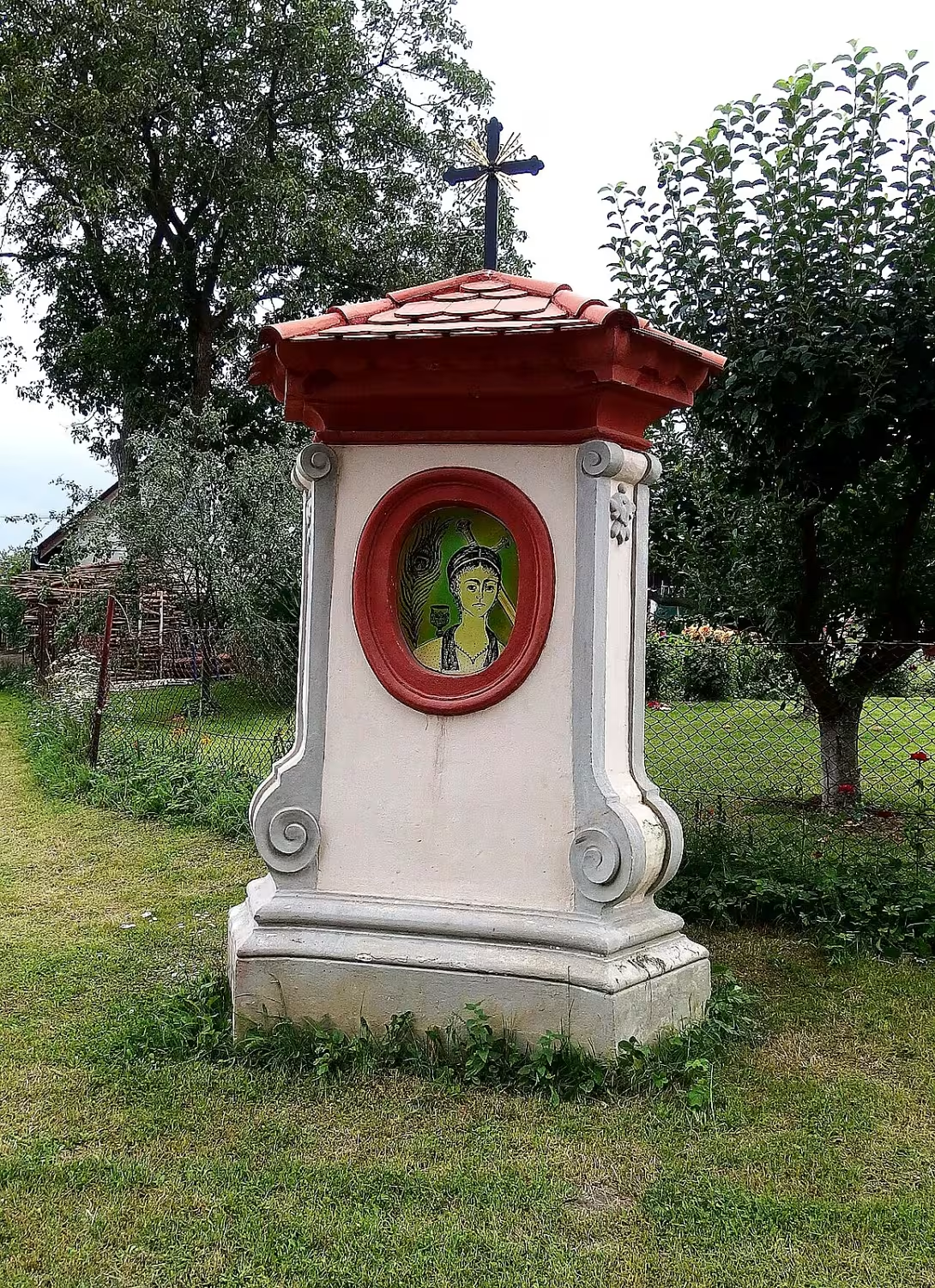
The torment of God in Úvaln is a baroque monument. It stands in the centre of the village near the parish church of St. Nicholas. This building has been protected as a cultural monument since 1958 and entered in the Central List of Cultural Monuments of the Czech Republic. It is remarkable by its architecture and historical significance. Construction from the second half of the 18th century attracts attention with unique elements and rich history.
Architecturally, it is a brick construction with a plastered triangular plan, covered with corners and a needle roof made of burnt bags. At the top there is a metal cross with a halo, which gives the building a strong impression. Smooth walls have oval nuggets in the upper third of the shambrane with a circumference bar, which creates fine details. In 2010 the monument was repaired by the association Za Opava. In 2015, the Mosaics of Saint Barbara, Florian and Vavríce by Josef Ondráška were planted in oval níků.
The history of God's torment records several key events. According to the parish chronicle, a repair was carried out in 1933. The original e-mail paintings on the sheet, which depicted Saint Barbara, Florian and Jan Nepomuk, were lost irreversibly. These paintings were an important part of the memorial. Their loss subsequently led to the need for further renewal work. In 2015, new mosaics reenrich the visual appearance of the building.
The torment of God in Úvaln is now open to visitors. It is worth visiting not only for its historical significance, but also for its beautiful architecture. Location in the centre of the village near the parish church of St. Nicholas strengthens their activities and makes them part of the local cultural identity. Visiting this place allows you to explore the heritage of past generations and appreciate efforts to save it.
The memory in Úvaln resembles the rich history and traditions of the region. Her care and restoration prove the importance of protecting cultural heritage for future generations. Getting to know this building also supports efforts to maintain it in the long term.
Then and now
Drag the slider to compare how the landmark may have looked when it was built with the view today.
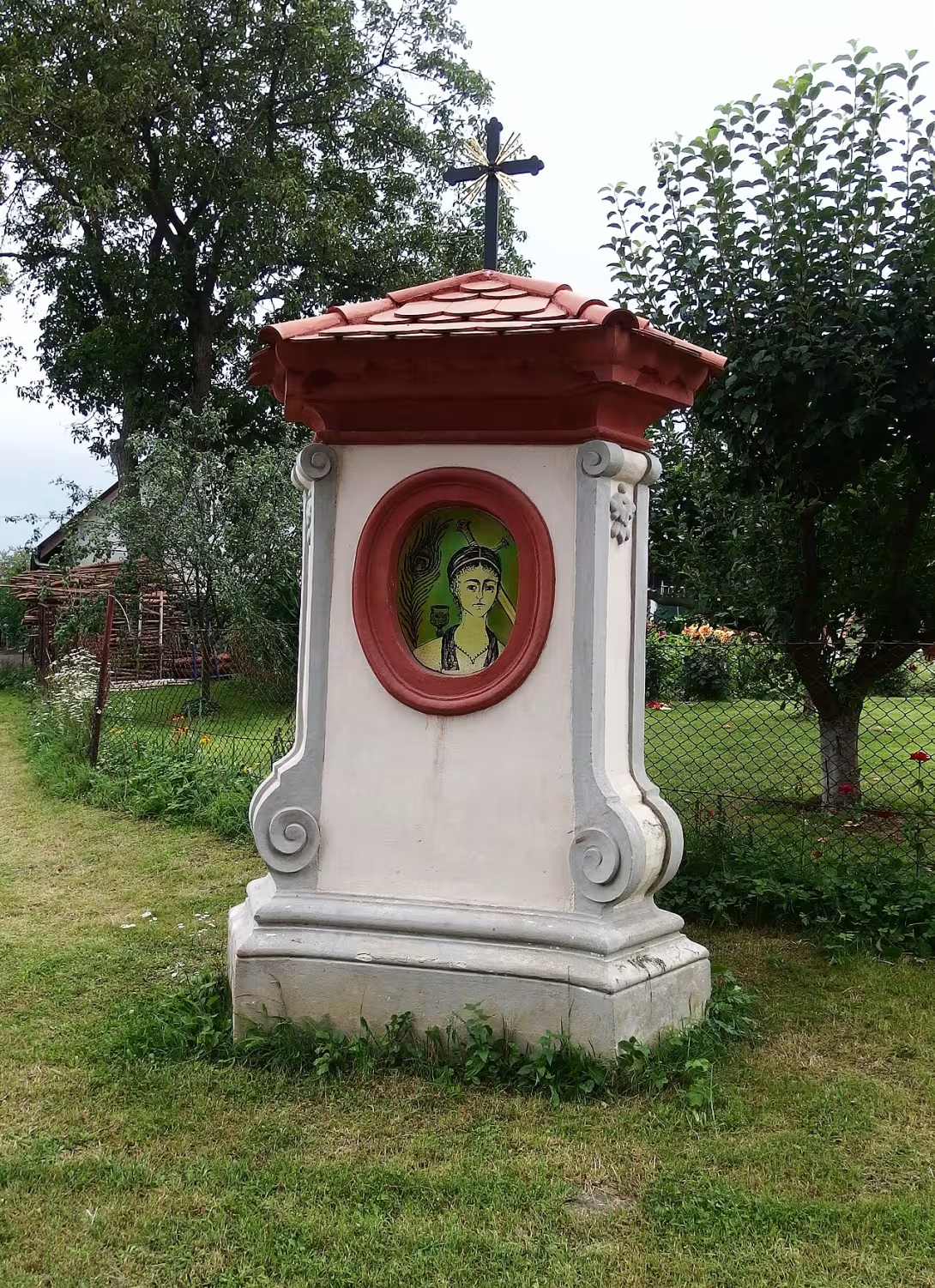

The historical appearance on the left is an AI-generated visualisation and serves as inspiration only.
Historical milestones
- 1933
- Correction of God's torture and the loss of original email paintings.
- 1958
- Registration to the Central List of Cultural Monuments of the Czech Republic.
- 2010
- Correction by Za Opava.
- 2015
- Putting the mosaics of the saints in oval nines.
Architectural development
The construction is walled, plastered and has a triangular plan. In the upper part of the walls there are oval niche. In 2015, new mosaics were planted in these towns.
Historical events
In 1933 a repair took place in which the original email paintings were lost. Further reconstruction and installation of mosaics took place in 2010 and 2015.
Points of interest
- It's a Baroque monument from the second half of the 18th century. Since 1958, the building has been protected as a cultural monument. - The building has a brick triangular plan and a hair roof made of burnt bags. - In 2015, the mosaics of St. Barbara, Florian and Vavríce by Josef Ondrášek were planted in the town. - In the 1933 repair, the original e-mail paintings on the sheet were lost.
Guide
Show guide text
This text was created by artificial intelligence and has not been editorially reviewed. It may contain inaccuracies.
Welcome to the heart of the village Úvalno. Stop for a second, take a deep breath and calm your steps. Right now, you're standing in front of one of the silent but prominent witnesses of local history. Before you stand God's torment, a small but dignified stone structure that acts as a spiritual anchor in this space. The first impression that radiates from it is a sense of stability and peace. It is a place where time has stopped, and where even today you can disconnect for a moment from the hustle and bustle of the outside world and just observe the details of centuries of tradition.
Let us now look together at what memory it is and where it comes from. This building dates from the second half of the eighteenth century, which was the era of the flowering Baroque style. The Baroque spoke to us with strong emotions, desire for heaven and deep faith, and it is these elements we will find here. At that time, God's torment was not only religious symbols, but it served as landmarks, places for a brief prayer of pilgrims or comments of important events. In Úvaln this building was placed directly in the centre of the village to be visible to all residents and remind them of their spiritual roots.
Now pay attention to the architecture itself, because it is very specific. If you look at the base of the building, you'll notice that it's not a regular square or rectangular shape. It's a brick building with a triangular plan. Note, however, that its corners are not sharp, but are finely cut, which gives the whole building some softness and harmony, typical of baroque feeling. The walls are smooth, clean, without unnecessary decorations, which brings all the attention to the top of the monument.
Please take a look above. At the top of the walls you will see oval nuggets that are embedded in so-called shamrans, thus in decorative frames that highlight these nobodies optically. These niche are the heart of the whole monument because in them are stored images of saints. The whole building is surrounded by a needle roof covered with traditional burnt bags. Its steep slope is not only practical for the drainage of rain and snow, but symbolically directed the visitor's view upwards, towards the sky. And at the very highest point, at the very top of the roof, there is a metal cross. If you look at it carefully now, you will see a gilded halo that shines gently in the sunlight and resembles divine glory.
But the history of this monument has not always been easy. Like many other buildings in our region, this has passed through the period of demise and renewal. A thousand nine hundred thirty-three were repaired, but unfortunately, at that time, the original decoration in the form of e-mail paintings, which probably once existed in nothing, was lost. Imagine how sad the locals must have felt when they saw these colored images disappear. Yet the monument survived and its value was recognised at the state level. In the year one thousand nine hundred fifty-eight, the building was officially registered in the Central List of Cultural Monuments of the Czech Republic, which provided protection for future generations.
When you look at the memory today, you see the result of the recent care and love of local people. In the year two thousand ten a thorough repair was carried out by Za Opava. It is a beautiful example of how volunteering and civic activity managed to save a piece of history that could eventually fall apart. The highlight of this renewal was the year of two thousand fifteen, when new mosaics were planted in empty oval nines.
Stop by these mosaics now and take a closer look. These are the works of the artist Josef Ondrášek. In each one you will find another saint who is of profound importance to the people in this area. The first is Saint Barbora, who is traditionally seen as a protector of people working in the heavy industry and also as a patron saint against sudden death. Next to it you will see Saint Florian, whose character is very popular in Czech municipalities because he is perceived as a protector of devastating fires. And the third of them is the holy laurel, a symbol of perseverance and courage in faith. These three figures together form the spiritual shield of the village and their mosaic design gives the construction new life energy and colors, which in contrast to the smooth wall seem very noble.
Perhaps now you might wonder why these saints are represented here. Although we do not know the exact name of the architect or the specific personality that originally commissioned the construction, the choice of saints in the year two thousand fifteen was not random. He reflects the needs and hopes of the people who live and live in Úvaln. It's a connection between the old baroque core and the modern artistic expression that carries the continuity of time.
This small structure contains a fascinating contrast. On one side, it's a simple triangle column made of stone and bags, on the other side it's a place full of symbols, from gilded halo to detailed mosaics. It's a reminder that even the smallest monuments can be of great importance if we look after them and know their story.
Now that you've looked at all the details, from the foundation to the top of the cross, I suggest you stand still for a moment and perceive the atmosphere of this place. Notice how the monument is inserted into the area of the center of the village. It's a meeting place, a place of peace and memory.
Thank you for spending this brief time with us at the Torments of God in the High. We hope you're interested in this story about baroque beauty and human care. We now invite you to explore further the surroundings of the village, where you will surely have other attractions and beautiful views. We wish you a pleasant continued journey and many new experiences in discovering our cultural treasures. Goodbye.
Tips for visitors
The best time to visit is early morning or late afternoon. At this time the light is finer, which will better highlight the details of the baroque wall structure and the metal cross on top.
The location is available by car and by public transport; Check the current connection in the search engine. Park in the centre of the village Úvalno near the monument.
For the best pictures we recommend focusing on triangular plan and burnt roof bags. Take with you comfortable shoes for a short walk through the centre of the village.
In the immediate vicinity is the parish church of St. Nicholas, which stands to visit. For families with children this walk is ideal thanks to easy access and the opportunity to show the children old architecture.
Frequently asked questions
Can the monument be visited?
This is a structure in a public space that can usually be seen from outside free of charge. We have not verified that this particular one is freely accessible.
Where is the monument?
Location: Úvalno, Moravskoslezský kraj. The map on this page shows the exact spot.
Why is the monument protected?
It is listed in the Central List of Cultural Monuments of the Czech Republic as a cultural monument (register no. 1000139149).
Businesses nearby
Do you run a restaurant, accommodation, shop, museum, rental, wellness or other visitor service near this monument? Show yourself directly to the people heading to it — this is how they will see you in the app and on the web:
Nearby
Boží muka stojí v blízkosti farního kostela svatého Mikuláše v obci Úvalno.
Accommodation nearby
Themed route
1. Boží muka (Úvalno), monument, this historical object is worth a tour for lovers of stone works. 2. The parish church of St. Nicholas, the church, the visit to this place will allow you to observe sacral architecture. 3. The reservoir near the church, the area, a walk in this area offers peace and quiet.
Seasonal recommendations
Spring: In the spring period, God's torment in Úvaln is transformed into a living flower paradise when the floods of flowers colour the surrounding landscape. The sun illuminates the memory with its fine and warm ray colour, which gives the atmosphere a mild and relaxing character. Visitors can look forward to quiet moments without overcrowding crowds because they have not yet started the main tourist season. It is recommended to visit the morning when the monument is opened at noon and when it is possible to enjoy a quiet moment with natural background. A good idea is to wear comfortable shoes for walking on lawns and clothes suitable for a mild temperature that makes it easier to adapt to rapid weather changes.
Summer: In summer, God's torment in Úvaln is surrounded by living greenery and flowering bushes, providing an ideal environment for relaxation in the sun. The sun rays illuminate the monument with their full shine, highlighting architectural details and the history of the monument. Summer brings the highest attendance, so it is advisable to visit the memorial earlier in the day to avoid long fronts at the entrance. Due to warm days, it is recommended to wear light clothes and protective sunglasses. Don't forget to bring your drinks so you can enjoy your visit without unnecessary interruption.
Autumn: In the autumn period, God's torment takes on a melancholy and calm character in the Valley of Melancholy when trees turn into golden and red shades. Sunshine brings a fine shine on the monument, which creates a nice background for photos. This period is ideal for those who seek peace and want to enjoy historical monuments without excessive crowds. The best time to visit is in the afternoon, when the weather becomes slightly colder and quieter. It is recommended to wear top clothes to protect against cold wind and suitable shoes on the lawn.
Winter: In the winter months, God's torment grows in the High of a calm and quiet character, surrounded by snow umbrellas or cold clouds. Sunshine illuminates the memory of its special brightness, which emphasizes its historical lines and creates an atmosphere of calm respect. Winter visits are usually less numerous, which makes it easier to explore the memory. It is recommended to wear warm clothes and protective shoes on freezing ground so that visits can be used without unnecessary obstacles to the weather.
Visualizations and artistic views


The visualisations are generated by artificial intelligence and serve as inspiration.
Photos from the area
Real photos taken near the monument


Zdroj a licence jsou uvedeny u každého snímku.
Tips from visitors
No tips yet. Be the first!
Log in and add your tip.
Sources and literature
Photos: Palickap / CC BY-SA 4.0 — Wikimedia Commons. The author and licence also appear when you hover over the image.
Faktickým podkladem tohoto textu byl článek na Wikipedii, jehož autory jsou přispěvatelé Wikipedie. Článek je dostupný pod licencí CC BY-SA 4.0.
Location on the map
Příběhy a pověsti
Legendy, pověsti a příběhy spjaté s touto památkou
Fotografie návštěvníků
Zatím žádné fotografie. Buďte první, kdo přidá fotografii z návštěvy!
Log in a přidejte svou fotografii nebo hodnoťte.
Za ověřenou návštěvu v aplikaci získáte víc bodů — poznáme podle GPS, že jste na místě.
Reviews and comments