



Boží muka z roku 1717 Wayside shrine
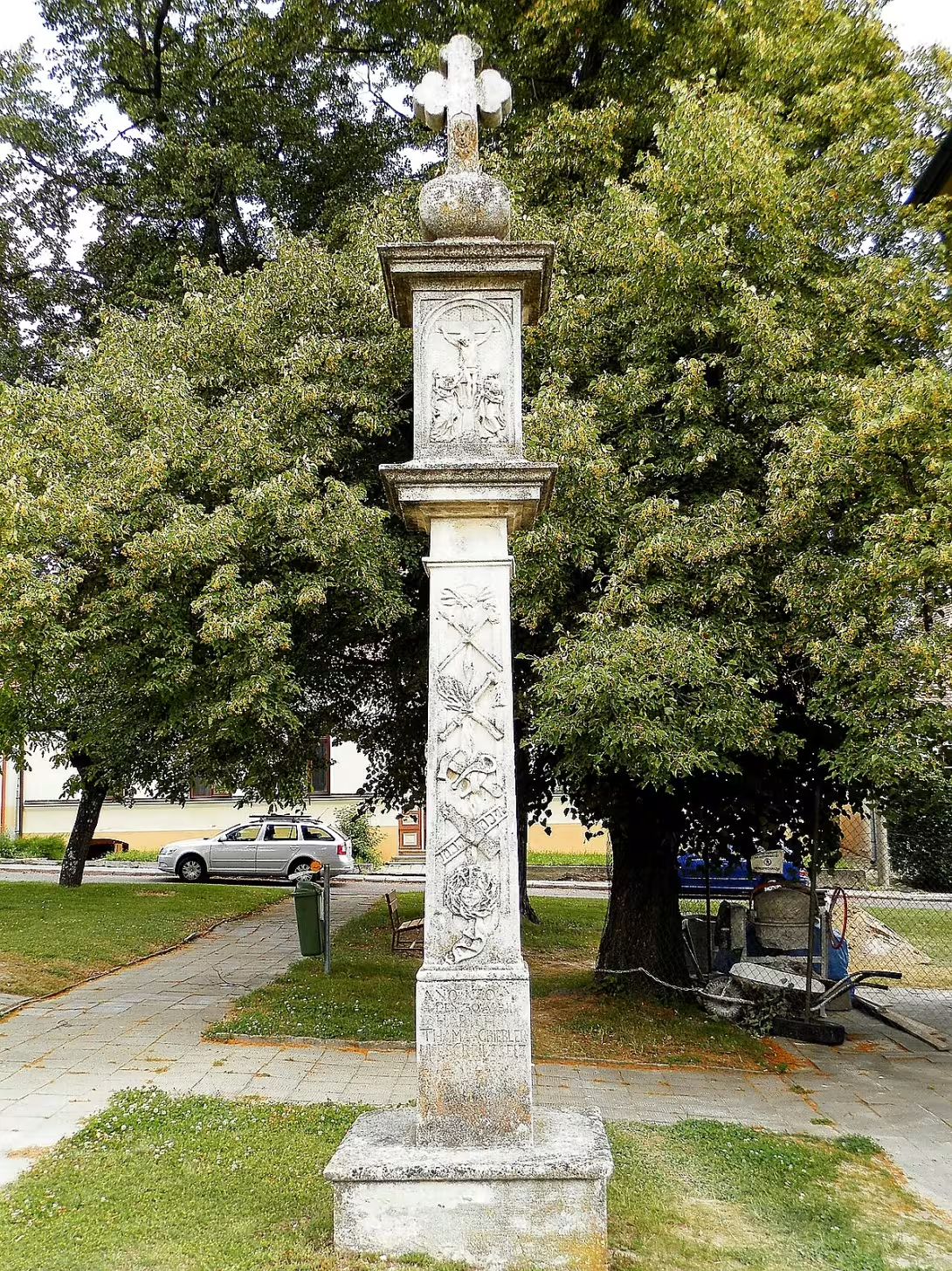
The divine torture in the village Havraníky in the district of Znojmo is a Baroque building from 1717, protected as a cultural monument of the Czech Republic. Their importance lies primarily at an excellent artistic and craft level.
The oldest history of this object was not captured by detailed reports specifying events associated with its creation. It is known, however, that this is a Baroque work from the beginning of the eighteenth century.
From the point of view of art processing it is a work of high quality. Official sources confirm its precise execution, which is a fundamental characteristic of this type of object.
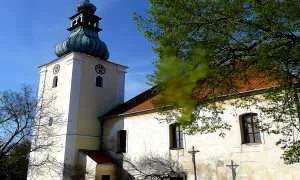
There was a significant change in location in the history of the object. In 1987, God's torment was moved outside St. Linhart's Church in Ravranice, where they are now.
This monument is protected as a cultural monument and is located in the village Havraníky in the district of Znojmo in the South Moravian Region.
This monument is an important element of the local sacral environment and it shows a quality baroque craft. Due to its historical value and artistic design, it is worth a visit.
Then and now
Drag the slider to compare how the landmark may have looked when it was built with the view today.
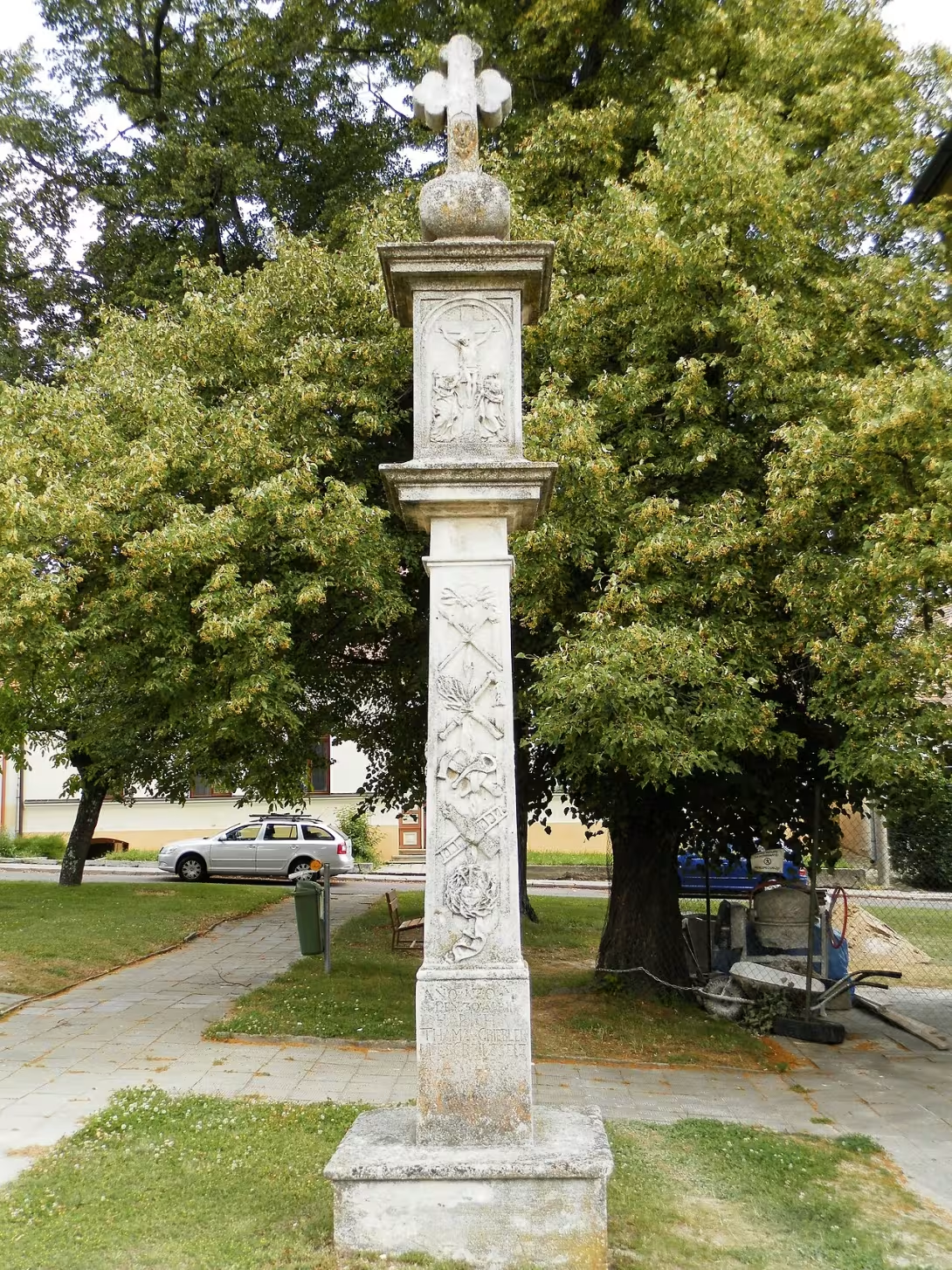
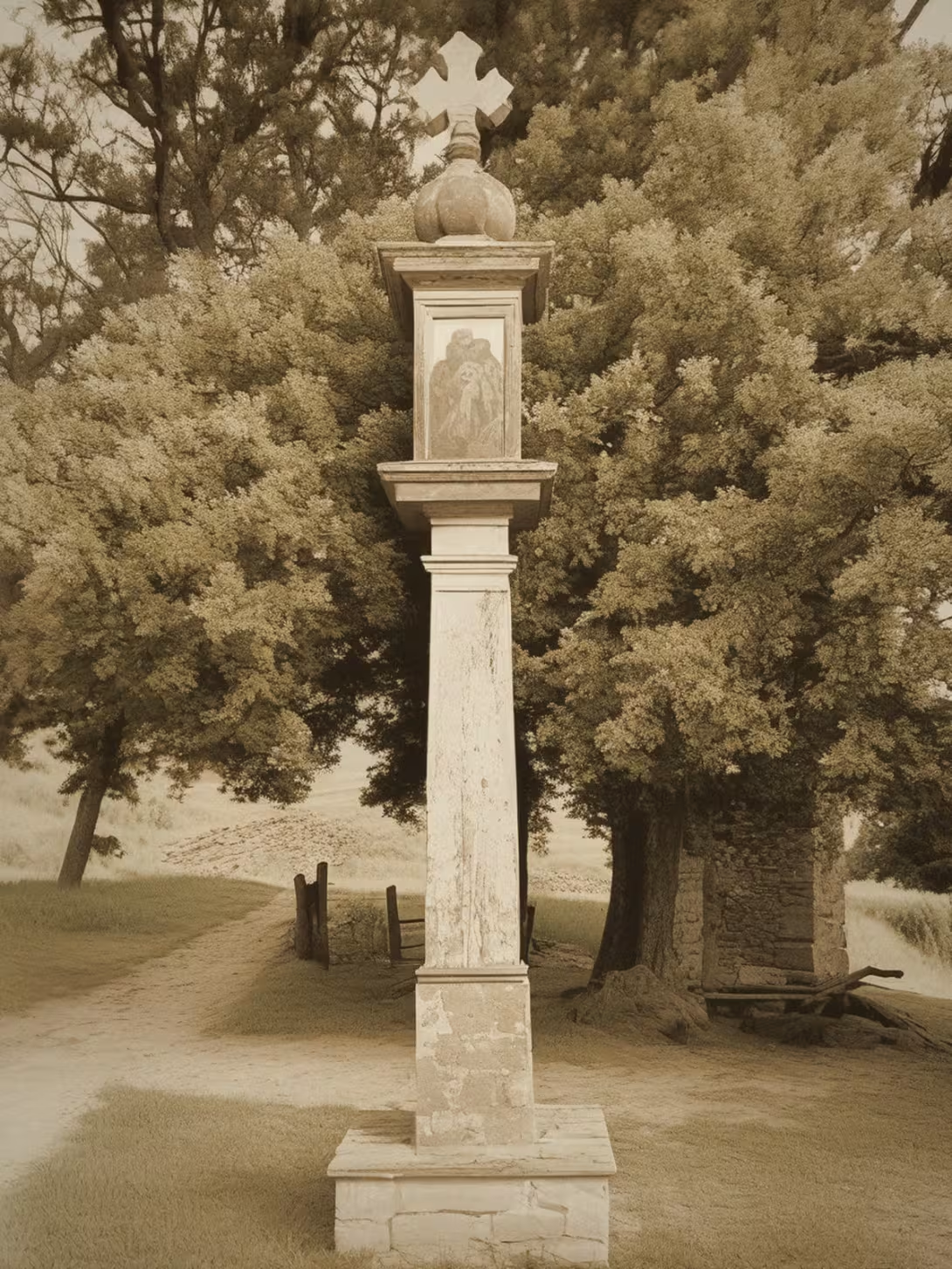
The historical appearance on the left is an AI-generated visualisation and serves as inspiration only.
Historical milestones
- 1987
- secondary location in front of St. Linhart's Church in Ravranice
Points of interest
- It's a Baroque object from 1717. - The building is protected as a cultural monument of the Czech Republic. It excels at a high artistic and craft level. - In 1987, God's torment was moved outside St. Linhart's church. - They are located in the municipality of Havraníky in the district of Znojmo.
Guide
Show guide text
This text was created by artificial intelligence and has not been editorially reviewed. It may contain inaccuracies.
Welcome to the village Havraníky. You just stopped at something that carries a deep print of centuries. You are standing right in front of the baroque torments of God, which have been in some form since seventeen hundred and seventeen. Feel this moment, feel the calm that radiates this place. Before your eyes is the work that survived the storm of time, changes in political regimes, and generations of people, so that today it can tell you its silent but extremely important story. Look at the overall form of this object. Even though his history is deep, his presence here is very lively. Feel the weight of history that radiates from this place, and try to stop for a moment and just let yourself watch.
Now let's go deeper into the past and understand why this object is even here. Imagine the beginning of the eighteenth century, namely the year seventeen hundred seventeen. This was a time when the Baroque style controlled not only the architecture of large cities and churches, but also the rural landscape. At that time, God's torment was a common but extremely important element of every village and every journey. It wasn't just a stone building; It was an expression of deep faith, a point of orientation for pilgrims and a symbol of protection for locals. Creating such a work required not only money, but above all great courage and commitment. Although we see this object today as a protected cultural monument of the Czech Republic, it was a living symbol of their daily life and spiritual bond with the outside world for the people at the time.
Now pay attention to the architecture itself and to what you're seeing right now. Feel the baroque character of this work. The Baroque is not about simplicity, but about dynamics, about curves and about feeling movement, even if the material is solid and constant. When you look at God's anguish, notice how their shape tries to rise to heaven. Even if we don't focus on specific sculptures or paintings that could be part of the future, feel the overall composition. Feel how the line of the object is breaking and trying to get your attention. The Baroque style was designed to impress a man, to awaken him to wonder and remind him of something higher than his own, earthly existence. Take a look at how this object worked in the surrounding space. It's a work that doesn't seem foreign, but it always seems to have grown out of this place.
But it is important to know that the place where you are standing is not exactly where these divine torments arose. In the history of this object there was one of the most important moments that influenced his perception today. In the year one thousand nine hundred eighty-seven there was a secondary location. God's torment has been moved so that they can better correspond with the surrounding environment, specifically in front of St. Linhart's Church. This was necessary for their preservation and for them to be perceived in accordance with the spiritual centre of the village. This movement reminds us that monuments are not just static things, but living entities that we must take care of and place them in such a way that their importance is preserved for future generations.
Now that you're looking at these ancient shapes, you might wonder who's behind this work. Who was the master who did the work in 1717? Who were those craftsmen who worked with such patience with the material? The answer is surprisingly simple, yet fascinating: we don't know them. In the history of these torments of God, there are no specific names of architects or significant figures to finance this work. And that's where their greatest strength lies. This anonymity gives God's torment something timeless. They are not memorials of a particular person, but monuments of the whole period, the whole way of thinking and the entire human effort to connect with the invisible world. They're God's torment to the people, not individuals.
But this ignorance opens the door to a great secret. Imagine the unknown face of the creator who stood in this exact place over 300 years ago. What did he have in mind when he watched his work be finished? What prayers have people been bringing here for centuries? This absence of names creates some mysticism around the object. Every man who passes these torments can put his own story, his own hope, or his own sadness into them. An unknown architect unintentionally allowed us to make this place our own for every visitor. This mystery of anonymity may be the greatest gift these baroque monuments of the Ravens have left us.
Now that you've been through history, architecture and the secrets of this place, let me ask you not to stop. This monument is just one of many points that make up the rich history of this region. Continue to walk towards the church of St. Linhart, located in close proximity. Feel the atmosphere of the village Havraníky, feel its calm and try to capture the connection between the past and the present you have just experienced. Thank you for stopping by and paying attention to this silent witness to history. We wish you a beautiful and inspiring further journey along this beautiful region. Goodbye.
Tips for visitors
The best time to visit is during bright days when sunlight best highlights the Baroque details of the object. The quiet atmosphere in the village Havraníky is ideal for observing a historical monument without a great rush.
Traffic to the monument is possible by car and public transport.
We recommend taking drinking water and comfortable shoes for possible walks. As it is an outdoor object, prepare for current weather conditions.
For the best photos we recommend using natural light around noon or at sunset, which will highlight the baroque shapes beautifully. The best angles for the images can be found right at God's torture itself.
For families with children, the visit is suitable as a short and easy experience in the natural environment. There are no other specific sights in the area you could visit.
Frequently asked questions
Can the monument be visited?
This is a structure in a public space that can usually be seen from outside free of charge. We have not verified that this particular one is freely accessible.
Where is the monument?
Location: Havraníky, Jihomoravský kraj. The map on this page shows the exact spot.
Why is the monument protected?
It is listed in the Central List of Cultural Monuments of the Czech Republic as a cultural monument (register no. 107236).
Businesses nearby
Do you run a restaurant, accommodation, shop, museum, rental, wellness or other visitor service near this monument? Show yourself directly to the people heading to it — this is how they will see you in the app and on the web:
Nearby
ITEX Show interactive overview of the surroundings - restaurants, accommodation, rentals and other places within a 15 km radius.
Data: OpenStreetMap contributors, 15 km radius.
‡ Historical monuments
- 90 years after the creation of Czechoslovakia (5.6 km)
- Sign to create park (6.4 km)
- Museum Retz im Bürgerspital (7.2 km)
- New Hrade (8.0 km)
- statue Krista (12.4 km)
- statue of the Virgin Marie (12.4 km)
- statue of the Virgin Marie (12.5 km)
- sv. Klement (12.5 km)
Restaurant and catering
- Restaurant Pizzeria Styl (5.3 km)
- Phoenix (5.9 km)
- Bermuda Pajzl (6.0 km)
- Gin House (6.0 km)
- Premium (6.7 km - Prague 2133 / 100)
- Bürgermeisterstüberl (7.3 km)
- Stadtcafé Retz (7.3 km - Náimerstraße 5)
- Schlossgasthaus (7.4 km - Schloßplatz 5)
Accommodation
- Guesthouse U Hrnčír (2.1 km)
- Hotel Dukla (5.3 km - Dutch 30)
- water camp Stará Vodárna (5.3 km)
- B & B Pension Grant LUX Znojmo (5.4 km)
- U Mikuláše (5.5 km)
- Residente Zvol (5.6 km)
- Dana (6.3 km)
- Winzerhof Familia Fleischmann (7.0 km - Sommerseite 17)
› Rental and sports
- Jan Šuler (5.6 km - Vienna Class 7)
- Bike Service Kamil Jarmara (5.8 km - Pontassievská 16)
- Outdoor (5.8 km)
- Cyclo Kuchera (5.9 km)
- Sportisimo (5.9 km)
- Ronja (6.1 km)
- FITKO (6.4 km)
- Martes Sport (6.5 km)
© Tourism and nature
- Popice (guest.) (1.5 km)
- O Dress (2.3 km)
- Shobes (vineyards) (2.4 km)
- Above Taxation (2.8 km)
- Pod Sobesem (3.4 km)
- Four Season (5.5 km)
- Hradiště (edge) (5.6 km)
- Gránice Valley (cross-road) (5.7 km)
Accommodation nearby
Themed route
Thematic cruise route from Ravens
1.Boží muka z roku 1717 * Type: * Historical landmark It is worth a visit because it is a unique example of baroque art embedded in the landscape context. God's torment was built as a monument to the victims of Turkish invasions and is known for its architectural beauty and historical significance.
2. Chapel of the Virgin Mary Snow * Type: * Religious monument This chapel is located near God's torture and is an ideal place for peaceful meditation and the use of the natural environment. Its history dates back to the 18th century and provides a view of the traditional religious customs of the area.
3. Church of St. Lawrence * Type: * Cultural construction It is located near God's torment and is an important cultural centre for local residents. His history and architecture represent the rich history of the Ravens, making the visit interesting for the lovers of history.
4. The Tanks of God's Torture * Type: * Historical area Visiting this place offers the opportunity to immerse yourself in the atmosphere of the 18th century and to understand the context in which God's torment was built. Here you can also explore the surrounding green spaces and enjoy quiet moments in nature.
This route offers a view of the rich history and culture of the village Havraníky, with an emphasis on its Baroque monuments.
Seasonal recommendations
Spring season offers a view of the awakening landscape and a fine, scattered light that highlights the details of the historical building. The trees are starting to bloom around the Ravens, and everything is getting fresh air. An ideal visit in the morning is when the air is the cleanest. Get dressed in layers because the morning cold can still smell.
During summer, the surrounding area is filled with intense sun and long days allow visitors until late evening. The atmosphere is warm and alive. In the main summer season we recommend arriving early in the morning to avoid the greatest heat and possible groups of people. Don't forget the sun protection and plenty of fluids.
Autumn brings melancholy into place thanks to colorful leaves and morning fog that create a mystical mood. Light is softer and greener in this period. For comfortable movement we recommend stronger shoes suitable for wet terrain and windbreaker. The best time to observe colors is the middle of the day.
In winter there is a monument in silence and emptiness, especially when the landscape is covered with snow or freeze. The day is very short, so plan a visit to match the noon light. It is necessary to have very warm clothes and shoes with good grip to make the journey along the paths safe.
Visualizations and artistic views


The visualisations are generated by artificial intelligence and serve as inspiration.
Photos from the area
Real photos taken near the monument


Zdroj a licence jsou uvedeny u každého snímku.
Tips from visitors
No tips yet. Be the first!
Log in and add your tip.
Sources and literature
Photos: Ph-435 / CC BY-SA 3.0 — Wikimedia Commons. The author and licence also appear when you hover over the image.
Location on the map


Příběhy a pověsti
Legendy, pověsti a příběhy spjaté s touto památkou
Fotografie návštěvníků
Zatím žádné fotografie. Buďte první, kdo přidá fotografii z návštěvy!
Log in a přidejte svou fotografii nebo hodnoťte.
Za ověřenou návštěvu v aplikaci získáte víc bodů — poznáme podle GPS, že jste na místě.
Reviews and comments