



Emin zámek Chateau
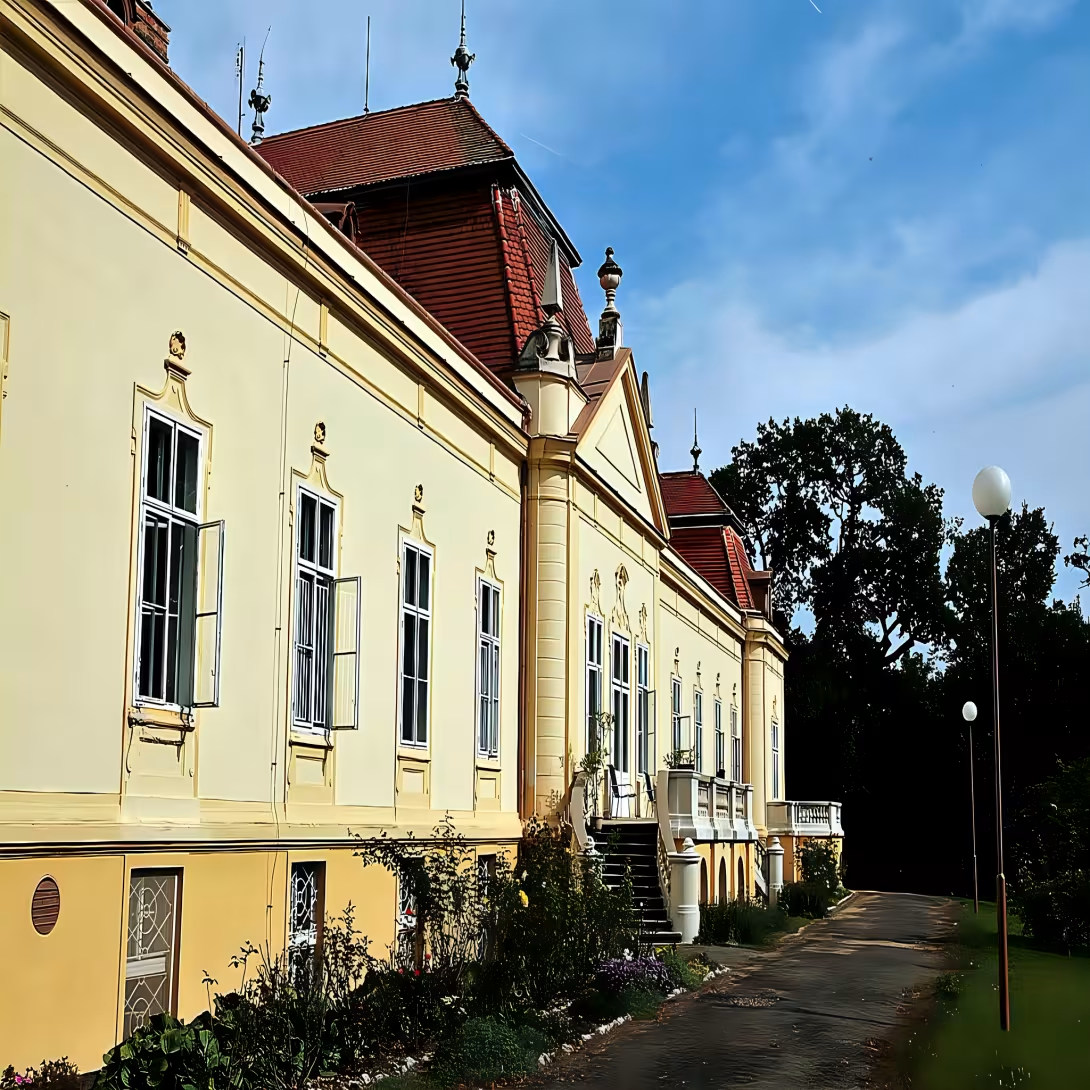
Emin zámek (also Eminy, German Emmahof) grows in a forested landscape corridor near the Yevishka River, approximately four kilometres west of Hrušvan nad Yevishovka. It is located in the north edge of the village Šanov in the district of Znojmo and is therefore one of the less frequent historical buildings of the Czech-Moravian border.
The castle was built in 1882 by Edvard Khuen-Belassy, a member of the old noble family. The construction was built in a neo-Baroque style and the original owner named it Emin - according to his wife Emanuele. In the following period, at the end of the nineteenth century, the castle became the centre of cultural events. There was a famous decorator and artist Alfons Mucha who was involved in interior decoration and left several paintings. The castle thus connects its history with one of the most important personalities of the European Art Nouveau.
The beginning of the twentieth century brought serious loss to the castle - a devastating fire struck it. In 1913, he was taken over by Count Karl Khuen-Belasi and he had it put into place. The castle remained in the house of the Khuen until 1945. After World War II, he was nationalized on the basis of Benes' decrees and gave up his original purpose. In a way, however, he maintained the cultural dimension - already in the early 1920s, the art historian Max Dvořák stayed here in the early stages of his career. Also here in 1921 Dvořák died; buried in nearby Hrušovany above Yevishovka.
There is currently a Social Welfare Institute in the castle, although the building is open to the public. Every year there are open doors and traditional social ball, keeping the castle the role of a meeting place. Thus, despite its social function, it retains an element of openness towards visitors.
Traffic availability of the location is not an easy matter - no officially marked tourist route leads to the castle. The most practical approach leads from the train station to the settlement of the New Court along the road to the castle itself. The road continues to the right. The last option for cycling lovers remains the arrival on the Muchov Cycle Path or the Marshrut called After the straight line, which leads along the river Jevishka.
Then and now
Drag the slider to compare how the landmark may have looked when it was built with the view today.
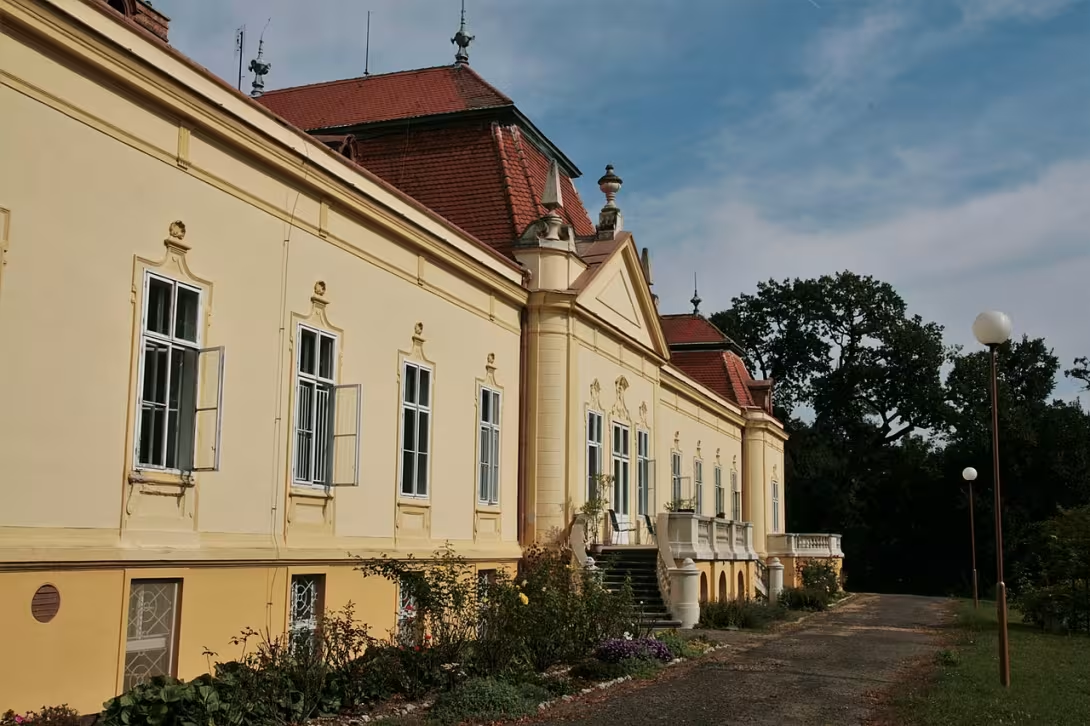
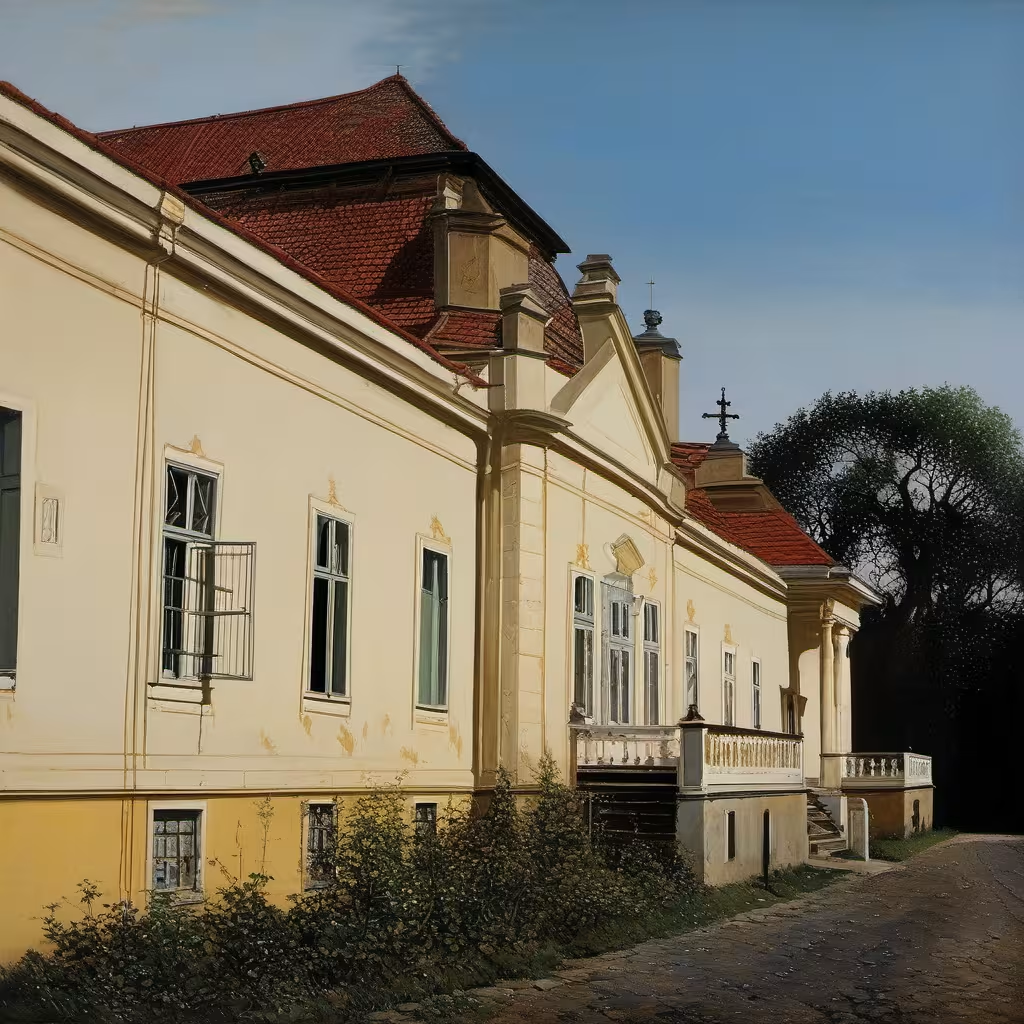
The historical appearance on the left is an AI-generated visualisation and serves as inspiration only.
Historical milestones
- 1882
- The position of Edvard Khuen-Belassy castle.
- 1921
- Max Dvorak's death at Emma's castle.
Architectural development
Emin zámek was built in Neo-Baroque style and restored after the fire in the early 20th century. The castle has undergone architectural changes that reflect its history and cultural significance.
Historical events
- 1882
- The position of Edvard Khuen-Belassy castle.
- 19th Century
- The stay and contribution of Alfonso Mucha to the decor.
- 1913
- Restore the castle after the fire by Count Karl Khuen-Belas.
- 1921
- Max Dvorak's death at Emma's castle.
Owners
Edvard Khuen-Belassy (1882), Karl Khuen-Belasi (after the recovery of 1913), Nationalized in 1945
Points of interest
- Emin zámek was built by Edvard Khuen-Belassy in 1882 in a neo-Baroque style and named after his wife Emanuele.
- The chateau became a centre of cultural events at the end of the nineteenth century, when Alfons Mucha stayed here, who joined the interior decoration and left his paintings.
- After the fire in the early twentieth century, the castle was preserved in the original condition by Count Karl Khuen-Belasi in 1913.
- Art historian Max Dvořák stayed in Emino's castle in the early stages of his career and died here in 1921.
- Despite the fact that it is at the same time the seat of the Social Welfare Institute, the castle hosts open-door days each year and the traditional social ball.
Guide
This guide is narrated by a synthetic voice generated by artificial intelligence.
Show guide text
This text was created by artificial intelligence and has not been editorially reviewed. It may contain inaccuracies.
Emin Castle, in German Emmahof, stands in the forests by the Jevišovka River, about four kilometres west of Hrušovany nad Jevišovkou. It lies in the northern extension of the cadastral territory of the municipality of Šanov in the Znojmo region.
The Neo-Baroque castle was built in eighteen eighty-two by Edvard Khuen-Belassy. He named it after his wife Emanuele, and so it became Emin Castle.
At the end of the nineteenth century, the painter Alfons Mucha stayed here. He participated in decorating the castle and painted several pictures there. However, these were destroyed by fire at the beginning of the twentieth century. In nineteen thirteen, Count Karl Khuen-Belasi had the castle renovated.
At the beginning of his professional career, the art historian Max Dvořák also lived here. He died at the castle in nineteen twenty-one and is buried in nearby Hrušovany nad Jevišovkou.
The Khuen family owned the castle until nineteen forty-five. Then it was nationalized on the basis of the Beneš Decrees. Today it is home to a social care institute. Every year, a Traditional Social Ball is held here.
From Hrušovany, a small road leads to the castle through the hamlet of Nový Dvůr, which continues further to Pravice. Cyclists can get here on the Muchova cycle path or on the Po rovince trail, which follows the course of the Jevišovka River.
Tips for visitors
Best time to visit Emin's castle is in the spring or autumn season, where the woods are full of cabbage and the surrounding area offers a peaceful and comfortable space for walks. This time of year also offers pleasant temperatures for long tours.
When visiting Emma's castle, bring comfortable clothes and shoes suitable for walking along the track. Additional recommendations include protective sunglasses, especially in the summer months, and coffee or tea for a comfortable break during the tour.
Photography of Emma's castle offers several beautiful perspectives. The best light is usually in the early morning or in the evening, when the sun illuminates the roof and surrounding forests in a gentle sunset. For families with children the castle is an interesting place for short walks and games on the outside.
Frequently asked questions
Can the monument be visited?
Some buildings of this kind are open for guided tours, others serve another purpose or are privately owned. We have not verified whether and when this monument is open – please ask the operator.
What are the opening hours and admission?
We have not verified the opening hours or admission. Current information is published by the operator. Official website: http://www.eminzamek.cz/
Where is the monument?
Location: č.p. 275, Šanov, Jihomoravský kraj. The map on this page shows the exact spot.
Why is the monument protected?
It is listed in the Central List of Cultural Monuments of the Czech Republic as a cultural monument (register no. 26285/7-6763).
For kids
Imagine going back 144 years to when Emin zámek was still young and full of life. While you're there, you hear the sparkling sound of leaves and falling flowers that grew in the garden around the castle.
It was like in a game where the lead hero lived in this castle complex with a rich history. Emin zámek was built in 1882 and served as a summer residence of the noble family. Who lived here? Nobility! What happened here? It was a lot of fun, balls and concerts.
Businesses nearby
Do you run a restaurant, accommodation, shop, museum, rental, wellness or other visitor service near this monument? Show yourself directly to the people heading to it — this is how they will see you in the app and on the web:
Nearby
The surrounding area of the castle consists of forests and fields.
Accommodation nearby
Themed route
Route: Emin zámek and surroundings
1. Emin zámek (lock) - The main goal is to see this unique Baroque castle, which is famous for its unique architecture and rich history. The castle is worth a visit thanks to its beautiful interiors and exhibition exposition. 2. Church of St. James (church) - stands near the castle and is worth visiting for its unique architecture and history. The church is famous for its beautiful facade and rich decoration. 3. Šanov Lip (tree) - stands near the castle and is known as one of the oldest and largest Lips in Bohemia. Lipa is protected as a natural monument and is worth visiting for its unique history and beauty. 4.Šanov (municipality) - worth visiting for its peaceful atmosphere and beautiful nature. The village offers a tour of historical houses and monuments.
Seasonal recommendations
Spring: In the spring season the Emin zámek Castle is surrounded by flowering trees and flowers, creating a pleasant atmosphere. We recommend visiting the castle after the rain, when the lighting and color of the flowers are even more impressive. Visitors' doses are usually smaller in this period, so you can see the castle more calmly. It is advisable to bring an umbrella and comfortable shoes for a walk in the flowers.
Summer: In the main summer season the Emin zámek Castle is very popular, so it is good to arrive early so you can pass through the entrance without long queues. We recommend to visit the castle in the morning when the sun is shining and it is pleasant temperature. Clothes should be light and comfortable for walking in the garden.
Autumn: In autumn, nature is beautifully coloured around the castle Emin zámek, creating a pleasant atmosphere. We recommend to visit the castle in the period after rain, when the lighting and colour of the leaves are even more impressive. Visitors' doses are usually smaller in this period, so you can see the castle more calmly.
Winter: In winter the Emin zámek castle is lit and pleasant heat inside. We recommend that you visit the castle in the period from 10 to 16 hours when it is open so that you can pass through the entrance without long queues. It is advisable to bring warm clothes and shoes with a good grip for safe walking on a wet surface.
Visualizations and artistic views


The visualisations are generated by artificial intelligence and serve as inspiration.
Photos from the area
Real photos taken near the monument

Zdroj a licence jsou uvedeny u každého snímku.
View from the area
This animation was generated by artificial intelligence from a real photograph of the surroundings. The motion and details are not real footage of the location.
Atmosphere of the place
This atmospheric visualisation of the place and period was generated by artificial intelligence. It is not real footage of the location.
Tips from visitors
No tips yet. Be the first!
Log in and add your tip.
Sources and literature
Photos: Martin Strachoň / CC BY-SA 4.0, rozlišení zvýšeno umělou inteligencí — Wikimedia Commons. The author and licence also appear when you hover over the image.
Faktickým podkladem tohoto textu byl článek na Wikipedii, jehož autory jsou přispěvatelé Wikipedie. Článek je dostupný pod licencí CC BY-SA 4.0.
Location on the map


Příběhy a pověsti
Legendy, pověsti a příběhy spjaté s touto památkou
Fotografie návštěvníků
Zatím žádné fotografie. Buďte první, kdo přidá fotografii z návštěvy!
Log in a přidejte svou fotografii nebo hodnoťte.
Za ověřenou návštěvu v aplikaci získáte víc bodů — poznáme podle GPS, že jste na místě.
Reviews and comments