



hospodářská stavení venkovské usedlosti Homestead
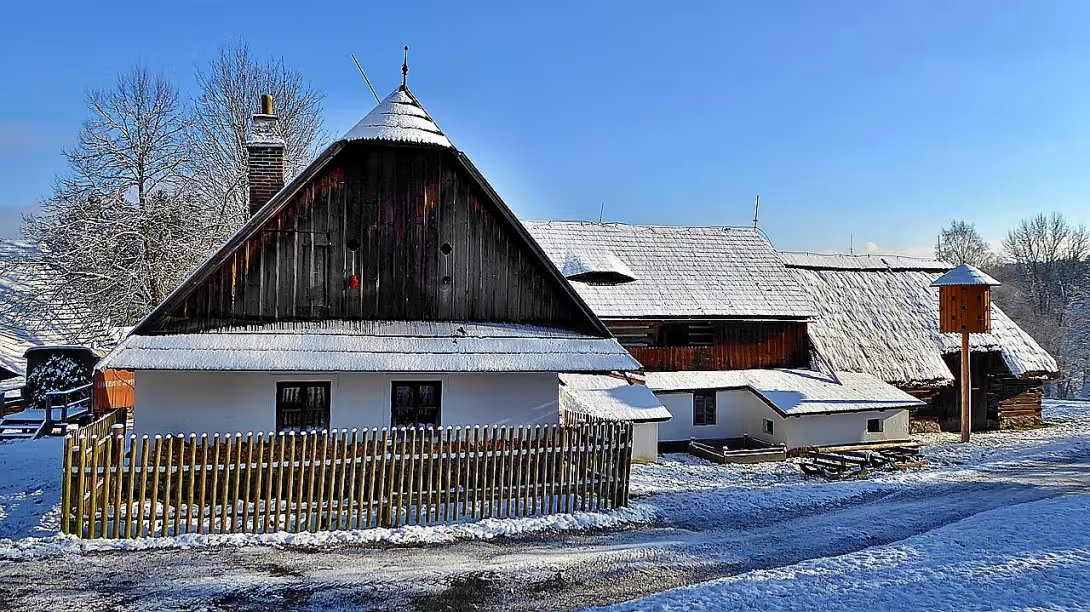
The farm buildings of the rural estate in the village Vejvanov in Rokycanska are the remains of the historical grafted area from the house No. 9. A granary and a barn were preserved from the original complex. Thanks to their construction and carpentry details, they have been recognised as a cultural monument since 2019.
Limited data are available on the origin of the estate. The maps of a stable cadastral from 1839 capture a wooden structure on a given plot, but it had a completely different ground plan than the current buildings. The preserved granary and barn are supposed to come from the first half of the 19th century.
From the point of view of architecture, both buildings are examples of traditional carpentry craft. The granary on the south border of the land is a grafted grafted floor. He's got a brick suspect, a saddle roof, and a hamball crock. Within the village is one of the last preserved specimens of this type. The barn situated on the west side of the complex shows a similar construction, even though the beams from the older building were secondary to its construction.
On both objects there are visible carpentry details such as marks, connections and traces of trimming beams. In addition, the original pern bulkheads were preserved to a significant extent in the barn.
The fate of the estate was fundamentally influenced in the 20th century. The residential house that formed the core of the complex was probably demolished in the 1960s and replaced by a new building. To date, only the said economic status remained.
The monument is a valuable testimony about the fading blasphemous rural architecture in Rokycanska. Her visit allows the study of authentic carpentry techniques from the 19th century.
Historical milestones
- 1820
- The expected formation of granary and barn in the first half of the nineteenth century.
- 1839
- Record of wooden construction on land in maps of a stable cadastral.
- 1960
- Likely demolishing the original residential building and building a new one.
- 2019
- Official recognition of economic buildings as a cultural monument.
Architectural development
The original grafted objects are probably from the first half of the 19th century. The residential house was probably demolished in the 1960s and replaced by a new building. The barn was exported during construction using beams from an older building.
Points of interest
- The original grafted area has preserved the granary and barn, which since 2019 is a cultural monument. - The granary is one of the last preserved specimens of its type within the village. - In building the barn, the beams from the older building were reused. - On both objects you can see the carpentry details such as marks, connections, and traces of beams. - In the barn, the original pern bulkheads were preserved to a significant extent.
Guide
Show guide text
This text was created by artificial intelligence and has not been editorially reviewed. It may contain inaccuracies.
Welcome to Vejvanov, Rokycanska. Stop for a second and look around you. You stand before the silent witnesses of ancient times telling the story of life in the countryside, hard work and the craftsmanship of our ancestors. In front of you are the remains of the historic grafted estate. Even though you no longer see the entire original site, these two buildings that stand before you carry the spirit of the last century. It is a place where time has stopped and where you can feel the atmosphere of old Czech countryside. Let's look together at what you see here. There's a granary and a barn in front of you. These buildings are not just ordinary economic buildings, but valuable monuments of folk architecture. It is assumed that both buildings were created in the first half of the nineteenth century, namely around the year eight hundred twenty. So imagine what this place looked like more than two styles ago. At that time, the estate was fully operational, the granite was safely stored in the granary for the future harvest and hay and tools were stored in the barn. In the maps of a stable cadastral of eight hundred thirty-nine years, the wooden structure on this land is already clearly recorded, confirming that this area was an important part of local economic life. Now pay attention to the construction of these structures. Look carefully at the walls. Note the typical grafted construction that is characteristic of traditional carpentry craft. The grafting is that the burrow on self-tightened wooden beams, which in the corners fell exactly into each other. It's a technique that required tremendous precision and knowledge of material. If you look down to the foundation itself, you'll see a brick suspect. It was intended to separate the wood from the wet ground so that the beams would not decompose and the construction could cost tens and hundreds of years. This combination of wood and bricks is a typical feature of the construction approach in this area. Please pay attention to the granary for a moment. It's the real jewel of this place. The granary is one of the last preserved specimens of its kind throughout the village Vejvanov. At a time when there were no modern granary warehouses, this building was crucial to the survival of the family and the economy. It had to be built to keep the grain dry and protected from pests. When you look at her, think of her as a symbol of security and stability that carries the tradition of generations. Now, take a look at the barn. Here, too, you can see the details of the carpentry that testify to the championship of the people who built it. Here, however, there is one very interesting detail that is not visible at first sight, but is important for understanding the history of this place. In building this barn, beams from an older building were reused. That was very common at the time. Wood was expensive and valuable material, so it was treated with care. So if you look at the beams in the barn construction, you see essentially recycled material that has already served in another building, maybe even older than this estate. It's fascinating to think that the wood you see today might have been part of a house that doesn't exist anymore. When we think about the history of the entire complex, it's important to realize that today we're only seeing part of the original whole. Originally there was also a residential house where there lived a family that operated the estate. Probably, however, around the year around nine hundred and sixty were demolished and replaced by a new construction that no longer matched this traditional grafted style. This leaves only these economic structures, but it survived thanks to its quality and resilience. The survival of these buildings is a great happiness. That is why in the year two thousand nineteen were officially recognised as a cultural monument. This step recognised their unique character and importance for the whole municipality and region. Now, try to imagine what noise and bustle it probably used to be. Carriages full of grain, sounds of animals, voices of people working in fields and granary. It is quiet here today, but it is this calm that allows us to see the details that we would miss in our daily haste. Look again at the connections of wooden beams, the texture of old wood, which has been ventilated and gained its typical colour. Every crack in the wood tells its own story about surviving winters and hot years. It's fascinating how these simple buildings can survive changes in modes, technology, and generations. The granary and barn stand here as a reminder of a time when man was much more bound to the rhythm of nature and the quality of the work of his hands. The fact that these buildings are protected today means that we will be able to admire this carpentry art in the future. Imagine you're a 19th-century carpenter. You don't have modern machines, you only have axes, saws, and your experiences passed down from father to son. Each beam must be carefully selected, worked and fitted. This precision is the reason why these structures are still standing before you, even if they no longer fulfil their original function. Now I'll leave you to look at the space at your own pace. Walk around the granary, look at the details of the brick suspect and feel the atmosphere of this historic corner Vejvanova. Try to realize how rare it is to see a grafted granary in such a state. It's a real one you rarely meet around here. Thank you for spending time with us at these silent monuments. We hope you are interested in this short trip to the past and that you have felt respect for the craft of our ancestors. Now you can continue to explore the surroundings and discover the other beauties of the region. We wish you a pleasant walk and a beautiful day.
Tips for visitors
The best time to visit is late spring or autumn, when the surrounding nature complements the appearance of old wooden buildings and is not too hot. We recommend that you travel by car to the village or use available public transport, the current connection of which is checked by internet search engine.
To visit we recommend to wear comfortable shoes suitable for rural terrain. Since these are private or economic buildings that can only be viewed from the outside, we recommend that we carry only basic items.
For the best photos we recommend to come in the morning or late afternoon light, which highlights the structure of grafted walls of granary and barn. The most interesting angles are details of the carpenter's craft and general views of the rest of the complex.
Families with children can use visits to show what the old rural economy looked like and how grain granaries were built before. There are no other specific monuments listed in the record within half an hour of the time.
Frequently asked questions
Can the monument be visited?
This is a residential or farm building, not a museum with opening hours. Please view it from public space and respect the owners' privacy. We have no information about access to the interior.
Where is the monument?
Location: Vejvanov. The map on this page shows the exact spot.
Why is the monument protected?
It is listed in the Central List of Cultural Monuments of the Czech Republic as a cultural monument (register no. 1999997610).
Businesses nearby
Do you run a restaurant, accommodation, shop, museum, rental, wellness or other visitor service near this monument? Show yourself directly to the people heading to it — this is how they will see you in the app and on the web:
Nearby
🏰 Historic sites (92)
- Hrad na Babské skále 1.6 km
- Pieta 3.2 km
- Muzeum Josefa Hyláka 3.7 km
- zámek Terešov 4.5 km
- sv. Jan Nepomucký 4.7 km
- Jan Tetřev 4.9 km
- Zámek Prašný Újezd 5.2 km
- Panna Maria Immaculata 5.3 km
- hrad Radeč 5.6 km
- Pomník obětem obou světových válek 5.6 km
- sv. Jan Nepomucký 5.8 km
- František Bělohlávek 6.3 km
- Pomník padlým - 1. sv. válka 6.4 km
- Socha Panny Marie Svatohorské 6.4 km
- Jiří Potůček - Tolar 6.6 km
- Pomník osvoboditelům 6.7 km
- Obětem ve Světové válce, obětem německé okupace 6.9 km
- Pomník osvoboditelům 7.0 km
- Březina 7.0 km
- Expozice požární ochrany Zbiroh 7.3 km +420 778 785 806 web
🍽️ Restaurants and dining (98)
- Selský dvůr 2.2 km +420 371 796 371 web
- Na Trucovně 3.4 km
- La Boema 3.6 km
- U Jeníčka a Mařenky 5.3 km
- U Oťase 5.6 km
- Restaurace Němčovice 5.7 km
- Hostinec Pod Radčem 6.2 km
- Koruna 6.3 km
- Café Vídeň 6.3 km
- Bistro Ultramarinka 6.5 km
- Hospůdka u Zuzanky 7.0 km
- Hospoda Přísednice 7.1 km
- Hospůdka na vyhlídce 7.5 km
- U starýho kozla 7.7 km web
- U Rudolfovy kratochvíle 8.0 km Zámek 1 +420 606 719 629
- Na Rybárně 8.1 km
- Stará hospoda 8.3 km +420 371 791 618
- V Podhradí 8.4 km
- Brooklyn 8.4 km
- U Slunce 8.5 km
🏨 Accommodation (29)
- Skautský tábor 5.4 km
- Stellplatz Němčovice 6.1 km web
- Tábor Lhotka 7.6 km web
- Zámek Zbiroh 7.9 km web
- Na Rybárně 8.1 km
- U Potůčků 8.1 km
- Autokemp Veselý Habr 8.7 km web
- U Mloka 8.8 km +420725348980 web
- Intercamp TJ Volduchy 9.0 km +420 774 984 954;+420 739 257 145 web
- Hotel Berounka 9.3 km
- Planá 9.4 km
- Kobylka 9.7 km web
- U Přívozu 10.4 km
- Pod Mostem 10.5 km web
- U Varských 10.5 km
- Hotel Mýto 10.7 km
- Nadryby Valentovský mlýn 10.8 km
- Pohoda 10.9 km +420 606 114 069 web
- Resort Brdy 11.1 km
- Bouchalka 11.5 km
🚲 Rentals and sport (17)
- Sokolovna 3.9 km
- Lanové centrum 7.7 km
- Koupaliště Týček 9.8 km
- Koupaliště Volduchy 10.5 km
- KV servis 10.6 km
- Sokolovna 10.6 km Plzeňská 387
- Dronte -Zvíkovec, rekreační středisko Pohoda 10.9 km
- Víceúčelové hřiště 10.9 km
- Sokolovna Kařez 11.0 km
- Wake Point Holoubkov 11.0 km +420 739 018 135 web
- Martin Kovařík - Bike Rotation 11.2 km
- machondak-sport 13.2 km +420 777 083 538 web
- Lodě Skryje 13.3 km +420 777 083 538 web
- Koupaliště Nová Huť 13.6 km
- Sport Beran-cykloobchod+servis 14.3 km náměstí Československých legií 22
- Vratislav Steiner 14.7 km Tylova 287 +420 604 440 926 web
- Kola Sport Hájek 14.7 km Hradební 173 +420 773 238 191 web
🥾 Hiking and nature (179)
- Rovnička 2.3 km
- Bechlov 2.7 km
- Na Hůrkách 3.2 km
- Kramářka 3.3 km
- Hrádek 3.4 km
- Na Floriánu 3.9 km
- Radlice 4.1 km
- Výhled na Kamenec 4.2 km
- Čihátko 4.7 km
- Hůrka 5.0 km
- Radeč 5.2 km
- Bílá skála 5.3 km
- Bílá skála 5.3 km
- Brno 5.3 km
- Chlumec 5.4 km
- Černá skála 6.0 km
- Na vrších 6.0 km
- Rozhledna Na Vrších 6.0 km
- Čihátko 6.1 km
- Holý vrch 6.1 km
Accommodation nearby
Trips and activities nearby
Guided tours, tickets and activities nearby from GetYourGuide
Affiliate link: if you buy from the partner, we may receive a commission. The price for you does not change.
Search tours and activities →Themed route
Walk around the estate
1. Economic buildings of the rural estate - Main objective. A tour of old buildings used to store crops and raise animals. 2. Tanks - Space between buildings. A place where all day working operations of the estate had previously taken place. 3. Internal exposure - Exhibited objects on the premises of buildings. A chance to see the history of rural life and farming.
Seasonal recommendations
In spring, the surroundings of the estate awaken to life and the young greenery highlight the shapes of economic buildings. The light is fine, which is ideal for observing facade detail. We recommend shoes suitable for wet soil and visit in the morning when the air is the cleanest.
In the summer months they dominate the construction of rich paint and sharp shadows that create deep contrast. Everything around the buildings is in full bloom. The best thing is to come early in the morning or at sunset to avoid heat. Don't forget the light clothes and the sun hat.
Autumn brings golden tones and fogs to the landscape, which give rural architecture a mysterious atmosphere. The colours of the leaves in the surrounding area match the materials of the buildings. Layer clothes and solid shoes are suitable, because the road can be slippery from fallen leaves.
Zimą is an estate in quiet and quiet, often accompanied by a snow blanket that unifies the appearance of the whole area. The lighting is cold and the days are short. It is necessary to wear warm winter clothes and waterproof shoes, while the best time to visit is around noon.
Visualizations and artistic views

The visualisations are generated by artificial intelligence and serve as inspiration.
Photos from the area
Real photos taken near the monument


Zdroj a licence jsou uvedeny u každého snímku.
Tips from visitors
No tips yet. Be the first!
Log in and add your tip.
Sources and literature
Faktickým podkladem tohoto textu byl článek na Wikipedii, jehož autory jsou přispěvatelé Wikipedie. Článek je dostupný pod licencí CC BY-SA 4.0.
Location on the map
More monuments – Vejvanov
Show all in the municipality
Příběhy a pověsti
Legendy, pověsti a příběhy spjaté s touto památkou
Fotografie návštěvníků
Zatím žádné fotografie. Buďte první, kdo přidá fotografii z návštěvy!
Log in a přidejte svou fotografii nebo hodnoťte.
Za ověřenou návštěvu v aplikaci získáte víc bodů — poznáme podle GPS, že jste na místě.
Reviews and comments