

Hrobka Karla Merta Tomb
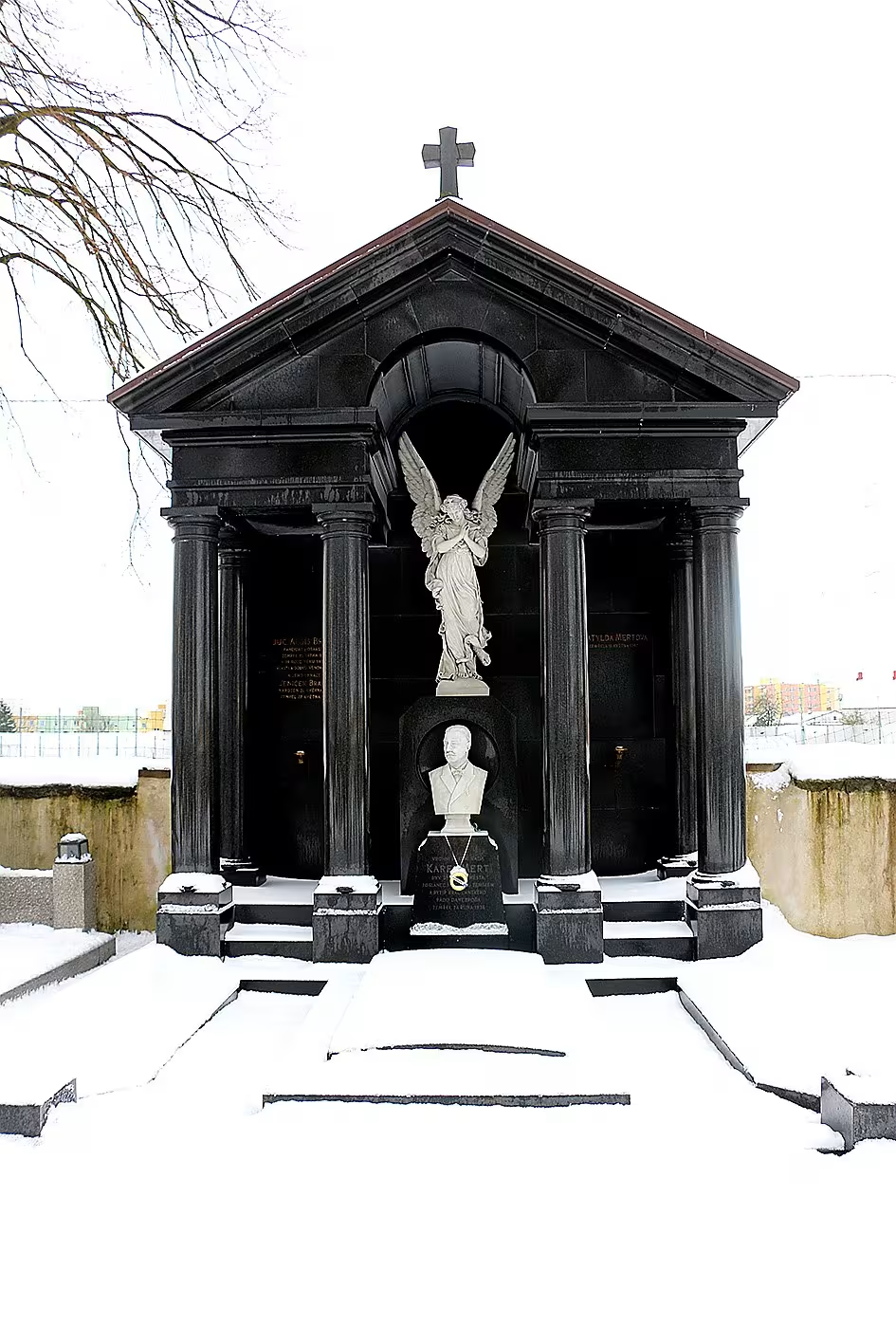
Hrobka Karla Merta is an architectural monument in Jindřich Hradec, which serves as the last resting place of the former mayor of the city. The building from 1936 to 1937 is located in the cemetery near the church of St. Wenceslas. Since 2011 it has been registered as a cultural monument.
The tomb was built by architect Václav Neubauer along with Antonín Pfeifer. The wife of the deceased politician, Matylda Mert, contributed to its construction after Karel Mert died on 26 October 1936.
The building is inserted into the wall of the cemetery and stands on a tiered base with a rectangular plan. The construction is dominated by six cylindrical columns without entaze, of which four are in front and two are at the back wall. The columns stand on the prism foot and end with a simple head with a ring and a cover plate. They carry smooth molds, preplanted with a ledge and a triangular tympanone with a saddle roof, which is opened in the middle half circle. A stone cross is placed on the top of the ridge.
In the back of the tomb, there is a marble statue of an angel with fluffy flapping wings and hands on his chest on the prism pedestal. This figure created by Josef Strachovský at the turn of the 19th and 20th centuries is older than the construction itself. Among the front columns is a marble bust of Karl Mert on a pedestal with piped longitudinal sides at the top. The inscription states that Karel Mert was the Chief Legal Council, the former mayor of the city, a member of the Assembly of the Land and a knight of the Royal Danish Order of Danebroga.
Outside the tomb is a grave place in its breadth. It is covered with stone graduated plates and is enclosed by a low stone wall with a circular plate in front of the pedestal.
The monument is a valuable example of interwar architecture and a demonstration of marble art processing. Her visit offers insight into the history of the other hradec self-governing leadership and period sculptures.
Then and now
Drag the slider to compare how the landmark may have looked when it was built with the view today.
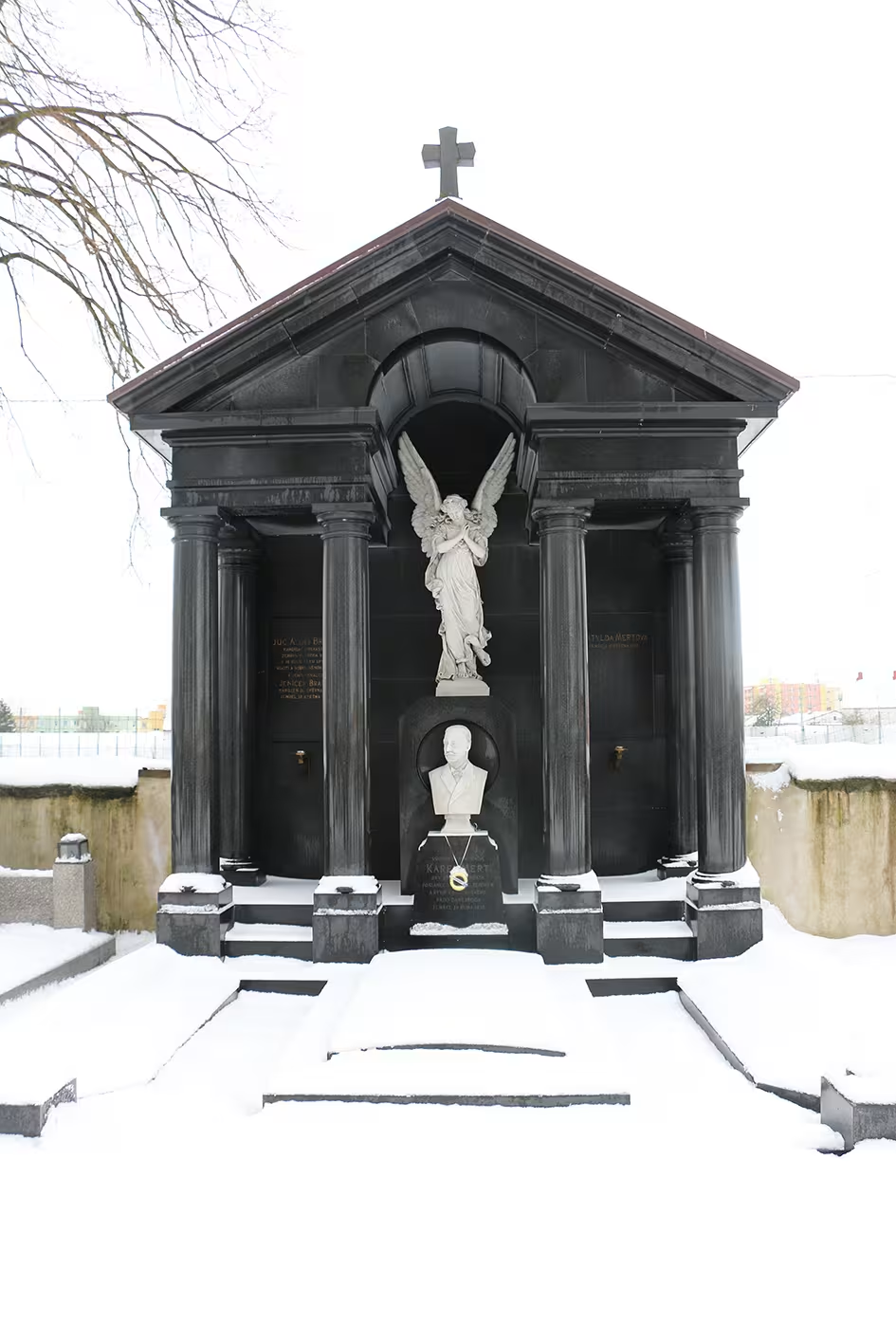
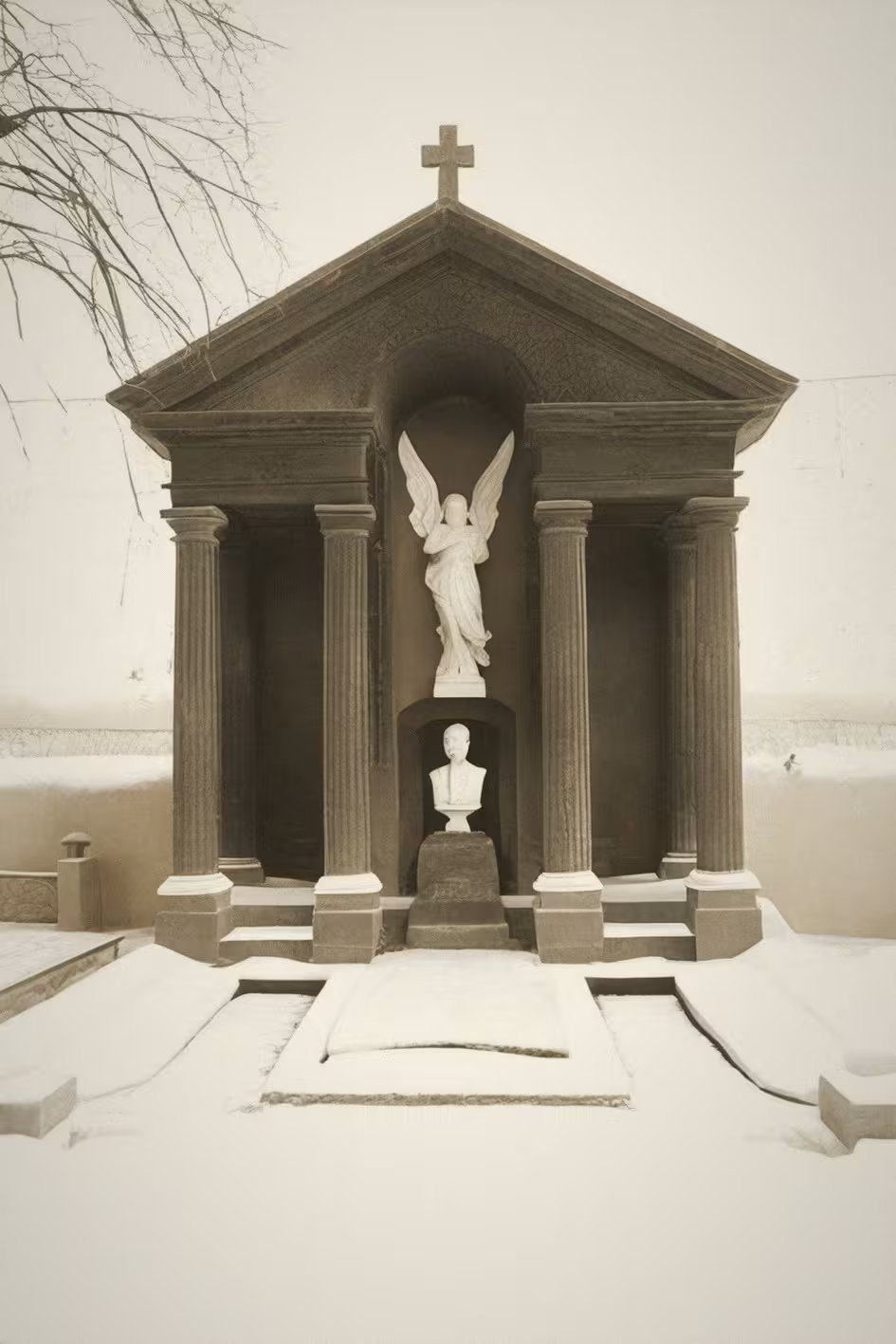
The historical appearance on the left is an AI-generated visualisation and serves as inspiration only.
Historical milestones
- 1900
- Creating a marble statue of an angel by Josef Strach
- 1936
- The death of Karl Mert and the construction of the tomb
- 1937
- Completion of the tomb in Henry's Hradec
- 2011
- Writing the tomb into the list of cultural monuments
Architectural development
The tomb has a rectangular plan on a tiered footstool and is supplemented by six cylindrical columns carrying a triangular tympanone. On top of the ridge is a stone cross. Part of the marble bust of Karl Mert and the statue of an angel, which was created at the turn of the 19th and 20th centuries.
Owners
Matylda Mertová
Points of interest
- The tomb was built between 1936 and 1937 as a resting place for the former mayor of the city. - The construction was built by architect Václav Neubauer along with Antonín Pfeifer. - The marble statue of an angel in the back is older than the building itself. - Karel Mert was the Chief Legal Council, a member of the Assembly of the Earth and a knight of the Danish Order of Danebroga. - Since 2011, the building has been registered as a cultural monument.
Guide
This guide is narrated by a synthetic voice generated by artificial intelligence.
Show guide text
This text was created by artificial intelligence and has not been editorially reviewed. It may contain inaccuracies.
Welcome to Henry's Hradec. Right now you're standing in front of a place that radiates peace and deep respect for the past. In front of you is the tomb of Karl Mert, a silent witness to the history of this city. When you look at it, you will notice that it is not a separate building standing in the middle of the area, but it is very sensitively inserted directly into the wall of the cemetery at St. Wenceslas's church. It's a place where architecture connects to the final rest of a man who left a deep mark in this city with his work and life.
Stop for a moment and feel the atmosphere of this place. This building didn't even happen as a common grave. It's the result of love and gratitude. The tomb was built in a short period of time between a thousand nine hundred thirty-six and a thousand nine hundred thirty-seven. Now let's look at why it was created. The main impetus for her construction was the death of Karl Mert, who left this world in the year one thousand nine hundred thirty-six. Karel Mert was not an ordinary citizen, he was a former mayor of the city, a man with great responsibility who found his purpose in helping the city and its inhabitants. It was at the behest of his wife, Matilda Mert, who wanted to give her husband the proper honor and provide him a dignified place for eternal sputum, this tomb was designed and built.
Now pay attention to the very form of the construction. If you look carefully at its shapes, you will see a harmonious combination of different elements. The architects who took the project were Václav Neubauer and Antonín Pfeifer. These two creators were perfectly able to combine the elements of classical architecture with fine artistic decoration. Notice the marble that gives the whole piece a sense of grandeur and purity. The marble is not only a building material, but it serves as a canvas for artistic details, which are designed to create a sense of peace and hope. See how the tomb naturally connects to the wall that surrounds it, and yet it appears as a separate, targeted element.
Speaking of personalities connected to this place, we need to get back to Karl Mert himself. He was an educated and respected man, the High Legal Council and the Member, which shows his high social standing and expertise in law and administration. His life was dedicated to order and justice, which is reflected in the clean lines of his last resting place. Next to it is Matylda Mertová, whose wish to build this building is still here. It's a reminder of how strong a personal bond can be even after death.
Now I'm going to lead you to one really interesting thing, which may not be obvious at first glance, but which gives this place a special depth. Please take a look at the marble statue of an angel found in the back of the tomb. You might expect that the statue was created at the same time as the construction itself, in the mid-1930s. But the truth is much more fascinating. This statue of an angel is significantly older than the tomb itself. It was created by the artist Josef Strachovský in the year one thousand nine hundred. That means the angel existed more than 30 years before the tomb was even built. It is a fascinating detail that shows how different periods can meet within one monument and how an older work of art can be integrated into a newer architectural unit to give it a spiritual dimension.
Feel this contrast between the time of creation of the statue and the time of construction of the tomb. It's like a dialogue between two generations of artists who met at one point to form together instead of respect. Thanks to such details and architectural value, the tomb was officially included in the list of cultural monuments in the year two thousand eleven. With this recognition, the State has confirmed that it is not just a family grave, but a work that is of value to society and that must be protected for future generations.
Now, if you look at the overall composition again, you realize that this tomb is more than just a stone structure. It's a story about the power of law, about city leadership, about family love, and about artistic craft. From the marble angel Josef Strachovský to the vision of the architects Neubauer and Pfeifer to the sadness and devotion of Matylda Mert. All these threads intertwine here in the silence of the cemetery wall.
I wish you to take the sense of peace and respect of the people who helped build Jindřichův Hradec as we know it today. I suggest you now walk quietly around the surrounding area, perceive the silence of St. Wenceslas's Church and slowly move to the next sights of this beautiful city. Let your curiosity guide you and discover details that tell stories from the past.
Thank you for a moment at Karl Mert's tomb. I hope you're interested in this short trip to history. I wish you a pleasant continuation in your discovery of Henry's Hradec. Goodbye.
Tips for visitors
The best time to visit is early morning or late afternoon, when the light is softer and the space is more peaceful. The location is available by car and by public transport; Check the current connection in the search engine.
We recommend that you wear suitable shoes for walking around the cemetery terenia and possibly a small lighter or candle if you wish to honor the memory of the former mayor.
For the best photos we recommend focusing on architecture details from flights 1936 to 1937. The ideal light for images of the tomb is in late afternoon, when the sun highlights the plastic shapes of the building.
In the immediate vicinity is the church of St. Wenceslas, which is an ideal complement to the journey behind this architectural monument.
Families with children can use a visit to tell about the history of the city and the people who have led it in the past, and it is important to educate children on respect for the piety site.
Frequently asked questions
Can the monument be visited?
Cemeteries and graves are usually accessible; please respect the dignity of the place. We have not verified the opening hours of this cemetery.
Where is the monument?
Location: Jindřichův Hradec. The map on this page shows the exact spot.
Why is the monument protected?
It is listed in the Central List of Cultural Monuments of the Czech Republic as a cultural monument (register no. 1000159796_0004). It is protected as part of a larger listed ensemble.
Businesses nearby
Do you run a restaurant, accommodation, shop, museum, rental, wellness or other visitor service near this monument? Show yourself directly to the people heading to it — this is how they will see you in the app and on the web:
Events nearby
Zdroj akcí: otevřená data měst a obcí ČR (Národní katalog otevřených dat) a kalendář akcí Národního památkového ústavu.
Nearby
🏰 Historic sites (58)
- sv. Jan Nepomucký 0.7 km
- Muzeum Čs. armády 1938 0.7 km
- Hrad a Zámek Jindřichův Hradec 0.7 km +420 384 321 279 web
- Dům gobelínů 0.7 km
- Čmelák Z 37 0.8 km
- Muzeum Jindřichohradecka 0.8 km
- Sousoší Nejsvětější Trojice 0.8 km
- Muzeum fotografie a moderních obrazových médií 0.9 km
- Muzeum Jindřichohradecka 1.0 km
- Památník židovských sousedů 1.0 km
- Mistr Jan Hus 1.0 km
- Bedřich Smetana 1.1 km
- tři odboje 1.2 km
- Boleslav Jablonský 1.3 km
- úzkorozchodná dráha 2.1 km
- Obětem 1. světové války 3.1 km
- Pomník obětem 1. a 2. světové války 4.1 km
- Památník Černínskému statku 5.6 km
- pomník dosídlení českým obyvetelstvem 6.0 km
- sv. Jan Nepomucký 6.6 km
🍽️ Restaurants and dining (126)
- Piketa 0.1 km Na Piketě 912
- U Václava 0.1 km
- Netopýr 0.2 km
- Bistro 0.3 km web
- Restaurace Hvězdárna 0.5 km
- Pivnice Kufr 0.5 km
- Pizza Herb 0.7 km
- Zámecká maštal 0.7 km
- Kapr pod hradem 0.7 km web
- KFC 0.7 km
- Smetana 0.8 km web
- Pod zámkem 0.8 km
- Mama's bistro 0.8 km
- Bílá paní 0.8 km
- Čínská restaurace 0.8 km
- Kebab House 0.8 km
- Herna bar Sport 0.8 km
- Cukrárna - kavárna 0.8 km
- Cukrářství lavendy 0.8 km web
- Koktejl bar 0.8 km
🏨 Accommodation (67)
- U Hesů 0.2 km
- U Tkadlen 0.6 km
- Cyklopenzion Kasper 0.8 km
- Bílá paní 0.8 km
- U Muzea 0.8 km
- Nežárka 59 0.8 km Nežárecká 59 web
- hotel Vajgar 0.8 km
- Concertino 0.9 km
- Penzion Na 15. poledníku 0.9 km +420 775 222 223 web
- Pension Švejk 1.0 km
- Penzion Měšťan 1.0 km
- MIKA 1.0 km
- Hana 1.0 km
- IGA 1.1 km
- U Papoušků 1.2 km
- Florian palace 1.2 km
- Marie 1.4 km
- Penzionek JH 1.5 km Claudiusova 413 +420 724 140 818 web
- Frankův dvůr 2.9 km Jemčinská 125 +420 777 996 666 web
- Stará škola 4.6 km web
🚲 Rentals and sport (11)
- Author 0.8 km
- VK Vajgar 1.1 km
- Cyklo & Ski Galík 1.1 km sídliště Vajgar 920 web
- Sportovní vybavení - Ivan Šot 1.2 km
- Alfa Sport 1.3 km
- Fitko Eden 1.3 km
- Cycle experts 1.3 km web
- TJ Slovan, Jindřichův Hradec 1.4 km
- Sportisimo 1.9 km
- Tělocvnična 12.1 km
- Kuželkárna 14.5 km
🥾 Hiking and nature (118)
- vyhlídka Karlov 0.5 km
- 15. poledník 0.9 km
- Husovy sady 1.0 km
- Mertovy sady 1.2 km
- SportPark R&F 2.2 km web
- Borek 2.9 km
- Obludiště 3.0 km web
- Vyhlídka Karla Zvěřiny 3.0 km
- Lamy 3.7 km
- Kozy, ovce, lamy 3.7 km
- Pumy severoamerické 3.8 km
- Sovy 3.8 km
- Velbloud dvouhrbý 3.8 km
- Mývalové 3.8 km
- Oslové 3.8 km
- Pštrosi 3.9 km
- Skunk 3.9 km
- Dikobrazi 3.9 km
- Surikaty 3.9 km
- Papoušci 3.9 km
Accommodation nearby
Themed route
Here is a proposal for a short thematic walk:
1. Church of St. Wenceslas (sanctuary) - The starting point of the journey, which serves as a spiritual center of the area and the dominant surroundings. 2.Hrobka Karla Merta (memorial) - The main destination of the visit located in the immediate vicinity of the church, where one can honor the memory of this man.
Seasonal recommendations
In the spring, the surroundings of the tomb awaken to life and the young green creates a fresh framework for quiet contemplation. We recommend a visit in the morning when the light is fine. Due to the moisture of the ground, it is advisable to wear a fixed sole that does not soak.
In the summer months it dominates the space of intense sun and hot air, which slows the pace of the step. The best time to visit is early morning or late evening to avoid hot heat. Remember light clothes made of natural materials and hat for head protection.
Autumn brings a melancholy atmosphere and golden colours to the cemetery space. The lighting is soft and nostalgic during this period, which underlines the nature of the drinking place. We recommend layered clothes and waterproof shoes for frequent collisions.
Zimą is a place of rigorously and rigorously, often in the dark of short days or under a layer of snow. The silence of this season is deepest, and the atmosphere is very brave. It is necessary to choose warm winter clothes, thermobra and high-quality shoes with anti-slip soles.
Visualizations and artistic views


The visualisations are generated by artificial intelligence and serve as inspiration.
Photos from the area
Real photos taken near the monument


Zdroj a licence jsou uvedeny u každého snímku.
Tips from visitors
No tips yet. Be the first!
Log in and add your tip.
Sources and literature
Photos: Khamul1 / CC BY-SA 4.0 — Wikimedia Commons. The author and licence also appear when you hover over the image.
Faktickým podkladem tohoto textu byl článek na Wikipedii, jehož autory jsou přispěvatelé Wikipedie. Článek je dostupný pod licencí CC BY-SA 4.0.
Location on the map
More monuments – Jindřichův Hradec
Show all in the municipality
Příběhy a pověsti
Legendy, pověsti a příběhy spjaté s touto památkou
Fotografie návštěvníků
Přidat fotografiiZatím žádné fotografie. Buďte první, kdo přidá fotografii z návštěvy!
Máte k místu vzpomínku nebo zajímavý příběh?
Log in a přidejte svou fotografii nebo hodnoťte.
Za ověřenou návštěvu v aplikaci získáte víc bodů — poznáme podle GPS, že jste na místě.
Reviews and comments