



Kaple Stětí svatého Jana Křtitele Chapel
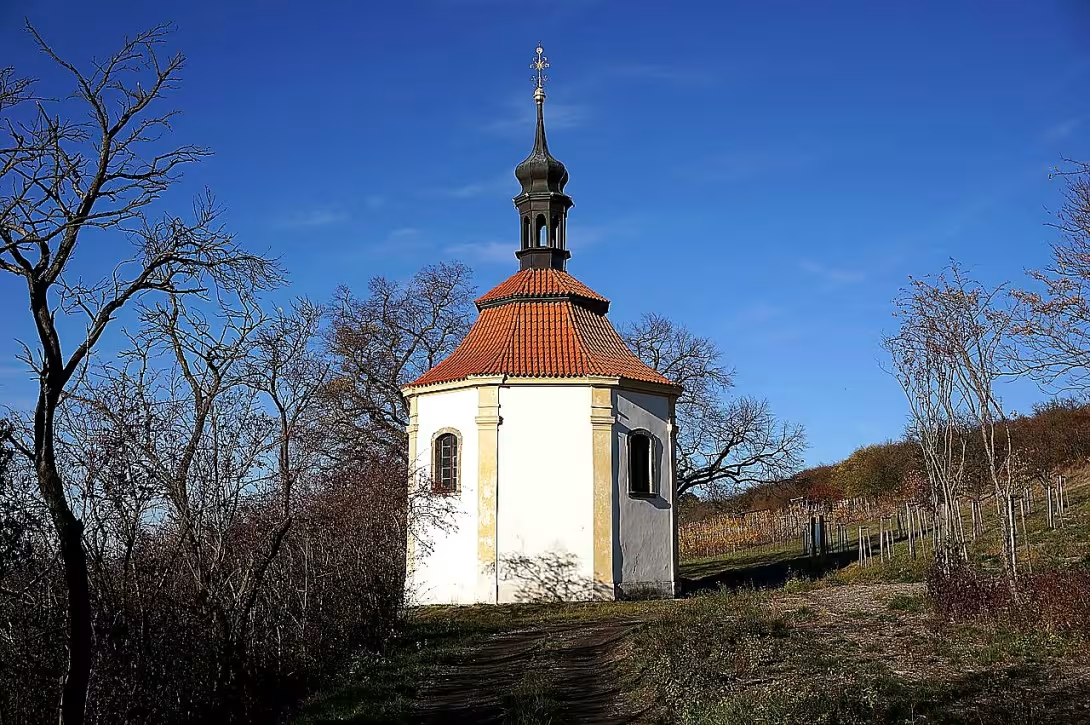
Kaple Stětí svatého Jana Křtitele is a Baroque building from 1735, which stands on a hill in the village Dřísy in Praha- east. The building is located on the edge of the St. Vineyard vineyard and is protected as a cultural monument.
The construction was built at the time when the Baroque was in the Czech lands. This period was characterized by the construction of many chapels and churches with rich ornamental and illusionist painting.
Architecturally, it's an octave chapel about 12 meters high. The building is covered by a mansard roof with a sump and a lantern. This is made up of an occipital lid with an onion cap, beaten with copper, ended with a poppy and double cross. The National Pilasters complement Tuscan warheads. The interior lighting is provided by four oblong, segmentalized windows with simple sides. On the west side there is an entrance with a rectangular portal, segmentality ending with a ledge and a condom in which is placed a statue of St. John the Baptist.
The interior of the chapel is decorated with frescos and illusory paintings of Josef Kramolín from 1770. The Rococo altar panels with scenes from the life of St. John the Baptist and the ceiling painting depicting the Holy Trinity are an important element.
Over the years, the chapel has undergone several repairs. The first one took place in 1820, then in 1882-1883. The fresco decoration was renovated in 1949.
The monument is a valuable example of baroque architecture and painting in the region of Prague-East. Her visit offers the opportunity to see the preserved rococo details and unique illusionist paintings in the direct neighbourhood of the St. Vineyard vineyard.
Historical milestones
- 1735
- the formation of the chapel
- 1770
- formation of fresco decoration from Josef Kramolín
- 1820
- repair of chapel
- 1882-1883
- repair of chapel
- 1949
- repair of fresco decoration
Architectural development
The chapel was built in 1735 and later repaired in 1820 and 1882- 1883. In 1770 it was supplemented by fresco decoration, which underwent repair in 1949. Architecturally dominated by an eight-sided plan and a copper canopy with a double cross.
Points of interest
- It is a Baroque building from 1735, which stands on a hill in the village Dřísy. The building is eight-sided, approximately 12 meters tall and has a copper onion roof. - There is a statue of St. John the Baptist in the condom above the entrance. - The interior is decorated with frescos and illusory paintings of Josef Kramolín from 1770. There are rococo altar panels in the chapel and a ceiling painting depicting the Holy Trinity.
Guide
Show guide text
This text was created by artificial intelligence and has not been editorially reviewed. It may contain inaccuracies.
Welcome to the old days. Right now, you're facing one of the most beautiful gems in this country. In front of you is the chapel of St. John the Baptist. It's a place where spiritual peace joins with an amazing view of the surrounding countryside. Notice how dominant this building shines at the top of the hill, in close proximity to the Svatoclas vineyard. It is the first impression that most of the visitors are astonished because the chapel is easy and yet noble.
Now let's stop a little bit at how this building came into being. The chapel was built in the year seven hundred thirty-five. At that time, in our countries, the barroc culminated, which placed great emphasis on emotions, dynamics and the game of light and shadow. Although today we do not know exactly who was the author of the architectural plan, it is clear that the builders wanted to create something special. The chapel was not only an ordinary place of prayer, but was meant to be a visible sign of faith even from a long distance, confirming its strategic location on the hill.
Now pay attention to the architecture itself. Look at the shape of the building. It's not an ordinary rectangle, but an octave building. This shape is typical of baroque centralized buildings because it allows visitors to perceive space from different angles and creates a sense of harmony. The chapel reaches a height of approximately twelve metres, which gives it some monumentality, although it is relatively small in absolute terms.
Look up now. Your eyes will lead to the Mansard roof, which ends with an onion lid. Note that the roof is copper, which gives it the typical feel that we know from many historical centers of our cities. It's a detail that the chapel gives its unmistakable character. And while you're looking up, focus your view of the area above the main entrance. In the end, in such a decorative arch, you will find the statue of St. John the Baptist, who is the patron saint of this place.
If you look closer at the walls, notice the pilasters. They're sort of glued columns that decorate the facade. Their endings are Tuscan warheads. It is a very clean and elegant style that gives stability and softness to the building. This whole look is protected as a cultural monument, which means that the state recognises its great value for our history and culture.
Now let's move on to what's inside. Even though the chapel appears soft from the outside, its inner space is a true triumph of baroque art. The interior is richly decorated. The main jewel is frescoes and illusory paintings. These are images that are drawn so skillfully that they create an impression of depth and space that actually doesn't exist. It's a so-called illusion of the eye.
This amazing decoration was created in the year of tyre seven hundred seventy and the author was Josef Kramolín. He was a master of his craft who could transform walls and arches into open skies full of symbols and figures. The work of Josef Kramolín in this chapel is one of the peaks of the painting at the time. It is a fascinating idea that in this small space architecture meets painting so perfectly that together it evokes a sense of infinity.
The history of the chapel was not only about creation, but also about care and repairs. Over the centuries, the building required maintenance to be preserved in such good condition. The first major repair took place in the year of eight hundred and twenty. There was another major renovation in eight hundred and eighty-two to eighty-three. These interventions were necessary to prevent material from falling apart due to weather, because the location on the hill means that the building is exposed to wind and rain much more than the buildings in the valley.
Special attention was paid to inner art. The frescoes of Josef Kramolín are very fragile. Therefore, in the year nine hundred forty-nine, a thorough reconstruction of the fresco decoration took place. Thanks to this we can still admire the colors and details that could otherwise be lost irreparably. It is a reminder of how important it is for us to guard our heritage and maintain it for future generations.
The interesting thing that might interest you is the combination of this place with the surrounding landscape. Imagine what this chapel looked like in the eighteenth century when it was newly built. It was probably the most distinctive building in the area, which served as a beacon for pilgrims and locals. It is fascinating that even after almost three centuries, she has retained her grace and still acts as naturally as if she had grown organically with a hill in the old days.
When you stand in front of this eight-sided building today, feel the atmosphere of peace. Notice how the copper onion canopy shines in the sunshine and how the statue of St. John the Baptist watches over all who come in. It's where time stopped. The Baroque época, with its desire for grandeur, has become more of a hugely balanced form.
Now invited to see the memory closely at your own pace. Walk around her, admire the details of Tuscan warheads, and consider the route the materials and people must have traveled to create this work in the year seven hundred thirty-five. If you have the chance, look into the space where the colors of Josef Kramolín still live.
I hope this short trip to history has helped you better understand the beauty and meaning of the Chapel of the House of St. John the Baptist. It's a little piece of history that carries great artistic value. We wish you a pleasant rest of the trip to the Old Town and enjoy the beauty of the St. Vineyard and the surrounding view. Goodbye.
Tips for visitors
For the best visual experience we recommend a visit in late afternoon. At this time, the sunlight will best highlight the baroque details of the octagonal structure and its characteristic Mansard roof.
You can reach the monument by car and public transport; Please check the current connection in the search engine. Due to the position on the hill we recommend to take with you comfortable shoes and water.
Photography is ideal from places that offer a view of the entire height of the building, which is approximately twelve meters. The best light conditions for the 1735 architecture can be found at a low angle of the sun.
For families with children it is suitable to walk in the vicinity of the St. Vineyard vineyard. This area offers a quiet environment for spending time together in nature.
Frequently asked questions
Can the monument be visited?
Religious buildings are usually open mainly during services; at other times a visit is normally arranged with the parish or the operator. We have not verified specific times.
Where is the monument?
Location: Dřísy. The map on this page shows the exact spot.
Why is the monument protected?
It is listed in the Central List of Cultural Monuments of the Czech Republic as a cultural monument (register no. 1000131718).
Businesses nearby
Do you run a restaurant, accommodation, shop, museum, rental, wellness or other visitor service near this monument? Show yourself directly to the people heading to it — this is how they will see you in the app and on the web:
Nearby
Kaple se nachází na okraji Svatováclavské vinice.
Accommodation nearby
Trips and activities nearby
Guided tours, tickets and activities nearby from GetYourGuide
Affiliate link: if you buy from the partner, we may receive a commission. The price for you does not change.
Search tours and activities →Themed route
Kaple Stětí svatého Jana Křtitele Type: Sacral monument Why is it worth a visit: This small chapel is a dominant place and reminds of the tradition of the beheading of St. John the Baptist. Its simple architecture offers a quiet place to reflect and admire the historical heritage of the village Dřísy.
Saint Vincent's vineyard Type: Vinohradian landscape Why is worth a visit: The chapel is located right on the edge of this vineyard, which allows you to connect a spiritual experience with the beauty of the wine landscape. The walk between the rows of vines offers a view of the typical rural architecture and natural beauty of the region.
The area of the chapel and the immediate area Type: Local environment Why is it worth a visit: The immediate surroundings of the chapel form part of the Svatoclava vineyard where one can admire the harmony of human work and nature. This place is ideal for a short stop, photo and atmosphere of a quiet wine region.
Final walk in the vineyard Type: Hiking trip Why is it worth a visit: After visiting the chapel you can continue along the edges of the Svatoclava vineyard to enjoy the quiet and the views of the surrounding countryside. This part of the route allows you to fully experience the specific character of the site where the sacral monument is tangled with the wine tradition.
This route is designed to respect the limited range of information available and to focus solely on the main objective and its immediate surroundings, namely the Svatoláclav vineyard. No other fictional or unmentioned sites are included here. The traveler gets an authentic experience from Dřísy, focused on the spiritual and landscape values of this specific place.
Seasonal recommendations
In spring, the surroundings of the chapel awaken to life, and the landscape around Jas summer foretells fresh greenery. The soft spring light highlights the details of the construction while the air is fresh. We recommend shoes suitable for humid terrain and a visit in the morning when nature is most filled with colours.
The summer season brings clear sun and rich contrast between white walls and surrounding vegetation. The atmosphere is warm and peaceful, ideal for a short stop while walking through the countryside. It is advisable to choose light clothes and a sun hat, while the best is to come in early morning to avoid heat.
The autumn colors the surrounding trees into golden and red shades, creating a melancholy background for this sacral structure. The light is lower and more golden in this period, which gives the place a special depth. It's practical to wear layered clothes and a warm sweater, because it can be colder in the autumn wind.
In winter the monument can be surrounded by snow, which gives it a clean and quiet character. The landscape is minimalist and peaceful, which underlines the spiritual atmosphere of the place. Waterproof shoes and warm winter clothes are necessary, and we recommend a visit at noon when the most daylight is.
Visualizations and artistic views

The visualisations are generated by artificial intelligence and serve as inspiration.
Photos from the area
Real photos taken near the monument


Zdroj a licence jsou uvedeny u každého snímku.
Tips from visitors
No tips yet. Be the first!
Log in and add your tip.
Sources and literature
Photos: MartinVeselka / CC BY-SA 4.0 — Wikimedia Commons. The author and licence also appear when you hover over the image.
Faktickým podkladem tohoto textu byl článek na Wikipedii, jehož autory jsou přispěvatelé Wikipedie. Článek je dostupný pod licencí CC BY-SA 4.0.
Location on the map
Příběhy a pověsti
Legendy, pověsti a příběhy spjaté s touto památkou
Fotografie návštěvníků
Zatím žádné fotografie. Buďte první, kdo přidá fotografii z návštěvy!
Log in a přidejte svou fotografii nebo hodnoťte.
Za ověřenou návštěvu v aplikaci získáte víc bodů — poznáme podle GPS, že jste na místě.
Reviews and comments