



kostel svatého Jiljí (Křelov) Church
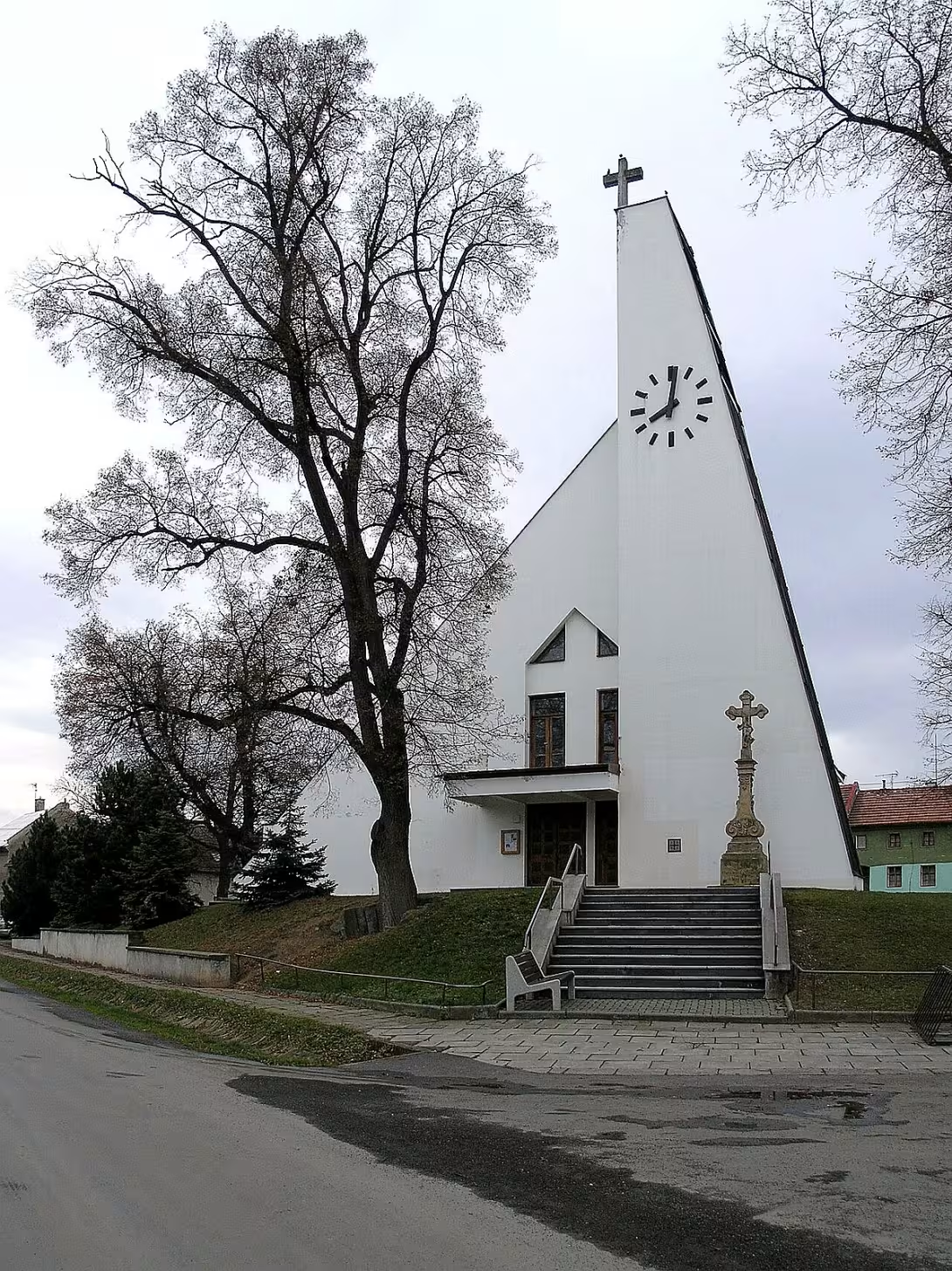
The Church of Saint Giles in Křelov stands as a modern architectural testament to resilience and renewal. Constructed between 1991 and 1993 by Polish architect Jerzy Pekala, it is located on Lipové Square at the heart of Křelov. Built on the site of its baroque predecessor demolished in 1963 due to severe structural issues, its consecration in 1993 marked a significant moment in post-revolutionary Czechoslovakia, symbolizing both historical continuity and modern innovation.
The origins of the Church of Saint Giles trace back to medieval times, with the first documented mention dating to 1279 during a dispute over patronage rights between two nobles. However, details about its appearance or location from that era remain undocumented. The baroque church that preceded the current structure was built between 1719 and 1721 and consecrated in 1741 by Olomoucký biskup Jakub Arnošt z Lichtenštejnu. Despite several renovations, including a significant one in 1928 to secure its vaulting, it suffered from foundational instability due to being partly built on unstable ground. This led to its eventual demolition in the early 1960s after repeated structural failures.
The modern Church of Saint Giles reflects contemporary architectural design while addressing historical challenges. Designed by Jerzy Pekala, this structure features a unique orientation and employs modern materials such as reinforced concrete for both the main building and its tower. Despite these advancements, the church has faced ongoing issues with foundation stability, necessitating repairs in 2008 and 2017 to address structural concerns.
Throughout its history, the Church of Saint Giles has been associated with notable figures and events. In 1990, Pope John Paul II consecrated the foundation stone during his first visit to Czechoslovakia, underscoring the church's importance in the post-revolutionary era. The church was later consecrated in 1993 by Archbishop Ján Graubner and papal nuncio Giovanni Coppy, marking its official opening.
Today, the Church of Saint Giles stands as a cultural and historical landmark in Křelov. Situated on Lipové Square, it is surrounded by mature trees that enhance its serene environment. A baroque stone cross from 1762, protected as a cultural monument, marks the entrance to this modern church. Despite ongoing structural challenges due to unstable foundations, the church remains an important site for both locals and visitors.
Visiting the Church of Saint Giles offers insight into the resilience and renewal that characterized post-revolutionary Czechoslovakia. Its unique architectural design and historical significance make it a worthwhile destination for those interested in modern architecture and religious history. The church's enduring presence serves as a reminder of the community's ability to adapt and thrive amidst challenges, inviting visitors to explore its rich narrative and appreciate its role within Křelov.
Historical milestones
- 1279
- První dokumentovaná zmínka o kostele svatého Jiljí.
- 1719
- Výstavba barokního kostela začala.
- 1721
- Dokončení výstavby barokního kostela.
- 1741
- Barokní kostel byl zasvěcen biskupem Jakubem Arnoštem z Lichtenštejnu.
- 1963
- Demolice barokního kostela kvůli strukturálním problémům.
- 1990
- Papež Jan Pavel II. zasvětil kámen úrazu během návštěvy Československa.
- 1991
- Začátek výstavby moderního kostela svatého Jiljí.
- 1993
- Moderní kostel byl zasvěcen arcibiskupem Janem Graubnerem a papežským nunciem Giovanni Coppy.
Architectural development
Constructed between 1991 and 1993, the Church of Saint Giles replaced a baroque predecessor demolished in 1963 due to structural issues. Designed by Jerzy Pekala, it features modern architectural elements with an atypical orientation. Despite its contemporary design, challenges related to unstable foundations have persisted, necessitating repairs such as those conducted in 2008 and 2017.
Historical events
- 1990
- Pope John Paul II consecrated the foundation stone during his first visit to Czechoslovakia.
- 1993
- The church was consecrated by Archbishop Ján Graubner and papal nuncio Giovanni Coppy.
Points of interest
- The Church of Saint Giles is built on the site where a baroque predecessor stood until 1963; its demolition was due to severe structural issues, highlighting a recurring theme of instability at this location.
- Although the first documented mention of the church dates back to 1279 during a dispute over patronage rights, no details about its medieval appearance or exact location are available, adding an air of mystery to its early history.
- In 1990, Pope John Paul II consecrated the foundation stone for the modern Church of Saint Giles during his first visit to Czechoslovakia, marking it as a symbol of renewal in post-revolutionary times and connecting it with significant global religious figures.
- Despite employing modern materials like reinforced concrete, the church has faced ongoing issues with foundation stability since its construction, necessitating repairs in 2008 and 2017, reflecting challenges that mirror those of its predecessors.
- A baroque stone cross from 1762 marks the entrance to this modern church; it is protected as a cultural monument, serving as a tangible link between Křelov’s historical past and its contemporary architectural landscape.
Guide
This guide is narrated by a synthetic voice generated by artificial intelligence.
Show guide text
This text was created by artificial intelligence and has not been editorially reviewed. It may contain inaccuracies.
The Church of Saint Egidius in Křelov is a new building from 1991 to 1993. It was designed by Polish architect Jerzy Pekala and stands on the site of a Baroque church that had to be demolished in 1963 due to serious structural damage and neglected maintenance.
The church in Křelov is mentioned as early as 1279 in a record of a dispute between two nobles over patronage rights. However, what it looked like at that time and where exactly it stood has not been preserved. The Baroque Church of Saint Egidius was built from 1719 to 1721 and was consecrated in 1741 by Olomouc bishop Jacob Ernest of Liechtenstein. Until 1836 it was surrounded by a cemetery. During the Seven Years' War in 1758, the church was plundered and damaged by the Prussian army. After 1834, rector Martin Foukal took credit for its restoration, personally painting and decorating the church. He also provided a new image of Saint Egidius for the main altar and two paintings for the side altars by the Viennese painter Jan Turovsky. Four bells hung on the fifty-meter-high tower.
But the fate of the Baroque building was determined by the subsoil. The church stood partly on rock and partly on shifting clay and sand, so the masonry began to crack shortly after completion. The cracks were repeatedly repaired and in 1865 and 1866 the church had to be closed. After war damage, restoration took place from 1946 to 1948, but as early as 1950 the tower was shifted by twenty centimeters. In 1961 the church was closed and two years later its demolition was ordered. Křelov then remained without a Catholic church for thirty years and the faithful gathered in the rectory basement adapted as a chapel.
After November 1989 plans for a new church could be realized. Pope John Paul II blessed the foundation stone in 1990 during his first visit to Czechoslovakia. The church was consecrated in 1993 with the participation of Olomouc archbishop Jan Graubner and papal nuncio Giovanni Coppa. However, the unstable subsoil soon manifested itself again. In 2008 the slipping northeast corner was secured with concrete piles.
The church stands on Lipové náměstí among tall trees. The entrance is accessed by a stone staircase and at its top stands a heritage-protected Baroque cross from 1762. Unusual is the orientation of the building, the entrance is approximately to the east and the altar to the west. A diagonally cut prismatic tower with a belfry and clock protrudes from the façade. The entire building has a reinforced concrete structure and the foundation stone consecrated by the pope is installed in the lower part of the tower.
Frequently asked questions
Can the monument be visited?
Religious buildings are usually open mainly during services; at other times a visit is normally arranged with the parish or the operator. We have not verified specific times.
Where is the monument?
Location: Křelov, Olomoucký kraj. The map on this page shows the exact spot.
Businesses nearby
Do you run a restaurant, accommodation, shop, museum, rental, wellness or other visitor service near this monument? Show yourself directly to the people heading to it — this is how they will see you in the app and on the web:
Events nearby

Zdroj akcí: otevřená data měst a obcí ČR (Národní katalog otevřených dat) a kalendář akcí Národního památkového ústavu.
Nearby
The Church of Saint Giles is situated in Křelov's central Lipové Square, surrounded by mature trees. The area does not have other significant monuments within a 5 km radius.
Accommodation nearby
Trips and activities nearby
Guided tours, tickets and activities nearby from GetYourGuide
Affiliate link: if you buy from the partner, we may receive a commission. The price for you does not change.
Search tours and activities →Themed route
Tematická výletní trasa: Kostel svatého Jiljí (Křelov)
1. Kostel svatého Jiljí (Křelov) - Hlavní cíl - Typ: Náboženský památník - Proč stojí za návštěvu: Tento barokní kostel, postavený v 18. století, je architektonickou perli Křelova. Jeho bohaté interiéry a historická důležitost nabízejí cenný vhled do náboženských tradic oblasti.
2. Lipové Náměstí (Křelov) - Typ: Veřejný prostor - Proč stojí za návštěvu: Centrální náměstí Křelova je obklopeno starobylými lípy, které dodávají míru a krásu. Je to ideální místo pro relaxaci a pochopení místního života.
3. Kostelní věž - Typ: Architektonický prvek - Proč stojí za návštěvu: Vystoupení na kostelní věž nabízí jedinečný pohled na Křelov a okolní krajinu. To je skvělá příležitost pro fotografii i pochopení historického kontextu oblasti.
4. Nádvoří kostela - Typ: Historický areál - Proč stojí za návštěvu: Nádvoří je klidným místem, kde si můžete užít klidné chvilky a prohlédnout se po detaily kostela. Je to také místo, kde se konají různé komunitní akce.
5. Interiér kostela - Typ: Umělecká expozice - Proč stojí za návštěvu: Interiér nabízí bohatství uměleckých děl, včetně oltářů a soch. Je to skvělý příklad barokního umění a poskytuje hlubší vhled do historie náboženského života ve městě.
Tato trasa vám umožní prozkoumat nejen kostel svatého Jiljí, ale i jeho okolí a přírodní krásy Křelova.
Seasonal recommendations
Spring: Visiting the Church of Saint Giles in Křelov during spring offers a unique experience as nature awakens around this historic site. The surrounding landscape is adorned with vibrant wildflowers and lush greenery, creating a picturesque setting that enhances the church's architectural beauty. As daylight hours extend, visitors can enjoy the soft natural lighting that highlights intricate details of the structure. This season often sees moderate crowds, making it an ideal time to explore without the hustle of peak tourist seasons. It is advisable to wear comfortable walking shoes and layers, as temperatures can vary with cool mornings and warmer afternoons.
Summer: The summer months bring a lively atmosphere to the Church of Saint Giles in Křelov, with longer days providing ample daylight for exploration. This period often coincides with heightened tourist activity due to the pleasant weather, so arriving early is recommended to avoid larger crowds. The lush greenery and blooming flowers create an idyllic backdrop, making it a perfect time for photography enthusiasts. Visitors should dress in light, breathable clothing and carry water to stay hydrated during their visit.
Autumn: Autumn at the Church of Saint Giles offers a serene and enchanting experience as the foliage transforms into warm hues of red, orange, and yellow. The cooler temperatures provide a comfortable environment for walking around the church grounds, which are particularly stunning when bathed in the golden light of late afternoon sunsets. This season tends to attract fewer visitors, allowing for a more tranquil visit. It is advisable to wear layered clothing to accommodate fluctuating temperatures throughout the day.
Winter: Winter adds a magical touch to the Church of Saint Giles with its quiet and contemplative atmosphere. The church may be adorned with festive decorations during the Advent period, enhancing its historic charm. With shorter daylight hours, it's best to plan your visit earlier in the day to fully appreciate the site under natural light. Visitors should dress warmly in layers and wear sturdy footwear for walking on potentially icy paths. Keep in mind that some facilities might have reduced operating hours due to the colder weather.
Visualizations and artistic views


The visualisations are generated by artificial intelligence and serve as inspiration.
Photos from the area
Real photos taken near the monument


Zdroj a licence jsou uvedeny u každého snímku.
Tips from visitors
No tips yet. Be the first!
Log in and add your tip.
Sources and literature
Photos: Matěj Baťha / CC BY 3.0 — Wikimedia Commons. The author and licence also appear when you hover over the image.
Faktickým podkladem tohoto textu byl článek na Wikipedii, jehož autory jsou přispěvatelé Wikipedie. Článek je dostupný pod licencí CC BY-SA 4.0.
Location on the map
Příběhy a pověsti
Legendy, pověsti a příběhy spjaté s touto památkou
Fotografie návštěvníků
Zatím žádné fotografie. Buďte první, kdo přidá fotografii z návštěvy!
Log in a přidejte svou fotografii nebo hodnoťte.
Za ověřenou návštěvu v aplikaci získáte víc bodů — poznáme podle GPS, že jste na místě.
Reviews and comments