



Lovecký zámeček Nové Valteřice Hunting lodge
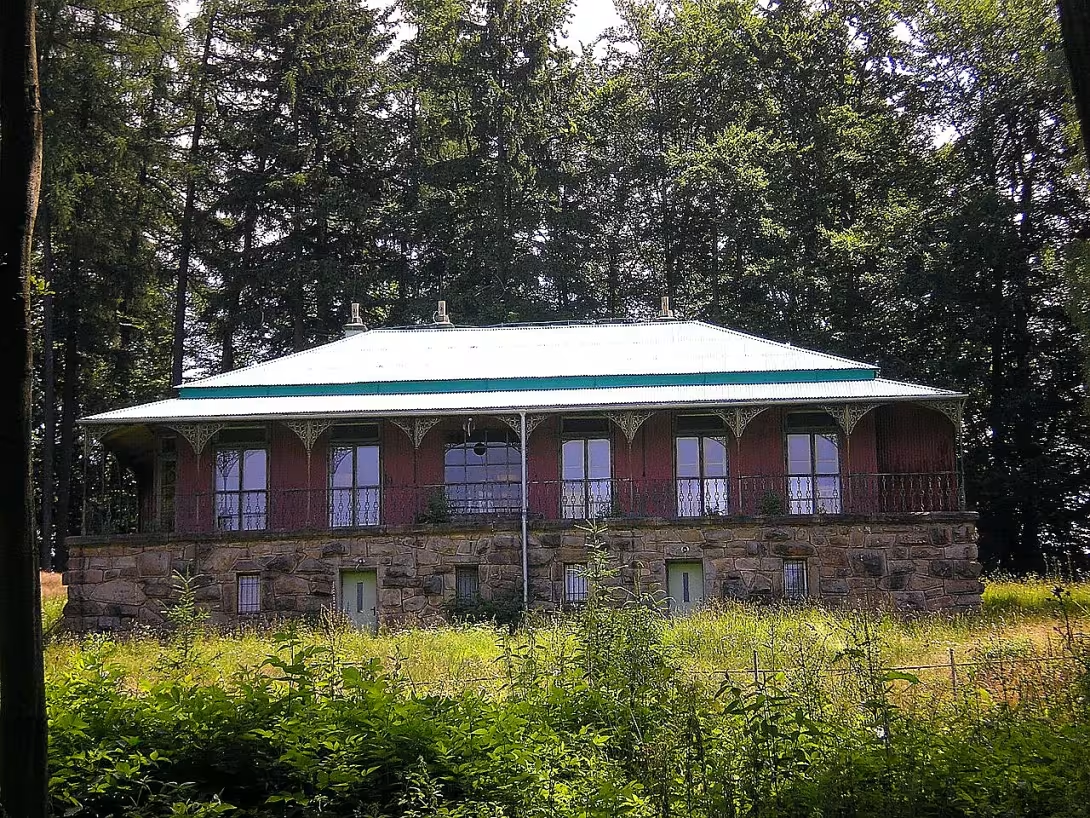
The hunting castle in Nové Valterice near Moravian Beroun is a unique historical building from the end of the 19th century. It excels in particular by using non-traditional materials and imported cast iron pavilion from the Vienna World Exhibition. The building consists of two connected pavilions. It represents a unique example of the industrial architecture of its time and has since 1958 been registered as a real-estate cultural monument.
The construction was built between 1864 and 1876 by Lichtenštejnové. The creation of the building falls within the period when new technical possibilities have been promoted in European architecture. In the Czech countries, the use of cast iron and corrugated sheet was combined with period historism.
The architectural whole consists of two ground buildings connected by a covered transition. The main pavilion is partially underwritten and stands on a massive stone suspect in which there are other rooms. The construction of both walls and roofs is made up of corrugated sheet. The front is decorated with arcades with cast iron columns whose upper part decor an ornament resembling lace. In the interior are visible rolled ceiling vaults. The second, smaller pavilion of a rectangular plan was originally served as a feast room. Its saddle roof has metal pillars with similar lace decoration. The most important part of the complex is the cast iron pavilion purchased at the Vienna World Exhibition in 1873.
After World War II, Liechtenstein's assets were expropriated on the basis of Benes' decrees and transferred to the state. In the second half of the 20th century, the complex served as a recreation centre for the employees of the Chemické výrobky Ostrava plant and in the summer months as a pioneering camp. From 2004 to 2014 the company CLAW s. r. o.
Apart from the pavilions themselves, there was a bottling plant of mineral waters with high flow capacity, which is now in desolate condition. The current appearance of the site has affected the long-term decaying and impact of trees, especially beech and birch. The castle park, as reported in the 1985 landmarks, has never had the character of a classic park and lacks precious timber. The original access staircase is now almost unnoticeable, only the railing remains visible. There are still identifiable remnants of the playground and cabins of the former camp.
While the main building remains in relatively decent condition, the mineral water bottling plant is freely accessible and devastated. The entire building is owned by a private company and is not normally accessible to the public.
The hunting lodge in Nové Valterice is a remarkable proof of technical maturity and aesthetic sensations of the 19th century. Despite its current dismal state, it remains a valuable testimony about the history of industrial architecture, which deserves the attention of experts and interested in technical monuments.
Historical milestones
- 1873
- Purchase of cast iron pavilion at the Vienna World Exhibition.
- 1945
- Expropriation based on Beneš's decrees.
- 1958
- The declaration of memorial protection.
Architectural development
The construction consists of two ground buildings with a structure of corrugated sheet. The main pavilion stands on a stone suspect and is decorated with cast iron columns with lace ornament. The interiors contain rolled ceiling vaults.
Historical events
1873: Purchase of cast iron pavilion at the Vienna World Exhibition. 1945: Expropriation of property based on the Beneš Decrees. 1958: Announcement of monument protection.
Owners
Lichtenštejnové (1864- 1945), State (after 1945), Chemical plants Ostrava, company CLAW s. r. o. (2004 to 2014).
Points of interest
- The castle is a unique historical building from the end of the nineteenth century, which excels at the use of non-traditional materials. - Part of the complex is a cast iron pavilion which was purchased at a world exhibition in Vienna in 18 hundred and seventy-three. - The construction of the walls and roof of the main building consists of corrugated sheet and the front is decorated with cast iron posts with lace ornament. - There was a bottling plant with high flow capacity, which is currently in desolate condition. - After World War II, the property was expropriated and in the second half of the twentieth century it served as a recreation centre and pioneer camp.
Guide
Show guide text
This text was created by artificial intelligence and has not been editorially reviewed. It may contain inaccuracies.
Welcome to New Valterice. You are standing in front of one of the most interesting and least common building units in the whole area. Before your eyes, there is a hunting lodge, which people often call the summer castle. Perhaps at first glance you don't see tall towers, massive stone walls or rich decorating that you would expect from a classic castle. Instead, you're being approached by something far more precious and unique. Feel the strange atmosphere that combines nature's calm with the bold spirit of scientific and technical progress. This object is not just a building, it is a witness to the time when the world began to change under the influence of new materials and unprecedented inventions.
Now let's look together at how this place came into being. This castle is not the work of random builders, but it was created with great intent of the House of Liechtenstein. In the second half of the nineteenth century, which was an era of huge transformations and industrial expansion, this mighty family wished to have a place in this part of the landscape to rest, have fun and, above all, hunt. Lichtenštejnové were not just ordinary landowners, they were people with great visionaries who were not afraid to find new ways to express their taste and their attitude towards the modern world. It is thanks to their decision that we can now admire the construction that deviates from a number of traditional buildings.
Now pay attention to the architecture itself, which you see right in front of you right now. Note that this complex does not consist of one large monolith, but consists of two separate buildings, a pavilion which are located at ground level. However, these two parts are not separated by emptiness, but are connected by a covered transition that allows smooth movement between them. This creates a harmonious and coherent whole that is beautifully inserted into the surrounding environment.
Take a closer look at the materials from which this building is drawn. This is what makes this summer's castle absolutely unique. At the time of its creation, most of the buildings were still made of heavy materials such as stone, brick or wood. But here you see something else. Notice the walls and roof of the main building. Its construction consists of corrugated sheet. At that time, it was a completely unprecedented choice, a symbol of modern age and industrial power. Feel the texture, the regular cords that give the building a specific look and at the same time give it a lightness that you will not see at the then buildings. And then there's another, extremely important element that plays a major role here. It's a cast-iron. The cast iron is not just an accessory, but it is the very essence of some parts of this object.
And this is where we come to one of the most interesting things that must now fascinate you. The cast iron pavilion you see here, it's really of world origin. Imagine the year eighteen hundred seventy-three. There was a huge world exhibition in Vienna. It was an event that attracted the attention of the entire human world, a place where the latest scientific discoveries, works of art and modern technology were mixed. Lichtenštejnové was there, watching the biggest news, and that's where they chose this wonderful cast iron piece to bring it here, to New Valters. Imagine the journey, the astonishment of such a modern and rare element becoming part of their private resort in the heart of this country. So this pavilion is a living piece of the history of world technology that has been transferred from the city to this quiet environment.
But the history of this place was not just a linear story of peace and luxury. As you may have heard, after a thousand and nine hundred forty-five, there have been major changes in the possession of property throughout our state. On the basis of those legal decisions known as the Beneš decree, this object was expropriated. This meant that the era when the House of Liechtenstein hosted its friends here and devoted itself to hunting was finally over. Yet this building did not become a forgotten ruin. On the contrary, its exceptional character and its untraditional character were later fully recognised. In a thousand and nine hundred and fifty-eight, this monument was officially declared an object of deserving conservation. This tells us that despite the turbulent political changes and the changes of owners, the value of this unique castle has remained immense for all of us and we must protect it for future generations.
Now that you know the secrets of the corrugated sheet metal and cast iron that came from the world exhibition, I suggest you continue your tour of the entire complex. Feel the combination of materials, which was so unusual in the nineteenth century, and try to imagine the emotions that this modern building caused in those visitors. Walk around, observe the details and enjoy the atmosphere of this place, which is such a unique link between the old world and the new era of industry.
Thank you for spending this moment with us and paying attention to the history of this summer's castle. We wish you a beautiful and inspirational walk around New Valterice.
Tips for visitors
The best time to visit is during the late spring or early autumn, when the surrounding beech and birch forests offer the most beautiful coloured scenery. Due to the poor state of the building we recommend a visit in daylight when the terrain is clearer.
You can easily get to the monument by your own car, which can be disabled near the village Nové Valteřice. Public transport is possible, but check the connection in the current connection search engine as the frequency of connections to this area is limited.
Since this is a historic building in bad technical condition, we recommend fixed shoes and clothes for nature. Don't forget to pack enough fluids and snacks because there are no services or refreshments in the immediate vicinity of the castle.
For photographers, the most interesting connection between the two pavilions is through the transition. The best lighting conditions for capturing architecture in contrast to surrounding nature occur shortly after sunrise or before sunset, when soft light highlights the facade details.
For families with children, the location is suitable for easy walking through the forest. However, due to the state of the monument, caution should be exercised and only in the safe areas of the site to avoid injury.
Frequently asked questions
Can the monument be visited?
Some buildings of this kind are open for guided tours, others serve another purpose or are privately owned. We have not verified whether and when this monument is open – please ask the operator. According to the heritage register the structure is in poor condition – do not enter it and take care nearby.
What are the opening hours and admission?
We have not verified the opening hours or admission. Current information is published by the operator.
Where is the monument?
Location: Nové Valteřice. The map on this page shows the exact spot.
Why is the monument protected?
It is listed in the Central List of Cultural Monuments of the Czech Republic as a cultural monument (register no. 1000142406).
Businesses nearby
Do you run a restaurant, accommodation, shop, museum, rental, wellness or other visitor service near this monument? Show yourself directly to the people heading to it — this is how they will see you in the app and on the web:
Nearby
Obec Nové Valteřice, Moravský Beroun, okolní lesní porosty s buky a břízami.
Accommodation nearby
Themed route
1. Municipality of Nové Valteřice Type: Plate Why to visit: It is the perfect place to start your trip. Here you can head towards the main monument.
Lovecký zámeček Nové Valteřice Type: Summer Castle Why to visit: It is the main destination of the whole trip. You can admire the beautiful structure here.
3. Forestry with beech and birch Type: Natural space Why to visit: They offer a pleasant walk in nature. You can enjoy the shade of trees here.
4. Moravian Beroun Type: Area Why to visit: This part of the area forms the conclusion of your route. It's a place that complements your whole trip.
Seasonal recommendations
Spring: In the spring season, the hunting lodge Nové Valteřice appears in a new light when the sun lights up the old walls and green nature around it. The morning freezer often covers the lawns with a fine skull of the glacier, giving the atmosphere a mild romance. It is advisable to be on time in the morning when the temperature is colder and the crowd is not yet afraid. Batch clothing should include a warm shirt or sweater that can be easily postponed when the sun begins to heat the landscape.
Summer: In the summer season the hunting lodge Nové Valteřice is full of life. The high-rise building is lit by long sunlight, which emphasizes its historical architecture. Nature around the castle walls is in full bloom and attracts many visitors. It is advisable to take a walk early in the morning or evening to avoid the hottest hours of the day while taking advantage of light. Don't forget the ties, sunglasses and plenty of drinking water.
Autumn: Autumn brings the hunting castle Nové Valteřice melancholic atmosphere with darker nebium and leaves that turn into live colors. The castle looks like lost in its romantic environment, where every step brings a new beautiful perspective. The visit is best at noon, when the sun still lights up the landscape and the temperature remains pleasant. Clothes should be warm but flexible to change temperature, because the autumn day can quickly change.
Winter: In winter the hunting lodge Nové Valteřice is covered with snow and looks like a medieval fortress revived by an ice crown. Sunbeams that leak through the clouds, illuminate its walls with fine gold and create unique atmospheric sensations. The visit is best at the beginning of the day when the temperature is milder and snow is clean.
Visualizations and artistic views

The visualisations are generated by artificial intelligence and serve as inspiration.
Photos from the area
Real photos taken near the monument

Zdroj a licence jsou uvedeny u každého snímku.
Tips from visitors
No tips yet. Be the first!
Log in and add your tip.
Sources and literature
Photos: Milan dnb / CC BY-SA 3.0 — Wikimedia Commons. The author and licence also appear when you hover over the image.
Faktickým podkladem tohoto textu byl článek na Wikipedii, jehož autory jsou přispěvatelé Wikipedie. Článek je dostupný pod licencí CC BY-SA 4.0.
Location on the map
Příběhy a pověsti
Legendy, pověsti a příběhy spjaté s touto památkou
Fotografie návštěvníků
Zatím žádné fotografie. Buďte první, kdo přidá fotografii z návštěvy!
Log in a přidejte svou fotografii nebo hodnoťte.
Za ověřenou návštěvu v aplikaci získáte víc bodů — poznáme podle GPS, že jste na místě.
Reviews and comments