



Modlitebna Mosque
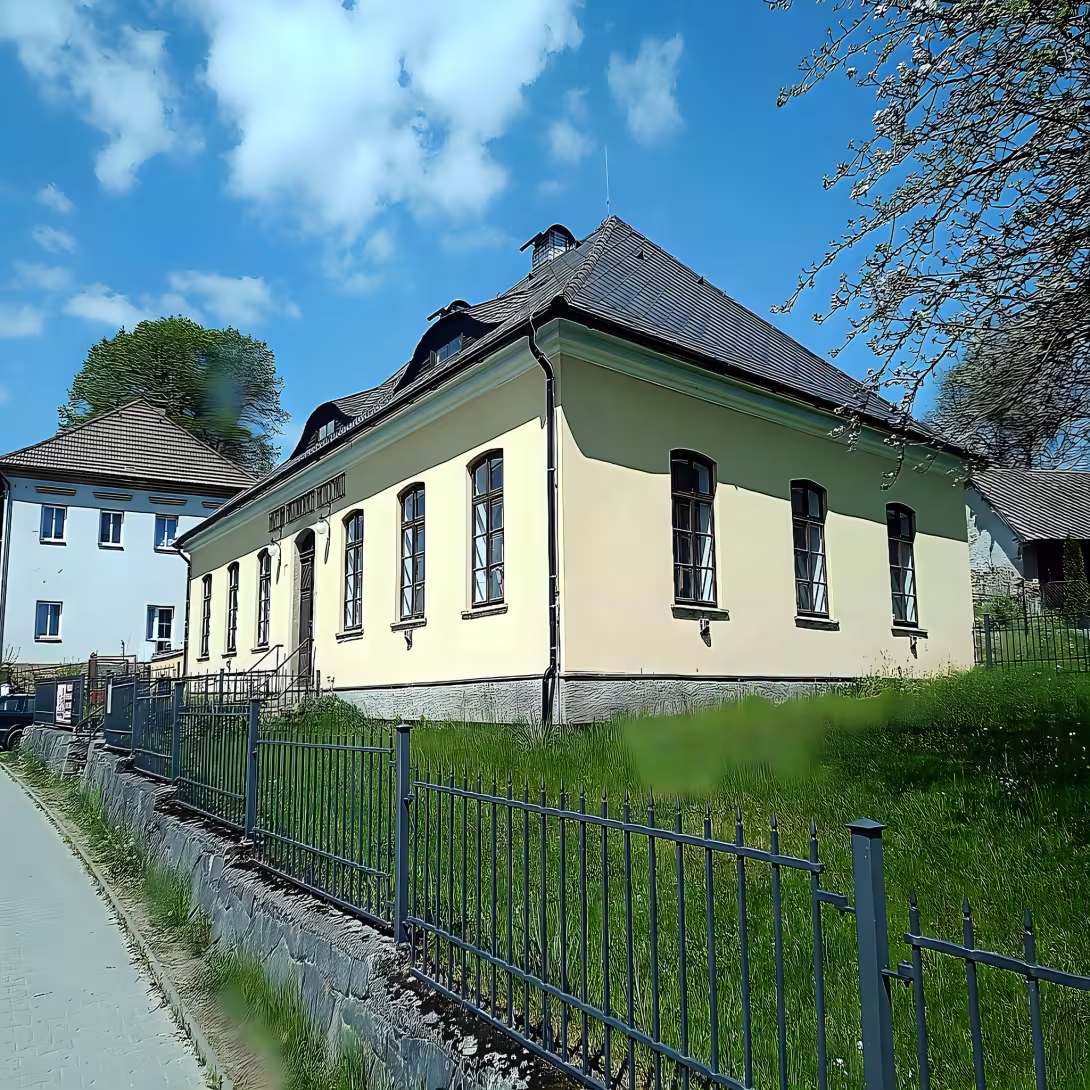
The Evangelical Prayer, called Presbyterna, is a walled rural building from the 1960s in Svratouch, Pardubice Region. The building is important as an example of the village evangelical school building. Since 1958 it has been among the cultural monuments.
The establishment of the choir in Svratouch is closely linked to the issue of the tolerance patent of emperor Josef II from 1781. The College of the Augsburg Religion was the first in the region. Count Filip Kinský invited the first priest from Hungary so that the believers of the restored church would not be without a preacher. According to the matrix of the first tolerant vicar Michal Vincenzenta, 18 peasant families, 11 homestead families and 19 families from Svratouch have joined the congregation in 1781. They were joined by families from Heralka, Hlumetin, Svratky, Gypsies, Crusaders, Milovas, Kameníček, Čachnova, Ruda, Hlinska, Zalibený and from settlements in Politchev. In total, the College included 102 families with 533 persons.
The setting up of the Evangelical School dates back to 1783, with the initial teaching on the farms. The budget for construction was drawn up in March 1784. The owner of the estate promised construction material on condition that the municipality provided the land. The first building of the school stood opposite today's presbytery. At the end of the 18th century, 56 children entered this private school. The original school burned down in 1863. This led to the immediate construction of a new building that is today's building. In 1877 evangelical and Catholic schools were merged into one institution. In the building of today's presbyterns was placed an apartment teacher and two classes, while in the Catholic school was an apartment managing and first class. In 1898 she started teaching in a new separate school for all pupils.
The building is a ground floor longitudinal brick object. The main entrance is centrally located and highlighted by undecorated stone lining. The interior divides the corridor into the right side with one large room and the left side with another larger room and background. The monument-protected building also includes a wall with a gate and an economic building that served as a toilet.
Since 1920, the winter prayer hall of the Evangelical Choir under the police seniors has been in operation in the building. There were Sunday schools and other events. Significant personalities associated with the site include Jan Pail, whose commemorative plaque is on the corner of the garden, Hrauslav Pipal, who worked here in 1951-1967 and participated in the renovation of the building, or Bohdan Pivonka. He worked here in 1968-1989 and hid dissidents such as Peter Uhl and Anna Shabat. The next preacher was Radomir Žářský.
In 2007 the municipality of Svratouchy bought the building. It was related to the disappearance of the vicar's place and the emergence of a preaching station from the choir in Kroun. The Museum of Historical Motorcycles has been operating here since 2016. In the vicinity there is a Catholic parish school from 1841, a rectory from 1871 and a single-boat church which was rebuilt in 1911-1912.
The monument represents a unique combination of the religious and educational history of the region. Visiting this place offers insight into the architecture of rural schools and the history of the tolerance patent.
Historical milestones
- 1958
- Classification among cultural monuments.
- 1920
- The beginning of the use of the building as a winter prayer house.
- 2007
- Purchase presbyterns of municipalities.
- 2016
- Opening of the Museum of Historical Motorcycles.
Architectural development
The building is a ground floor longitudinal object with a centrally located entrance. The interior is divided into several rooms and facilities. The building also includes a protected economic object and a wall with a gate.
Historical events
In 1863, the original school burned down and a new building was built. The winter prayer house has served here since 1920. In 2007, the building was purchased by municipalities.
Owners
Evangelical Choir, Svratouchy municipality since 2007
Points of interest
- Construction from the 1960s in Svratouch serves as an example of the building of a rural evangelical school. The College of the Augsburg Religion was the first in the region. - The building was created after the fire of the original school from 1863 and has been a cultural monument since 1958. - In the building was Bohdan Pivoňka, who hid people in opposition. - The Museum of Historical Motorcycles has been operating here since 2016 after reconstruction.
Guide
Show guide text
This text was created by artificial intelligence and has not been editorially reviewed. It may contain inaccuracies.
Welcome to this remarkable building that hides a layer of many decades of local history. You're standing in front of a building that looks like a typical representative of a rural building, but its history is much richer than it might seem. In front of you stands a brick structure with a characteristic longitudinal plan, which, by its simplicity and silverness, tells the story of education, faith and technical passion. Feel the atmosphere of this place where the spiritual cliff meets with the noise of the engines.
Now let's move back more than 150 years in time. This building was built in the 1960s. In order to understand why it's even standing here, we need to look at the events of the year one thousand eight hundred sixty-three, when the original school building burned down. It was from this sad incident that the need to build a new space for children and their education came. At that time, the evangelical school worked here. It was an important point in the life of the village, a place where the young generation learned to read, write and learn the world. It is fascinating to think how many children have flowed through here over the decades, how many basic life has been taught and how many dreams have been born in these walls.
Now pay attention to the architecture itself. The building is a real representative of the rural school building at the time. Notice its shape, which is elongated, i.e. longitudinal. It is a practical solution that has enabled the effective layout of the classrooms and corridors. If you look closer at the details, focus mainly on the stone lining that frames windows and doors. It is these elements that provide stability and a typical appearance from the time of its creation. The whole object is modest, but its value lies in this modesty. This is proof of the time when it was built in terms of function and durability. Thanks to its architectural value, the building was included as cultural monuments in the year one thousand nine hundred fifty-eight, which provided protection for future generations.
When we talk about the history of this place, we can't ignore the spiritual dimension. At a later time, specifically since the year one thousand nine hundred twenty, the building began to serve as a winter prayer house for the Evangelical Choir. So imagine how the space that had previously filled the noise of school children turned into a place of silence, contemplation and common prayers during cold winter months. It is very important that the College of the Augsburg Religion was first established here in the region. This shows a strong community and the need for freedom of religion in this area. In the context of the belief and social order in our countries, we can mention in the background the influences of personalities such as Josef second, Filip Kinský or Michal Vinczent, who have influenced people's lives in similar areas. In addition, Bohdan Pivoňka worked in the building, which is another name that was entered into the memory of this place.
Now we come to the part that may surprise some of you. The history of buildings is not static, but it is constantly evolving. After years of service as a school and prayer, the time has come for a new chapter. In the year two thousand and seven, the building was purchased by the municipality, which opened the door for a completely new kind of use. Since the year two thousand and sixteen, the Museum of Historical Motorcycles has been operating here. It is a fascinating contrast that in the spaces where people used to pray and learn children, today we hear the sound of engines and admire the beauty of machines. This transformation shows how historical monuments can be approached moderately in order to stay in use while being protected.
Were you able to notice how different worlds intertwined in one building? From the school fire to the religious collection to the machine museum. It is basically a mirror of the history of our region, where priorities, values and interests were alternated. You may be interested in the question of how large machines can fit in such a narrow and longitudinal building and how they are handled in these historic walls without suffering the memory itself. It is this tension between old and new that creates the current character of this place.
You have learned that this building is a unique example of rural architecture and also witnessed a religious awakening in the region. It is a place that has survived fire and regime changes and today offers us a view of the world of technology.
We now invite you to further explore. You can focus more on the details of the stone lining that you saw a moment ago, or you can enter in and let yourself be relieved by the exposure of motorcycles that are now the heart of this house. Feel the smell of old wood and stone mixed in the space with the smell of machine oil. It's an unusual but very authentic combination.
Thank you for spending some time with us at this monument. We hope that you are interested in the story of this building and that you will carry a sense of respect for a place that so faithfully serves its inhabitants, whether as a school, temple or museum. We wish you a pleasant rest of the way and many new discoveries around. We'll listen to you say goodbye and wish you a beautiful day.
Tips for visitors
The best time to visit is late spring or autumn, when the outdoor landscape surrounding this former school looks best and trees do not interfere with the view of the wall. Transport to this place is possible by car and public connections; Check current options in the Internet search engine.
During the visit we recommend to take opposites for walking around and quality shoes. Since it's a nineteenth-century walled building, it's interesting to follow the details of rural architecture from that time.
For the best photos we recommend to come to the morning or late afternoon lights that highlight the texture of the walls. The most interesting angles are from the surrounding space, where you can see the entire facade of the building.
In the immediate vicinity you can visit the Catholic parish school from 1841 and the parish from 1871, which together with the prayer house form a unique set of historical buildings.
Families with children can use a visit to explain what rural schools looked like in the past and how they differed from today's educational establishments.
Frequently asked questions
Can the monument be visited?
Religious buildings are usually open mainly during services; at other times a visit is normally arranged with the parish or the operator. We have not verified specific times.
Why is the monument protected?
It is listed in the Central List of Cultural Monuments of the Czech Republic as a cultural monument (register no. 1000150702).
Businesses nearby
Do you run a restaurant, accommodation, shop, museum, rental, wellness or other visitor service near this monument? Show yourself directly to the people heading to it — this is how they will see you in the app and on the web:
Events nearby
Zdroj akcí: otevřená data měst a obcí ČR (Národní katalog otevřených dat) a kalendář akcí Národního památkového ústavu.
Nearby
V blízkosti se nachází katolická farní škola z roku 1841 a fara z roku 1871.
Accommodation nearby
Themed route
Here is the design of the thematic route:
1. Catholic parish school (building) - Historical building from 1841, which served to educate children in this area. 2. Fara (building) - Construction from 1871, which represents the architecture of the priesthood from the international century. 3. Modlitebna (religious building) - The main destination of the journey, a place for quiet contemplation and prayer.
Seasonal recommendations
In the spring, the surroundings of the building awaken to life and the young green creates a fresh frame around the building. The soft spring light hits the walls in fine tones, which underlines the cleanliness of the place. We recommend shoes suitable for humid terrain and light layering of clothing so that visitors can withstand variable weather. The best thing is to go to the morning hours when the air is the purest.
Summer brings with it intense sun and rich colors of surrounding nature. The building on hot days offers a pleasant cold and peaceful shelter from heat. In the main summer season it is advisable to choose the Breathable clothes and make sure to visit in late afternoon hours when shadows are longer and light golden. Don't forget the sun protection on the way to the memorial.
Autumn covers the space of melancholy and colour leaves, which creates contrast with the material of the building. The atmosphere is quiet and encourages to think, while the low sun creates deep shadows. It's practical to have a waterproof coat and tight leaf shoes. The ideal time for a visit is in the morning, when the fog and place are usually mysterious.
Winter turns the landscape into a minimalist image, where white snow highlights the architecture of the prayer house. The silence of this time is deepest and space seems very sober. It is necessary to choose warm and waterproof clothes as well as quality winter shoes to make the movement around it safe. Advent time is the most appropriate visit in daylight, which quickly disappears in winter.
Visualizations and artistic views

The visualisations are generated by artificial intelligence and serve as inspiration.
Photos from the area
Real photos taken near the monument


Zdroj a licence jsou uvedeny u každého snímku.
Tips from visitors
No tips yet. Be the first!
Log in and add your tip.
Sources and literature
Photos: Aktron / CC BY-SA 4.0, rozlišení zvýšeno umělou inteligencí — Wikimedia Commons. The author and licence also appear when you hover over the image.
Faktickým podkladem tohoto textu byl článek na Wikipedii, jehož autory jsou přispěvatelé Wikipedie. Článek je dostupný pod licencí CC BY-SA 4.0.
Location on the map
Příběhy a pověsti
Legendy, pověsti a příběhy spjaté s touto památkou
Fotografie návštěvníků
Zatím žádné fotografie. Buďte první, kdo přidá fotografii z návštěvy!
Log in a přidejte svou fotografii nebo hodnoťte.
Za ověřenou návštěvu v aplikaci získáte víc bodů — poznáme podle GPS, že jste na místě.
Reviews and comments