



Náhrobek Skrbenských Tombstone
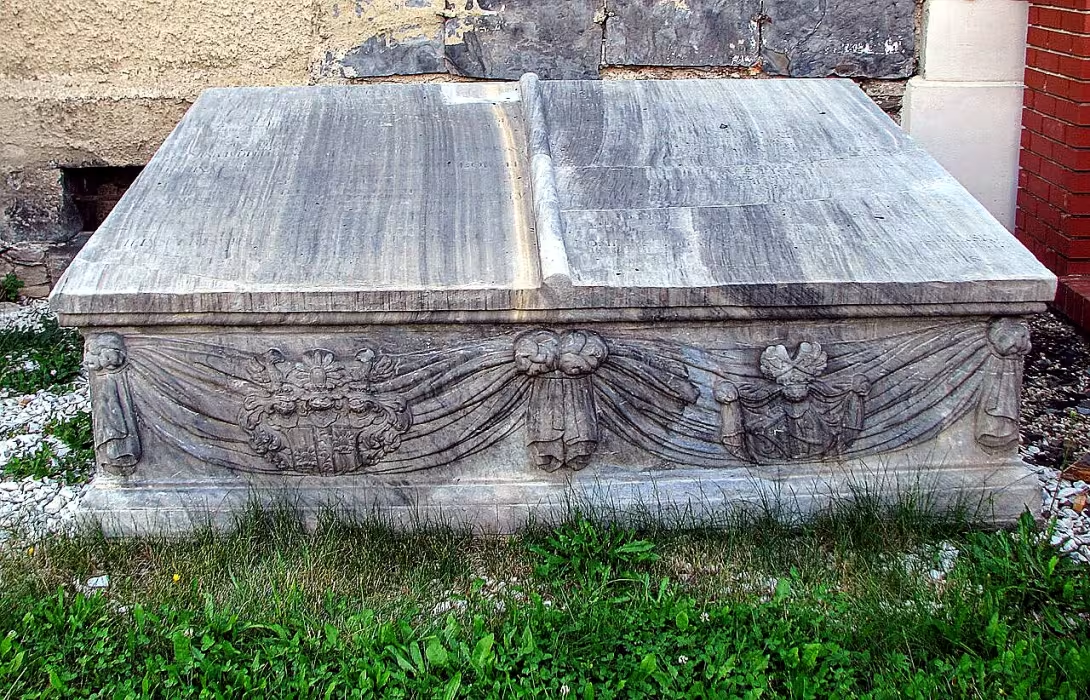
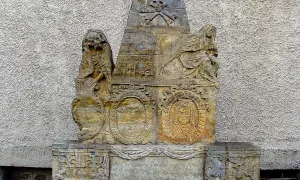
Náhrobek Skrbenských, located in the cemetery at the parish church of St. Michael's Archangel in Hoštálkovach in the district of Bruntál, is a Baroque monument with deep roots in the Czech region. This monument was recognized as a cultural monument in 1972 and recorded in the Central List of Cultural Monuments of the Czech Republic, which shows its historical and artistic value. In the vicinity there is another sandstone tombstone from Skrubensky's Castle.
The history of the family of Skrubenských dates back to 1666, when Kryštof Bernard the free master of Skrubenský from the Castle inherited the castle in Hoštálkov. He was married to Barbora Judita Tvorkovsky from Kravař and had a son named František Albert. After moving to Opava, he became a judge and tax collector for the Principality of Opava. In 1660 he married Kateřina Apolena Bořitová from Budč for the second time. During his life the castle was expanded in Hoštělkovů and Christopher Bernard Skrubenský became known as a brave Protestant who prevented violent reCatholics after the end of the 30-year war. Died March 13, 1683.
The tombstones of the sarcophagus of Christopher Bernard Skrubenski from the Castle and his wife Apolena Borítovská from Budč are designed to create the impression of an open book. These low marble boards are decorated with reliefs and carry carved inscriptions. In 2015 the tombstone was subjected to a restaurant, which helped preserve its historical appearance.
Kryštof Bernard Skrbenský z Hříště and Kateřina Apolena Bořitová z Budče are key figures associated with this tombstone. Christopher Bernard was not only the owner of the castle, but also an active Protestant who opposed the reCatholics after the Thirty Years War.
Today, the Strobensky tombstone in Hoštělkovsky is accessible to visitors and pilgrims. Its historical value, associated with Baroque architecture and the interesting life of its owners, makes it an important cultural monument. Visiting this place offers an opportunity to explore the rich history of the region and appreciate the artistic skills of past generations.
Náhrobek Skrbenských is not only a monument to the cemetery, but also a testimony about an important period in Czech countries. Its history and architecture attract visitors who want to know more about the past and cultural heritage of the region. This monument is therefore not only an important historical site, but also an inspiration for those interested in Baroque art and history of the Czech Republic.
Historical milestones
- 1686
- formation of marble sarcophagus
- 1972
- registration in the list of cultural monuments of the Czech Republic
- 2015
- restaurant tombstone
Architectural development
Sarcophagus are made of marble with embossed decoration. In 2015, the tombstone was subjected to a restaurant.
Historical events
1683 - the death of Christopher Bernard Skrubenski from the game; 1972 - entry of the monument into the list of cultural monuments of the Czech Republic.
Points of interest
- Náhrobek Skrbenských is a Baroque monument with deep roots in the Czech region. - This monument was recognised as a cultural monument in 1972 and recorded in the Central List of Cultural Monuments of the Czech Republic. - The tombstones of the sarcophagus are designed to create the impression of an open book and are decorated with reliefs. - In 2015 the tombstone was subjected to a restaurant, which helped preserve its historical appearance. - The tombstone is accessible to visitors and pilgrims and offers an opportunity to explore the rich history of the region.
Guide
Show guide text
This text was created by artificial intelligence and has not been editorially reviewed. It may contain inaccuracies.
Welcome to the village Hošťálkovy. You're standing in front of something that requires peace, patience and, above all, a attentive eye. Before your eyes lies two low marble sarcophagus that carry the weight of hundreds of years. At first glance, they may seem like two pieces of stone, but when you look at them, you start to see a story that was written in stone so that it never disappeared. Feel this atmosphere of silence and nobility that rules these monuments. They are witnesses of ancient times standing here while the world around them is constantly changing.
Let us return together to a deep past, namely 1686. Imagine the world of that time, the era of the Baroque, when art tried to express the deepest human feelings, faith and eternity. It was this year that these marble sarcophagus were formed. It was not just an ordinary task for craftsmen, but an effort to create a permanent monument for people who played an important role in the region at the time. This monument is not just a tomb, it is an expression of grandeur and an attempt to preserve the memory of the particular people who once lived and ruled here.
Now pay attention to the very form of these subjects. Look at these marble boards. There's something extraordinary about them that you must be interested in if you look at them with inner calm. These plates are not just straight or flat. Their shape is brilliantly designed to create the impression of an open book. It's as if someone wanted to say that the life of these people was like a book that was now opened before you to read. But this book will never close because its pages are carved into hard marble. Notice the details on the faces of these sarcophagus. You see these embossed images, these reliefs that are masterfully carved into the stone. It's subtle work that tells stories without a word. And right next to them, you'll see carved inscriptions. These inscriptions are the key to understanding who is resting here. They are words that have been cast out of stone to withstand wind, rain, and time.
So who were the people for whom this monument was created? The names you read here carry the weight of the old families. It's Christopher Bernhard Skrubenski from the Playhouse and his wife Apolena Bořitovsky from the Budch. These names are not just names, they are marks of land, tradition and history of this region. Christopher Bernard and Apolena were connected not only by marriage, but also by a common destiny and a common place they chose for their last rest. Their existence was part of a complex network of relationships and power that worked in Czech countries at the time. When you look at these sarcophagus, you look directly at their track in time.
You may now wonder what this monument has done to this day. It's fascinating that we can watch these marble creatures so clearly today. This monument has a very strong position. In 1972 it was recognised as an important cultural monument and was included in the Central List of Cultural Monuments of the Czech Republic. This means that its value has been officially recognised by the State and its protection has become an obligation. But history didn't stop in the last century. Even recently, this monument has been taken care of. In 2015 a thorough restaurant took place, thanks to which these marble boards and their fine details are again as visible and beautiful as they were probably at the time of their creation. This care allows us to see the baroque championship in its purest form.
There is one thing that might interest you, one little mystery or rather fascinating thought. Think about the shape of the open book. Why would anyone choose this shape for a tombstone? Books are carriers of wisdom, history and stories. By being shaped as open books, these sarcophagus become constantly read. Anyone who stops like you right now becomes a reader of this stone book. It's like these people want to stay in a conversation with people who don't come until hundreds of years later. It's a constant call from the past that encourages you to stop and think about what we're going to leave behind.
Now that you've looked at these details and sucked the atmosphere of this place, I suggest you continue your walk. Hošťálkovy has many other secrets and instructions waiting for your discovery. Let this experience of contact with the baroque past remain within you for a while. Thank you for taking the time to stop at this very headstone of Skrubenski. We wish you a wonderful journey and many other interesting experiences in the next survey of this beautiful region. Goodbye.
Tips for visitors
The best time to visit is in the spring or autumn season when the weather is pleasant and the light is ideal for photography. This time also offers a beautiful green landscape around the cemetery.
When you visit, wear a suitable suit because the local climate can be cold. Don't forget the protective sunglasses and water if you are planning a long walk.
Photography of the Skrubenski tombstones is best possible at noon, when light falls directly on marble sarcophagus plates. The best views often appear from a slightly withdrawn place, which allows you to capture the overall context of the cemetery.
In the vicinity of the tombstones it is possible to visit the parish church of Archangel Michael and explore the nearby sandstone tombstone of Skrubensky from the Castle. These places offer interesting historical information about the Skrubenski family.
Frequently asked questions
Can the monument be visited?
Cemeteries and graves are usually accessible; please respect the dignity of the place. We have not verified the opening hours of this cemetery.
Where is the monument?
Location: Hošťálkovy, Moravskoslezský kraj. The map on this page shows the exact spot.
Why is the monument protected?
It is listed in the Central List of Cultural Monuments of the Czech Republic as a cultural monument (register no. 1337439559).
Businesses nearby
Do you run a restaurant, accommodation, shop, museum, rental, wellness or other visitor service near this monument? Show yourself directly to the people heading to it — this is how they will see you in the app and on the web:
Nearby
Hřbitov u farního kostela Archanděla Michaela v Hošťálkovech a sousední pískovcový náhrobek Skrbenských z Hříště.
Accommodation nearby
Themed route
1. The cemetery at the parish church of Archangel Michael in Hoštálkov (Type: Funeral area). A tour of the historical place near the church. 2. Náhrobek Skrbenských (Type: Memorial). The main destination of the journey, which serves as an important monument. 3. Sand tombstone of the Strobenské from the Hornet (Type: Stone Monument). Neighborhood sandstone object for observation.
Seasonal recommendations
Spring brings freshness and awakening life around the tombstone. The trees start to green and the birds sing, creating a calm and optimistic atmosphere. The light is fine in this period, which allows you to better see fine engravings on the stone. I recommend a visit early in the morning when the air is still fresh. Prepare your layered clothes because the morning cold can still smell.
In the summer months the monument is surrounded by thick leaves and the sun shines the strongest. The atmosphere is warm and lively, but due to high temperatures it can be unpleasantly hot near the monument. The best time for a tour is early morning time to avoid the biggest crowds and direct noon heat. Don't forget light clothes, headgear and plenty of fluids.
Autumn changes surroundings in a sea of gold and red colors, which gives the monument a nostalgic and deep touch. The morning mist creates a mysterious mood and the light is low and golden. It's the perfect time for a quiet contemplation in solitude. Dress in larger jackets and select fixed shoes because the soil can be wet and slippery.
Zimą makes the monument very lonely between naked branches of trees. If it's cold or snow outside, the stone gets an interesting look, but the atmosphere is quiet and cold. Due to short days, plan a visit around noon to use the most daylight. The need is a very warm winter jacket, scarf and gloves, because there can be unpleasant wind in open space.
Visualizations and artistic views


The visualisations are generated by artificial intelligence and serve as inspiration.
Photos from the area
Real photos taken near the monument


Zdroj a licence jsou uvedeny u každého snímku.
Tips from visitors
No tips yet. Be the first!
Log in and add your tip.
Sources and literature
Photos: Pavel L. / CC BY-SA 4.0 — Wikimedia Commons. The author and licence also appear when you hover over the image.
Faktickým podkladem tohoto textu byl článek na Wikipedii, jehož autory jsou přispěvatelé Wikipedie. Článek je dostupný pod licencí CC BY-SA 4.0.
Location on the map
Příběhy a pověsti
Legendy, pověsti a příběhy spjaté s touto památkou
Fotografie návštěvníků
Zatím žádné fotografie. Buďte první, kdo přidá fotografii z návštěvy!
Log in a přidejte svou fotografii nebo hodnoťte.
Za ověřenou návštěvu v aplikaci získáte víc bodů — poznáme podle GPS, že jste na místě.
Reviews and comments