



Pomník Hanse Kudlicha v Nové Vsi Monument
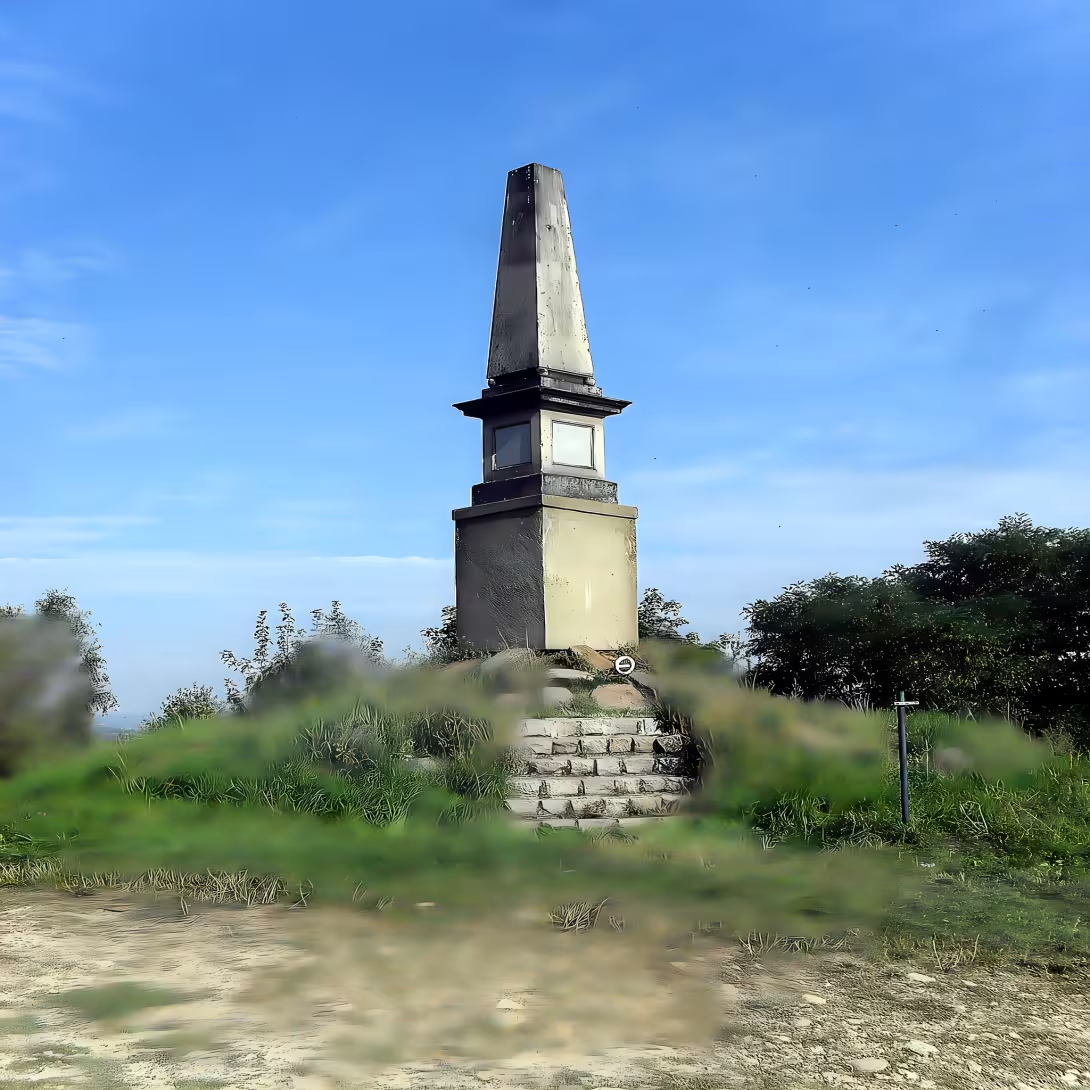
Pomník Hanse Kudlicha v Nové Vsi is a historical monument from 1888. Reminds of the abolition of robots in the Austrian Empire. It is located on the top of the Yalovina (a place known as the March) at an altitude of 383 metres. It represents the largest monument of this type in northern Bohemia.
The memorial pays tribute to a member of the Reich Assembly, Hans Kudlich. In 1848 he made a successful proposal to abolish robots, which took place on 8 September of the same year. The construction was built by the inhabitants of the districts of Bílina, Duchcov and Teplice to remember this fundamental social change. It emerged in a period of historism, when Europe had a tendency to remember revolutionary and social changes from the mid-19th century.
From the point of view of architecture it is a sandstone obelisk on a brick pedestal. The original base had a height of four metres and the obelisk itself was 5.7 metres, weighing approximately 10 tonnes. Construction and masonry work was carried out by Heinrich Siegmund, while sculpture and stonework was the work of Anton Bauer and F. Kahlert. A significant element is the commemorative stones that donated almost all the villages of the then districts of Duchcov, Bílina and Teplice. Originally there were about 150, today between 109 and 114 pieces. The inscriptions on the plates are written bilingual, Czech and German, even if they are now difficult to read.
The formal disclosure took place on 7 and 8 September 1888 with the personal participation of Hans Kudlich. He came from Karlovy Vary to Teplice, where he was greeted by a spillet of people in the Railway Class. The next day, a parade of 25,000 people gathered in Teplický Market Square. In his lead Kudlich went accompanied by Mayor Teplice Karl Stöhr and Mayor Franz Waag of Shanov. The parade was on top of Yalovina, followed by the speeches of Hans Kudlich and Emanuel Milner.
In 1987, she threatened complete liquidation. It was decided to remove it for the construction of a water tower. The monument was not protected as a cultural monument at the time, which led to its dismantling on 8 July 1987. Parts of the building were stored in a corral about 100 meters further east. The existence of the building was saved thanks to the merits of the ONV Teplice Culture Department, which promoted its inclusion in the list of cultural monuments in 1988 under the number 5-5252.
The reconstruction took place between 1990 and 1992. The investor was the company of the North Bohemian Water and Sewerage, which built water in 1989. The installation of the memorial, terrace and stairs itself took place in August 1991. The whole process was completed in mid-September 1992 with the installation of commemorative stones and on 23 October of the same year four commemorative plates were installed.
At present, the monument has a more powerful appearance than in its original form. The total height from the foot in the field is 11 metres and the base diameter is 13 metres. The construction is divided into three parts: the lower conical filling body with a height of about three metres is used for storing commemorative stones. On the top platform there is a concrete shank with dimensions of 1,5 × 1,5 metres and a height of two metres, on which is a six-metre sandstone obelisk.
The memorial to the abolition of robots is an important witness to the social shift in the history of the region and the Austrian Empire. Visiting this place offers the possibility of meeting the history of emancipation of rolnictwa in northern Bohemia.
Historical milestones
- 1888
- The ceremonial discovery of the monument involving Hans Kudlich and the parade of 25,000 people.
- 1987
- Dismantling of the monument and storing its parts into the fence for the construction of a water tower.
- 1988
- Writing a monument into a list of protected cultural monuments.
- 1992
- Completion of the installation of the monument, terrace and installation of commemorative stones and boards.
Architectural development
The monument consists of a lower four-metre section with a square base and a 5,7-metre obelisk of approximately 10 tonnes. The stones donated by the districts of Duchcov, Bílina and Teplice were used for the construction. Memory boards are written bilingual in Czech and German.
Historical events
1848: the abolition of robots in the Austrian Empire; 1888: the ceremonial discovery of the monument; 1987: dismantling the monument for the construction of a water tower; 1992: completion of memorial renewal.
Points of interest
- It is the largest monument of its kind in northern Bohemia and reminds of the abolition of robots. - Sandstone obelisk with pedestal originally had a weight of about 10 tons. - The monument is decorated with commemorative stones from almost all the villages of the then districts of Duchcov, Bílina and Teplice. - In the ceremony of 1888, 25,000 people gathered in the parade. In 1987, the monument was dismantled to build a water tower, but later it was saved and restored.
Guide
Show guide text
This text was created by artificial intelligence and has not been editorially reviewed. It may contain inaccuracies.
Welcome to the New Village, where history meets nature in one common harmony. Right now you're standing at the top of Yalovina, at an altitude of 200 feet, and in front of you is a monumental building that dominates the surrounding landscape. Look ahead. You can see here a massive brick pedestal from which a tall, thin obelisk rises towards the sky. It is a view that bears deep meaning and reminds us of a period of great social change. This space is not only a high point in the field, but a symbol of freedom and human dignity.
Let us now stop at why this monument was created and what its story is. You are in front of the largest monument of your kind in the entire northern Bohemia. It was built in the year of a thousand eight hundred eighty-eight and its creation was linked to a very important jubilee. It was exactly 40 years after the abolition of the robot in the Austrian Empire. To understand the weight of this moment, we need to go back a little further to history. The robot was a form of serenity, in which the subjects had to work for free in the fields of the government and in the işlets. It was a system that had bound people to the soil for centuries and limited their freedom.
This monument pays tribute to a man who had the courage and vision to end this injustice. His name is Hans Kudlich. He was a Member who, in the year one thousand eight hundred forty eight, submitted a successful proposal to abolish serenity. Imagine that bold step at a time when the power of nobility was almost absolute. Thanks to his efforts and courage, thousands of people throughout the empire could begin to live freer lives. That is why it stands here today, so that future generations do not forget the victory of human rights over the old order.
Now pay attention to the architecture itself and the details surrounding you. Look again at the tall obelisk and its base. The whole project was a work of architects named Heinrich Siegmund, Anton Bauer and F. Kahlert. Note how stable the walled base is, which carries the entire weight of the building. It is fascinating to think that this sandstone obelisk, along with the base, had a weight of about ten tonnes in the original version. This is a huge amount of stone that must have been transported here to the top of Jalovka at a time when modern machines did not exist.
When you approach the monument, focus on commemorative stones and plates that decorate the base. If you look at them carefully, you will find that they are not only an ornament but a testimony of solidarity. These stones were donated by almost all the municipalities of the then districts of Duchcov, Bilina and Teplice. It is a beautiful proof of how powerful the people of the region have united recognition for the abolition of robots. Each of these stones represents a community of people who wanted to express their gratitude for their freedom.
Now, let's talk about the people involved in this place. In addition to Hans Kudlich himself, names like Karl Stöhr, Franz Waage or Emanuel Milner appear in connection with this monument. They are personalities who in different roles have contributed to making this symbol of freedom stand right here. The strongest memory, however, is linked to the day of the solemn revelation in the year one thousand eight hundred eighty-eight. Imagine this scene: a parade of an incredible twenty-five thousand people welcomed to this peak of Jalovka. It was a huge crowd that came to celebrate freedom. What is most fascinating, however, is the fact that Hans Kudlich himself was present at the festival. Imagine the moment when a man who pushed for the abolition of serenity in parliament 40 years ago stands before this monument and sees how powerful his actions have affected the lives of thousands of people.
But the history of this place wasn't just about festivities. The monument has also gone through a difficult time, which teaches us how fragile the monuments can be. In a thousand and nine hundred and eighty-seven, the monument had to be dismantled. The reason for this was the construction of a water tower, which was a project that was given priority over historical value at the time. Parts of the monument were stored in the corral where they were waiting to be saved. It is, however, a shopping mall that a year later, in the year one thousand nine hundred and eighty eight, the monument was included in the list of protected cultural monuments. That was a crucial way to relight him.
In the year one thousand nine hundred ninety-two, the installation of the monument was finally completed. At that time there was also a terrace on which you are now moving, and commemorative stones and plates were resettled. So when you look at this obelisk today, you don't just see the stone, but you see the victory of forgetting. You see a structure that was knocked down, but thanks to people's efforts it was rebuilt and returned to its original place.
The interesting thing that might interest you is the combination of mass and symbolism. Ten tons of sandstone that stands here is not only a physical burden on the country, but a symbol of the unshakeable freedom. It is the largest such monument in northern Bohemia and its location on top of the hill is not random. To be seen from a distance, it is to be a beacon that reminds that the path to human equality is long and challenging, but it is worth every effort.
Now that you know the story of this place, I suggest you feel the atmosphere in silence. Look around you at the landscape you're looking at from this point. Here, in the silence of Jalovina, you can feel the contrast between the calm of nature and the stormy history that led to the destruction of robots. Note how the light is reflected from the surface of the sandstone and how the structure fits firmly into the terrace.
This monument is a reminder that one person with clear purpose and courage can change the lives of millions. Hans Kudlich left a trail here that persists after more than a hundred and sixty years. It's a place to think about what freedom means to us today and how important it is to keep a memory of those who fought for it.
Thank you for spending some time with us at Hans Kudlich's memorial. We hope that this story of courage, belonging and rebirth of the monument has intrigued you. We now invite you to explore further the surroundings of New Vsi and to discover other hidden corners of the region. We wish you a pleasant continuation of your journey and a beautiful day spent in the womb of history and nature. Goodbye.
Tips for visitors
The best time to visit is late spring or autumn, when the landscape around the top of Yalovina is in colors that complement the historical appearance of the monument. Transportation to the place is possible by car and public connections, specific routes and connections can be checked in maps.
For a walk to the top we recommend to take comfortable shoes suitable for the field and plenty of water because the path leads in nature. For families with children, a trip to the monument is a great opportunity for a short hike with a lesson about the history of cancelling vacant work.
For the best photos we recommend to come to the morning or late afternoon lights that highlight the details of the largest monument of this type in northern Bohemia. Ideal angles are from a low perspective to excel the size of the work against the sky.
In addition to the monument itself, you can use the surroundings of the hill of Yalovčina, now known as in breeding, to relax in nature near the village Nová Ves.
Frequently asked questions
Can the monument be visited?
This is a structure in a public space that can usually be seen from outside free of charge. We have not verified that this particular one is freely accessible.
Where is the monument?
Location: Nová Ves. The map on this page shows the exact spot.
Why is the monument protected?
It is listed in the Central List of Cultural Monuments of the Czech Republic as a cultural monument (register no. 1000156312).
Businesses nearby
Do you run a restaurant, accommodation, shop, museum, rental, wellness or other visitor service near this monument? Show yourself directly to the people heading to it — this is how they will see you in the app and on the web:
Nearby
Pomník se nachází na vrchu Jalovčiny, dnes známém jako Ve chvojkách, poblíž obce Nová Ves.
Accommodation nearby
Trips and activities nearby
Guided tours, tickets and activities nearby from GetYourGuide
Affiliate link: if you buy from the partner, we may receive a commission. The price for you does not change.
Search tours and activities →Themed route
Here is the design of the thematic route:
1. Nová Ves (municipality) - The starting point of the path where you can orient yourself to higher positions before output. 2. In the chase (place) - A natural area that serves as a road to the main destination. 3. The memorial of Hans Kudlich (memorial) - The main monument located on the top of Jalovina, which resembles an important personality.
Visualizations and artistic views

The visualisations are generated by artificial intelligence and serve as inspiration.
Photos from the area
Real photos taken near the monument


Zdroj a licence jsou uvedeny u každého snímku.
Tips from visitors
No tips yet. Be the first!
Log in and add your tip.
Sources and literature
Photos: Qwertz0451 / CC0, rozlišení zvýšeno umělou inteligencí — Wikimedia Commons. The author and licence also appear when you hover over the image.
Faktickým podkladem tohoto textu byl článek na Wikipedii, jehož autory jsou přispěvatelé Wikipedie. Článek je dostupný pod licencí CC BY-SA 4.0.
Location on the map
Příběhy a pověsti
Legendy, pověsti a příběhy spjaté s touto památkou
Fotografie návštěvníků
Zatím žádné fotografie. Buďte první, kdo přidá fotografii z návštěvy!
Log in a přidejte svou fotografii nebo hodnoťte.
Za ověřenou návštěvu v aplikaci získáte víc bodů — poznáme podle GPS, že jste na místě.
Reviews and comments