



původní červenský železniční most Railway bridge
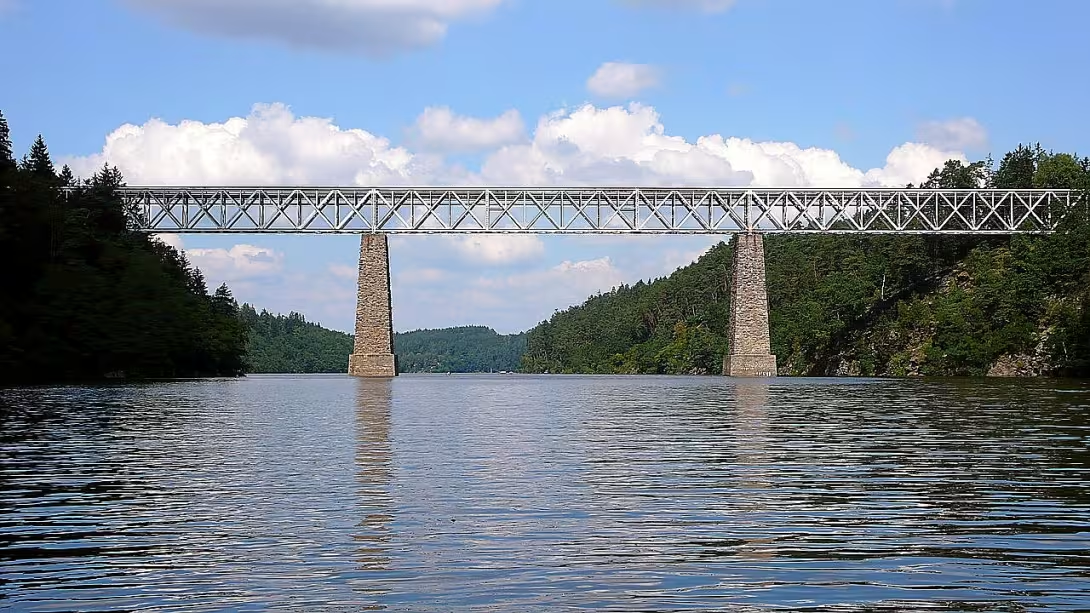
The original railway bridge at Red nad Vltavou is a historic steel building from 1886-1889. It was used to overcome the Vltava valley on the Tábor- Rajice track. With a length of 253 metres and a height of 68 metres, it was one of the most important bridge structures in Austria at the time of its creation.
The bridge was created as part of the strategic project of the Czech Moravian Transverse. The aim was to connect key areas of the Czech countries during the period of massive construction of the railway infrastructure of Austria-Hungary. The construction was carried out by Prague Mostárna for the price of 510 000 gold pieces and officially opened on 20 November 1889.
The construction is made of steel and its total weight is 940 tonnes. Technically, a remarkable high number of connections, namely 329 000 rivets. Due to the subsequent launch of the eagle dam, two stone pillars have been reinforced. In its time, the bridge took second place in the ranking of the highest buildings of Austria, behind which was only the Trisana bridge in the Alps.
The relationship to conservation has been complicated over the years. The first entry in the register of cultural monuments took place in 1988. However, in October 2016, the Ministry of Culture declared by a declaratory decision that this registration was not valid. The situation changed on 27 October 2021 when the bridge was once again declared a cultural monument under register number 106761.
In 2019, discussions began on the emergency condition of the carrier steel structure, which no longer suited modern rail transport. The Railway Administration considered the destruction of the building. The new steel structure corresponding to the current standards would be harder, and the existing lower structure would not bear it. The demolition was opposed by activists, monuments, Czech Tourist Club and the surrounding village. They proposed using the bridge for walking and cycling.
Thanks to the re-entry into the list of cultural monuments in 2021, the Railway Administration had to abandon demolition. The railway operation on the bridge was definitively terminated on 14 August 2024. In parallel with it, a new iron concrete arc Schwarzenberg Bridge was launched in November 2024, which is the largest one in the Czech Republic with a range of 156 metres.
The original bridge is currently being transferred to the Viaduct. The aim is to reconstruct this technical monument into a cycle path and cultural space. The building is worth visiting as a significant example of historical bridge construction in the late 19th century. It is a unique testimony about the development of transport in the region, which is now awaiting a new phase of exploitation.
Historical milestones
- 1889
- Official opening of the steel bridge on 20 November.
- 1988
- First registration of the building in the register of cultural monuments.
- 2021
- Re-declaration of the bridge for a cultural monument.
- 2024
- Termination of the rail operation on 14 August.
Architectural development
It is a steel construction made by Prague Mostarna, which weighs 940 tonnes and contains 329 000 rivets. Two stone pillars were reinforced before the Eagle Dam was launched. Currently, the support steel structure is in emergency condition.
Historical events
1889 - opening the bridge for rail traffic; 1988 - first registration as a cultural monument; 2016 - cancellation of the registration of cultural monuments; 2021 - re-entry as a cultural monument.
Owners
Railway Administration
Points of interest
- It's a steel structure from 1886-1889 with a length of 253 meters and a height of 68 meters. - He was the second highest bridge in Austria at the time of his creation. - Construction weighs 940 tons and contains 329 000 rivets. - The construction was carried out by Prague Mostárna for the price of 510 000 gold pieces. - Rail traffic on the bridge was definitively terminated on August 14, 2024.
Guide
Show guide text
This text was created by artificial intelligence and has not been editorially reviewed. It may contain inaccuracies.
Welcome to one of the most significant technical structures in our region. You are standing in front of the original railway bridge at Red above the Vltava River, which is dominated by its massive construction and deep beneath it is the valley of the Vltava River. If you look at it now, you will see a fascinating interplay of steel and space that carries echoes of ancient times when the railroad was changing the face of the entire European continent. It is a place where the courage of the then builders meets the natural beauty of the surrounding nature.
Now let's move back more than a hundred and thirty years in time. This bridge was not only a common link between two shores, but was a key part of an ambitious project called the Czech Moravian Transverse. The aim was to create an important railway line connecting Tábor and Rajice to facilitate transport across the territory. Work on this construction took place between 1886 and 1889. Imagine what a challenge it must have been when there were no modern cranes or computer calculations. Yet this colossal building was completed and officially opened on November 20th, 1889. At the time of its creation it was one of the most important bridge structures in all of Austria, which shows a high level of engineering.
Now pay attention to the very structure that surrounds you. Look up and see the dimensions of this work. The bridge is two hundred and fifty-three meters long and its height is sixty-eight meters. It's a real steel giant. Note the precision with which the parts are connected. Although steel may now seem to be common material, in the late nineteenth century it was a symbol of progress and strength. The whole structure weighs an incredible nine hundred forty tons. If you look very carefully at the connections, you will see thousands of tiny metal nails called rivets. In total, there are 3,200 thousand in the bridge. Each of them was burned by hand, which required enormous patience and precision of thousands of workers.
While the names of specific architects remained hidden and unknown in time, we know that Prague Mostárna was behind the implementation of this building. It was top of the line in the industry that was able to turn plans into this tangible reality. The price for this work at the time was estimated at five hundred and ten thousand gold pieces. It is fascinating to think how much work and capital has been invested in this one point in the landscape so that trains can safely overcome the deep Vltava Valley.
When you pass by, feel the atmosphere of a place that served as a living artery for thousands of passengers and tons of cargo. The bridge was so valued that already in 1988 it was first registered in the register of cultural monuments. Although there have been some changes in later years, in 2021 the bridge was officially declared a cultural monument, confirming its irreplaceable value for our history and technical heritage.
Now, I want to impress you with one interesting thing that will help you see the size of this place better. By the time the bridge was completed, it was the second highest bridge in Austria. Imagine the feeling of the first passengers who dared to run over these steel rods at 60 meters above the river level. It was a sense of freedom, but probably a slight tingle in the knees. This bridge was a symbol of man's victory over the terrain, a bridge to modern times.
Today, however, we are entering a new chapter in the history of this place. The railway operation, which lasted more than a century, was definitively completed on the 14th August of the year two thousand twenty-four. That means no more trains on these tracks. The bridge is now passing from the role of the transport hub to the role of the silent witness of history. It's a stop point where a useful tool becomes a monument.
Now, let's take some time for our own observation. Go through the surroundings, see the silence that is now in existence, and think about how many stories have happened here over the years. Who all crossed that bridge, where they traveled, and what they felt when they looked down into the depths of the valley. This steel structure with its hundreds of thousands of rivets is like an open book on industrial revolution and human effort.
Thank you for accompanying me on this short trip to history. I hope you have felt pride and admiration for the people who built this colossus. Now invited to further explore the surroundings and your own admiration for this unique building. We wish you a pleasant rest of the day and a pleasant experience in discovering other gems of our landscape. Goodbye.
Tips for visitors
The best time to visit is the late afternoon when the sun hits the metal construction of the old bridge, highlighting its historical details. For photography we recommend looking for sightseeing points along the Vltava River bank, where it is possible to capture the contrast between the old emergency building and the new Schwarzenberg Bridge.
Travel to the area by car or public transport; Check the current connection and stop options in the Internet search engine. We recommend taking comfortable shoes into the field, as you move around the river and dam.
In addition to the bridge itself, visit the Orlická dam and the new Schwarzenberg Bridge nearby. For families with children it is ideal to walk along water where children can observe the flow of the river and compare two different generations of bridge structures.
Frequently asked questions
Can the monument be visited?
This is a structure in a public space that can usually be seen from outside free of charge. We have not verified that this particular one is freely accessible. According to the heritage register the structure is in poor condition – do not enter it and take care nearby.
Why is the monument protected?
It is listed in the Central List of Cultural Monuments of the Czech Republic as a cultural monument (register no. 1000128587).
Businesses nearby
Do you run a restaurant, accommodation, shop, museum, rental, wellness or other visitor service near this monument? Show yourself directly to the people heading to it — this is how they will see you in the app and on the web:
Events nearby
Zdroj akcí: otevřená data měst a obcí ČR (Národní katalog otevřených dat) a kalendář akcí Národního památkového ústavu.
Nearby
Vltavská řeka, Orlická přehrada a nově vybudovaný Schwarzenberský most.
Accommodation nearby
Themed route
Here is the design of the thematic route:
1. Eagle dam (water surface) - An ideal place to start the journey and admire the landscape. 2. Schwarzenberg Bridge (new bridge) - The modern building offers beautiful views of the surroundings. 3. The original red railway bridge (monument bridge) - The main destination of the trip, where you can admire the old technique and construction. 4. Vltava River (water flow) - Walk along the shore for calming down after visiting bridges.
Seasonal recommendations
In the spring, the surroundings of the bridge awaken to life and the young green contrasts with a rusty structure. The light is soft and pleasant, which helps to observe the details from the outside. We recommend shoes suitable for wet terrain and visit in the morning when the air is the cleanest.
Summer brings a sharp sun that highlights the red color of iron and creates deep shadows. The bridge is surrounded by dense vegetation and higher temperatures. It is advisable to choose light clothes and a cap, the best time to visit is early morning or late evening to avoid heat.
The landscape is painted in gold and brown tones, which match the state of the building. The atmosphere is melancholy and often accompanied by fog, which gives the bridge a mysterious look. It's practical to wear a waterproof jacket and visit a place when the trees are the most colorful.
In winter, the bridge is cold and raw, especially if the construction is covered with snow or frost. The lighting is grey and the days are short, which underlines the abandonment of the object. Hot clothing, lining of clothing and firm soles are essential to prevent slipping in the surrounding space.
Visualizations and artistic views

The visualisations are generated by artificial intelligence and serve as inspiration.
Photos from the area
Real photos taken near the monument


Zdroj a licence jsou uvedeny u každého snímku.
Tips from visitors
No tips yet. Be the first!
Log in and add your tip.
Sources and literature
Photos: Vlastní dílo / CC BY 3.0 — Wikimedia Commons. The author and licence also appear when you hover over the image.
Faktickým podkladem tohoto textu byl článek na Wikipedii, jehož autory jsou přispěvatelé Wikipedie. Článek je dostupný pod licencí CC BY-SA 4.0.
Location on the map
Příběhy a pověsti
Legendy, pověsti a příběhy spjaté s touto památkou

Fotografie návštěvníků
Zatím žádné fotografie. Buďte první, kdo přidá fotografii z návštěvy!
Log in a přidejte svou fotografii nebo hodnoťte.
Za ověřenou návštěvu v aplikaci získáte víc bodů — poznáme podle GPS, že jste na místě.
Reviews and comments