



rotunda sv. Oldřicha Chapel
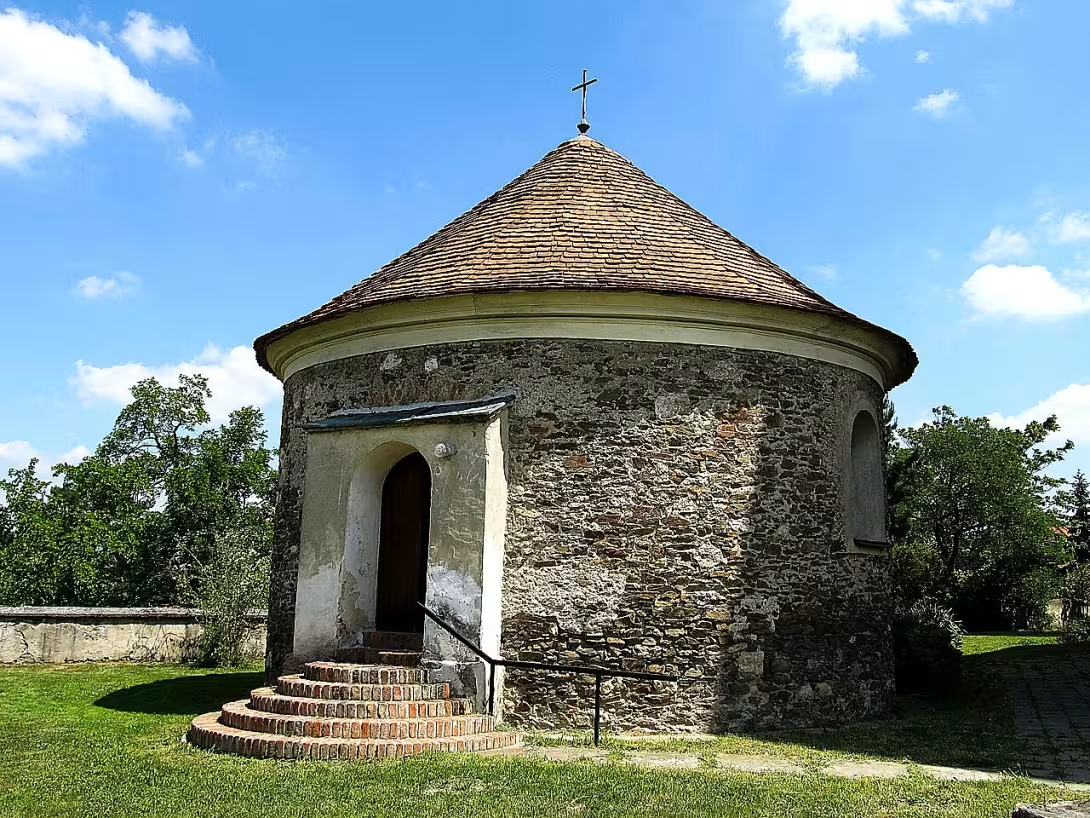
Rotunda is part of the church area of St. Peter and Paul and stands in Hrádek, a small town district of Znojmo. Its beginnings date back to the beginning of the 13th century, when it was formed as a karner - a smaller chapel originally designed to preserve the bones, which accompanied the creation of new churches of the medieval era.
The construction is characterized by its cylindrical shape with two floors. In its basement there is a skeleton that closes the dome, which is a technical solution suitable for small space. The lower part of the rotunda was built from the quarry wall up to 0.6 metres above the terrain, the rest of the building from bricks. This solution indicates the gradual achievement of the construction and local construction practices. The construction also has a small apside, which breaks the simple cylindrical shape and gives it the typical features of medieval sacral architecture.
The long century of moisture and time left traces of it on the building until the 1980s, when the interior space was remodeled. There is extraordinary cooperation behind this renewal: Stanislav Krátký was the initiator, the bishop who worked in Hrádek from 1978 to 1999. He was created by Josef Horák, an artist from Husovice, Brno, born on 22 March 1936. Horák graduated from the electrical industry and the School of Arts in Brno. His journey to the inner decoration of the sanctuary began in industry and personal interests, but in rotunda he became the creator of a unique whole.
Horace's works are quite unique - pottery of the cross road, sacrifice table, shrine and sculpture of the Virgin Mary with Jesus. All these elements were modelled by the author in his light box of smaller parts, limited by their dimensions, because he had only a work desk and ceramic furnace available. Each small piece was burned and later folded into a whole - a time-consuming process in which the ceramic was fired by Mrs Jiřina Vlasková in Kunštáta and carried by car to Hrádek. Horák also designed stained windows, which are themously connected to the rest of the decoration. Thus the ancient rotunda gained a new life and became a place of authentic human creation of the 20th century, which joins the tradition of medieval godliness.
Then and now
Drag the slider to compare how the landmark may have looked when it was built with the view today.
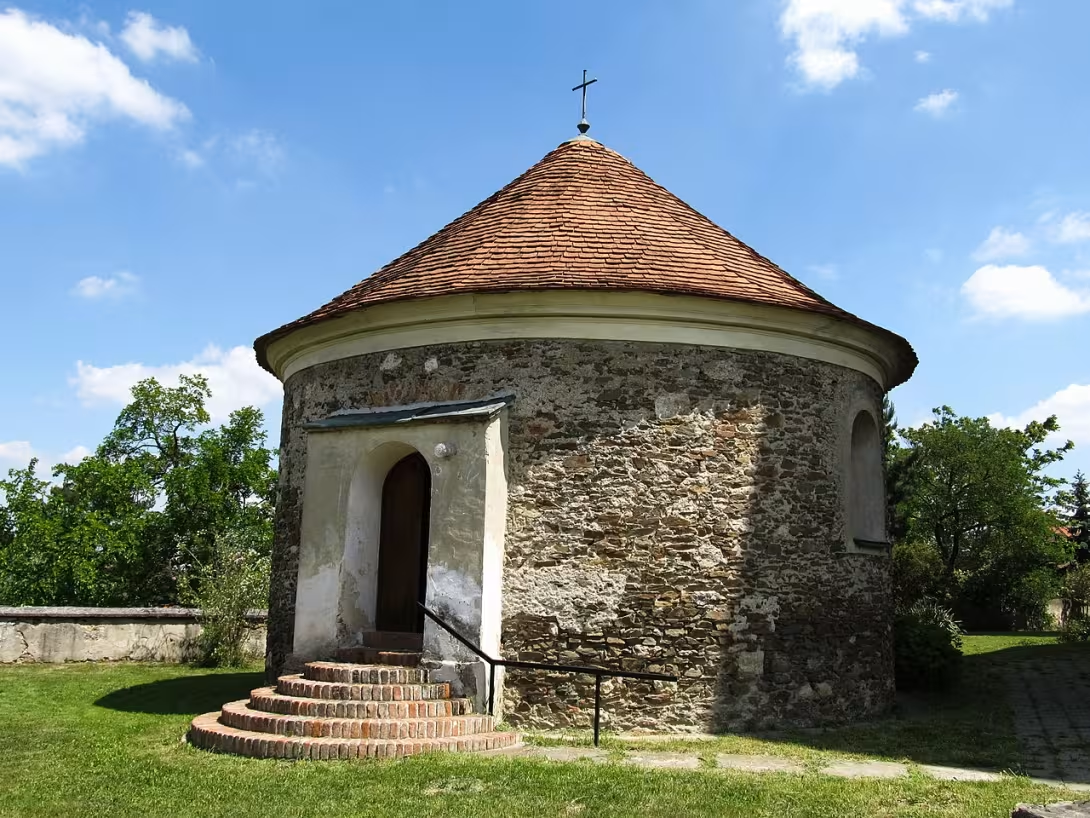
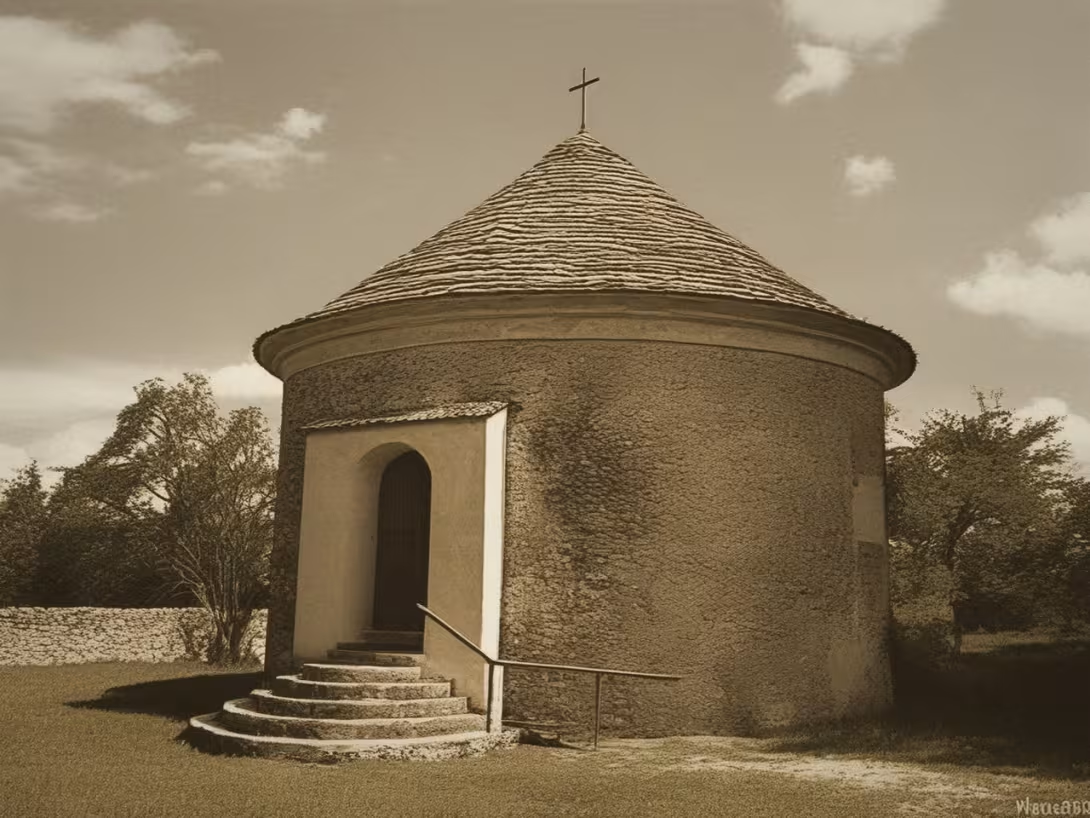
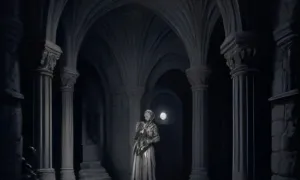
The historical appearance on the left is an AI-generated visualisation and serves as inspiration only.
Historical milestones
- beginning of the 13th century
- The creation of a rotunda as a carner when the church of St. Peter and Paul was founded.
- Around 1350
- Completion of rotunda foundations with a combination of quarry masonry and brick masonry.
- 1978-1980
- Opening of the modern interior modification under the direction of Bishop Stanislav Krátky.
- 1980-1989
- Creation of a unique rotunda decoration by Josef Horák (ceramics, stained glass).
- 1980-1989
- Burning and assembly of ceramic elements with the help of Jiřina Vlasková.
Architectural development
Rotunda is originally a Gothic building from the quarry at the bottom and bricks from the top. In the 1980s, the inner part of the chapel was newly modified and supplemented with ceramic decoration and stained glass. These elements were made up of smaller parts which were then folded into the total plastics and installed in the interior. The decoration is thematic with religious motives and historical context of rotunda.
Historical events
- beginning of the 13th century
- The creation of a rotunda as a carner at the newly founded church of St. Peter and Paul.
- 1761-1764
- The position of the late Baroque church of St. Peter and Paul, to which the rotunda belongs.
- 80 1980s
- Restoring the rotunda and creating its contemporary decoration on the initiative of Bishop Stanislav Krátý and artist Josef Horák.
Points of interest
- The Rotunda of St. Oldřich was created in the early 13th century as a carner, i.e. a smaller chapel for the preservation of bones in the establishment of new churches.
- The building has two floors, in the basement there is a skeleton covered with dome, which is a suitable solution for small space.
- The lower part of the rotunda is from the quarry wall to a height of 0.6 meters above the terrain, the upper part is from bricks, which reflects gradual construction and local traditions.
- In the 1980s there was a large modification of the inner space initiated by Bishop Stanislav Krátký, who was active in Hrádek from 1978 to 1999.
- The interior decoration was created by Josef Horák, a graduate of the electrical industry and the art craft school, who used small ceramic pieces composed into a whole.
Guide
This guide is narrated by a synthetic voice generated by artificial intelligence.
Show guide text
This text was created by artificial intelligence and has not been editorially reviewed. It may contain inaccuracies.
The Rotunda of Saint Oldřich belongs to Hrádek na Znojemsku. It stands in the grounds of the Church of Saint Peter and Paul. It dates from the beginning of the thirteenth century and originally served as an ossuary next to the newly founded church.
It is a cylindrical two-storey structure with a small apse. Its basement contains an ossuary vault topped with a cupola. The lower part of the walls is built from rubble masonry up to a height of sixty centimeters above ground level, and the rest of the structure is made of bricks.
The current interior appearance came into being in the nineteen eighties. The renovation of the rotunda was initiated at that time by Stanislav Krátký, who later became a bishop and worked in Hrádek from nineteen seventy-eight to nineteen ninety-nine. Already in the nineteen fifties he was a priest in the Brno district of Husovice and was sought out mainly by university students. Many of them visited him over the years, in Kunštát in Moravia, in Hrádek and in Mikulov.
It was precisely in Husovice that he met Josef Horák, a native of this district, born in nineteen thirty-six. The entire concept for the interior decoration of the rotunda came from him. He studied at an electrical technical secondary school on what is now Kounicova street and at the School of Artistic Crafts in Brno. He worked at the Brno armory in the production of teleprinters. He was driven out from there by the local chairman of the Communist party, so he left and worked as a laborer and concreter for the state enterprise Roads Brno until his retirement.
He created the ceramics for the rotunda himself. The Stations of the Cross, the altar table, the tabernacle and the sculpture of the Virgin Mary with the Christ Child are composed of smaller pieces. The size of each piece was determined by the work table in his small room, where he modeled them, and also by the dimensions of the ceramic kiln. Jiřina Vlasáková fired the pieces in Kunštát. Then they were transported in a private car to Hrádek and only there were they assembled into complete sculptures.
Josef Horák also designed the stained glass windows. Their subject matter connects with the other decoration of the rotunda.
Frequently asked questions
Can the monument be visited?
Religious buildings are usually open mainly during services; at other times a visit is normally arranged with the parish or the operator. We have not verified specific times.
Where is the monument?
Location: Hrádek, Jihomoravský kraj. The map on this page shows the exact spot.
Why is the monument protected?
It is listed in the Central List of Cultural Monuments of the Czech Republic as a cultural monument (register no. 25529/7-6362). It is protected as part of a larger listed ensemble.
For kids
Imagine going back to the time when the kings of the House of the Přemyslívov ruled Czech territory. Here, near Karlstejn Chateau, there was a small village church once dedicated to St. Oldřich.
How did it look here? Who lived here? What happened here?
Businesses nearby
Do you run a restaurant, accommodation, shop, museum, rental, wellness or other visitor service near this monument? Show yourself directly to the people heading to it — this is how they will see you in the app and on the web:
Nearby
- Late Baroque church from 1761- 1764, which forms an area with rotunda. It is located in the immediate vicinity of the rotunda and is protected as a cultural monument.
- A complex of Baroque parish buildings located near the rotunda and the church. It is also part of a protected area.
- Natural reservation located about 3 km from Hrádek, which is part of the natural park Blata u Znojmo. It is known for its rich forest and wetland ecosystems.
Accommodation nearby
Themed route
Thematic cruise route: Sacral Treasures of Hrádek
1. Rotunda Saint Oldřich (chapel) * Type: Roman sacral construction * The only preserved rotunda in the South Moravian Region, built in the 12th century. Its unique architecture and historical importance make it the center of the entire complex.
2. Church of St. Peter and Paul * Type: Late Baroque sacral monument * It is located in a close neighbourhood of the rotunda and forms a harmonious whole with it. Its interior with rich decoration and organ is a model of baroque art.
3. Baroque parish complex * Type: Historical parish building * Part of the protected area which complements the sacral ensemble. Its classical and Baroque elements reflect the changes of the village over the centuries.
* The route is aimed exclusively at the mentioned places in the immediate vicinity of the rotunda, without any additional supplements. *
Seasonal recommendations
Spring Spring on the rotunda of St. Oldřich offers a unique atmosphere where nature wakes up after winter peace. The sunny days illuminate the stone masonry with golden light, while spring grass, white convaline or early apple trees bloom around. The air is fresh but often variable, with sudden rain showers. The chapel thus becomes a place where the historical distress of stone walls meets with the dance movement of spring life. It is advisable to dress light but adapted to the weather jacket - the sun may be intense, but the rain will cool quickly. The best time to visit is in the morning when the surrounding area is quiet and light falls tilted, highlighting the detail of the rotunda. Avoid the noon hours when groups of tourists from nearby Chateau can gather.
Summer Summer brings hot, sunny days on the rotund of St. Oldřich when stone walls become heat accumulators. The atmosphere is alive - the leaves of trees in the surroundings, the sun reflects from the white plaster facades and the air is saturated with the scent of grass and flower. In the main summer season there are crowds of visitors, especially in the morning when the heat is still pleasant. It is recommended to come as soon as possible after opening to avoid crowds and to see the chapel in peace. Dress light, airy clothes, but don't forget the hat or sunglasses - the shadow along the rotunda is limited. The evenings are pleasant when the temperature decreases slightly and the surrounding landscape turns into golden tones.
Autumn Autumn on the Rotunda of St. Oldřich brings a magical atmosphere where the leaves around the chapel turn yellow, orange and red shades. The sun no longer falls directly, but inclined, creating long shadows on the stone walls and playing with the colors of the autumn forest. The air is cold, but often still bright, with a mild cold wind that disperses leaves. This time is ideal for those who seek peace - the crowds are shrinking and nature offers a unique scenery. Put on a warmer jacket or sweater, but don't forget the comfortable shoes, because under the leaves can be slippery. The best time to visit is early morning or in the afternoon when the light is softer and the surroundings are quiet.
Winter Winter on the Rotunda of St. Oldřich is quiet and mysterious, where the chapel becomes a place where history meets winter silence. The sun rises low above the horizon, illuminates stone walls with gray light and creates long shadows. The snow blanket, if it comes, gives the place a magical atmosphere, while the surrounding landscape turns into a white landscape. The air is cold and clean, but often dry. Wear warm clothes, including gloves and hats, because the cold can be sharp. The best time to visit is soon after opening, when the surrounding area is still quiet and the light is the softest.
Visualizations and artistic views


The visualisations are generated by artificial intelligence and serve as inspiration.
Photos from the area
Real photos taken near the monument


Zdroj a licence jsou uvedeny u každého snímku.
View from the area
This animation was generated by artificial intelligence from a real photograph of the surroundings. The motion and details are not real footage of the location.
Tips from visitors
No tips yet. Be the first!
Log in and add your tip.
Sources and literature
Photos: Vlach Pavel / CC BY-SA 4.0 — Wikimedia Commons. The author and licence also appear when you hover over the image.
Faktickým podkladem tohoto textu byl článek na Wikipedii, jehož autory jsou přispěvatelé Wikipedie. Článek je dostupný pod licencí CC BY-SA 4.0.
Location on the map

Příběhy a pověsti
Legendy, pověsti a příběhy spjaté s touto památkou
Fotografie návštěvníků
Zatím žádné fotografie. Buďte první, kdo přidá fotografii z návštěvy!
Log in a přidejte svou fotografii nebo hodnoťte.
Za ověřenou návštěvu v aplikaci získáte víc bodů — poznáme podle GPS, že jste na místě.
Reviews and comments