



Socha svatého Jana Nepomuckého (Olešnice v Orlických horách) Statue
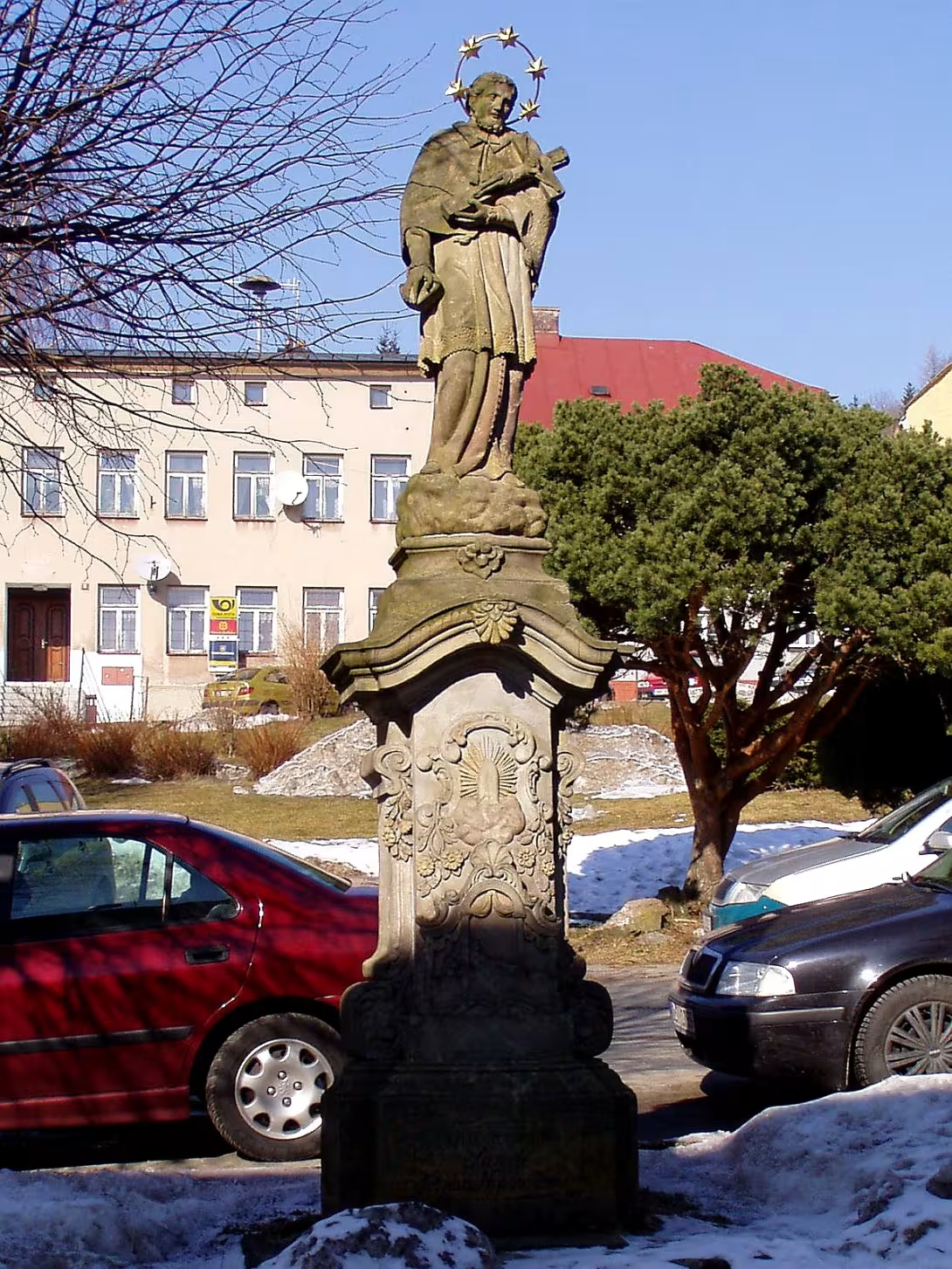
The statue of St. John Nepomuk, located in the southwest part of the square near the road communication in Olešnice in the Orlické Mountains, is a classical piece from 1826. This statue was ordered by local benefactors and made by sculptor Karl Mielnicki. Originally built on the road leading to Nová Města nad Metují, it is now protected as a cultural monument from 3 October 2014.
The creation of the statue was related to the period of the first Austrian Empire under the rule of František I., when classicism became a dominant artistic direction. This historical context reflects the influence of European cultural trends and local spiritual life, which gave special attention to Saint Jan Nepomucký.
The architecture of the statue is an example of classicism, a style characterized by symmetry, harmony and return to ancient ideals. The statue was made of materials suitable for the endurance and aesthetics of the time, reflecting techniques and art standards of the 19th century.
The original location of the statue on the road leading to New Town nad Metuje shows its importance for the local community, which considered it to be a spiritual protection and symbol. The subsequent relocation to Olešnice Square highlights the adaptability of the monuments within the urban environment.
The key event in the history of the statue was its official recognition as a cultural monument, which ensures its protection and care for future generations. This step underlines the importance of the statue not only as an artwork, but also as a historical witness to local traditions.
Today the statue is accessible to visitors and serves as a monument to the rich cultural and spiritual history of the area. Its location on the square ensures that it can be appreciated in the context of modern life while preserving its historical value.
The statue of St. John Nepomuk is not only a work of art but also part of the cultural identity of Olešnice. Her visit offers an opportunity to explore classical art and understand the historical development of the local community. This monument is proof of how art and culture can link the past to the present, thus becoming an essential part of the cultural heritage.
Historical milestones
- 1826
- Creation and location of the statue by the road.
- 2014
- Official protection as a cultural monument.
Architectural development
The statue of St. John Nepomuk is created in the style of Classicism, which reflects the aesthetic principles of the time. The original location by the road and the subsequent relocation to the square shows its adaptability within the urban environment.
Historical events
- 1826
- The statue was created and originally placed by the road.
- 2014
- The statue has been officially protected as a cultural monument since 3 October.
Points of interest
The statue of St. John Nepomuk is a classic piece from 1826. - This statue was ordered by local benefactors and made by sculptor Karl Mielnicki. - The statue was originally built on the road leading to Nové Města nad Metují, now protected as a cultural monument from 3 October 2014. - The creation of the statue was related to the period of the first Austrian Empire under the rule of František I, when classicism became a dominant artistic direction. - The statue was recognized as a cultural monument, which ensures its protection and care for generations to come.
Guide
Show guide text
This text was created by artificial intelligence and has not been editorially reviewed. It may contain inaccuracies.
Welcome to the beautiful Olešnice in the Orlické Mountains. You are standing in the heart of the village, in a place where everyday life is confronted with the quiet and relentless presence of history. In front of your eyes is the statue of St. John Nepomuk. Before we take a deeper look at this place, just look at it for a second. Feel the weight of the time that radiates from it, and the calm dignity that it brings to this space at the passageway. It is a fascinating feeling to stand so close to a work that has been standing here for nearly two hundred years, and which in silence watches the world change around it constantly.
Let us now move further into the past together and understand how this work really came into being. We must return to the year a thousand times eighty-six. This was the period when art direction known as Classicism was consolidated in our regions. This style was not just about looks, it was the way people understood the world at the time and sought meaning in it - they sought order, harmony, balance and beauty from pure and clear shapes. This statue is the exact mirror of this time. Its existence is not the result of chance, but of the deliberate and conscious actions of the people who lived here at the time. They were not kings or powerful rulers, but local benefactors. They were people close to you who felt the need for their community to create something lasting, something that would give them spiritual support and decorate their home. Their generosity and belief that art can strengthen the community are still alive in this work.
Now pay attention to the form itself and how the statue is processed. Even if you look at the work from a certain distance, feel the pursuit of perfection that was so typical of classical art. Notice how the statue works in accordance with the surrounding space of the square. Even if it is close to the road where cars pass by today, its presence seems balanced and peaceful. The work of art you see bears the mark of a man's championship, which in the early nineteenth century understood form and proportions. Even when you look at the details, feel the effort to express the dignity of the figure that the statue represents.
However, in order to understand the true value of this work, we must mention the names behind it. The first is sculptor Karel Mielnický. That was a name that raised respect at the time. Mielnický was not just a craftsman, he was a creator who could translate faith and respect into matter. His ability to work with form and breathe life into it is the reason why we look at this statue after so long. The second important element is the unknown benefactors. We may not know their names, but their will is materialized here. Without their decision and their willingness to support the artist, this statue would never have stood in this place and perhaps never existed.
Do you feel that this statue has always stood here, in this southwest part of the square? The reality, however, is much more interesting and tells the story of how the landscape itself and our communities change. Originally, this statue was built completely elsewhere. She was standing by a road that leads towards New Town above Metuji. Imagine it at that time - it was part of a journey that people were doing for work, for business or for visitors. She witnessed both horses and foot passengers. Over time, however, it needed to be transferred in order to be better perceived as part of the community and to be better protected. This transfer shows us how priorities change and how the area of the village changes over the centuries.
And it is this ability to resist time and all the changes in the world that lead us to one very important fact. This statue is not just an ordinary object in the landscape. It's the protected treasure of our history. Only recently, on October 3rd, two thousand fourteen, the statue was officially declared a cultural monument. That's the moment that gives this place new weight. This protection means that as a society, we have acknowledged that this work belongs to all of us and that we have a duty to preserve it for those who come after us. It's a commitment that connects a thousand times eighty-six to today.
Now, if you look again at the statue of St. John Nepomuk, try to see more than just a historical object in it. Try to see people's efforts for beauty, the courage of artists, and the constant movement of time that turns everything around, while keeping everything. He is the silent guardian of Olešnice who stands here to remind us of our roots and our connection to the past.
I hope that this brief insight into the past has enriched you and that this moment has given you a moment to think about. But don't stop at this one place. Olešnice v Orlických horách has many other secrets and beauty waiting for you. Continue to walk, discover new views of our mountains and enjoy every moment in this wonderful environment. Thank you for your attention, and I wish you a wonderful rest of the day on your next survey of our beautiful region.
Tips for visitors
The best time to visit the statue of St. John Nepomuk in Olešnice is from spring to autumn, when vegetation is best visible and the atmosphere calm. This time of year also offers pleasant temperatures for walking around the square.
When planning a visit to the statue of St. John Nepomucký, wear a suitable suit, because the climate can be variable. Photographers should consider bringing a stabilizing device for better pictures of the statue.
The photograph of the statue is most successful at noon, when the sun illuminates the monument and its details are clear. The statue is best photographed from the side of the square, where the background is natural landscape imagery.
The historical part of the town of Olešnice can be visited around the statue of St. John Nepomuk. Its streets and buildings offer an interesting view of the past, which is ideal for families with children who like short walks around historical locations.
Frequently asked questions
Can the monument be visited?
This is a structure in a public space that can usually be seen from outside free of charge. We have not verified that this particular one is freely accessible.
Where is the monument?
Location: Olešnice v Orlických horách. The map on this page shows the exact spot.
Why is the monument protected?
It is listed in the Central List of Cultural Monuments of the Czech Republic as a cultural monument (register no. 1519635274).
Businesses nearby
Do you run a restaurant, accommodation, shop, museum, rental, wellness or other visitor service near this monument? Show yourself directly to the people heading to it — this is how they will see you in the app and on the web:
Nearby
🏰 Historic sites (163)
- Obětem nacismu - 6.5.1945 Hugo Vogel 2.6 km
- Figura 3.8 km
- Bohaterom poległym za wolność i demokrację 3.9 km
- Izba pamięci Violetty Villas 3.9 km Fryderyka Chopina 2
- Zřícenina hradu Homole 4.1 km
- Kolumna Maryjna 4.1 km
- Trasa narciarstwa biegowego im. Janusza Rajzera 4.4 km
- Pomník 100 let od vzniku Československa 4.7 km
- Panna Maria 5.0 km
- park im. mjr pilota Czecha Nowackiego 5.3 km
- Fryderyk 5.4 km Wojska Polskiego 10
- Zřícenina Frymburk 5.5 km +420725044902
- Lázeňský Park 5.7 km
- Dworek im. Fryderyka Chopina 5.7 km
- Chopinova Busta 5.8 km
- Kamień Rübartscha 5.8 km
- Bartoňův kámen 6.1 km
- Aleja Doktora Ludwika Zamenhofa – twórcy esperanto 6.1 km
- Dobřany hrad 6.2 km
- Pałac Jeleniów 6.5 km
🍽️ Restaurants and dining (245)
- Zámeček 0.0 km web
- Restaurace Hartman 0.5 km web
- Skibar 1.2 km
- SKI Bar 3.9 km web
- Sedloňovský dvůr 4.2 km
- Karczma Bławatek 4.6 km Podgórze 4a
- Restaurace a Penzion Na Kovárně 5.1 km web
- Restauracja Czarny Staw Sport & Fun in Duszniki-Zdrój 5.1 km
- Werona 5.5 km
- Aleja Smaków 5.7 km
- Bistro Paradise 5.8 km
- Lawenda 5.8 km Zielona 1A +48505185361
- Dobre Smaki 5.8 km Zielona 1 +48748669175 web
- Hospoda Česká 5.9 km
- Pod Złotym Kasztanem 5.9 km
- Cukier Puder 5.9 km Fryderyka Chopina 2
- Bar Straszny Dwór 6.3 km Zieleniec 87
- Bar Mieszko 6.4 km
- Koupaliště Bystré 6.4 km
- Bar Hanka 6.4 km Zieleniec 17
🏨 Accommodation (265)
- Hotel Hartman 0.6 km web
- Penzion Na Staré Škole 2.1 km Polom 106 +420 602 436 986 web
- Calma 2.9 km Lasek Miejski 13A +48606326155 web
- Rekreační areál Hrádek 3.2 km web
- Na Koziej Hali 3.9 km +48748669574;+48509643190 web
- Chata Horalka 4.2 km
- Agroturystyka pod Grzywaczem 4.2 km +48500134470
- Domki pod Jabłonką 4.3 km
- Dom na Wzgórzu 4.4 km
- Hotel & Browar Jamrozowa Polana 4.5 km Olimpijska 1 web
- Agroturystyka 4.6 km +48 74 869 89 72
- Rancho Stokrotka 4.6 km +48512755677 web
- Akademicki Ośrodek Wypoczynkowy UUTP w Dusznikach Zdroju 4.6 km Podgórze 17 web
- Modrzewiowa Chata 4.7 km +48 534 677 328 web
- Słoneczne Podgórze | 4.8 km
- Słoneczne Podgórze I 4.8 km Podgórze 55
- Słoneczne Podgórze II 4.9 km Podgórze 56
- Słoneczne Podgórze II 4.9 km
- Ranczo "Panderoza" 5.1 km
- Villa Fortuna 5.3 km Graniczna 6 +48 74 814 88 52 web
🚲 Rentals and sport (29)
- Centrum Polskiego Biathlonu i Turystyki Aktywnej Jamrozowa Polana 4.4 km
- Sklep-wypożyczalnia 6.2 km
- Koupaliště Bystré 6.4 km
- Pohl Sport 8.0 km
- Spring Bike 8.6 km
- Cyklon Bike 8.6 km +48 697 949 955
- Lanový park 8.8 km
- Szalona Wypożyczalnia 8.9 km +48 534 422 724
- Park Wodny Verde Montana 8.9 km
- Wodny Świat 9.0 km +48 74 866 45 02 web
- Skicentrum Deštné 9.1 km
- Słoneczne Termy Zameczek 9.1 km
- Lezecká stěna 9.4 km
- Sportisimo 10.2 km
- Libra JÍZDNÍ KOLA 10.8 km web
- Pinguin 10.9 km
- Bike Your Way - Wypożyczalnia Rowerów Elektrycznych 11.0 km +48 698 519 940 web
- Plavecký bazén Náchod 11.4 km web
- Sokolovna 11.4 km
- R2 sport bike 11.7 km Husovo náměstí 1212 +420774711972 web
🥾 Hiking and nature (418)
- Utzův mechanický betlém 0.1 km
- Kostelní vrch 0.7 km
- Feistův kopec 0.9 km
- Červený kopec 1.0 km
- Panský vrch 1.0 km
- Kostelní vrch 1.1 km
- Pańszczyca 1.4 km
- Stenka 1.5 km
- Panský kopec 1.6 km
- Panský kopec 1.7 km
- Pańska Góra 1.7 km
- Kamienna Pola 1.8 km
- Kamienna Pola 2.0 km
- Kaplica Matki Bożej 2.2 km
- Skutina 2.4 km
- Taszowskie Górki 2.4 km
- Kalvárie 2.6 km
- pramen Dědiny - Zlatého potoka 2.8 km
- Rašelina 2.9 km
- Čihadlo 3.4 km
Accommodation nearby
Themed route
Thematic cruise route from Olešnice v Orlických horách
1.Socha svatého Jana Nepomuckého (Olešnice v Orlických horách)
Type: Historical statue
Why is it worth visiting: This famous statue of St. John Nepomuk is an icon of the village of Olešnice. Its history and architectural appearance attract many visitors who want to appreciate its beauty and history.
2. St. John Nepomuk Church
Type: Religious object
Why is worth a visit: The church is not only a spiritual centre of the local community, but also an architectural pearl with a rich history. Its interior offers a view of the artistic elements and decoration, which are also important for the cultural heritage of the village.
3. Local Market
Type: Cultural events
Why is worth a visit: The market is a living place where people meet and offer their products. It is a great opportunity to explore local gastronomy and works of art that reflect the cultural wealth of the area.
4. Local Museum
Type: Cultural institutions
Why is worth a visit: The Museum offers valuable information about the history and culture of Olešnice v Orlických horách. The exhibits here represent local traditions, artistic creation and history of the village.
5. Park by the church
Type: Green space
Why is worth a visit: The park is a place of peace and relaxation in the direct vicinity of St. John Nepomuk's church. Its greenery and quiet corners are ideal for relaxing after exploring local monuments.
This route offers a view of the cultural and historical wealth of Olešnice v Orlických horách, each of its points bringing unique impressions and insights about this Czech area.
Seasonal recommendations
Spring: In the spring season, the statue of St. John Nepomuk in Olešnice in the Orlické Mountains is illuminated by sunlight, which brings living colour to the surrounding vegetation. Flowers and trees are starting to bloom, which gives the statue a romantic background. During spring it is advisable to visit the morning or evening when fewer people gather for walks and enjoy a quiet atmosphere. It is recommended to wear light clothes with the possibility to zoom in on an umbrella or jacket because temperatures can be medium and suddenly start to rain.
Summer: In the summer period, the statue of St. John Nepomuk is illuminated by a long time of daylight, which allows you to see it in full glory. Nature is in bloom and forests offer shadow places to rest. The best time to visit is early morning or evening to avoid heat and crowds of tourists. It is recommended to wear summer clothes with sun protection - ties, hat and sunglasses - and always wear drinks.
Autumn: During the autumn, the surrounding area of the statue of St. John Nepomuk is covered with colorful tree leaves, creating a beautiful and melancholic atmosphere. The sun hides faster beyond the horizon, meaning shorter days and longer-lasting evening light. The best time to visit is early morning or late afternoon, when fewer people appear in nature. It is recommended to wear warm clothes with the possibility to zoom in on an umbrella or scarf and fasten the shoes for walking on dry but sometimes wet paths.
Winter: In winter, the statue of St. John Nepomuk is illuminated by ice rays and freezing air. The woods around them are covered in snow, which gives the landscape a completely different look. The best time to visit is during the sun days, when the frosty light best shows up. It is recommended to wear warm clothes - fur coats, gloves and shoes with good insulation - and be ready for a snow walk or ski trip nearby.
Visualizations and artistic views

The visualisations are generated by artificial intelligence and serve as inspiration.
Photos from the area
Real photos taken near the monument


Zdroj a licence jsou uvedeny u každého snímku.
Tips from visitors
No tips yet. Be the first!
Log in and add your tip.
Sources and literature
Photos: Addvisor / CC BY-SA 3.0 — Wikimedia Commons. The author and licence also appear when you hover over the image.
Faktickým podkladem tohoto textu byl článek na Wikipedii, jehož autory jsou přispěvatelé Wikipedie. Článek je dostupný pod licencí CC BY-SA 4.0.
Location on the map
More monuments – Olešnice v Orlických horách
Show all in the municipality
Příběhy a pověsti
Legendy, pověsti a příběhy spjaté s touto památkou
Fotografie návštěvníků
Zatím žádné fotografie. Buďte první, kdo přidá fotografii z návštěvy!
Log in a přidejte svou fotografii nebo hodnoťte.
Za ověřenou návštěvu v aplikaci získáte víc bodů — poznáme podle GPS, že jste na místě.
Reviews and comments