

Socha svatého Venancia Statue
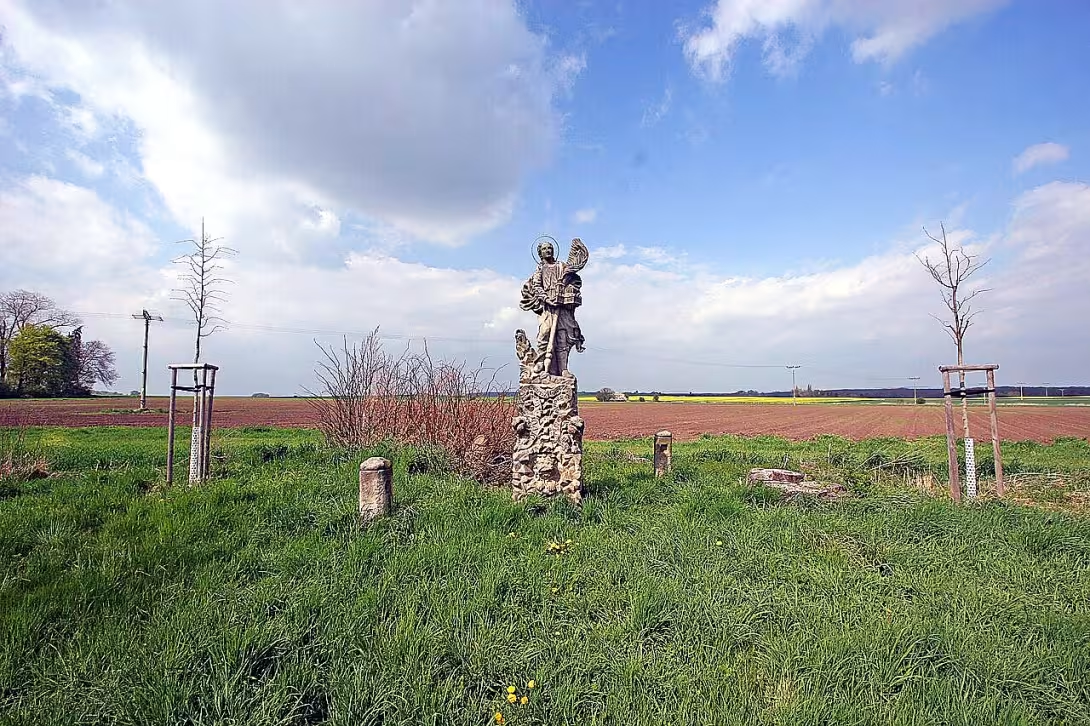
The Baroque-era statue of Saint Venantius is an exceptional example of folk stone-carving work from the early 18th century. Situated near the road connecting Smidary and Smidarská Lhota in the Hradec Králové region, this monument stands out for its intricate details and historical importance.
Dating back to 1727, the statue represents Saint Venantius, patron saint against the plague. The Baroque-era style is evident in the ornate carvings on the pedestal, which resemble rocks and feature a relief of a lion's head with paws. Above this, an inscription on a ribbon reads "DIVUS VENANTIVS CONTRA CASVM PATRONVS Die II. M. Novemb" - a testament to the saint's patronage against the plague.
The statue itself stands tall, depicting Saint Venantius in life-sized proportions. He is shown with his right leg bent and leaning on a rock, while his left leg stretches out behind him. His hands are clasped together, holding a Romanesque church with a tower and a smaller pilgrimage chapel. A staff with a partially unfurled banner featuring a relief of the Latin cross rests against his body.
Originally, the pedestal was surrounded by an enclosure, remnants of which can still be seen in the form of three sandstone pillars. The inscription on the ribbon mentions November 2nd, while the lion's heads on the pedestal are holding onto it.
Today, the statue remains a significant cultural monument, having been declared as such in 2008. Visitors can still marvel at its intricate details and historical significance, making it a must-see destination for anyone interested in Baroque-era art and architecture.
Then and now
Drag the slider to compare how the landmark may have looked when it was built with the view today.
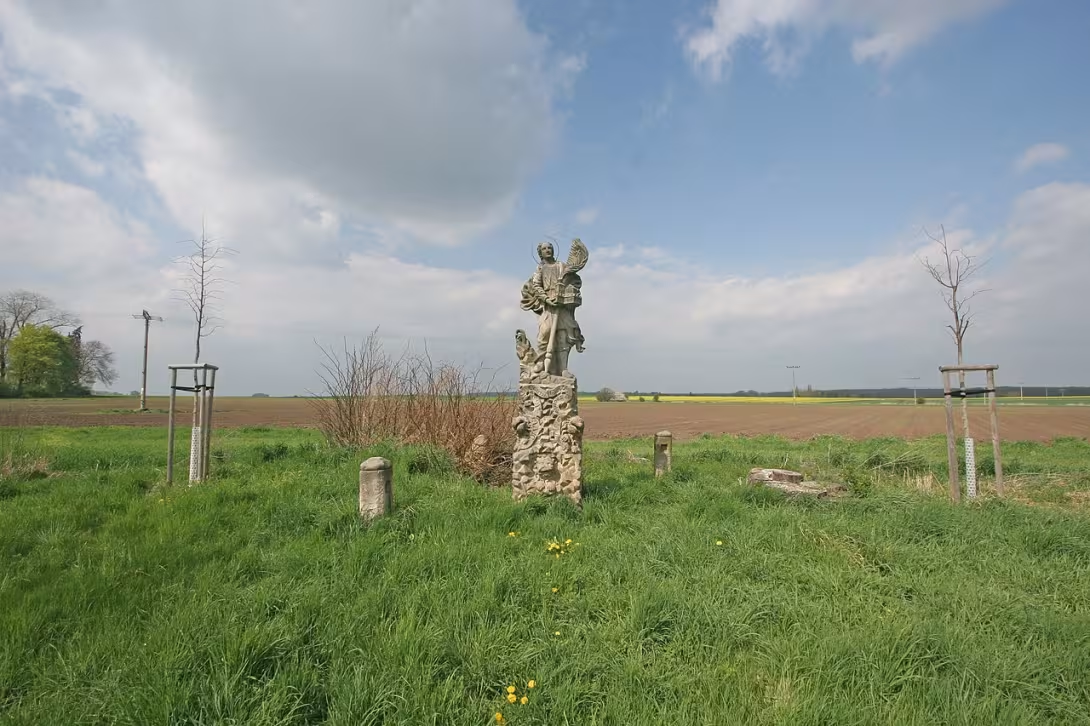
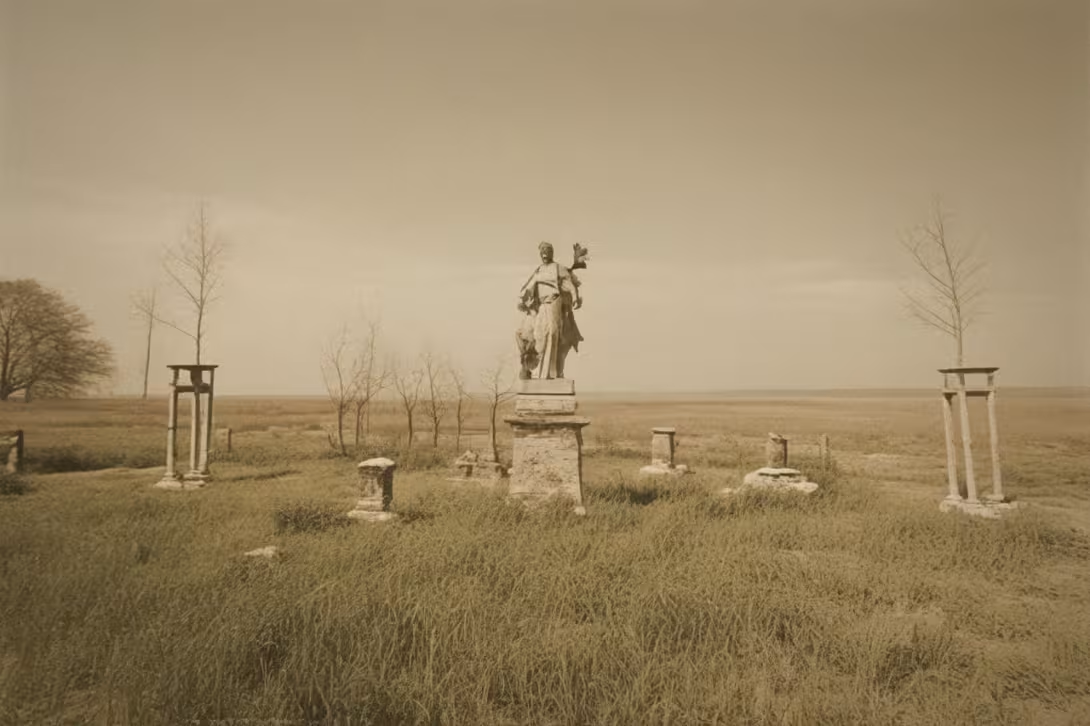
The historical appearance on the left is an AI-generated visualisation and serves as inspiration only.
Historical milestones
- 1727
- The statue of Saint Venantius is created.
- 2008
- The statue is declared a cultural monument.
Architectural development
The statue features a pedestal with a relief of a lion's head and a inscription on a ribbon. The pedestal is decorated with carvings resembling rocks.
Historical events
In 2008, the statue was declared a national cultural monument
Points of interest
– The statue of Saint Venantius is an exceptional example of folk stone-carving work from the early 18th century.
– Dating back to 1727, the statue represents Saint Venantius, patron saint against the plague.
– The Baroque-era style is evident in the ornate carvings on the pedestal, which resemble rocks and feature a relief of a lion's head with paws.
– The inscription on a ribbon reads "DIVUS VENANTIVS CONTRA CASVM PATRONVS Die II. M. Novemb" – a testament to the saint's patronage against the plague.
– Today, the statue remains a significant cultural monument, having been declared as such in 2008.
Guide
This guide is narrated by a synthetic voice generated by artificial intelligence.
Show guide text
This text was created by artificial intelligence and has not been editorially reviewed. It may contain inaccuracies.
Welcome. You have arrived at a quiet, significant point in your journey through the Hradec Králové region. As you stand here, perhaps catching your breath or simply pausing to take in the surroundings, take a moment to look at the figure standing before you. You are looking at the statue of Saint Venantius, a silent witness to the passing of centuries, positioned near the road that connects Smidary and Smidarská Lhota.
Take a moment to truly observe the presence of this monument. It does not possess the overwhelming scale of a cathedral or the polished perfection of a royal palace, and that is precisely where its beauty lies. It is a piece of history that feels deeply connected to the earth and the people who once traveled these very paths. As you look at the stone, try to sense the atmosphere of the era from which it emerged.
To understand this statue, we must travel back in time to the year 1727. This was the height of the Baroque era, a period characterized by movement, emotion, and a profound sense of drama. However, this is not the grand, sweeping Baroque of the great architects in distant cities. Instead, what you see is a beautiful example of folk stone-carving. This was art created by the hands of local craftsmen, people who lived, worked, and prayed in this very landscape. While the identity of the artist remains unknown to us, their devotion is etched into the very texture of the stone. They may not have been trained in the great academies, but they possessed a deep, sincere understanding of their faith and their materials.
As you examine the statue, notice the character of the carving. In folk art, there is often a wonderful honesty—a way of interpreting the complex styles of the time through a local, more personal lens. The Baroque influence is visible in the spirit of the work, yet it remains grounded, humble, and accessible. It is a testament to the skill of an anonymous mason who, over three hundred years ago, decided that this specific spot deserved a symbol of protection.
Now, let us consider why Saint Venantius was chosen to stand guard here. In the 18th century, life was often fragile. The shadow of the plague was a constant reality for many communities, a terrifying force that could sweep through a region without warning. Because of this, Saint Venantius became a vital figure in the spiritual life of the people—he was revered as the patron saint against the plague.
Imagine the travelers, the farmers, and the families who passed this way in the 1700s. For them, this statue was more than just a piece of carved stone; it was a source of hope. Seeing the figure of Saint Venantius would have offered a sense of spiritual security, a prayer in stone offered for protection against disease and misfortune. Placing such a monument near a road was a deliberate act, creating a sacred landmark for those on the move, offering a moment of reflection and a plea for safety in an uncertain world.
It is remarkable to think about how much this statue has endured. It has stood through the changing seasons, through the rise and fall of empires, and through the transformation of the landscape around Smidary and Smidarská Lhota. It has watched the road change from a dirt track to the path you see today. For centuries, it was simply a part of the landscape, a familiar landmark for locals.
However, its importance was formally recognized in 2008, when the statue was declared a cultural monument. This designation ensures that the work of that unknown 18th-century craftsman is preserved for future generations. It acknowledges that even a piece of folk art, standing by a roadside, carries the immense weight of our shared human history and our ancient need for protection and faith.
As you stand here, I invite you to look closely at the details of the stone, to feel the weight of the history it carries, and to appreciate the simple, enduring power of this Baroque survivor. It is a small but profound connection to the people of 1727, reminding us of their fears, their hopes, and their artistry.
Thank you for taking this moment to connect with the past. As you continue your journey through the Hradec Králové region, may you find many more such hidden stories waiting to be discovered. Please, continue on your way, and enjoy the rest of your exploration.
Tips for visitors
The best time to visit Socha svatého Venancia is during the spring or autumn when the weather is mild and sunny, making it ideal for photography. Avoid visiting during peak summer months as the statue can be quite hot.
When visiting Socha svatého Venancia, be sure to bring comfortable walking shoes and clothing suitable for the weather. Don't forget your camera and a bottle of water to stay hydrated.
The best spots for photography are around the statue itself, as well as along the road where you can capture the surrounding landscape. The morning or late afternoon sun provides the most flattering light for photographs.
If you're looking for something to do nearby, consider visiting Smidary and Smidarská Lhota within a 30-minute drive from the statue. These charming towns offer a glimpse into rural Czech life.
Frequently asked questions
Can the monument be visited?
This is a structure in a public space that can usually be seen from outside free of charge. We have not verified that this particular one is freely accessible.
Why is the monument protected?
It is listed in the Central List of Cultural Monuments of the Czech Republic as a cultural monument (register no. 1419877810).
Businesses nearby
Do you run a restaurant, accommodation, shop, museum, rental, wellness or other visitor service near this monument? Show yourself directly to the people heading to it — this is how they will see you in the app and on the web:
Nearby
🏰 Historic sites (138)
- Sv. Jan Nepomucký 0.6 km
- zámek Smidary 1.1 km
- Chotělice 2.4 km
- zámek Skřivany 3.4 km
- Dr. J. E. Proche 3.6 km
- sv. Jan Nepomucký 3.6 km
- Zámek Sloupno 4.0 km
- svatá Anna 4.8 km
- Morový sloup 5.2 km
- K. H. Borovský 5.3 km
- Zámek Vysoké Veselí 5.3 km
- František Palacký 5.3 km
- Svatý Václav 5.4 km
- sv. Jan Nepomucký 5.4 km
- Panna Maria Immaculata 5.4 km
- sv. Václav 5.4 km
- sv. Florián 5.4 km
- sv. František Xaverský 5.4 km
- sv. Šebestián 5.4 km
- Mariánský sloup 5.4 km
🍽️ Restaurants and dining (33)
- U Bodláka 5.1 km
- Fantazie & Flowers Coffee 5.5 km
- U puku 5.7 km Dukelská třída 973 +420 603 175 227 web
- Hospůdka Na Hřišti 5.7 km
- Hospoda Myštěves 6.5 km
- Barešův Ranč 8.1 km web
- Lískovice 8.2 km
- U Karla IV. 10.3 km
- Hostinec u Růženky 10.9 km
- U Kameníka 11.1 km
- U Maxe 11.1 km T. G. Masaryka 105
- Restaurace Motel Charlie 12.0 km +420 493 597 571 web
- Motorest Milovice u Hořic 12.7 km
- U Patřínů 12.8 km Konecchlumí 15 +420 601 188 013 web
- Café U Rybiček 13.0 km +420 604 929 231 web
- Koruna 13.1 km Palackého 80
- Hospoda na hřišti 13.2 km +420 777 539 158
- Restaurace u Ságnerů 13.3 km +420777 643 039 web
- Hospoda u Novotných 13.5 km
- Na Blahu 13.7 km
🏨 Accommodation (5)
- Kemp Lodín 10.1 km web
- Kemp Milovice u Hořic 12.3 km web
- Hotel Hradec 14.2 km Náměstí 54
- Hotel Coruna 14.6 km Pražská 10 web
- Hotel Královský Dvůr 14.8 km
🚲 Rentals and sport (8)
- Motokros 2.5 km
- Myslivecký klub 12.0 km
- Autocross KPM KOSICE 12.6 km
- Sportovní hala Gymnázia 14.3 km Šalounova 2164
- Motokros 14.4 km
- Cyklosport 14.4 km Aloise Hlavatého 2207
- Slavíčkova hala 14.5 km Sokolská 795
- Autokros 14.6 km
🥾 Hiking and nature (60)
- Kamenec 1.6 km
- Vlčí hůrka 2.1 km
- Homolka 2.9 km
- Sychrov 3.2 km
- Loučná hora 4.7 km
- Smrkovec 5.1 km
- Městký park u Novobydžovského hřbitova 5.3 km
- Horka 6.2 km
- Velký Borek 6.6 km
- Vertánov 7.0 km
- Chlum 7.5 km
- Za Kouty 7.7 km
- Na kopci 7.9 km
- Archa – schrána na svátost oltářní, posvěcená hostie. 8.6 km
- Chrást 8.8 km
- Pískovka 9.3 km
- Pařezová 9.4 km
- Oborský vrch 9.4 km
- Češovské valy 9.6 km
- Kamenec 9.6 km
Accommodation nearby
Themed route
Thematic Tour Route
The main goal of this tour is to visit the Statue of Saint Venantius, situated near a road in the Hradec Králové region.
Stop 1: Roadside Viewpoint Type: Scenic overlook Why visit: Enjoy the panoramic views of the surrounding countryside from this elevated spot, which offers a unique perspective on the statue and its surroundings. (Approximate distance from the statue: 0.5 km)
Stop 2: Local Church Type: Historical landmark Why visit: This charming church is located nearby and provides insight into the region's rich history and cultural heritage. Take a moment to admire its architecture and peaceful atmosphere. (Approximate distance from the statue: 1.2 km)
Stop 3: Vantage Point Park Type: Green space Why visit: This small park offers a serene escape from the hustle and bustle of daily life, with walking trails, benches, and scenic views of the surrounding landscape. Take a leisurely stroll and enjoy the fresh air. (Approximate distance from the statue: 0.8 km)
This tour provides a unique blend of natural beauty, cultural significance, and historical interest, all centered around the iconic Statue of Saint Venantius.
Seasonal recommendations
Spring
As you visit the statue of Saint Venancio during spring, you'll be greeted by the vibrant colors of blooming flowers and lush greenery surrounding the monument. The soft sunlight casts a warm glow on the statue, making it an ideal time to take photos. Keep in mind that the area can get crowded with tourists and locals alike, so plan your visit accordingly. It's recommended to arrive early to avoid the peak hours.
Summer
During the summer months, the atmosphere around the statue of Saint Venancio is lively and festive. The warm weather brings out the best in the surrounding park, with children playing and picnics being enjoyed by families. The statue itself takes on a golden hue as the sun shines down upon it. Be prepared for larger crowds and consider arriving earlier to beat the heat.
Autumn
As autumn arrives, the atmosphere around the statue of Saint Venancio becomes cozy and inviting. The leaves change colors, casting a warm orange glow over the area. The air is crisp and cool, making it an ideal time to take leisurely strolls around the park. Keep in mind that the days are getting shorter, so plan your visit accordingly.
Winter
During the winter months, the statue of Saint Venancio takes on a serene and peaceful atmosphere. The snow-covered surroundings create a picturesque backdrop for photos, while the cold weather keeps the crowds to a minimum. It's recommended to dress warmly and consider visiting during the morning or early afternoon hours when the sun is out.
Visualizations and artistic views


The visualisations are generated by artificial intelligence and serve as inspiration.
Photos from the area
Real photos taken near the monument


Zdroj a licence jsou uvedeny u každého snímku.
Tips from visitors
No tips yet. Be the first!
Log in and add your tip.
Sources and literature
Photos: Petr1888 / CC BY-SA 3.0 — Wikimedia Commons. The author and licence also appear when you hover over the image.
Faktickým podkladem tohoto textu byl článek na Wikipedii, jehož autory jsou přispěvatelé Wikipedie. Článek je dostupný pod licencí CC BY-SA 4.0.
Location on the map
Příběhy a pověsti
Legendy, pověsti a příběhy spjaté s touto památkou
Fotografie návštěvníků
Přidat fotografiiZatím žádné fotografie. Buďte první, kdo přidá fotografii z návštěvy!
Máte k místu vzpomínku nebo zajímavý příběh?
Log in a přidejte svou fotografii nebo hodnoťte.
Za ověřenou návštěvu v aplikaci získáte víc bodů — poznáme podle GPS, že jste na místě.
Reviews and comments