



Sousoší sv. Jana Nepomuckého Statue
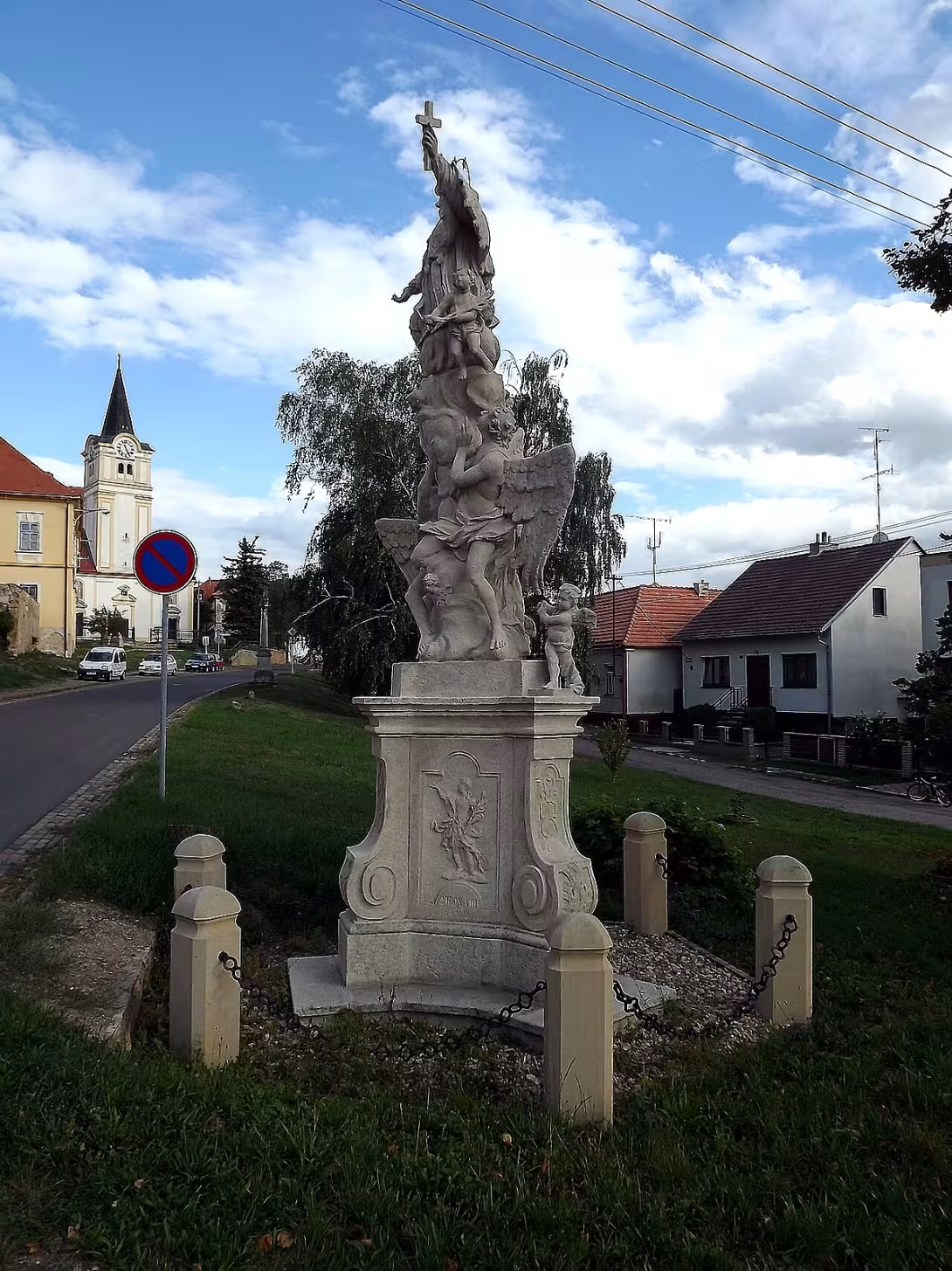
The statue of St. John Nepomuk on the Šatov village is one of the most important Baroque sculptures around Znojmo. This monument-protected composition from the second quarter of the 18th century stands in front of the church of St. Martin and is one of the rare preserved Baroque sculpture in the region, which preserved the original arrangement with stone columns and chains. His authorship remains unknown, but his creation relates to religious renewal after the Battle of White Mountain and to the expansion of the cult of St. John Nepomuk, who reached its peak in the Czech countries at this very time.
The sculpture was ordered by the husbands Gabriel and Sabin Schiller, of whom Gabriel served as Rector of the Brotherhood of God. This religious organization played a key role in the care of the poor and organization of spiritual life in the region. The work was created during the late Baroque period, when the Catholic Church actively supported sculpture creation as an instrument of counter-reformation. As a result, a number of monumental sculptures appeared in the Czech countries to strengthen faith and Catholic identity. The Šatov sculpture is not only a work of art but also a document of social and religious transformation of its time.
Architectural is a typical Baroque sculpture with religious themes. It is made by a statue of St. John Nepomuk, which two angels deliver to heaven, supplemented by three little angels. The overall impression is strengthened by 16 stone columns of connected chains, which surround the memory and give it a monumental character. The base is triangular and carries the reliefs of St. Martin and St. Donat, Latin inscription with the names of donors and the year of renewal (1901). The sandstone was probably used as material, typical of Czech Baroque sculpture. The Latin inscription on the pedestal contains the names of the Schilers' husbands, which was common in the Baroque era - both townspeople and nobles liked to record their contributions to religious art as a sign of piety and social standing.
Since its inception, the sculpture of the local parish that took care of it belonged. The only documented event associated with his destiny is the renovation in 1901, as evidenced by the inscription on the pedestal. Other historical sources about his fates are unknown, but the preservation of the original layout with chains and columns is rare in the Czech environment. This illustrates the care of the memory and the fact that the locals considered it an important part of the cultural heritage.
The interesting thing is that Saint Jan Nepomucký was one of the most popular saints in the Czech lands in the 18th century. His cult was associated with protection against danger and his reverence developed especially after canonization in 1729. The Šatov sculpture thus reflects not only religious but also social customs of the time. The Brotherhood of God's Body, who was Gabriel Schiler Rector, played an important role in organising religious life and caring for the poor, which was also reflected in the location of the sculpture in a public area in front of the church.
Today the monument is located on the Šatov village, near St. Martin's Church, and is freely accessible. The surrounding area offers other Baroque and classicist buildings such as the rectory, and a natural landscape typical of South Moravia. The town of Znojmo, famous for its historical monuments, including the castle and cathedral, is just five kilometres away. The Šatov sculpture is an important example of baroque sculptures in the region and its visit allows you to know not only the artistic but also the religious and social heritage of the region.
The monument is worth visiting not only for baroque art lovers, but also for those interested in the history of religious life in Czech countries. The preserved original layout with chains and columns is a rare example of what baroque sculpture in this region looked like. The statue of St. John Nepomuk is not only an artistic work but also part of the living history of Šatov and its inhabitants.
Historical milestones
- 18th century (2nd quarter)
- The creation of sculptures to order the Schiller husbands.
- 1901
- The reconstruction of the sculpture, recorded on the pedestal.
Architectural development
The sculpture was created during the late Baroque period, when monumental sculpture was typical with religious theme. The material is probably sandstone, typical of Czech Baroque sculpture. The base with reliefs and inscriptions was probably added later to highlight the importance of the monument and recall its renovation history. The chains connecting the pillars around the statues have symbolic significance - they represent a link between the Earth and the celestial world.
Historical events
- 18th century (2nd quarter)
- Making sculptures to order the husbands Gabriel and Sabina Schiller, of whom Gabriel acted as rector of the Brotherhood of the Body.
- 1901
- Renovation of sculptures, as indicated on the pedestal.
Points of interest
- The statue of St. John Nepomuk on Šatovské váží is a rare preserved Baroque plastic, which preserved the original arrangement with stone columns and chains connecting the entire composition.
- Its origin is related to the religious renewal after the Battle of White Mountain and to the expansion of respect for Saint Jan Nepomukki, who reached its peak in Czech countries at the time of its creation.
- The memorial was ordered by the Schilers, of which Gabriel held the office of Rector of the Brotherhood of God Body, who participated in the care of the poor and organization of spiritual life in the region.
- The Latin inscription on the pedestal contains the names of the donors and the year of reconstruction from 1901, the only documented event associated with his destiny.
- The preservation of original layout with chains and columns is rare in the Czech environment and shows the care of the monument as part of the cultural heritage.
Guide
Show guide text
This text was created by artificial intelligence and has not been editorially reviewed. It may contain inaccuracies.
Welcome to this beautiful place where history and art meet. You're standing in front of a baroque statue that will charm you with its elegance and religious significance. You can see before you the statue of St. John Nepomuk, which is from the second half of the eighteenth century. This work, which was created on the Šatov village, is the work of an unknown master.
Look up - two angels take St. John Nepomuk to heaven. His face is full of peace and wisdom, while three little angels move around him, giving a whole quiet joy. Under the statue there is a three-sided pedestal which carries the reliefs of two saints - Saint Martin and Saint Donat. On its sides is also the Latin inscription and names of two husbands who supported this project.
Let's move on to the edges of this sculpture. Notice the sixteen stone columns that are connected by chains. These elements not only emphasize the overall composition, but also provide a distinct Baroque atmosphere. This share of baroque art is rarely preserved and has maintained its original arrangement.
The creation of this sculpture is linked to the time when Czech countries sought religious renewal after the Battle of White Mountain. At that time, respect for Saint Jan Nepomuk, who was considered to be the protector of the Czech nation, was also developing. The husband and wife of Schiller, Gabriel and Sabina were the main supporters of this work. Their names are recorded on the pedestal, which is proof of their loyalty and interest in this religious art.
Now pay attention to details that can tell you more about the history of this place. The Latin inscription on the pedestal may be a surprise to you because it is typical of the period when this language was still used in religious works. Remember that in the eighteenth century there were many Czech families who were devoted to supporting the church and religious monuments.
The interesting thing is that this sculpture was repaired in the nineteenth century. This fact is recorded on the pedestal, which shows long-term care of this work. This shows how important this monument was for local people and for future generations.
If you want to learn more about the history of this place, I recommend you check the base and carefully read the names and inscriptions. You can also visit the local museum, where there is probably more information about this Baroque work. Now enjoy this moment and explore what other secrets and beauty these places hide.
Thank you for your attention and we wish this visitor to leave you with the feeling that you have encountered something really important. Follow other sights and discover the history of our region. May this visit bring you joy and inspiration.
Tips for visitors
Best time to visit and why
Visiting the sculpture of St. John Nepomuk is best planned for spring or autumn when the weather is pleasant and the light is soft. The morning or late afternoon is an ideal time for photography because the light highlights the details of the statues and creates pleasant shadows. In the summer months avoid the noon hours when the sun can be too strong and cause unpleasant glare on the statues.
It is recommended to use public transport if you come from other parts of Moravia, because the place is available by buses bound for Zlaim. Check exact routes and connections in the transport search engine or on the carrier's official website.
What to take with you
When visiting, wear comfortable shoes, as the terrain around the baits can be uneven. It is also recommended to take water, especially in the summer months, and a small camera or smartphone with a good lens for detailed photos. If you are planning a tour of the church or other sacral monuments, dress well because it is a place with a religious atmosphere.
Photography - best places and light
The best views of the sculpture are from the south side, where the statue is well lit and the details of angels and saints are visible. It is recommended to take a close-up photograph to show sculpture details, while capturing the overall view of the sculpture in the context of the bait. The morning or evening light gives the photos warm and pleasant tones.
What to visit in the area (within 30 minutes from the location)
Close to the sculpture there is a church of St. Martin, which is worth visiting for its historical architecture and peaceful atmosphere. Another option is to look at baroque and classicist buildings such as the rectory, located near the village. The natural surroundings offer the possibility of short walks through fields and forests typical of South Moravia.
Tips for families with children
Sousoší sv. Jana Nepomuckého can be interesting for children who are interested in history or sculpture. Parents can look for details on statues or tell stories about the saint. There is enough space in the area for short games or walks, and visiting a church or a parish can be a fun experience for children if you explain to them how such buildings looked in the past.
Frequently asked questions
Can the monument be visited?
This is a structure in a public space that can usually be seen from outside free of charge. We have not verified that this particular one is freely accessible.
Where is the monument?
Location: Šatov, Jihomoravský kraj. The map on this page shows the exact spot.
Why is the monument protected?
It is listed in the Central List of Cultural Monuments of the Czech Republic as a cultural monument (register no. 1000144051).
Businesses nearby
Do you run a restaurant, accommodation, shop, museum, rental, wellness or other visitor service near this monument? Show yourself directly to the people heading to it — this is how they will see you in the app and on the web:
Nearby
Sousoší se nachází na Šatovské návsi, nedaleko kostela svatého Martina. V okolí se nachází další barokní a klasicistní stavby, jako je fara a další drobné sakrální památky. Přírodní okolí je tvořeno rovinatou krajinou s polnostmi a lesy, typickou pro jižní Moravu. V dojezdu 5 km se nachází město Znojmo s množstvím historických památek, včetně zámku a katedrály.
Accommodation nearby
Themed route
Daily cruise route to the statue of St. John Nepomuk in Šatov
1. Statue of St. John Nepomuk on Šatov village This important Baroque monument from 1735 is one of the most important Czech sculptures. Sculpture works of this type are rare and express a deep religious tradition. The local statue, located in front of the church of St. Martin, is one of the last statues of this saint, which was declared patron of Bohemia. It's a great opportunity to learn the Baroque art tradition.
2. St. Martin's Church There is a Baroque church of St. Martin above the statue, which is architecturally interesting. Its interior decoration and historical frescoes preserve the spiritual atmosphere of the place. In the church there is also a memorable statue of St. John Nepomuk, which is associated with a local legend about his martyrdom life.
3. Fara in Šatov Above the church is a Baroque rectory, which is a typical example of classical construction. Its facade and interior are well preserved and represent an interesting example of historical spiritual housing. Fara is also an important historical proof of life in South Moravia in the 18th century.
4. Around Šatova - forests and fields After visiting historical monuments it is advisable to go to the surroundings where the forest and field landscape are located. This flat landscape is typical of South Moravia and offers pleasant walks. You can relax here and enjoy a quiet environment that is suitable for relaxation and attention to nature.
End of route After visiting all these places you can return to Šatova or continue to the nearby town of Znojmo, which is approximately 5 kilometers away. In Znojj you can visit other historical monuments such as the castle and cathedral, which are worth visiting.
Seasonal recommendations
Spring Sousoší sv. Jana Nepomuckého in Šatov in the spring months offers a unique atmosphere of awakening nature. The sun illuminates the statue with a fine, scattered light that creates playful shadows on stone faces and detailed ornaments. The surrounding area awakens from winter sleep - meadows flourish, trees develop and air smells of moisture and greenery. In this period the visit is ideal for those who want to experience quiet moments outside the main tourist mountains. I recommend visiting a memory early in the morning or late in the afternoon when the site is almost empty. Wear light but protective clothing - spring weather is variable, so wear a raincoat or sweater. It is also important to protect yourself from rain, which may be common during this period.
Summer In the summer months, the sculpture becomes a center of attention thanks to the sunlight, which highlights every detail of the statue. The warm, long days illuminate the stone faces with a golden reflection, while the shadows stretch short and sharp. The atmosphere is alive - visitors are around the monument, children are playing and the air smells of flowers and grass. In the main summer season, however, more people must be counted on, especially on Sundays and weekends. The best time to visit is early morning, when it is still cold and the crowds have not yet started. Dress lightly, but with sun protection - hat, sunglasses and cream are essential. Remember also enough water because summer temperatures can be high.
Autumn The autumn visit to the sculpture brings a magical atmosphere where nature paints itself in golden, red and brown shades. The sun rises lower in the sky, so its light illuminates the statue with a soft, scattered light that highlights the delicate features of the faces and details. Leaves on trees and on the ground create a pleasant, warm foundation that gives the place a calm and reflective mood. In this period the visit is ideal for those who seek peace and quiet. I recommend visiting a memorial in the week when the site is less disturbed. Wear warmer clothes because autumn evenings can be cold and rainy. Also remember waterproof shoes, because wet leaves can be slippery.
Winter In the winter months, the sculpture becomes a symbol of peace and quiet, surrounded by white snow cover. The sun rises lower in the sky, so its light illuminates the statue with a soft silver shine that creates contrast to snow. The atmosphere is calm and quiet, ideal for those looking for an escape from the city's bustle. However, shorter opening times and possible weather restrictions should be envisaged during this period. The best time to visit is at noon, when the light is the most distinctive and snow cover most emphasizes the detail of the statue. Dress warm - warm jacket, gloves and caps are necessary. Also remember waterproof shoes, because ice and snow can be slippery.
Visualizations and artistic views


The visualisations are generated by artificial intelligence and serve as inspiration.
Photos from the area
Real photos taken near the monument


Zdroj a licence jsou uvedeny u každého snímku.
Tips from visitors
No tips yet. Be the first!
Log in and add your tip.
Sources and literature
Photos: JAn Dudík / CC BY-SA 3.0 — Wikimedia Commons. The author and licence also appear when you hover over the image.
Faktickým podkladem tohoto textu byl článek na Wikipedii, jehož autory jsou přispěvatelé Wikipedie. Článek je dostupný pod licencí CC BY-SA 4.0.
Location on the map

Příběhy a pověsti
Legendy, pověsti a příběhy spjaté s touto památkou
Fotografie návštěvníků
Zatím žádné fotografie. Buďte první, kdo přidá fotografii z návštěvy!
Log in a přidejte svou fotografii nebo hodnoťte.
Za ověřenou návštěvu v aplikaci získáte víc bodů — poznáme podle GPS, že jste na místě.
Reviews and comments