



Sýpka v Prostřední Lhotě Granary
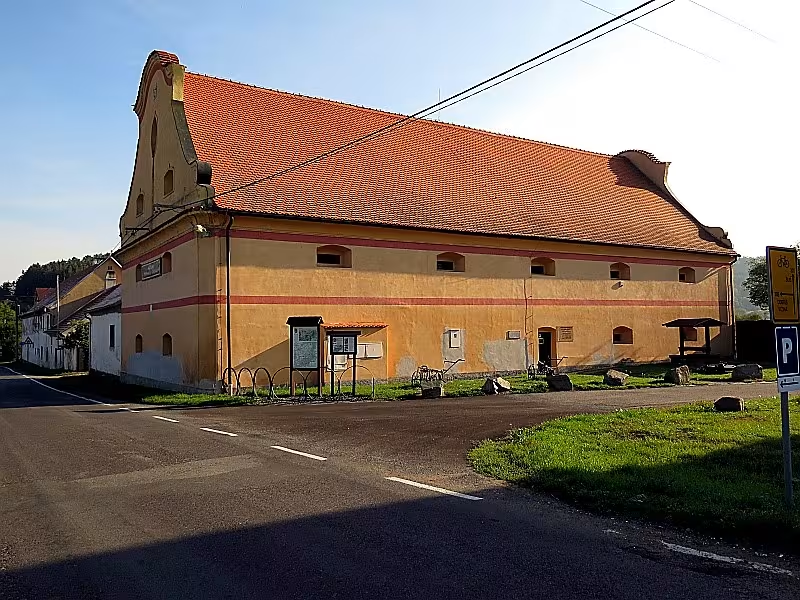
Sýpka v Prostřední Lhotě is a monumental Baroque building in the part of the village of Chotilsko in the district of Příbram. Since 2004 it has served as a museum dedicated to the life of the rural population of Central Povltavi. This four-story building is listed in the Central List of Real Cultural Monuments of the Czech Republic. It represents a significant legacy of the economic estate of the order of the Crossroads with a red star.
The history of the site dates back to the 14th century. Central Lhota and neighbouring Záborna Lhota were founded by Kucman from Hohenstollen, a townsman from the New Book who was rich in gold mining in the region. The middle Lhota lies on the north edge of the golden red region of the Dog Mountain on the left bank of the Vltava. In 1669 he bought the Knight's Order of the Crusaders with the red star of the Old Book estate from Petr Vratislav of Mitrovice, which included this village. In 1770, they built themselves as part of the local farm. At the time of its creation, there were enlightenment reforms under the rule of Marie Theresa in Czech countries.
Architecturally it is a monumental four-storey building with a saddle roof and rounded corners. The building is mostly exposed from a quarry stone, the masonry is equipped with bricks and the roof is covered with burnt bags. The main western shield is oriented towards the road. It is optically voluously shaped, horizontally divided by decorative plates and ended with a bell-shaped peak. In the middle of the upper part of the shield is a rectangular cartouche with a cruiser star and the year 1770. The interior of the granary is divided into three floors and an attic which connects a steep wooden staircase. All floors have beam ceilings with plank cover and plank floors. During the later reconstruction, the original wooden ventilation tower was removed from the ridge of the roof.
The fate of the building was closely linked to its ownership. After the construction, the Crossroads' granary belonged to a red star. In the second half of the 20th century, the building was used as a warehouse by the Economic Co-operative of the warehouse and production from Dobrovich. At the beginning of the 21st century, this historic Baroque building was reconstructed thanks to the support of the village of Chotilsko.
Today, the building is the headquarters of the Mining Museum branch in Pribrami. The museum exhibition in the Middle Lhota is dedicated to the life of the rural population of Central Povltavi and was opened on 2 July 2004. The building is located on the southern edge of the village in the place where the local road to Libčice is diverted from road 102.
The historical granary represents a valuable document of rural life and Baroque architecture in this area. Her visit offers insight into the history of the Central Supremacy and the lives of people around the Golden Rim.
Historical milestones
- around 1350
- The foundation of the village of Middle Lhota Kucman from Hohenstollen
- 1669
- Redemption of Old Book Manor by the Order of the Crossroads with the Red Star
- 1770
- Building a granary as part of a farm
- around 1950
- Use of the building as a warehouse by economic cooperative from Dobrovich
- 2004
- Opening a museum dedicated to the life of the rural population
Architectural development
The building is mainly exposed from quarry stone with local accessories made of bricks and covered with burnt bags. The western shield is bent volutous with decorative moldings and cartouche with cruiser star. During the later reconstruction, the original wooden ventilation tower was removed from the roof ridge.
Historical events
1770: granary construction; 2004: opening of the Museum of Life of the rural population of Central Povltavi.
Owners
order of Crossroads with red star (from 1669), Economic cooperative warehouse and production from Dobří (2nd half of the 20th century), municipality of Chotilsko (present)
Points of interest
- It's a monumental Baroque building that was built in 1770 as part of a farm of the Order of Crossroads with a red star. - Since 2004, the building has been used as a museum dedicated to the life of the rural population of Central Povltavi. - The building has four floors, it is built mainly of quarry stone and has a bent volt shield with a bell top. There's a rectangular cartouche on the shield with a cruiser star and 1770. In the second half of the 20th century, the granary was used as a warehouse for the Dobrovich cooperative.
Guide
Show guide text
This text was created by artificial intelligence and has not been editorially reviewed. It may contain inaccuracies.
Welcome to Middle Lhota. Right now, you're standing in front of a building that, in its size and appearance, dominates the surrounding landscape. It's a granary, a monumental building that will impress you with its power at first glance. In front of you you can see an object which is not just an ordinary house, but a real witness of centuries, written in the list of real cultural monuments of the Czech Republic. Stop for a moment, take a breath and feel the atmosphere of this place where the history of agriculture is linked to the spiritual heritage of the past.
If we were to go back in time now, we would have to go deep into the Middle Ages, until a thousand and three hundred and fifty, when the village of Promedium Lhota was founded by a man named Kucman from Hohenstollen. That was the beginning of the fate of this place. But the building you're standing in front of is much later. The key moment was the year of the thousand six hundred sixty-nine when the Old Book Manor bought the Order of the Crossroads with the Red Star. It is these clergy with craft and economic aim that have begun to build their background here. The granary you see was built in a thousand seven hundred seventy as an important part of their farm. At that time it was a strategic point for storing cereals, which was the basis of the survival and wealth of the entire estate in the agricultural landscape.
Now please pay attention to the architecture itself. Look up on the roof and finish it. Notice the characteristic volute shield, which is a typical element of the Baroque period. These elegant shield curves add nobility to the building and distinguish it from ordinary economic structures at that time. The building is finished with a saddle roof, which complements its balanced appearance. If you look closer at the walls, you'll see that the building is built mostly of quarry stone, which gives it a sense of stability and unshakefulness. Note also the height of the object. The granary has a total of four floors, which at the time indicated a huge amount of supplies that the Order was able to store here. The whole area acts as a fortress to protect the earth's most precious fruit from moisture and thieves.
Now let's think about who worked in these areas. Although we do not know today the names of the particular architects who drew this plan, or the names of the individual workers who laid the stones, we know that there was constant violence. Imagine here people in eighteenth century clothing, the sound of carriages full of grains, dust in the air, and the strict order brought here by the Crusaders with the red star. This building was not just a warehouse, it was the heart of the economy of the farm. Every grain of wheat or rye that was stored here meant safety for the people around it.
But the history of the granary does not end with the passing of the monks. The times have changed and the use of this space. Around the year a thousand and nine hundred and fifty became part of another system. At that time, it was used as a warehouse by an economic cooperative from Dobrovich. It was a period when the granary returned to its original purpose, i.e. to store raw materials, but already in the spirit of the time when agriculture was modernised and organised into cooperatives. The building thus survived these turbulent years without losing its integrity and beauty.
And now we're coming up with one of the most interesting changes that the granary has become in a new context. Since the year two thousand four no longer store grain, but human memory. The building became the headquarters of the Mining Museum branch in Příbrami. It is fascinating that the space that once served to accumulate material values now serves to accumulate knowledge and memories. The internal exhibition is dedicated to the life of the rural population of the Central Světáví. It is a place where you can find out what the daily effort, joy and misery of the people who lived here looked like and worked in the fields and in the forest and formed the face of this region. It's a bridge between the past and the present.
The interesting thing that may interest you is this contrast. Imagine that in one and the same building, the baroque elegance of the volute shield meets the stillness of the quarry stone and the stories of ordinary people from the countryside. The granary works like a big archive. First she archived the earth's crops, then later she became an archive of human destinies. It is a monumental reminder of how the social structure changed from the time of the Crossroads through the cooperative system to today's museum care.
Now that you have become familiar with the exterior and history of this unique object, we invite you to further explore. If you have the chance, enter and be carried out exhibits that reveal the details of life in the Uvltava. Feel the silence of the thick stone walls that carry echoes of a thousand seven hundred seventy. Go through the floor that once hosted tons of grain and now hosts memories of the people who made up the history of this village.
Thank you for spending a moment with us at this beautiful Baroque monument. We hope you are interested in the Grave of Lhota with its history and architecture. We wish you a pleasant rest of the tour and many new discoveries in this beautiful corner of the country. Goodbye.
Tips for visitors
The best time to visit is late spring or autumn, when the landscape around Vltava shines with colors and the building excels in natural light. Use your own car or public transport to get to the Middle Lhota, check the specific connections in the current timetables.
To visit we recommend to wear comfortable shoes suitable for rural terrain and camera. The building is a monumental building from 1770, so prepare to observe the details of Baroque architecture.
For the best photos we recommend to come in the morning or late afternoon lights that highlight the texture of the facade. The most interesting views offer the surrounding area of the building, where its size and historical significance can be seen.
The surrounding area offers the possibility of walking in the northern part of the golden-ore region Dog mountains, located near the Vltava. It's the perfect path for those who want to link history to nature.
Families with children will appreciate the area around the granary and the opportunity to tell the children stories about the old economic estates and order of the Crossroads who built the building.
Frequently asked questions
Can the monument be visited?
Some buildings of this kind are open for guided tours, others serve another purpose or are privately owned. We have not verified whether and when this monument is open – please ask the operator.
What are the opening hours and admission?
We have not verified the opening hours or admission. Current information is published by the operator.
Why is the monument protected?
It is listed in the Central List of Cultural Monuments of the Czech Republic as a cultural monument (register no. 1000148848).
Businesses nearby
Do you run a restaurant, accommodation, shop, museum, rental, wellness or other visitor service near this monument? Show yourself directly to the people heading to it — this is how they will see you in the app and on the web:
Events nearby
Zdroj akcí: otevřená data měst a obcí ČR (Národní katalog otevřených dat) a kalendář akcí Národního památkového ústavu.
Nearby
Budova se nachází na severním okraji zlatorudního revíru Psí hory v blízkosti Vltavy.
Accommodation nearby
Themed route
Travel route:
1. Sýpka v Prostřední Lhotě (museum) - The main destination of the trip, where you can see the historical building and exposition. 2. Golden ore region of the Dog Mountain (area) - A place with a history of searching for precious metals, located near the museum. 3. Vltava (river) - Natural dominant in the surroundings, suitable for walking by the water.
Seasonal recommendations
In spring, the surrounding area of the granary wakes up to life and the building stands out among the fresh greenery. Soft spring light is ideal for observing construction details. We recommend shoes suitable for wet grass and visit in the morning when the air is the cleanest.
In the summer months the landscape is dominated by bright sun and hot air. Massive granary walls offer pleasant cold and shade. The best time for arrival is the late afternoon, when the sun falls and does not burden the sight. Don't forget light clothes and heat protection.
Autumn paints the surrounding nature into golden and brown tones, creating a nostalgic atmosphere. The fog in the morning gives the memory a mysterious look. It is advisable to choose layered clothes and visit the place when the colours of the leaves are most intense.
In winter, the granary acts in quiet and calm, possibly under a layer of snow that accentuates its shapes. The lighting is weak in this period and the days are short. A warm jacket, hat and non-slip shoes are necessary for comfortable movement.
Visualizations and artistic views

The visualisations are generated by artificial intelligence and serve as inspiration.
Photos from the area
Real photos taken near the monument


Zdroj a licence jsou uvedeny u každého snímku.
Tips from visitors
No tips yet. Be the first!
Log in and add your tip.
Sources and literature
Photos: Sovicka169 / CC BY-SA 4.0 — Wikimedia Commons. The author and licence also appear when you hover over the image.
Faktickým podkladem tohoto textu byl článek na Wikipedii, jehož autory jsou přispěvatelé Wikipedie. Článek je dostupný pod licencí CC BY-SA 4.0.
Location on the map
Příběhy a pověsti
Legendy, pověsti a příběhy spjaté s touto památkou
Fotografie návštěvníků
Zatím žádné fotografie. Buďte první, kdo přidá fotografii z návštěvy!
Log in a přidejte svou fotografii nebo hodnoťte.
Za ověřenou návštěvu v aplikaci získáte víc bodů — poznáme podle GPS, že jste na místě.
Reviews and comments