






Větrný mlýn (Brušperk) Windmill
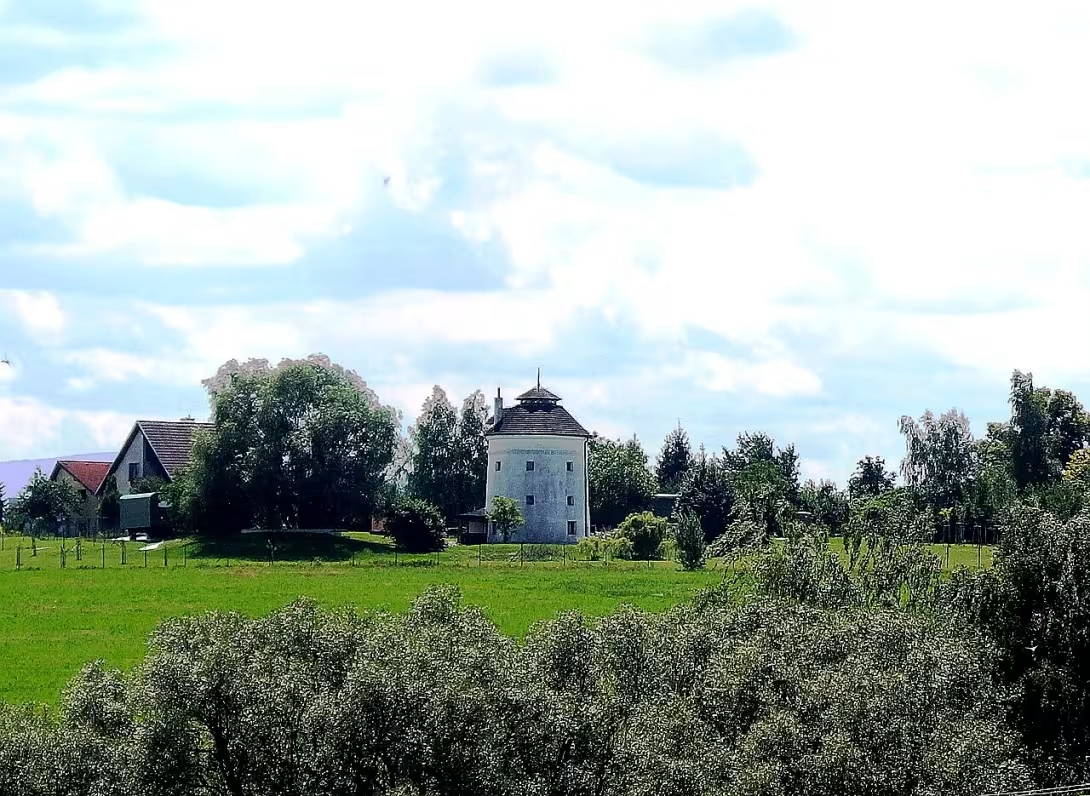
The windmill in Brušperk is a walled-up classical building of the Dutch type. It originated around 1830 at an altitude of 280 metres. Since 1992, the building has been protected as a cultural monument of the Czech Republic and represents an important evidence of technical development in the foothills of Beskyd.
The construction was built in the period of national renewal and the beginning of the industrial revolution, in the era of political stability after the wars of Naples. The mill was built on an elevated location northeast of the town centre Brušperk in the Frýdek-Místek district.
Architecturally, it is a three-storey plastered object on a circular plan. The upper part above the windows is decorated along the perimeter of the ledge with the tooth cut. The mill covers a conical roof with shingles. In the place where the windwheel shaft was originally located, there is a skylight with a saddle-backed roof.
The first known miller was Lysek, who owned the building until 1860. He then sold it to Jan Lednický and the mill remained in his family's possession. During the 20th century, the building underwent a major technological change. In 1940 it was equipped with cylindrical stool and converted to electric drive, the original wind wheel was removed. In the past, the building also served as a warehouse and underwent a series of reconstruction.
The history of the mill is linked to the fate of the miller Viktor Lednický. In 1941 the mill was officially sealed, but the miller continued despite the ban on grinding. Viktor Lednický was also active in the antitinetic resistance, for which he was arrested in 1941 and executed on 19 October 1944.
Currently, the building serves as a private recreational facility. Although it has undergone many reconstructions, it has retained an external historical character that reminds itself of the region's technical past.
This mill is an example of the transformation of the technical monument into a modern recreational object, a fate shared by many similar constructions in the Czech environment. The visit to Brušperk offers an opportunity to see this historic building, which, despite its new use, remains an important witness to local history.
Historical milestones
- 1830
- Construction of a windmill.
- 1940
- Installation of cylindrical stool and electrification mill.
- 1992
- Declaration for the cultural monument of the Czech Republic.
Architectural development
Originally a Dutch-type windmill was later converted into an electric drive. The construction is walled, plastered, with a circular plan and a skylight at the site of the original shaft. In the past he also served as a warehouse and underwent a series of reconstruction.
Historical events
In 1940 the mill was equipped with cylindrical stool and electrified. Miller Viktor Lednický was arrested in 1941 for resistance activity and executed in 1944. In 1992, the building was declared a cultural monument.
Owners
Lysek (until 1860), Jan Lednický (from 1860), family Lednický, currently private owner.
Points of interest
- The windmill in Brušperk is a walled-up classical building of the Dutch type, which was built around 1830 at an altitude of 280 metres. - The building has been protected as a cultural monument of the Czech Republic since 1992. - In 1940 the mill was equipped with cylindrical stool and converted to electric drive, the original wind wheel was removed. - The miller Viktor Lednický was active in the antitinetic resistance, for which he was arrested in 1941 and executed in October 1944. - Currently, the building serves as a private recreational facility.
Guide
Show guide text
This text was created by artificial intelligence and has not been editorially reviewed. It may contain inaccuracies.
Welcome to Brušperk. Right now, they've stopped at something that's very special in this country. You are standing right in front of the windmill, which is a silent witness to the many years that have passed by. Before you go any further, pay attention to this object for a moment. Feel his presence, his strength, and the special harmony he carries. This round, walled machine, as you might say, is not just an ordinary building. It's a story about the power of nature and the human effort to control it.
Look at his shape. See that massive, circular structure that appears to be firmly anchored in the ground? This mill is built in the so-called Dutch style, which determines its specific appearance and the way it was designed. This whole building, which has three floors, began to emerge around 1830. Imagine that time when the world moved much slower and people had to be perfectly consistent with what the country and the weather offered. At that time, the wind was the main source of power that fueled life and work. This mill was built precisely so that it could use this invisible force to grind the grain and to ensure the livelihood of the people in this area.
Now that you've realized his age, look at the details right in front of your eyes. Notice this beautiful roof. It has the shape of a cone, and it rises to the sky. It is covered with shingles, which gives the construction its characteristic texture and ancient appearance. And if you look a little bit lower, just below the edge of the roof, you'll see a ledge. It's not just a simple edge, but it's beautifully decorated with a tooth cut. These small, regular shapes create an interesting shadow and rhythm under the roof, which gives the whole building a classical elegance. The whole building, even though it is a machine for work, carries the beauty that we see in it after nearly 200 years.
Now let's move forward in time and think about how this mill was changing. History is not static, things change to survive. During the last century, this object has undergone a fundamental transformation. Imagine the moment when the original wind wheel stopped moving. In 1940 it was decided that the mill would no longer depend solely on the wind blowing. A new technical solution was installed and the mill was converted into electric power. This was a huge change that meant that the work could continue even when the air sea was calm. It was during this period that the mill was also equipped with cylindrical stool, which further modernised its function. This transition time, when the old tradition met with new energy, is still felt in the body of this building.
When you look at these walls, you can ask who's been moving around in this place. Even though the names of the builders themselves have not gone away, we know of the people who were closely associated with this place. Names such as Lysek, Jan Lednický or Viktor Lednický are associated with and associated with this history. They're characters who left their mark in this place, whether through work, ownership or caring for this place. Each of these personalities is part of the complex tissue of history that is here in Brušperk.
Now I want to invite you to think about one interesting thing. This mill stands at an altitude of 200 feet. It's a place where the wind has its strength and history meets natural conditions. You may find it strange that such an old machine that once fought the wind serves today as a private place to rest and recreation. It is a fascinating transformation - from a place of hard work and constant movement has become a place of calm and visitors who want to enjoy the atmosphere of history.
Finally, please pay attention to how valuable this place is. Since 1992, this windmill has been officially declared a cultural monument to the Czech Republic. That means his existence is protected as part of our common heritage. It is proof that even a building that has undergone so many changes deserves to be preserved for future generations.
Now that you know about its beginnings, its architecture and its changes, I suggest you continue your walk. Look around, see the atmosphere of this place and try to imagine how it was here hundreds of years ago. Thank you for spending this moment with us and for being interested in this piece of history. We wish you a wonderful trip and many other interesting experiences in the next survey area. Goodbye.
Tips for visitors
The best time to visit is during sunny days in the late afternoon, when the low sun beautifully paints the details of the masonry facade and shingles roof. At this time, you will avoid direct bright light and take impressive pictures.
You can easily reach the monument by car or local transport directly to the village Brušperk. Parking is possible in the nearby area, we recommend to monitor local traffic signs for safe shutdown.
Take with you fixed shoes to move around the mill in the field and camera with wide-angle lens to capture the entire circular structure with the surrounding landscape foothills of Beskyd.
In the immediate surroundings you can explore the picturesque village Brušperk, which offers a quiet atmosphere typical of this Frýdek-Místek district, ideal for walking.
For families with children, the place is suitable as a stop on a trip to nature. Children can admire the unique conical shape of the building and explore the surrounding grassy areas that are safe to move.
Businesses nearby
Do you run a restaurant, accommodation, shop, museum, rental, wellness or other visitor service near this monument? Show yourself directly to the people heading to it — this is how they will see you in the app and on the web:
Nearby
Obec Brušperk, okres Frýdek-Místek, krajina v podhůří Beskyd.
Accommodation nearby
Themed route
Thematic cruise route from Brušperk
1. Větrný mlýn (Brušperk) - monument The main objective of our route is the historic windmill, which stands in the center of the village Brušperk. This mill is an example of the technique of the past and its architecture captures every visitor. It's the perfect place to understand the history of miller in this area.
2. Peak Beskyd - natural environment After visiting the mill we will look at the surrounding landscape beauty foothills of Beskyd, which surround Brušperk. These places offer quiet moments for relaxation and views of the natural landscape around the town. Beautiful greenery and clean air from the Beskyd foothills are ideal for short walks.
3. Center Brušperku - cultural and historical space Subsequently we move to the center of Brušperk, where you can discover small alleys with old buildings. The centre offers the opportunity to explore local shops and restaurants that allow you to know the cultural and gastronomic life of this part of Frýdek-Místek district.
4. Ambient Lesy - natural space If you like nature walks, we recommend visiting the surrounding forests of Brušperka. These green areas are ideal for relaxing in the sun or for short marches and cycling trips. Forests offer a quiet place to relax and an opportunity to enjoy fresh air.
5. Ancient Domy - architectural monument At the end of the route we will look at some of the ancient houses in Brušperk, which resemble the history of the town. These houses are an important element of cultural heritage and their architecture is interesting for anyone interested in historical buildings.
This route offers you the opportunity to know not only the windmill Brušperka, but also its surroundings and cultural heritage.
Seasonal recommendations
In spring the mill will surround the lush green and the first flowers that will give the place a fresh look. Soft spring light is ideal for observing construction details. We recommend to wear more layers of clothing because the weather is variable, and visit the monument in the morning.
The summer season brings bright sun and rich green landscape, which contrasts beautifully with the mill colours. The atmosphere is full of energy and life. Because of the largest number of visitors, it's best to come first thing in the morning. Don't forget light summer clothes and plenty of fluids.
Autumn turns the surroundings into a sea of gold and red colors, creating a nostalgic and calm mood. Fog in the valley can give the building a mysterious look. Moisture resistant shoes and late afternoon visit, when the light is warmer.
In winter the mill works majestically, especially if it is covered with snow and the sky is freezing blue. There is silence and peace. It is necessary to wear warm winter clothes and to verify the opening times in previous days which are shorter in that period.
Visualizations and artistic views


The visualisations are generated by artificial intelligence and serve as inspiration.
Photos from the area
Real photos taken near the monument


Zdroj a licence jsou uvedeny u každého snímku.
Tips from visitors
No tips yet. Be the first!
Log in and add your tip.
Sources and literature
Photos: Palickap / CC BY-SA 4.0 — Wikimedia Commons. The author and licence also appear when you hover over the image.
Faktickým podkladem tohoto textu byl článek na Wikipedii, jehož autory jsou přispěvatelé Wikipedie. Článek je dostupný pod licencí CC BY-SA 4.0.
Location on the map
Příběhy a pověsti
Legendy, pověsti a příběhy spjaté s touto památkou

Fotografie návštěvníků
Zatím žádné fotografie. Buďte první, kdo přidá fotografii z návštěvy!
Log in a přidejte svou fotografii nebo hodnoťte.
Za ověřenou návštěvu v aplikaci získáte víc bodů — poznáme podle GPS, že jste na místě.
Reviews and comments