



Vodní mlýn (Loučky) Water mill
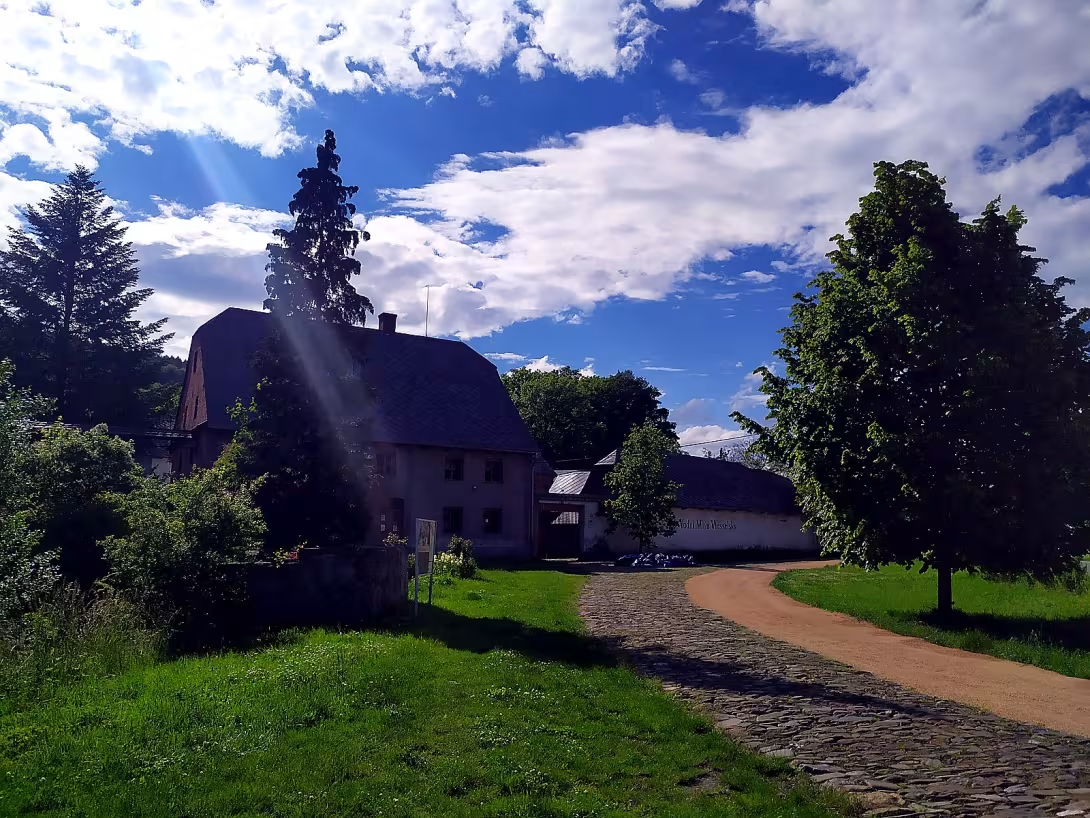
The Wesselsky Water Mill, also known as the Pazera Mill, is a historic Renaissance building on the right bank of the river Odry in the cadastral area of Loučky nad Odrou in the district of Nová Jicin. This technical monument with a history dating back to the 16th century represents a unique set of original mill facilities. Since 1999 the building has been protected as a cultural monument of the Czech Republic.
The first written mention of the mill dates back to January 25, 1571, when Jan Tomáš ze Zvole a Goldštejna handed over the fojt mill to Paul Schwarz. The Czech countries were then in a period of late Renaissance under the rule of the Habsburgs, when the nobles strengthened their power in the countryside. The Privileges issued when the mill was handed over defined precisely the obligations of the subjects. They had to maintain the river and drive, bring back mill stones and ensure the transport of grain to grinding and scrapping.
Architecturally, the building is connected with the use of hydroenergy. The drive starts in Jakubčovice and after almost three kilometres brings water to the building. Near the mill, the drive is lined with a quarry stone. The original technological equipment included three water wheels of the type of top water receptacle, which powered the milling composition, scrap mill and saw. In 2008, a new six-piece water bike was installed, including a renewed water path with vantroks and floodgates.
The ownership history of the mill is closely linked to the Wesselsky family, which purchased the building in 1762 and managed it until the end of World War II. The main owners were Lorenz Wesselsky, which in 1797 bought and concluded a contract with the head of the maintenance of the drive and saw. The last owner of this genus, Ferdinand Franz Wesselsky, ensured the production of electricity for part of the village. After his tragic death at the end of World War II and the subsequent displacement of the family he took over the mill in 1946 Hubert Pazdera, a relative of the original owners.
Key events in the history of the building include the development of miller activity and the gradual introduction of modern technologies such as electricity production, which took place in the mill until 1947. In 1959, Hubert Pazdera was forced to join the Single Agricultural Cooperative, which used the premises until 1983. Since 1997, she has been the owner of Vera Králová, who, together with her family, has started a gradual renewal of the monument.
Today the mill serves for accommodation and thanks to preserved technologies it is valuable proof of historical management in Oder. Visiting this place offers the opportunity to familiarize ourselves with a unique set of original facilities and technical solutions that have provided for the livelihood of local people for centuries. The preservation of this building is an important contribution to the knowledge of our technical history.
Historical milestones
- 1571
- The first written mention of the mill and the issue of the privilege of Jan Tomáš from Zvole.
- 1762
- Johann Wesselsky buys a mill for his son Valten.
- 1946
- Hubert Pazdera takes over the mill after the Wesselsky family.
- 1999
- The building is declared a cultural monument of the Czech Republic.
Architectural development
The original mill had three water wheels for the top water. The mill is lined with a quarry stone and measures almost three kilometres. The building has undergone a number of modifications over the centuries, including installation of electrical power generation equipment, and is currently being gradually restored.
Historical events
In 1571 a privilege was granted for the mill by Jan Tomáš from Zvole. In 1762 the mill bought Johann Wesselsky, thereby starting a long era of ownership of this genus. In 1999 the building was declared a cultural monument of the Czech Republic.
Owners
Jan Tomáš ze Zvole a Goldštejna (1571), Paul Schwarz (1571), Georg Willischner (1600), the Wesselsky family (1762-1946), Hubert Pazdera (1946- 1997), Vera Kralove (since 1997).
Points of interest
- The building is a historical Renaissance building, which since 1999 is protected as a cultural monument. - The first written mention of the mill dates back to January 25, 1571. - The drive bringing water to the building begins in Jakubčovice and measures almost three kilometres. - In 2008 a new six-tonne water wheel was installed, which complements the renewed waterway. - The last owner of the Wesselsky family provided electricity for part of the village.
Guide
Show guide text
This text was created by artificial intelligence and has not been editorially reviewed. It may contain inaccuracies.
Welcome to the water mill in Loučky. Right now, you are standing on the right bank of the Odry River and you have a place in front of you that is a living witness to many centuries of human effort, work and change of nature. Before you go any further, stop for a moment and feel the atmosphere of this place. Do you hear the constant movement of water? That sound is the heart of this entire compound. In front of you is a historic building that acts as a fixed point in a rapidly changing world. This object, which people in the area know under the names of the Wesselski or Pazera Mill, is not just an ordinary building, but the real treasure of our region.
Let's go back deep into the past together to understand how this mill came into being. If we want to find full beginnings, we have to move back more than four centuries. The first paper trail that tells us about this place dates back to 1571. In that year Jan Tomáš of Zvole issued a special right, a privilege that allowed this place to begin its long journey. The first man to become the real owner was Paul Schwarz. Since then, the mill has become an integral part of living in this landscape. Every decade, every year, new owners and new challenges have brought, but the mill has continued to exist here, using the power of water and still serving the people.
Now pay close attention to the construction itself and to what you see around you. This object is an excellent example of Renaissance architecture. Although time changes relentlessly, its basic character remains preserved. Notice how the building is located right next to the water. It wasn't an idea, it was a necessity. In order for the mill to work, it had to have a constant supply of power. And this is where human ingenuity meets natural strength. Look at the drive that brings the water to the mill. It's a fascinating technical element. This water channel does not start right here, but its journey begins much further, in the village of Jakubchovice. This water travels almost three kilometers to eventually reach here and spin the wheels of this mill. It's an incredible story of water that travels a long way just to help people process their crops.
When you look at the structure of the mill, you might be wondering what it was all for. In the past, this complex was much more complex than it might seem. It wasn't just one machine, it was the whole system. At some point this space was equipped with three water wheels. This bike wasn't just for decoration. It was the motor power of the time. She helped milk the grain for the whole area, served for scrapping and was also connected to a saw that processed wood. The mill was therefore the center of everything important for the survival and development of the local community. During the twentieth century the mill even adapted to modern times and began to produce electricity that served directly for the needs of the village. So you see how this object was constantly evolving along with human technology.
The history of this place is also a history of large families and important personalities. You can imagine all the people who worked here all their lives. Names like Georg Willischner, Martin Weigl or Count Franz Leopold Lichnovský appear in history. But one of the most important families associated with this place was the Wesselsky family. In 1762 Johann Wesselsky bought this mill for his son Valten, laying the foundations for a long period of their operation. Followed by other family members such as Lorenz Wesselsky or Ferdinand Franz Wesselsky, who took care of the mill and kept it going. Then, in 1946, there was a big change when the mill took over the Hubert Pazdera, after which it bears one of his famous names. These families didn't just build property here, they created a tradition that still exists today.
I want to tell you now one thing that may surprise you, which shows how much this mill is still alive. Even if it's a historical monument, there's always something going on in it. There was a great improvement in 2008. A new water bike was installed here. Imagine its size and weight - it weighs six tons! It is a modern element that has come together with the historical one, which again gives this place its full feel. It's proof that old things can have new power if you take care of them.
And it is the care of this object that is important. In 1999 this mill was officially declared a cultural monument of the Czech Republic. This means that his history, his face and his souls are now protected by law for future generations. It's not just an old house by the water, it's our common heritage.
Now that you know the stories that are hiding behind these walls, and you know how long the water has traveled to be here, I suggest you continue your search. Take a look at the surrounding countryside, feel the calm of the Odra River, and try to imagine how it was here hundreds of years ago when there was a sound of pounding of drinking and grinding of grains. Thank you for spending this moment with us and for being interested in the history of this special place. We wish you a nice walk and many other interesting experiences in our beautiful landscape. Goodbye.
Tips for visitors
The best time for the tour is late spring or summer, when the surrounding nature of the Oder hills is fully blooming and the river Odra offers pleasant refreshments. In this period you will enjoy the atmosphere of the historical mill in its natural environment.
The memory can be transported comfortably by private car. If you choose public transport, use the local connection to the village Jakubčovice nad Odrou, from where it is a short walk to the mill; Check the exact connection in the current search engine.
We recommend to wear fixed shoes suitable for movement in natural terrain and on historical floors of the mill. Do not forget the cap and water bottle, especially if you plan to stay longer in the surrounding countryside.
The best pictures are taken in the morning, when the sun lights up the mill from the river. The ideal place for photography is the view from the right bank Odry, which captures the mill in context with running water and surrounding greenery.
For families with children, a visit to the mill is an interesting lesson in the history of nature. Children will appreciate the proximity of the river Odry and the opportunity to observe the natural landscape. We recommend to combine the tour with a light walk along the river flow towards the village of Jakubčovice nad Odrou.
Frequently asked questions
Can the monument be visited?
This is a technical monument. Some are open as exhibitions, others are out of use or on private land. We have not verified whether this one is accessible.
What are the opening hours and admission?
We have not verified the opening hours or admission. Current information is published by the operator. Official website: http://www.vodnimlyn.cz/
Where is the monument?
Location: Odry, Moravskoslezský kraj. The map on this page shows the exact spot.
Why is the monument protected?
It is listed in the Central List of Cultural Monuments of the Czech Republic as a cultural monument (register no. 1000163151).
Businesses nearby
Do you run a restaurant, accommodation, shop, museum, rental, wellness or other visitor service near this monument? Show yourself directly to the people heading to it — this is how they will see you in the app and on the web:
Nearby
Řeka Odra, obec Jakubčovice nad Odrou, přírodní krajina Oderských vrchů.
Accommodation nearby
Themed route
Thematic cruise route: Vodní mlýn (Loučky) and surroundings
1. Vodní mlýn (Loučky) - Mill The main goal is to visit the historic water mill, which represents the technology and life in the countryside from the past. It is an ideal place for those who like industrial architecture and history.
2. River Odra - Natural landmark A short walk along the banks of the Odra River offers beautiful views of the natural landscape and the opportunity to relax. This point is ideal for nature lovers and relaxation.
3. Municipality of Jakubčovice nad Odra - City Visit the small town of Jakubčovice, where you can enjoy quiet walking on the streets and possibly visit the local market or restaurant. This place offers a view of life in a small Czech town.
4. Natural landscape of Oder hills - Landscape area Explore the surrounding natural landscape, rich in wild flora and fauna. This item is suitable for people in love with mountain trips and landscape tourism.
5. Municipality of Odry - City Weigh your visit to the village Odry where you can discover local cultural monuments and architecture. This place is suitable for those who want to learn more about the history and culture of the region.
This route offers a combination of history, nature and local culture, making it ideal for a day trip.
Seasonal recommendations
Spring: In spring, the surroundings of the mill awaken to life. The water in the stream has great power due to the melting of the snow and nature is beginning to green quickly. The light is fine in this period, which creates a pleasant atmosphere for walks. I recommend a visit in the morning. The clothes should be layered, because the morning cold can still feel, but the afternoon can be warm.
Summer: In summer there are the most sunny days and dense greenery around the mill provide a pleasant shade. The atmosphere is alive and warm. It is best to arrive early in the morning to avoid the biggest crowds and the highest heat. Dress lightly and don't forget to protect yourself from the sun.
Autumn: Autumn brings gold and copper to the landscape, which are beautifully reflected in calmer water. Morning fog gives the place a melancholy and peaceful touch. It's the best time for those who want to be alone. Prepare waterproof shoes and laminated clothes, because humidity and cooling air can be more challenging.
Winter: Winter at the mill is very quiet and almost deserted. Here you can experience beautiful views of the frost or snow covering historical wood. Since the days are short, plan a visit around noon to use daylight. It is necessary to have very warm clothes and tight shoes in case of ice on the road.
Visualizations and artistic views


The visualisations are generated by artificial intelligence and serve as inspiration.
Photos from the area
Real photos taken near the monument

Zdroj a licence jsou uvedeny u každého snímku.
Tips from visitors
No tips yet. Be the first!
Log in and add your tip.
Sources and literature
Photos: Fried Marek / CC BY-SA 4.0 — Wikimedia Commons. The author and licence also appear when you hover over the image.
Faktickým podkladem tohoto textu byl článek na Wikipedii, jehož autory jsou přispěvatelé Wikipedie. Článek je dostupný pod licencí CC BY-SA 4.0.
Location on the map

Příběhy a pověsti
Legendy, pověsti a příběhy spjaté s touto památkou

Fotografie návštěvníků
Zatím žádné fotografie. Buďte první, kdo přidá fotografii z návštěvy!
Log in a přidejte svou fotografii nebo hodnoťte.
Za ověřenou návštěvu v aplikaci získáte víc bodů — poznáme podle GPS, že jste na místě.
Reviews and comments