



zájezdní hostinec v Brandýse nad Orlicí House
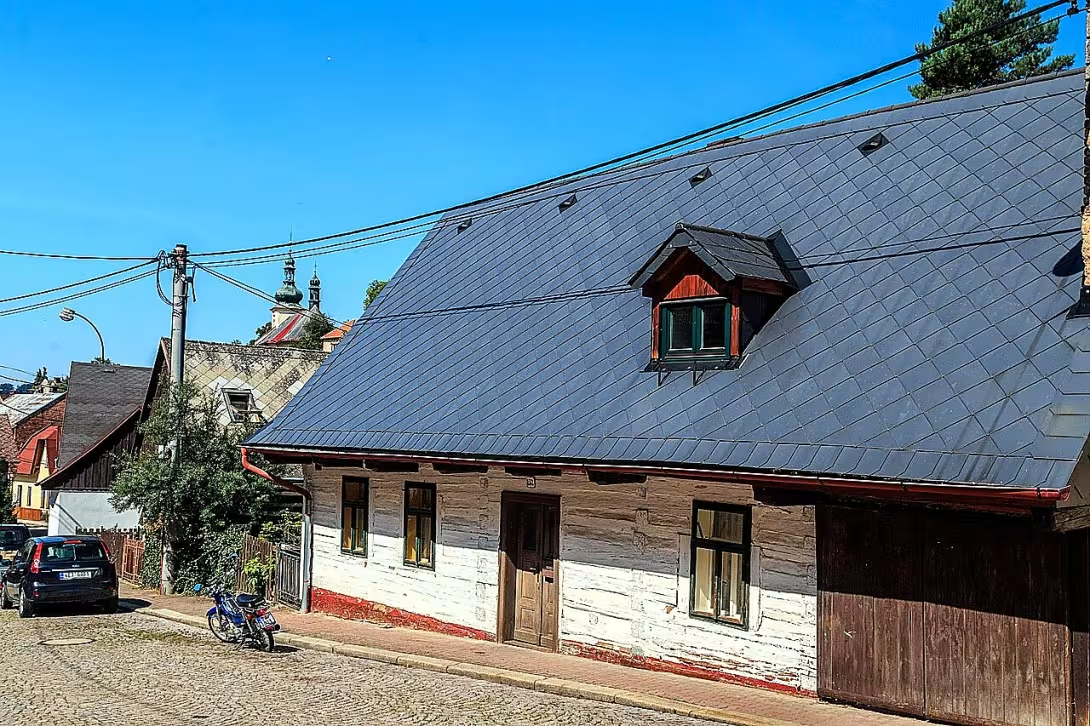
The former guesthouse no. 152 in Brandýse nad Orlicí is a terraced ground floor house which has since 1997 been protected as a real cultural monument. The building is located on Husova Street and represents traditional folk architecture with preserved tripartite layout.
There are few reports of the oldest history and the exact creation of the building. Historical sources, however, confirm that the house served as a tourist inn, which corresponds to its location and construction arrangement.
The building is oriented by the side side along the street and stands out with the grafted construction of the ground floor. The inner space divides the passable hall that leads to the courtyard and separates the living room from the former chamber. The residential area is lit by two windows facing the street while the chamber has one smaller window. The western shield facade has preserved the original grafted wall, but from the outside it has been reinforced by a new line of nodding without holes. The shield with the fracture covers the eternite templates and two smaller rectangular windows light up at the top.
The object has undergone modifications over time that changed its original appearance. While the ground floor remained in the grafted technique, the attic was adapted to live. This modernization included installation of a skylight and a change in the lighting of the attic.
The construction is a valuable proof of traditional rural architecture in the valley of Tiché Orlice. The visitors of Brandýs nad Orlicí have the opportunity to see the historic house, which, despite the recent interventions in the attic and the external admissions, maintains the characteristic features of its original disposition.
Historical milestones
- around 1800
- Probable period of construction of the timbered house as a coaching inn
- 1997
- The building was declared a cultural monument
- around 2000
- Adaptation of the attic for residential use and installation of a dormer window
Architectural development
The original grafted construction of the ground floor was completed over time with a new addition on the west side. Soil spaces were adapted for housing and equipped with a modern skylight. The shield facade is covered by eternity templates.
Points of interest
- Former zájezdní hostinec v Brandýse nad Orlicí has been protected as a real-estate cultural monument since nineteen hundred ninety-seven. - The house is a ground floor building made of wooden beams and represents traditional folk architecture with preserved tripartite layout. - The inner space divides the passable hall that leads to the courtyard and separates the living room from the former chamber. - The western shield facade has a preserved original wall made of wooden beams, which is reinforced from the outside with a newer slot without holes. - The attic of the building was adapted for living, which included installation of a skylight and changing the lighting of the attic.
Guide
Show guide text
This text was created by artificial intelligence and has not been editorially reviewed. It may contain inaccuracies.
Welcome to the beautiful town of Brandýs nad Orlicí. You have just stopped in front of a building that tells a quiet yet profound story of old roads, human hospitality, and how the world around us changes. You are standing directly in front of house number one hundred and fifty-two. At first glance, it may look like a simple, traditional country house, but believe me, beneath its wooden skin lies a history that reaches deep into the past. Feel the atmosphere of a place where people from far and wide once met, seeking rest on their long journeys.
Imagine the time around the year eighteen hundred. This is likely the period when this log house was built specifically as a zájezdní hostinec v Brandýse nad Orlicí. In those days, roads were not as comfortable as they are today, and traveling across the region was a true adventure. The inn was an essential stop for travelers. It was not just a house; it was a haven where they could warm themselves by the fire, find sleep, and exchange news or simple folk tales. This house was thus the heart of local communication, a place where the movement of the world met the tranquility of country life.
Now, give your full attention to the building itself, right before you. Look at its construction. It is a single-story house built from traditional wooden beams. This building method, known as log construction, is a typical feature of our folk architecture. Notice how the beams seem sturdy yet organic, as if the house grew directly from this earth. It is a structure that does not feel foreign, but rather like a natural part of the landscape. The house is oriented sideways along Husova Street, giving it a specific appearance where its long side follows the path of the road.
If you could peek inside, you would see something very interesting, which you can imagine even now. The entire interior space is divided into three parts, indicating a so-called tripartite layout. This way of arranging spaces was very practical at the time. A walkthrough hall divides the space as a whole. Imagine this hall as the main artery of the house, connecting different rooms and allowing free movement between them. This hall was likely where guests moved before settling into the various parts of the house.
It is fascinating to see how this building has been preserved for us to this day. While the original ground-floor spaces—the oldest parts of the house—have remained in an almost untouched state, the upper parts of the house, the space under the roof, underwent a great transformation in modern times. Around the year two thousand, this attic area was adapted for modern living. If you look up at the roof, you can notice the installation of dormers—small windows in the roof's slope—which bring light into this old space and allow for life in a modern sense. This contrast between the old wooden ground floor and the newly renovated attic is proof that history does not have to stop, but can merge with the present.
Although time has not recorded in our archives the names of the specific innkeepers who served weary pilgrims here two hundred years ago, or the names of the travelers who sought shelter here, we can imagine them. We can imagine the sound of carriage wheels stopping at the door, the smell of freshly prepared food, and the murmur of human voices carrying through the country air in the evening. This house was a witness to countless human fates that paused for just a moment to regain strength for the journey ahead.
Something that might interest you is the fact that this is not just an ordinary old house. Since nineteen ninety-seven, this building has been officially declared a cultural monument. This means that the state and the community have recognized its immense value. It is not just wood and beams; it is a piece of our shared memory that must be protected from oblivion and destruction. It is one of those pillars that help us understand how our ancestors lived and what their daily reality looked like.
Look at it for a moment longer and try to feel the weight of time. Every beam, every gap in the wood has its own voice. Even though the world around us has changed, even though Husova Street has turned into a modern road and people no longer travel by horse, this house still stands here as a silent guardian of tradition.
I hope this short stop has helped you see more than just an ordinary building in this log house. Now that you know everything that took place within it and why it is so important to us, I invite you to continue your walk through the town. Every other street and every other house in Brandýs nad Orlicí may have its own hidden story just waiting to be discovered. Thank you for your attention, and I wish you a beautiful and inspiring journey ahead.
Tips for visitors
The best time to visit is during sunny days from spring to autumn, when the beauty of the timbered architecture and the surrounding nature truly shines. During this period, it is also easier to explore the adjacent river valley.
Please check current public transport connections via online search engines.
Morning light is ideal for photographing the exterior of the inn, as it highlights the details of the timbered construction. The best shots can be taken from Husova Street, from where the house is oriented by its side.
In the vicinity, we recommend a stroll through the town of Brandýs nad Orlicí, which offers a peaceful atmosphere, or a trip to the picturesque valley of the Tichá Orlice river, which is ideal for hiking.
The location is suitable for families with children thanks to the easy terrain around the river. Children can admire the traditional rural building and then set off for a walk along the riverbank, which is safe and easily accessible.
Frequently asked questions
Can the monument be visited?
This is a residential or farm building, not a museum with opening hours. Please view it from public space and respect the owners' privacy. We have no information about access to the interior.
Where is the monument?
Location: Brandýs nad Orlicí, Pardubický kraj. The map on this page shows the exact spot.
Why is the monument protected?
It is listed in the Central List of Cultural Monuments of the Czech Republic as a cultural monument (register no. 1000120735).
Businesses nearby
Do you run a restaurant, accommodation, shop, museum, rental, wellness or other visitor service near this monument? Show yourself directly to the people heading to it — this is how they will see you in the app and on the web:
Events nearby
Zdroj akcí: otevřená data měst a obcí ČR (Národní katalog otevřených dat) a kalendář akcí Národního památkového ústavu.
Nearby
Město Brandýs nad Orlicí v okrese Ústí nad Orlicí, údolí řeky Tiché Orlice.
Accommodation nearby
Themed route
1. The Tichá Orlice river valley, a natural area. A walk here offers peace and beautiful views of nature. 2. The town of Brandýs nad Orlicí, urban area. Stroll through the streets and experience the local atmosphere. 3. zájezdní hostinec v Brandýse nad Orlicí, dining. Here you can relax and recharge.
Seasonal recommendations
Spring: In the spring, zájezdní hostinec v Brandýse nad Orlicí is surrounded by flowers and trees beginning to bloom. The sun illuminates the architecture with its warm light, adding a touch of charm to the entire setting. Weather can be unpredictable during this time, so we recommend dressing for mild temperatures and perhaps bringing an umbrella to avoid any unpleasant weather. The best time to visit is early afternoon, when there are fewer crowds and nature is in full bloom.
Summer: Summer offers long days and warm sunlight that highlights the historical architecture of the zájezdní hostinec v Brandýse nad Orlicí. Nature is in full bloom, creating ideal conditions for a stroll around the monument. During the peak summer season, there may be more visitors, so we recommend arriving in Brandýs nad Orlicí earlier in the day or visiting the inn towards the end of the day. Light clothing and sun protection (sunglasses, a hat) are key.
Autumn: In autumn, Brandýs nad Orlicí transforms into a colorful landscape paradise with foliage in shades of gold and red. The sun illuminates the monument with a softer light, adding an atmosphere of peace and relief from the summer heat. The weather can change quickly, so it is advisable to be prepared with warmer clothing and perhaps an umbrella for sudden downpours. The best time to visit is early afternoon or early evening, when temperatures are milder and there are fewer people.
Winter: Winter in Brandýs nad Orlicí offers a breathtaking scene with snow-covered trees and the zájezdní hostinec v Brandýse nad Orlicí illuminated by the evening light. The atmosphere is peaceful, allowing you to enjoy the historical monument in the quiet weather. Warm clothing and protection against the cold (a scarf, gloves) are essential for a comfortable stay.
Visualizations and artistic views


The visualisations are generated by artificial intelligence and serve as inspiration.
Photos from the area
Real photos taken near the monument


Zdroj a licence jsou uvedeny u každého snímku.
Tips from visitors
No tips yet. Be the first!
Log in and add your tip.
Sources and literature
Photos: Petr1888 / CC BY-SA 4.0 — Wikimedia Commons. The author and licence also appear when you hover over the image.
Faktickým podkladem tohoto textu byl článek na Wikipedii, jehož autory jsou přispěvatelé Wikipedie. Článek je dostupný pod licencí CC BY-SA 4.0.
Location on the map

Příběhy a pověsti
Legendy, pověsti a příběhy spjaté s touto památkou
Fotografie návštěvníků
Zatím žádné fotografie. Buďte první, kdo přidá fotografii z návštěvy!
Log in a přidejte svou fotografii nebo hodnoťte.
Za ověřenou návštěvu v aplikaci získáte víc bodů — poznáme podle GPS, že jste na místě.
Reviews and comments