



Zámek Dívčí Hrad Chateau
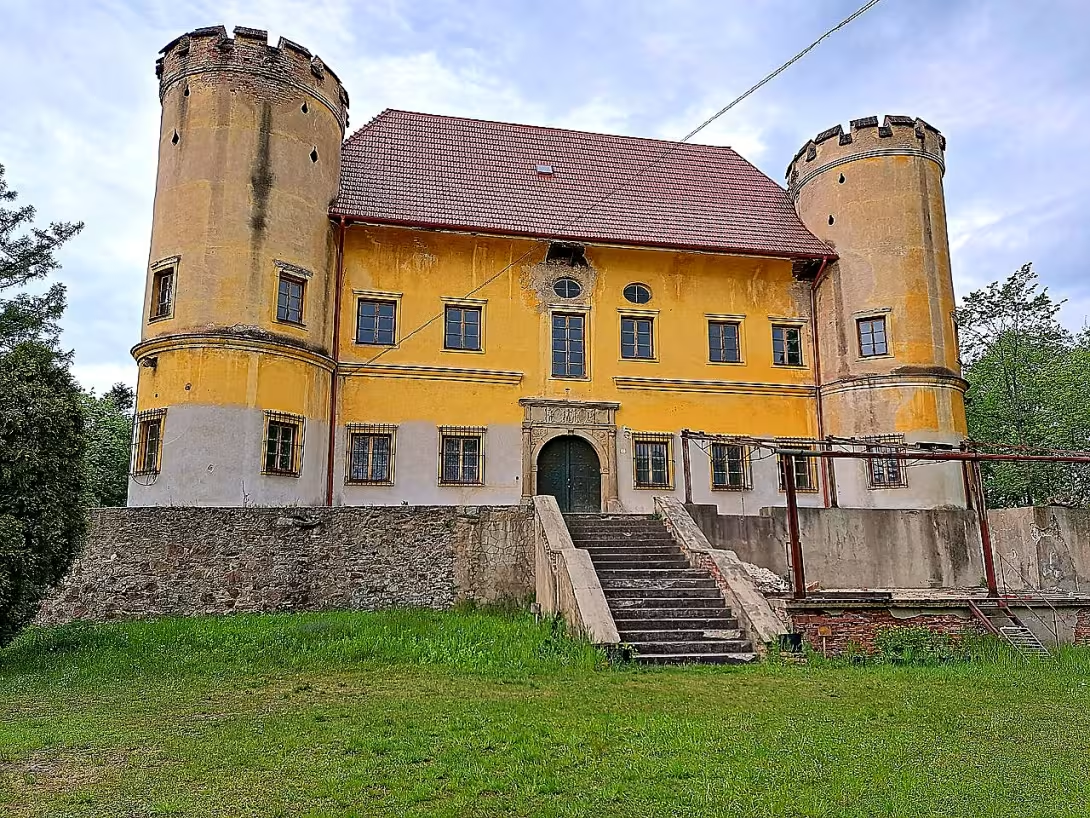
Zámek Dívčí Hrad is located in the same name village in the district of Bruntál, Moravskoslezský kraj. This Renaissance castle, built on the edge of the Manzlaha River, is famous for its rich history and architectural expression, which, despite several modifications, kept the original material schedule. The castle is part of a cultural monument, which includes a park, a former hobby house and other structures.
The first mention of the Gothic castle at the site of today's Girls Castle dates back to 1267. It was originally built by the lazy Olomouc Bishop Bruno of Schauenburg, whose men held the manor Dívčí Hrad in the 13th century. After several changes of owners, the castle was conquered by the army of Matyas Korvinus and trashed in 1474. In 1571 he again became the property of Olomouc bishop, who built the Renaissance castle Jan Sedlnický z Choltic on the site of the demolished castle between 1591-1593. For active support of the state uprising, the estate was confiscated in 1622 and donated to Archduke Charles, Grand Master of the Order of German Knights. After his death, the order belonged to the German knights who in 1768 set up a commendation in the place of the castle.
The castle has undergone several transformations. The original Gothic castle was built on a low edge surrounded by a natural moat of water and waxing, which provided a basis for its defence capabilities. In 1591-1593, the castle was rebuilt into a Renaissance style with corner towers and two belt walls, which resembled North Italian castels. In 1837, the castle was modified in a neo-gothic way.
The castle ownership has changed several times. After Archduke Charles, in possession of the Order of German Knights, the castle went to the Order of Johanites in 1768, later called the Maltese Knights. They managed the castle until 1945 when it was heavily damaged during World War II by artillery fire. After a temporary repair in 1953 he became owner of ONV in Krnov and since 1962 he became a national company of Medical Supply Prague, the Ostrava plant. In 1962-1969 the castle was reconstructed. Since 2020, he has been the owner of HIGHLANDER HERITAGE association, Z.s., which carries out rescue work and ensures the accessibility of the castle to the public during the tourist season.
Zámek Dívčí Hrad is a Renaissance single-storey building with four round corner towers on a square floor plan. Its smooth facades are divided by a profiled stone cordon ledge and main ledge. The main facade is vertically divided by six window axes, while the southern facade has five irregularly spaced window axes. The national towers are high up to the level of the roof ridge and finished by the battlements. The building is finished with a steep valb roof up ahead.
The interior of the castle contains a wide hall with a full vault, a square room with two arches and a smaller arched living room. The towers are flat-ceiling and indoor equipment includes modern elements of the neo-gothic and neo-Renaissance style.
Today's state of the castle Dívčí Hrad is the result of a long history ranging from Gothic castle to Renaissance reconstruction to modern restoration. The chateau is not only architecturally interesting, but also offers a view of the rich history of the region. For tourists, the Dívčí Hrad Castle is an ideal place to visit where they can enjoy the beautiful environment and zoom in on the historical events that shaped this area.
Then and now
Drag the slider to compare how the landmark may have looked when it was built with the view today.
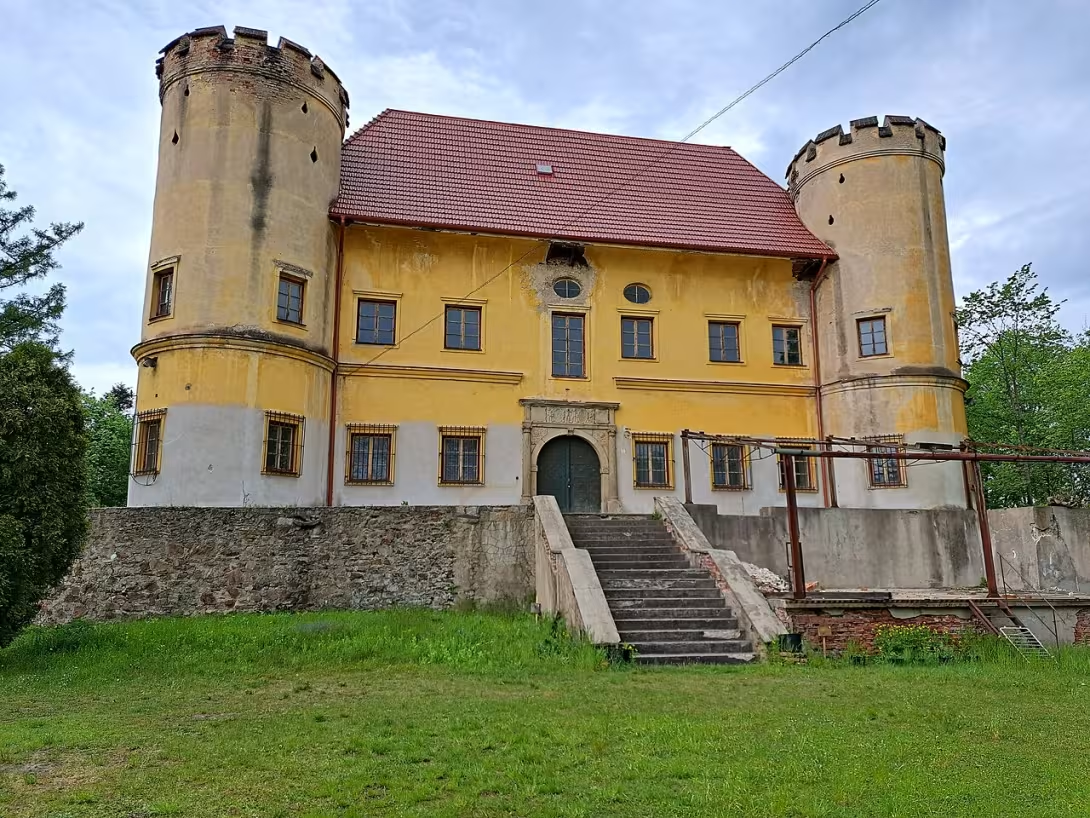
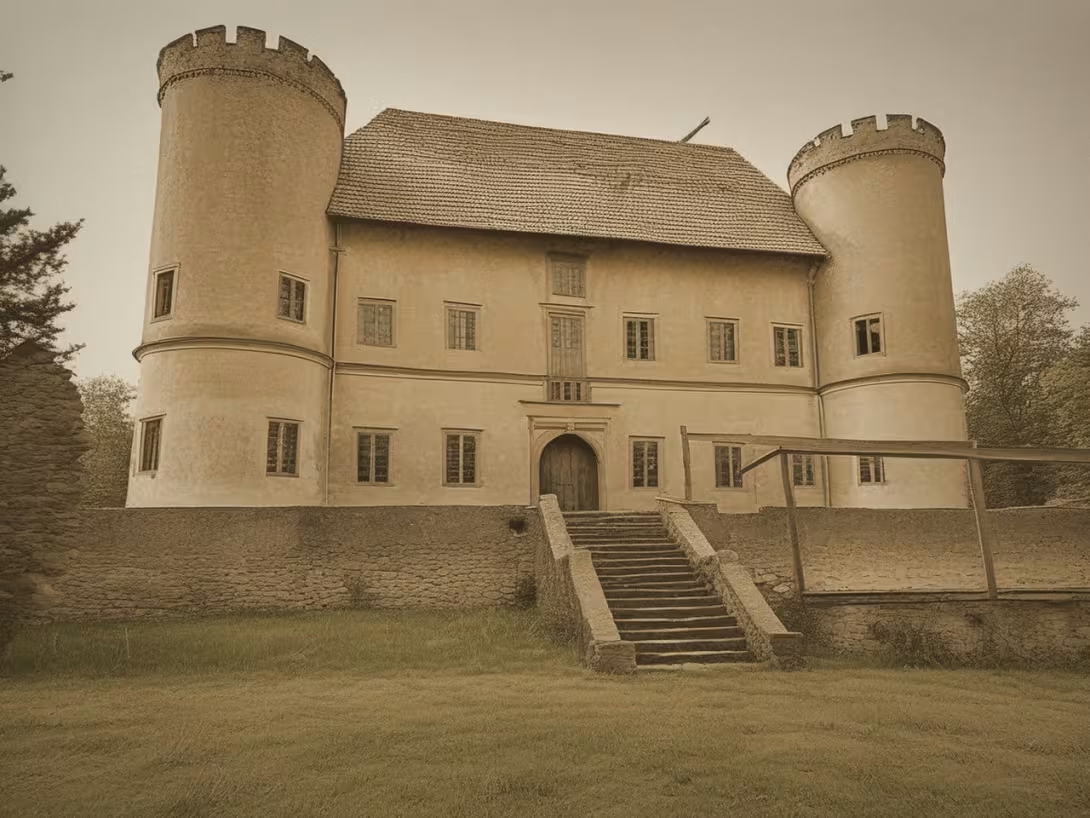
The historical appearance on the left is an AI-generated visualisation and serves as inspiration only.
Historical milestones
- 1267
- First mention of the Gothic castle
- 1474
- Maiburg Castle was conquered by the army of Matthias Korvino and defeated
- 1571
- The Bishop of Olomouc regained his castle
- 1580
- The barren castle was repaired and settled
- 1591
- The castle was rebuilt in 1591-1593
Architectural development
The lock was built in the place of an older Gothic castle. In 1591-1593, the reconstruction reminded of North Italian castels with corner towers and two belt walls. In 1837, the castle was modified in a neo-gothic way.
Historical events
- 1267
- First written mention of the Gothic castle
- 1474
- Maiburg Castle was conquered by the army of Matthias Korvino and defeated
- 1591
- A Renaissance castle was built
Owners
Olomouc Bishop
Matyah Korvinus
Olomouc Bishop
Jan Sedlnický z Choltic
The Order of German Knights
Johanites
Points of interest
- Zámek Dívčí Hrad is a Renaissance single storey building with four round corner towers on a square plan. The first mention of the Gothic castle at the site of today's Girls' Castle dates back to 1267. - In 1591-1593 the castle was rebuilt into a Renaissance style with corner towers and two belts of walls by Jan Sedlnický of Choltic. - After his death, the order belonged to the German knights who founded a commendation in 1768 at the castle. - The castle went through several transformations and was badly damaged by artillery fire during World War II.
Guide
This guide is narrated by a synthetic voice generated by artificial intelligence.
Show guide text
This text was created by artificial intelligence and has not been editorially reviewed. It may contain inaccuracies.
Dívčí Hrad castle, also called Děvice or Maiburg, stands on a promontory above the Osoblahou river in the village of the same name in the Bruntálsko region. It is a fortified Renaissance castle and a cultural monument. In addition to the building itself, it includes a park, former stables, a granary, a fountain, a stone bridge, ramparts with three bastions, and remains of the surrounding wall.
A Gothic castle once stood on this site, first mentioned in the year 1267. It was built by vassals of the Olomouc bishop Bruno of Schauenburg. The castle stood on a low promontory, protected by a natural water-filled moat with an embankment, and on the western side by another moat. Remnants of these are still visible today in the south and west. In the year 1474 the castle was conquered and demolished by the forces of Matthias Corvinus. Later it returned to the hands of the Olomouc bishop, was repaired, and by the year 1580 it was inhabited again.
Between the years 1591 and 1593 Jan Sedlnický of Choltic had a Renaissance castle built on the site of the demolished fortress. It resembled a smaller version of Northern Italian castles with corner towers and two strips of fortifications. The Sedlnickys supported the Estates Rebellion, and therefore their domain was confiscated in the year 1622. It was acquired by Archduke Charles, Grand Master of the Order of Teutonic Knights, and after his death it passed to the Order. From the year 1768 until 1945 the castle belonged to the Johannites, later called the Knights of Malta, who established a commandery here. In the year 1837 it underwent Gothic Revival renovations.
At the end of the Second World War the castle was severely damaged by artillery fire. After provisional repairs in the year 1953 it passed to the district national committee in Krnov. From the year 1962 it was owned by the national enterprise Healthcare Supply, and between 1962 and 1969 reconstruction took place. In the year 2019 the castle was purchased by the Highlander Heritage association, and since the year 2020 conservation work has been underway.
The single-storey building has a square ground plan and in the corners four round towers topped with crenellations. The most richly decorated is the main stone portal. It is framed by fluted pilasters and the arch above the entrance is decorated with relief heads of boys with curly hair, who hold in their mouths a leafy flourish. Above the cornice four caryatids carry two cartouches.
The portal leads into a wide hall with a barrel vault, whose fields are framed by stucco cornices. On the sides smaller vaulted residential rooms connect, and in the southwestern part a vaulted staircase rises to the upper floor. The rooms on the upper floor have flat ceilings, in some places with wooden beams. A rising stone bridge across the remains of the moat leads to the main entrance.
Tips for visitors
The best time to visit the castle Dívčí Hrad is in the spring or autumn season, when the natural beauty surrounding is in full glory and fewer people. This time of the season also offers lighter weather for long walks around the castle.
You can verify the best connection using the online route search engine.
When visiting you can take a hat or parasol for sun protection, shoes suitable for walking on uneven terrain and water. Also remember the camera or mobile phone with good camera quality to capture the beauty of the lock.
The best place for photography is at the corner towers, especially at noon, when the sun lights up the castle from the side. Morning and evening light also offers beautiful shadows and atmosphere for photos.
In the vicinity of the castle Dívčí Hrad you can visit the Manzlaha River, which provides ideal conditions for picnic or relaxation in nature. It may be interesting for families with children to explore the surrounding forests and forests where various activities can be organised on the outside.
Frequently asked questions
Can the monument be visited?
Some buildings of this kind are open for guided tours, others serve another purpose or are privately owned. We have not verified whether and when this monument is open – please ask the operator.
What are the opening hours and admission?
We have not verified the opening hours or admission. Current information is published by the operator.
Where is the monument?
Location: č.p. 56, Dívčí Hrad, Moravskoslezský kraj. The map on this page shows the exact spot.
Why is the monument protected?
It is listed in the Central List of Cultural Monuments of the Czech Republic as a cultural monument (register no. 46999/8-57).
For kids
Dívčí Hrad, secret and adventure!
435 years ago, in 1591, the castle Dívčí Hrad was built. He was supposed to be like a fortress that protects from enemy attacks. And really, he had hidden courses that could be used as offensive routes.
It was like a game where heroes went undercover as enemies and surprised them. Also today you may feel like heroes who will explore this mystical castle.
Businesses nearby
Do you run a restaurant, accommodation, shop, museum, rental, wellness or other visitor service near this monument? Show yourself directly to the people heading to it — this is how they will see you in the app and on the web:
Nearby
The surrounding landscape, other monuments and natural elements.
Accommodation nearby
Themed route
Route: Zámek Dívčí Hrad and surroundings
1. Zámek Dívčí Hrad (main destination) - unique Renaissance castle with remarkable interior and views of the surroundings. 2. Church of St. Peter and Paul (church) - historical church near the castle, which offers a quiet atmosphere and wonderful bells. 3. Dívčí Hrad ponds (pond) - picturesque ponds that are ideal for resting and watching birds. 4. Silesian Ostrava (city) - a city that lies close to Girlfriend Castle and offers a wide range of cultural and historical attractions.
Seasonal recommendations
Spring: Spring is the perfect time to visit the Castle of Girls when nature wakes up from winter sleep and the castle is surrounded by flowers and greenery. The atmosphere is relaxed and quiet, which is ideal for a tour of the castle and its gardens.
Summer: In the summer Dívčí Hrad is full of life and energy. We recommend that they arrive early to avoid crowds and can see the castle and its garden in peace. Summer weather is ideal for walking around gardens and surrounding forests.
Autumn: In the autumn period Dívčí Hrad is surrounded by colors of nature, when tree leaves turn into different shades of gold, red and brown. The atmosphere is calm and relaxed, which is ideal for a tour of the castle and its gardens.
Winter: In winter, Dívčí Hrad is quiet and quiet, which is the perfect time to explore the castle and its gardens without crowds.
Visualizations and artistic views


The visualisations are generated by artificial intelligence and serve as inspiration.
Photos from the area
Real photos taken near the monument


Zdroj a licence jsou uvedeny u každého snímku.
Atmosphere of the place
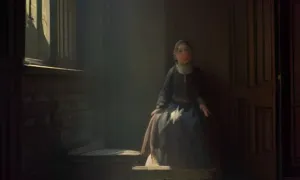
This atmospheric visualisation of the place and period was generated by artificial intelligence. It is not real footage of the location.
Tips from visitors
No tips yet. Be the first!
Log in and add your tip.
Sources and literature
Photos: Mikuláš Galuszka / CC BY-SA 4.0 — Wikimedia Commons. The author and licence also appear when you hover over the image.
Faktickým podkladem tohoto textu byl článek na Wikipedii, jehož autory jsou přispěvatelé Wikipedie. Článek je dostupný pod licencí CC BY-SA 4.0.
Location on the map

Příběhy a pověsti
Legendy, pověsti a příběhy spjaté s touto památkou
Fotografie návštěvníků
Zatím žádné fotografie. Buďte první, kdo přidá fotografii z návštěvy!
Log in a přidejte svou fotografii nebo hodnoťte.
Za ověřenou návštěvu v aplikaci získáte víc bodů — poznáme podle GPS, že jste na místě.
Reviews and comments