



železniční viadukt u Střelic Railway bridge
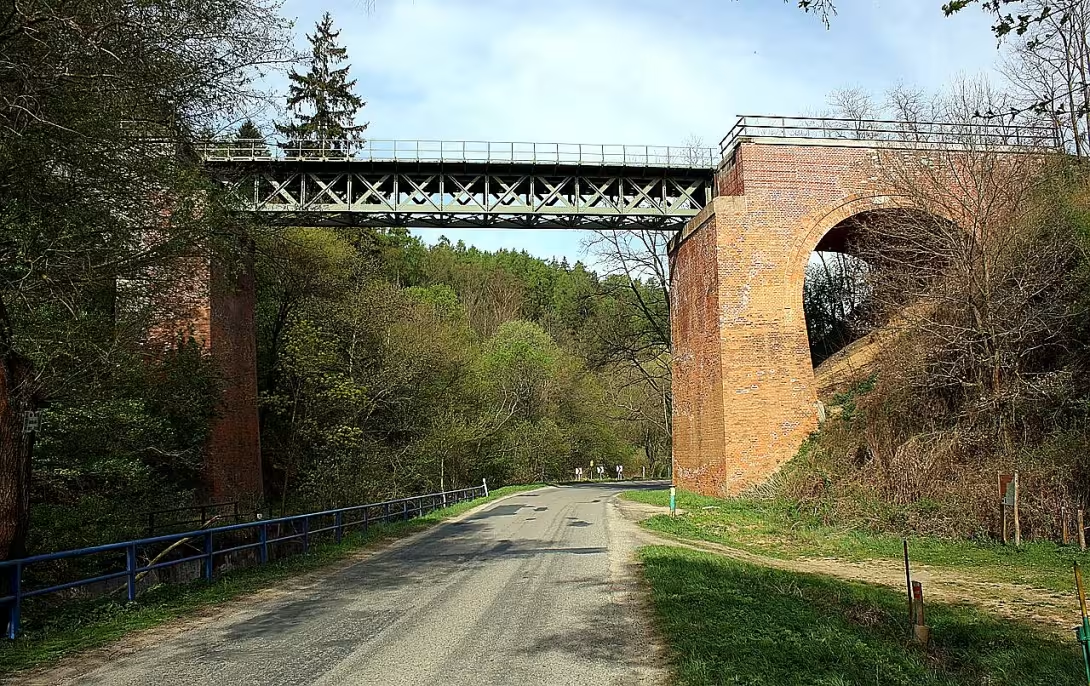
The railway viaduct near Střelice, also known as "Železnák," is a historical monument located on the line Brno - Hrušovany nad Jevišovka. Built in 1870, it crosses the valley of the river Botrava and connects the catalogues of the municipalities Střelice and Radostice. Viaduct is a technical monument from the period of intensive development of the railway network in the Austrian monarchy, representing an important element of the then infrastructure.
It was part of the section Hrušovany nad Jevišovka - Střelice, which belonged to the track of the Austrian railway company leading from Vienna. Although the line was designed as a double track, only one track was implemented in practice. Thus, despite its original design for two-track operation, the Viaduct operated only one track. Its architecture is divided into three parts: two extreme arches with pillars are built from bricks on the Brno side, while the central part consists of steel lattice construction. The latest part of the viaduct was completed in 1902.
The history of the viaduct is linked to its position in the extension of the railway network of the Austrian monarchy. The Viaduct was a strategic element for the connection from Vienna, key to the economic and transport development of the region. Although he was protected as a cultural monument, in 1987 his protection ended thanks to a belated entry on the state list.
Today the viaduct is accessible and represents an interesting location for visitors to the region. Despite the end of its protection, it remains an important witness to the historical development of rail transport and technology. The Viaduct is known in the region as "Iron Man" and its construction remains a fascinating example of 19th century engineering.
Visiting the viaduct offers the opportunity to explore not only the technical monument, but also to understand the historical context of its origin and importance to the region. The Viaduct is a witness to a time when the railway was a key element of the modernisation and development of society, which makes its visit not only interesting, but also educational.
Then and now
Drag the slider to compare how the landmark may have looked when it was built with the view today.
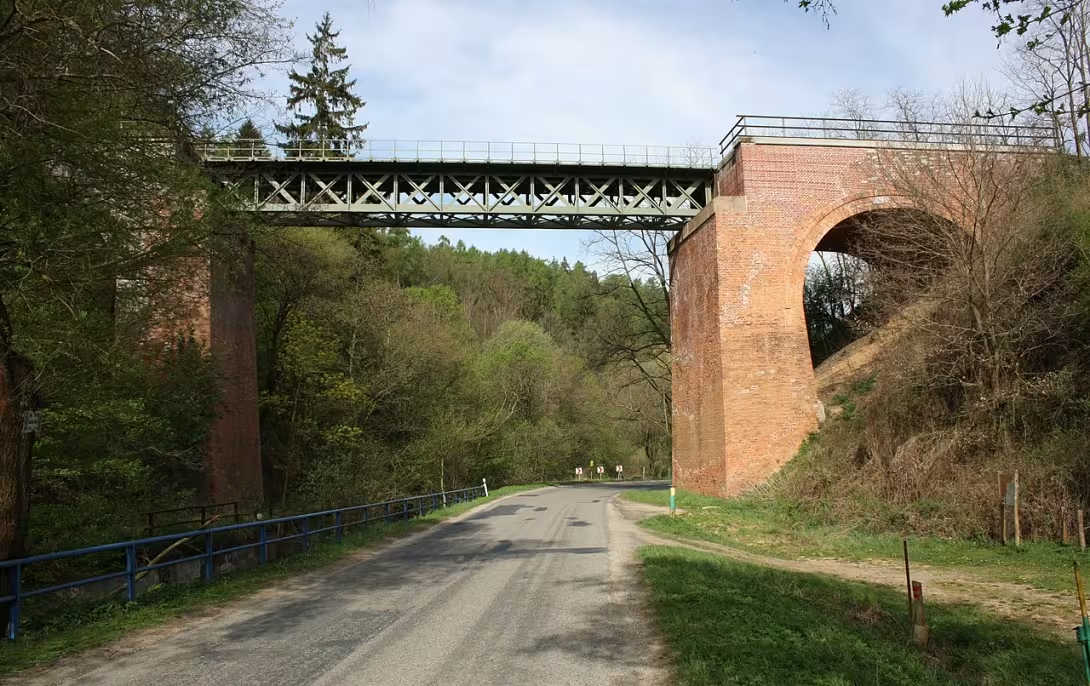
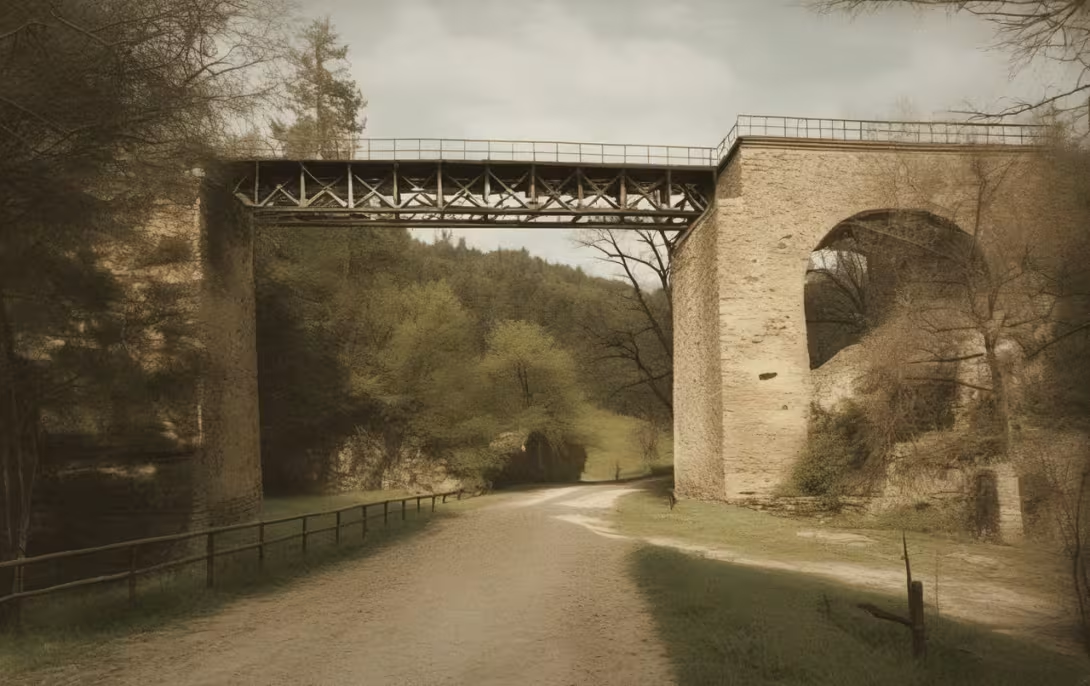
The historical appearance on the left is an AI-generated visualisation and serves as inspiration only.
Historical milestones
- 1870
- Position of the viaduct within the line Hrušovany nad Jevišovka - Střelice.
- 1902
- The latest part of the viaduct.
- 1987
- The end of the object's monument protection.
Architectural development
The construction is divided into three parts, with two extreme arches with pillars being made from bricks on the Brno side. The central part consists of a steel lattice structure designed for one track. The latest part of the whole viaduct was completed in 1902.
Historical events
Construction of the viaduct in 1870 in the framework of the expansion of the Austrian railway company's runway. Termination of the monument protection on 31 December 1987.
Points of interest
- Viadukt is a historical monument located on the line Brno - Hrušovany nad Jevišovka. - Built in 1870 and crosses the valley of the river Botrava, connecting the catalogues of the municipalities Střelice and Radostice. - Viaduct is a technical monument from the intensive development of the railway network in the Austrian monarchy. - The architecture of the viaduct includes two extreme arches made of bricks and a central steel lattice structure, completed in 1902. - The Viaduct was protected as a cultural monument, but the protection ended in 1987 due to delayed entry on the state list.
Guide
Show guide text
This text was created by artificial intelligence and has not been editorially reviewed. It may contain inaccuracies.
Welcome to the railway viaduct at the Shooter, which the locals call Iron Man. You are standing in front of a massive building that rises over the valley of the river Botrava right on the boundary of the catastres of the municipalities Střelice and Radostice. This is where the railway connecting Brno to Hrušovany nad Yevišovka falls or rises through deep valleys, and at first glance you can see that it is a sophisticated engineering building from the time when the Austrian monarchy decided to connect its suburbs and the more remote regions of the railway network. You can hear the sound of the wind and perhaps the distance sound of the train, which gives you the atmosphere of the railway heart. Let us now immerse ourselves in the history of this place and see what awaits you around this railway work.
Viaduct was created in 1870 as part of the line between Hrušovany nad Yevišovka and Střelicemi. It was built for an Austrian public rail company, a private company operating important lines in the Habsburg monarchy. At that time it was an intensive development of the railway network, where routes were sought for connections between cities and industrial centres. The construction was originally designed for two tracks, which suggests that the building engineers counted on a larger operation than never took place here. In practice, only one track has been used today. This is an interesting fact that shows how planning was different from reality. At that time, the Austrian state rail company built routes throughout the monarchy, and this viaduct was part of the ambitious Brno-South-Western Moravia connection project. In 1870 this area was part of Austria-Hungary and the railway was a symbol of modernisation and progress that changed the whole landscape.
Now let's look at what you see right around you. Check the viaduct facade and its extent. The construction crosses the valley of Botrava and connects the catalogues of two municipalities. In 1902, the latest part of the viaduct was created, which means that the construction was extended or modified for 30 years after its original position. This proves that the railway remained important even after the First World War and during the interwar period. Notice the overall length and height of the bridge, which crosses the valley of the River Botrava. Look at how the building has adapted to the terrain and how it surpasses the difference in height between the two cadastras. The valley of Botrava is narrow and steep, which required a firm solution for the line item. This extended part from 1902 shows that the construction was alive and adapted to the needs of the time. Take a look at the river beneath you and think of how this bridge has made it possible to overcome difficult terrain.
As far as personalities are concerned, the authors and specific builders remain unknown. Architects were not captured in the sources, as well as historical figures associated with this place. So we can't tell you the story of a particular builder or discoverer, but we can mention that the construction was carried out by the Austrian State Railroad Company, which at that time was building tracks throughout the monarchy. The work on the track was probably challenging because it was the lower environment of the river Botrava, which required a careful engineering solution. Yet unknown builders have created a building that has lasted more than 150 years and still serves its purpose. Their identity remains a mystery that can only be deciphered in the archive springs of the Austrian Railways. It is this lack of names that makes building even more fascinating because it remains an example of a collective work without names.
The interesting thing is that even though the line was designed for dual-track operation, there is only one track. This non-use of the second track is a technical speciality which has been preserved to this day. Another remarkable thing is that in 1987 the protection of this building ended as a cultural monument. Which means he stopped being protected as a monument, and yet remains a significant landmark. It is not a extinct building, but still a functional railway object that crosses the valley of Botrava and connects two cadastral territories. Local folk names such as Železnák show that this building has become part of the local identity and memory of the surrounding population. It is this popular name that goes beyond the official label and recalls that monuments live in conscious people. The Iron Man stays in the hearts of the locals even though official protection is over.
Let's move on now. Viaduct u Střelice is a technical monument from the intensive development of the railway network in the Austrian monarchy. You are standing where the history of the link between Brno and South Moravia passes in the present. If you have the opportunity, look around and see the landscape that connects this path. Notice how the railway has adapted to the terrain and how this viaduct has enabled transport connections through a difficult valley. Look at the River Botrav below you and think how hard it must have been to build such a structure in the valley over a hundred and fifteen years ago. The landscape around it was changing, but this bridge remained a constant witness to the terrain conquering by rail. This place offers a unique view of how technology and nature form a combination.
Thank you for your attention and we look forward to seeing you at this place. Continue to explore the surroundings of Shrelice and Rahovac, or return to the station with new knowledge of what the railway construction looked like in the nineteenth century. This viaduct is a monument to the time when railways have become a symbol of progress and connection of distant places. Goodbye to other stops of our audio guide and thank you for being a part of this audio experience. Hopefully this stop will inspire you to further explore the history of Moravia and take away the memory of this railway treasure between Brno and Hrušovany nad Yevišovka.
Tips for visitors
The best time to visit is spring or autumn, when nature is the most colorful in the valley. For the best light on the images we recommend early morning hours or time just before sunset.
The road to the viaduct is also possible by car through public transport. For up-to-date information about connections and stopping options, please check with electronic search engines.
Pack comfortable outdoor walking shoes and plenty of fluids in the way. If you plan to stay longer in the field, protection against insects may also be useful.
For families with children it is best to walk in the valley of the river Botrava, which offers a quiet environment.
The best places for photography are located in the valley where the monumental face of the building can be captured in accordance with the landscape.
Frequently asked questions
Can the monument be visited?
This is a structure in a public space that can usually be seen from outside free of charge. We have not verified that this particular one is freely accessible.
Where is the monument?
Location: Střelice, Jihomoravský kraj. The map on this page shows the exact spot.
Why is the monument protected?
It is listed in the Central List of Cultural Monuments of the Czech Republic as a cultural monument (register no. 1000140826).
Businesses nearby
Do you run a restaurant, accommodation, shop, museum, rental, wellness or other visitor service near this monument? Show yourself directly to the people heading to it — this is how they will see you in the app and on the web:
Events nearby




Zdroj akcí: otevřená data měst a obcí ČR (Národní katalog otevřených dat) a kalendář akcí Národního památkového ústavu.
Nearby
Údolí říčky Bobravy a silnice spojující obce Střelice a Radostice.
Accommodation nearby
Trips and activities nearby
Guided tours, tickets and activities nearby from GetYourGuide
Affiliate link: if you buy from the partner, we may receive a commission. The price for you does not change.
Search tours and activities →Themed route
1. Railway viaduct near Střelice - Technical monument - Stone and iron, viaduct from the mid-19th century, which surpasses the valley of Botrava and serves as a reminder of the development of the local railway; the views of the area are opened from the observation platform.
2. Valley of the river Botrava - Natural location - Malleable valley with river, meadow forests and suitable paths for walks; ideal for bird watching and outdoor rest.
3. Road connecting Střelice and Radostika - Cultural Landscape - Historical Communication, which connected two municipalities and now serves as a cycle path; along it are information boards about local history.
Seasonal recommendations
Spring: In the morning months železniční viadukt u Střelic turns into a green platform, dressed with new leaves and flowers. The sun penetrates through the shadows of the forest, creating hot shadows on concrete pillars. For a pleasant approach choose clothes with a light jacket and a pocket for shoes. Visit the memory earlier in the morning (between 8 and 10 hours) when there is less human body and nature awakens its beauty. Do not ask for exceptional events, but look forward to the silence of the forest and the first winds that cause a romantic mood.
Summer: During hot days the viaduct becomes a magnet for tourists looking for shadows along the iron bridge. The height position offers extensive views of the surrounding meadows and forests, but the heat may be uncomfortable. Wear shorter clothes, a hat and a sunscreen. Ideal is the visit of noon, when the sun best reflects from concrete and creates square shadows. Avoid the main weekend when people's density doubles. In Advent Time, you can use the quieter hours in the morning or evening.
Autumn: During November, the viaduct is dressed in grey-gold tones when forest leaves are thrown onto the floor. Cold shocks and foggy mountains supply rooms with secrets. Wear layered clothes and don't underestimate the warm casserole. The best is to plan the tour for the late morning (10-12 hours) when light draws the bridge into detail and the fog disperses. In this period the local ball will exceptionally appear on autumn night, but in general it is quiet and quiet.
Winter: During November and December, the viaduct will turn out to be a stone shadow under the congregation and youth. Wear warm jackets, waterproof pants and ham. The ideal is a visit during the white morning when the sun breaks through the fog and the bridge becomes a picture. At Advent Time, you can use the quieter noon hours when people focus on the Christmas markets outside the memory. Do not require specific actions, but look forward to a quiet and unique atmosphere.
Visualizations and artistic views


The visualisations are generated by artificial intelligence and serve as inspiration.
Photos from the area
Real photos taken near the monument


Zdroj a licence jsou uvedeny u každého snímku.
Atmosphere of the place
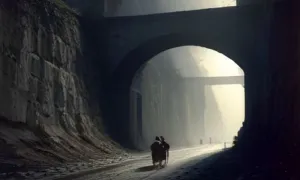
This atmospheric visualisation of the place and period was generated by artificial intelligence. It is not real footage of the location.
Tips from visitors
No tips yet. Be the first!
Log in and add your tip.
Sources and literature
Photos: Michal Klajban / CC BY-SA 3.0 — Wikimedia Commons. The author and licence also appear when you hover over the image.
Faktickým podkladem tohoto textu byl článek na Wikipedii, jehož autory jsou přispěvatelé Wikipedie. Článek je dostupný pod licencí CC BY-SA 4.0.
Location on the map


Příběhy a pověsti
Legendy, pověsti a příběhy spjaté s touto památkou
Fotografie návštěvníků
Zatím žádné fotografie. Buďte první, kdo přidá fotografii z návštěvy!
Log in a přidejte svou fotografii nebo hodnoťte.
Za ověřenou návštěvu v aplikaci získáte víc bodů — poznáme podle GPS, že jste na místě.
Reviews and comments