



Židovský hřbitov v Uherském Ostrohu Jewish cemetery
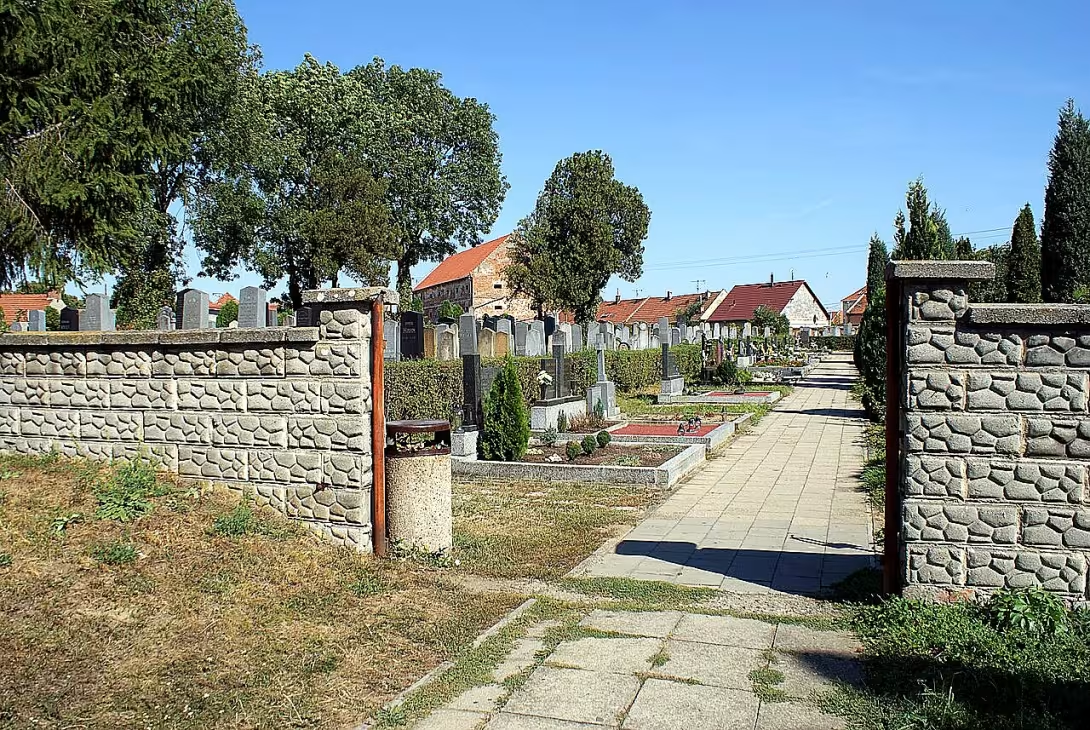
Židovský hřbitov v Uherském Ostrohu, founded in 1862, is the second place of this kind in this city. It is located on the Ostrožské suburb near Veselská Street, in the area of the town cemetery, and is protected as a cultural monument. Its importance lies primarily in preserved gravestones from the 19th and 20th centuries, supplemented by transferred tombstones from a destroyed older cemetery from the 16th century.
The cemetery was created when the Jewish community here needed a new place for funerals. Its foundation was linked to the period of national renewal and gradual emancipation of the Jewish minority. In Europe, industrialisation and urbanisation developed, affecting changes in funeral practices. New Jewish cemeteries began to be built all over the country.
The area has no significant architectural features. It is a classic Jewish cemetery with rows of tombstones which are arranged according to Jewish traditions. On an area of 2759 square meters there were about two hundred modern matrices. Special attention deserves to be paid to the tombstones transferred from the original older cemetery, destroyed in 1954. From this burial ground comes about a hundred tombstones, the oldest from the 16th century.
The possession and administration of the cemetery was linked to the fate of the island Jewish community. It disappeared in 1941 when Jews were deported to concentration camps. After the war, the cemetery was abandoned and in the 1950s the original morgue and the tomb house were destroyed. In 1959, a memorial was revealed to the victims of the Holocaust in the cemetery.
In 2009, there was a vandal attack that damaged 63 tombstones. This incident triggered a public debate on the protection of cultural monuments. The cemetery serves as a place to remember the victims of the Holocaust and commemorates the tragic fate of the community.
Today the cemetery is open to the public and is part of the city cemetery. His preserved tombstones and monument to Holocaust victims are an important source of information about local history. The cemetery is worth visiting as a reminder of the need to respect and protect the sights of the Holocaust.
Then and now
Drag the slider to compare how the landmark may have looked when it was built with the view today.
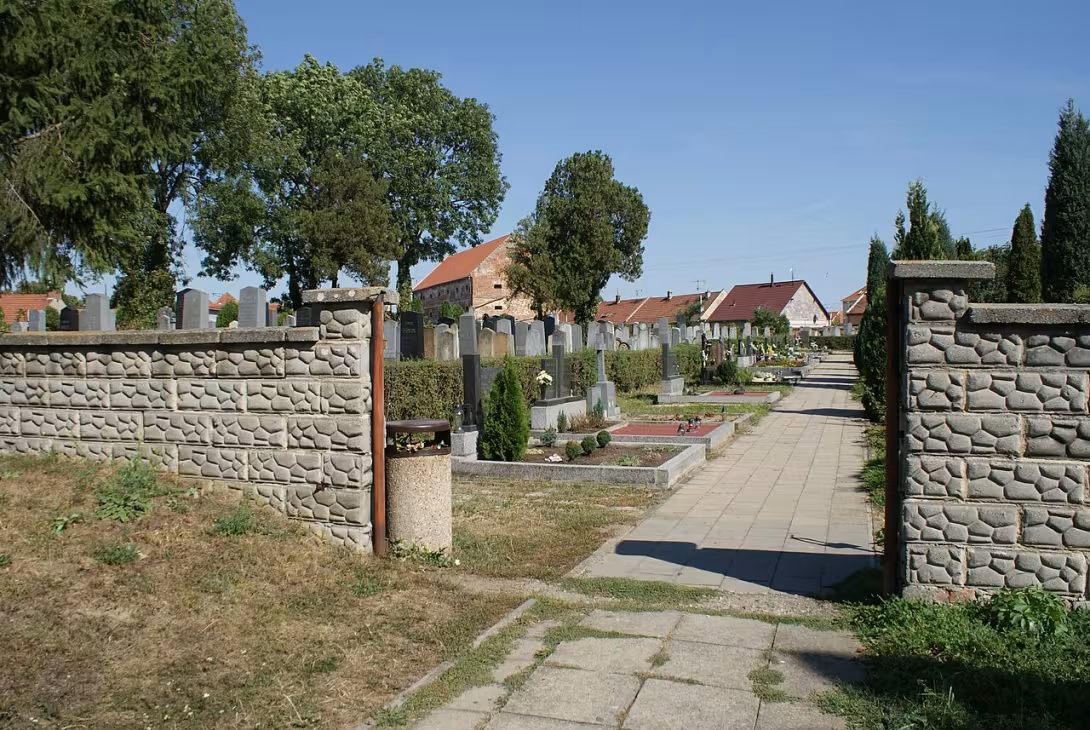

The historical appearance on the left is an AI-generated visualisation and serves as inspiration only.
Historical milestones
- 1862
- Establishing a cemetery as the second Jewish burial ground in Uherské Ostroh
- 1941
- Deportation of island Jews to Terezin and extermination camps
- 1954
- Disposal of the older Jewish cemetery and transfer of tombstones to the current premises
- 1959
- Exposing the monument to Holocaust Victims
- 2009
- Vandal attack with damage to 63 tombstones
Architectural development
The cemetery was created as the second Jewish cemetery in Uherský Ostroh in 1862. The area was originally part of the city cemetery, without significant architectural elements. In the 1960s a memorial was installed in the cemetery, which still serves as a symbol of the Holocaust monument. The cemetery is not known for specific architectural elements, but its importance lies in historical and cultural monuments.
Historical events
- 1941
- The demise of the Ostrožská Jewish community, the deportation of Jews to Terezin and then to extermination camps
- 1954
- Cancellation of the senior Jewish cemetery, its destruction and establishment of communication in its place
- 1959
- Discovering the monument to victims of the Holocaust in the cemetery
Points of interest
- It's the second Jewish cemetery in Hungary.
- It is located in the area of the town cemetery near Veselské street in Ostrožský suburb.
- It has an area of 2759 square meters with approximately 200 preserved tombstones from the 19th and 20th centuries.
- Includes transferred tombstones from a destroyed older cemetery from the 16th century, a total of about 100 pieces.
- In 1959, a memorial was unveiled to the victims of the Holocaust.
Guide
Show guide text
This text was created by artificial intelligence and has not been editorially reviewed. It may contain inaccuracies.
Welcome to this place full of memory and silence.
You're standing in a place that looks back. There is a Jewish cemetery in Uherské Ostroh in front of you - a second such resort in this city. You see green surfaces, stone shapes that pray silently for remembrance. Some tombstones are hundreds of years old, others are from a recent time. Notice how the shadows of trees are projected between them and how light plays on smooth stones. This is where history and peace meet.
This cemetery was created in 1862 as the second Jewish burial ground in Hungary Island. The Jews have rested here for centuries, until the tragic 1940s, when the island Jews were deported to concentration camps. After the war, only part of the tombstones from the original 16th century cemetery were preserved in this place. They were brought here to preserve their memory. In '59, a memorial was revealed to the victims of the Holocaust, which reminds those who no longer reside here.
Take a walk through the tombstones - matrices. Some are damaged, others are preserved. Notice how they differ in shape and font. These stones bear the names, dates and symbols that tell the stories of individuals and the entire community. Some tombstones are up to two centuries old, others come from a time when funerals were no longer held here. Every stone is like a page of a book that tells about life and death.
Now pay attention to the Holocaust Memorial. It was revealed in the year fifty-ninth and serves as a reminder of those who no longer reside here. It's a place where the pain of the past meets the desire for memory. In the year twenty-nine, the cemetery was damaged by a vandal attack that destroyed 36 tombstones. Yet the place remains a place of peace and respect.
One of the most interesting things is the fact that this cemetery includes tombstones from a liquidated old burial ground. They were brought here to preserve their history. That means you'll find stones up to five centuries old. Some of them are unique and tell stories that are otherwise lost.
Let's move on to the conclusion. This cemetery is not only a place of rest, but also a place of memory. It's a place where history and human pain meet. If you want to explore more, go through the tombstones and get carried away by their stories. Every stone has something to say, every symbol tells about life and death. Get carried away by this place and its secrets.
Thank you for stopping by this place. Be calm and respectful. May silence and monuments bring you a moment of reflection.
Tips for visitors
The best time to visit is in spring or autumn when the weather is pleasant and the sun does not blink directly into stone tombstones. In summer it can be hot in the cemetery and in winter some roads are covered with snow or ice. It is recommended to visit the cemetery early in the morning or afternoon when there are fewer visitors and you can see the tombstones in peace. The surrounding area is also pleasant to walk around the historic Ostrožská suburb, where old houses and Veselské street are located.
This time is ideal for photography because the light is softer and the tombstones are well lit without the shadows distorting detailed drawings on the stones.
The location is available by car and by public transport. It is recommended to verify the current connection in the search engine or to ask the local. The cemetery is located on the premises, so you don't have to look long.
When visiting, wear comfortable shoes and suitable clothes because the cemetery is on a wooded and uneven terrain. You can also bring a map or brochure with information about the cemetery if it is offered by local information. It is also appropriate to take a small towel or handkerchief because dust can accumulate on the stones. If you're interested in history, you can bring a notebook and a note pencil.
The cemetery is old and the tombstones are often worn, so you can take notes or see interesting inscriptions.
Photography is allowed, but it is recommended to look for places with good lighting such as tombstones on the edge of the cemetery where light is uniform. The best time for photography is in the morning or in the afternoon when the sun is not directly above your head. If you are interested in detailed photographs, focus on tombstones with nice reliefs or inscriptions. In the area of the town cemetery it is also possible to photograph historical houses in the Ostrožský suburb.
Good lighting and the right angle will help capture the beauty of old tombstones.
In the vicinity of the cemetery there is an Ostrožská suburb with historic houses and a Vesel street which is ideal for walking. If you have time, you can also visit the natural parks and forests within a few kilometers to complement the historic atmosphere of the area. There is also a city cemetery nearby, which shares the area with the Jewish cemetery and can be interesting for another tour. It is advisable for families with children to visit natural parks where children can run and discover nature.
The surrounding area offers a combination of history and nature that is suitable for all visitors.
For families with children it is advisable to visit the cemetery together with a tour of Ostrožský suburb where children can see old houses and historical details. You can also talk about the history and meaning of the cemetery, which the children can take. Children can play and discover plants and animals in natural parks nearby. It is also recommended to take action with you, such as painting or guessing, so that children have something to do during the visit.
The cemetery may be interesting for children from a historical point of view, but it is good to have an activity ready to entertain them.
Frequently asked questions
Can the monument be visited?
Cemeteries and graves are usually accessible; please respect the dignity of the place. We have not verified the opening hours of this cemetery.
Where is the monument?
Location: Uherský Ostroh, Jihomoravský kraj. The map on this page shows the exact spot.
Why is the monument protected?
It is listed in the Central List of Cultural Monuments of the Czech Republic as a cultural monument (register no. 1000120397).
Businesses nearby
Do you run a restaurant, accommodation, shop, museum, rental, wellness or other visitor service near this monument? Show yourself directly to the people heading to it — this is how they will see you in the app and on the web:
Events nearby

Zdroj akcí: otevřená data měst a obcí ČR (Národní katalog otevřených dat) a kalendář akcí Národního památkového ústavu.
Nearby
V okolí se nachází městský hřbitov, který sdílí areál s židovským hřbitovem. V blízkosti je také Ostrožské předměstí s historickými domy a veselskou ulicí. V okruhu několika kilometrů se nachází přírodní parky a lesy, které doplňují historickou atmosféru oblasti.
Accommodation nearby
Themed route
1.Židovský hřbitov v Uherském Ostrohu Type: Historical monument Why is it worth a visit: The main destination of our journey is a significant historical place with a number of old tombstones. It offers a deep insight into the history and traditions of the local Jewish community.
2. City Cemetery Type: Sacral and piety area Why is it worth a visit: This cemetery shares a common area with the main aim of our trip. Allows a peaceful walk and a perception of the historical context of the place.
3. Island Suburb Type: Historical installation Why is it worth a visit: The nearby area with historical houses and the rural street complements the whole location. The walk offers a unique atmosphere of ancient buildings.
4. Natural parks and forests nearby Type: Natural area Why is it worth a visit: There are these green areas and forests within a few kilometres. They perfectly complement the overall historical atmosphere of the entire area.
Seasonal recommendations
Spring
At the Jewish cemetery in Uherské Ostroh in spring days dominates fine but intense green color. Blossoming trees and flowering meadows create a calm atmosphere that is suitable for a peaceful tour. In the morning the air is clean and warm, allowing a comfortable walk without direct sunlight. Suitable clothes should be light, but adapted to possible rain. The best time to visit is early morning, when there are fewer people and nature is still full of life.
---
Summer
The main summer season is a cemetery full of sun and heat, but also crowds of visitors. It's best to come before noon to avoid the worst and most populous times. Clothes should be light and worn in wide pelvis to minimise sunbathing. Due to the high temperature, it is advisable to bring sun protection and plenty of water. Although the weather is favourable, it is important to be prepared for sudden changes such as storms.
---
Autumn
In autumn days, the atmosphere in the cemetery is quiet and melancholic, when leaves begin to change into golden and red shades. In the morning the air is colder but pleasantly warm, which is ideal for walking. Suitable clothing should be warm but light to avoid overheating. The best time to visit is in the morning when there are fewer visitors and nature is still full of dyes. It is also advisable to bring warm clothes for possible cooler evenings.
--- Winter
In winter, the Jewish cemetery in Uherské Ostroh is quiet and almost empty. Snow and freezing temperatures create a strange, quiet atmosphere that is suitable for those who seek peace. Due to the cold weather, it is advisable to come at the time when it is opened and dress up in warm clothes. The best time is in the morning or afternoon, when fewer visitors and the weather is more stable. It is also important to bring warm shoes and an overview of opening times that are usually shorter.
Visualizations and artistic views


The visualisations are generated by artificial intelligence and serve as inspiration.
Photos from the area
Real photos taken near the monument


Zdroj a licence jsou uvedeny u každého snímku.
Tips from visitors
No tips yet. Be the first!
Log in and add your tip.
Sources and literature
Photos: Feťour / Public domain — Wikimedia Commons. The author and licence also appear when you hover over the image.
Faktickým podkladem tohoto textu byl článek na Wikipedii, jehož autory jsou přispěvatelé Wikipedie. Článek je dostupný pod licencí CC BY-SA 4.0.
Location on the map


Příběhy a pověsti
Legendy, pověsti a příběhy spjaté s touto památkou
Fotografie návštěvníků
Zatím žádné fotografie. Buďte první, kdo přidá fotografii z návštěvy!
Log in a přidejte svou fotografii nebo hodnoťte.
Za ověřenou návštěvu v aplikaci získáte víc bodů — poznáme podle GPS, že jste na místě.
Reviews and comments