



Žižkova mohyla Memorial
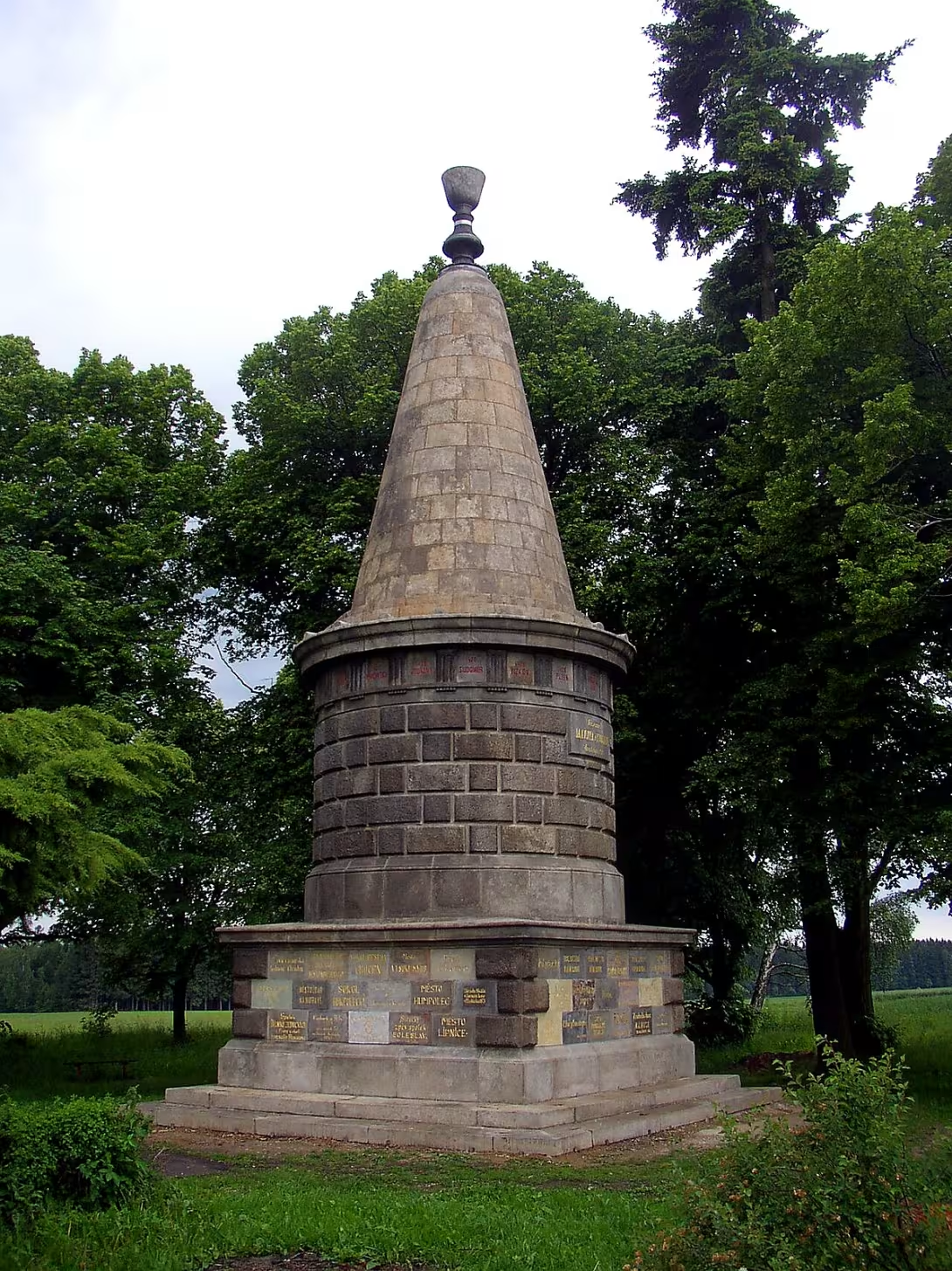
Žižkova mohyla is a neo-Renaissance monument dedicated to Hussite military leader Jan Zizek. It stands in the village Žižkovo Pole near Pribyslav. The object was discovered on September 20, 1874 at the place where the warlord was to die on October 11, 1424 in the arms of Michael Koudel of the Žitenice. The 14.7-meter-tall monument resembles a national hero. Since 19 December 1963 it has been included in the state list of real estate monuments.
The creation of the monument is linked to the period of national renewal and the effort to restore Hussite values. The area of 300 square fathoms was purchased in 1862 by Julius Grégr from the farmer Vít Kárník and was dedicated to the Prague unity of the Falcon. In 1869 he designed Jan Otto, a member of Prague's Sokol, building a stone mound. The project was created in the competition published in 1867, in which the architect Antonín Wiehl won with his design from 1870. The construction was carried out by Havlíčkobrod builder Josef Šupich, pupil of Josef Zítek. The ceremonial discovery in 1874 was organized by František Ladislav Rieger; Approximately 20,000 people participated.
From the point of view of architecture, it is a neo-Renaissance building consisting of four parts. The foundation is two stone stages with a four-sided prism made of stone blocks. 67 blocks from different parts of the Czech Republic are placed in this body. They are accompanied by inscriptions indicating the donor and the origin of the stone, including municipalities, associations and individuals. Among the inscriptions can be found the Beseda quote in Osti nad Orlicí "What does not break the word, it breaks the thumb" or the wish of the Czechoslovak Workers' Association in Vienna. Above the prism is a stone cylinder with a console ledge. There are listed victorious battles such as Prague, Plzeň, Sudomeční, Vodňany, Benešov, Vožice, Žižkov, Kutná Hora, German Brod, Hořice, Malešov and Pribyslav. The whole building is closed by a stone cone with a rounded tip and a chalice about 1.5 metres high, which symbolizes Czech Hussite. The original project also included iron barriers and planting of trees.
The possession of the monument changed in times. After the initial gift of Prague's Sokol, the town and its surroundings were donated to the Sokol in Pribyslav in 1916. The land and the monument itself are today owned by the town of Přibyslav, although the building is located on the town of Žižkovo Pole. In 2003 the mound underwent reconstruction under the direction of the restorer Petr and Jaroslav Máš.
There are certain attractions and historical disputes attached to the monument. While the mound reminds of Jan Žižka's death, this site is now under discussion. The alleged exact location of death is marked by a large cross in the middle of the field. According to the legend, there was later a brushless bush and in the 16th century the pear was mentioned here.
Žižkova mohyla is available by car on the road No 351 from the village Žižkovo Pole or from Dobrá. Visitors arriving by train can reach the monument on foot 3 km away from Pribyslav.
The monument represents an important testimony of Czech national confidence of the 19th century and respect for Hussite history. Her visit offers the possibility to arrange a connection between the historical personality of Jan Žižka and the architectural expression of national identity.
Then and now
Drag the slider to compare how the landmark may have looked when it was built with the view today.
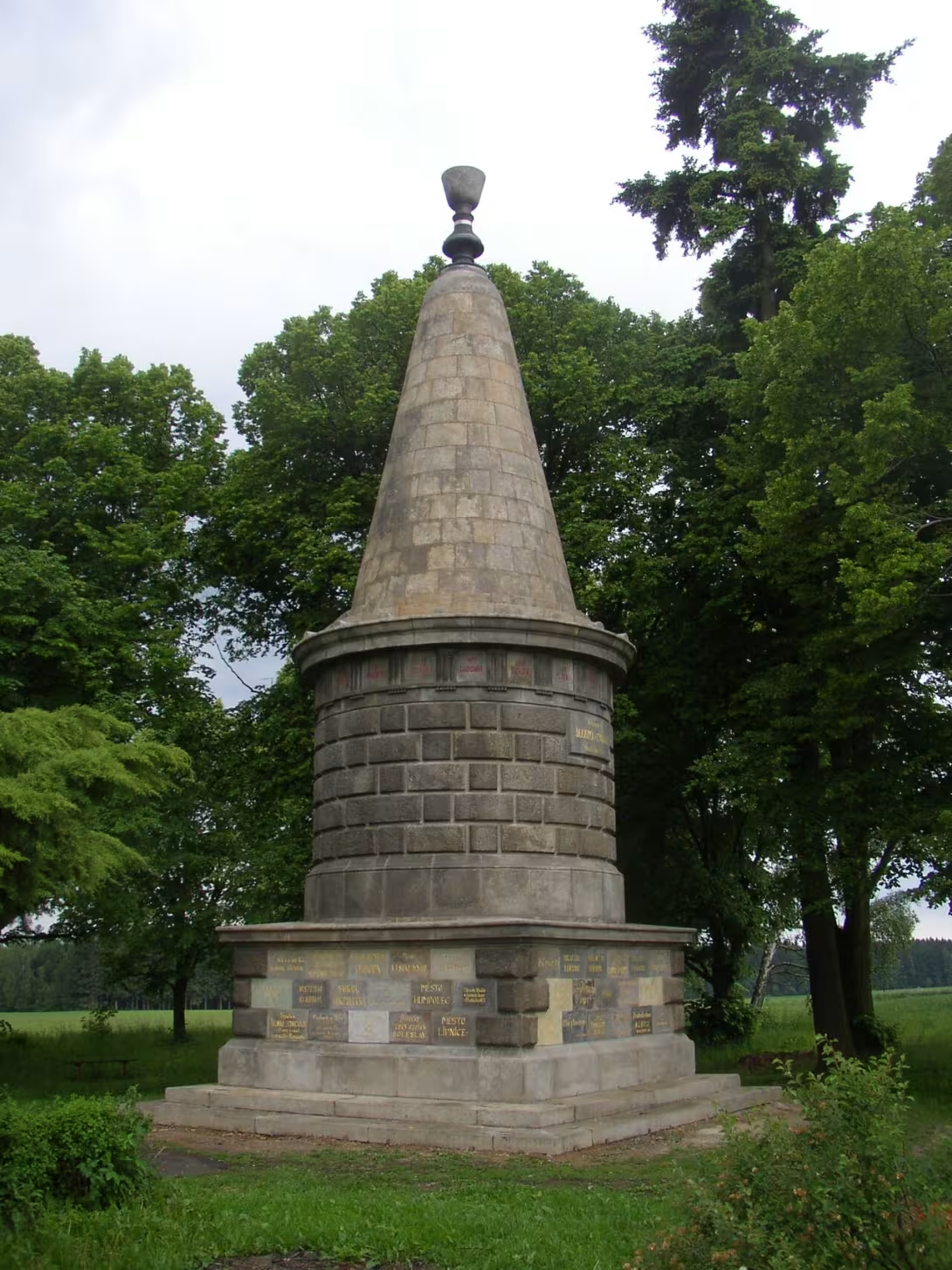
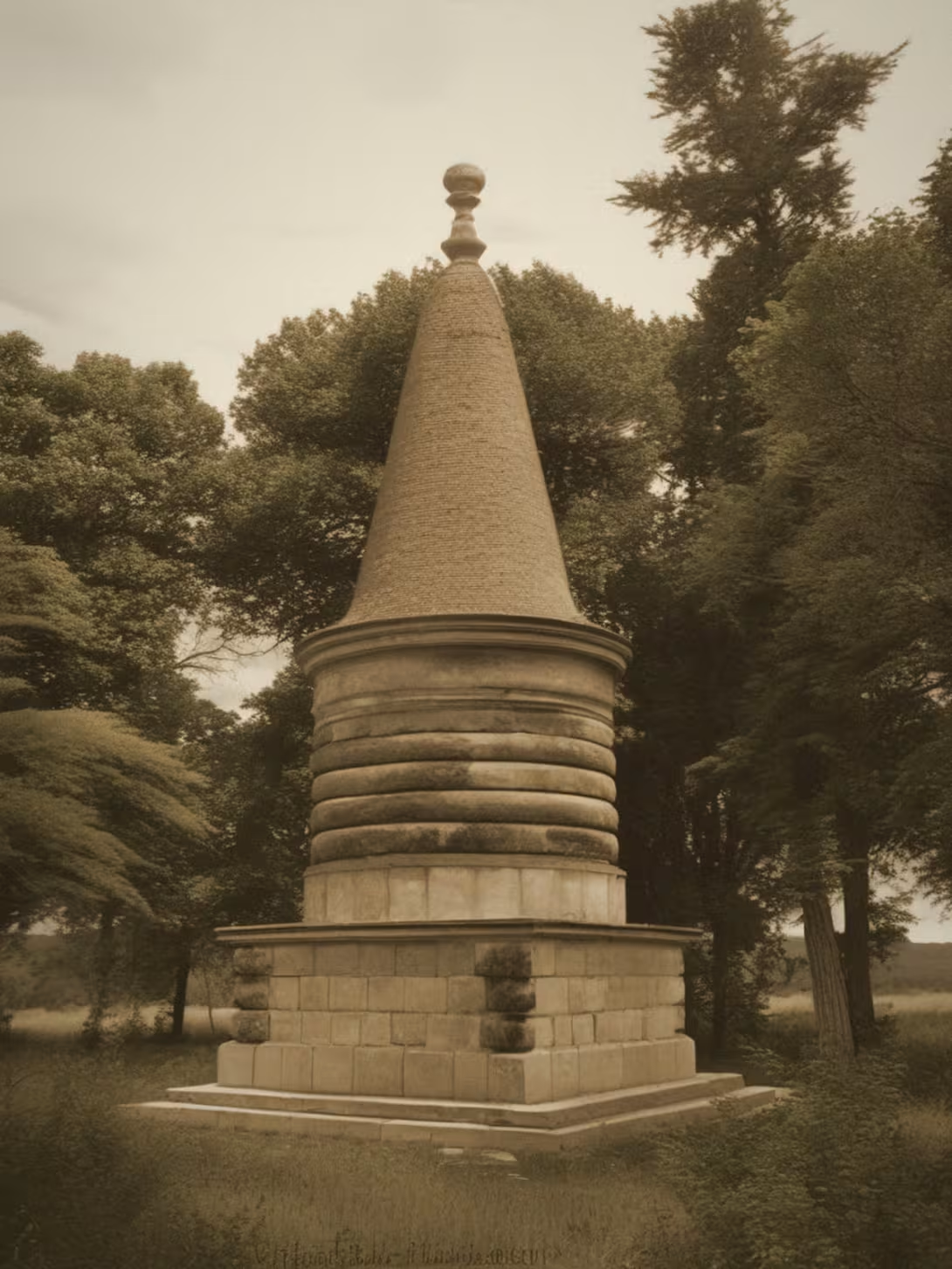
The historical appearance on the left is an AI-generated visualisation and serves as inspiration only.
Historical milestones
- 1862
- Julius Grégr purchased land for future mound
- 1874
- Ceremonial unveiling of the monument to the 450th anniversary of Žižek's death
- 1963
- Entry into the state list of real estate monuments
- 2003
- Reconstruction of the monument
Architectural development
The design was developed by architect Antonín Wiehl in neo-Renaissance style, realized by builder Josef Šupich. The construction uses stone blocks from different places of Bohemia, which were donated by various associations and municipalities. The whole building consists of degrees, four-sided prism, cylinder and cone.
Historical events
1874 Ceremonial discovery of the monument involving 20 000 people, 1963 Writing into the state list of real estate monuments, 2003 Reconstruction of the mound
Owners
1862 Julius Grégr (donated to the Prague Sokola), 1916 Falcon in Příbyslav, later City Příbyslav
Points of interest
- The memorial is 14.7 meters tall and dedicated to Jan Žižek. - 67 blocks from various parts of the Czech Republic are placed in the body of the building. - There are winning battles on the ledge, such as Prague, Plzeň and Sudometry. - The peak of the building consists of a stone cone with a chalice that symbolizes Czech husitry. - In 1874, approximately 20,000 people visited the grand unveiling.
Guide
Show guide text
This text was created by artificial intelligence and has not been editorially reviewed. It may contain inaccuracies.
Welcome to Zizkov's Pole. Right now, you are facing one of the most important symbols of Czech national confidence. In front of you is Žižkova mohyla, a massive stone monument that dominates the surrounding landscape. If you look at it, you'll see a high building that's been guarding this place for over a century. It is a place of silence, respect and deep history, where the memory of one of the largest Czech soldiers is linked to the desire of later generations to preserve their identity.
Stop for a moment and feel the atmosphere of this place. You are standing exactly where, according to historical records, John Žižka's life stopped in the year one thousand four hundred twenty-four. It is here, near Bíbyslav, that the man who became the legend of Hussite fighting has gone into eternity. But the monument that you see before you was not created immediately. His path to realization began much later, at the time of the national revival, when the Czechs sought their heroes and wanted to pay tribute in a tangible way.
Let us now look at how this project came into being. It all began in the year of a thousand eight hundred sixty-two when Julius Grégr purchased the land on which the mound stands today. It wasn't just about buying a piece of land, it was about creating a sacred space for future generations. However, the road to the completion of the construction took longer. The ceremony of the memorial took place on September 20th in the year one thousand eight hundred seventy-four. It was a very symbolic term because it celebrated the 4400 and 50th anniversary of the death of Jan Žižka. Imagine the crowd of people, the enthusiasm and the sense of belonging that had to rule this place at that time.
Now pay attention to the architecture itself. Look up and follow the line of construction. The entire object reaches a height of 14 and 7 tenths of a meter. The architect Antonín Wiehl is responsible for his appearance. The construction is designed very clearly and three main parts can be distinguished in its structure. First, feel the stone foundation, which provides stability and symbolizes strength. Above it is followed by a cylinder and the whole building is closed by a pointed cone.
Note the details on the memorial body. If you approach the ledge, the protruding part, you'll see the names of the cities and places written out. These are the names of the victorious battles that the Jan Žižka commander led. Among them you can see Prague, Plzeň or Sudometry. These names are not just geographical figures, but a reminder of the courage and military genius that changed the face of Central Europe at the time.
Now let's think about the personalities involved in this place. In addition to John Zížka himself, to whom the monument is dedicated, men from another time also left their trail. The Julius Grégr that purchased the land was a key figure, without which it would probably never have risen. František Ladislav Rieger and Jan Otto played a role with him. It was people who believed that the nation needed its symbols so that a sense of pride and self-respect could flow through its veins. For them, this mound was not just a pile of stones, but an expression of the political and cultural self-confidence of the Czech nation within the then empire.
Now I want to impress you with one very interesting fact, which may not seem crucial at first glance, but it has a profound meaning in it. Look at the body of the building again. Do you know that a total of sixty-seven blocks, i.e. stone blocks, were placed in this monument from various parts of Bohemia? That's not a coincidence. By using stones from different regions, the unification of the whole Czech territory around one hero was symbolic. It's like every part of the country has contributed its piece to a common monument.
When your eyes rise to the very top of the object, you will see a stone cone that ends with a chalice. Note this detail, because the chalice is the strongest symbol of Czech Hussite. He represents the desire for purity of faith, equality and truth. It's the top dot of the whole monument that connects earthly victory in battles with spiritual hope.
But the history of this place does not end in the nineteenth century. The memorial had to face the effects of time and weather over the years. In a thousand and nine hundred and sixty-three, he was entered on the state list of real estate monuments, which provided him with legal protection. In order to get to the condition in which you see it today, there were two thousand and three extensive reconstruction in the year. Thanks to it, we can still admire the purity of the lines and the legibility of the inscriptions that tell us stories from the past.
So you're standing in front of a work that's much more than just an architectural object. It's a place where military, faith and national pride meet. Jan Žižka, who probably breathed his last breath here, became a symbol of resilience. And this mound is a silent witness to how the view of his legacy changed over the centuries.
I suggest you now slowly go around the entire monument. Feel how the construction perspective changes depending on your perspective. Try to imagine what this field looked like 500 years ago and what it looked like on the day of the grand unveiling in a thousand eight hundred seventy-four. Let yourself be consumed by the silence of this place and think about what a national hero means to you personally.
If you have time, check the surrounding area of Žizkov Field. It's the perfect place to walk and think. Before you say good-bye to this monument, take your last look at the chalice at the top, which rises to the sky as a reminder of the constant search for truth.
Thank you for spending time with us at Zizkov's Mound. We hope that this interpretation has helped you better understand the importance of this place. We wish you a pleasant further journey and many new discoveries in your discovery of Czech monuments. Goodbye.
Tips for visitors
The best time to visit the monument is early in the morning or during the late afternoon, when the sunlight will highlight the details of the stone building and give the surrounding landscape a unique atmosphere in the Highlands. To travel to this historic place you can use a car or go on foot or on a bicycle along the surrounding rural roads, the nearest town of Přebyslav is just a few kilometres away. Take a raincoat or umbrella with you on your way with regard to your outdoor stay. This is a completely outdoor area without a roof. The town of Přebyslav is within 30 minutes' drive and you can visit a large cross in the village Žižkovo Pole indicating the alleged death of a famous warlord, which will enrich your trip with another historical dimension.
Frequently asked questions
Can the monument be visited?
This is a structure in a public space that can usually be seen from outside free of charge. We have not verified that this particular one is freely accessible.
Where is the monument?
Location: Žižkovo Pole. The map on this page shows the exact spot.
Why is the monument protected?
It is listed in the Central List of Cultural Monuments of the Czech Republic as a cultural monument (register no. 1000131455).
Businesses nearby
Do you run a restaurant, accommodation, shop, museum, rental, wellness or other visitor service near this monument? Show yourself directly to the people heading to it — this is how they will see you in the app and on the web:
Nearby
Pomník stojí v obci Žižkovo Pole 3 km severně od města Přibyslav; v blízkosti se nachází veliký kříž označující údajné místo smrti.
Accommodation nearby
Themed route
Žižkovo Pole Municipality This starting point lies close to the main destination and offers visitors a quiet rural environment with a direct link to the famous history of the Hussite warlord.
Žižkova mohyla Memorial This main destination of the whole trip is in the village Žižkovo Pole and reminds of an important historical event connected with Czech history.
The Great Cross Memorial site This great cross is located in the immediate vicinity of the memorial and marks the alleged death site.
_ City This city is located approximately three kilometers south of where the monument stands and forms the natural edge of the surrounding area.
Seasonal recommendations
Spring awakens the landscape around the monument into a fresh green, when the surrounding fields and meadows bloom with spring blossoms and the morning sun creates fine sloped shadows ideal for quiet contemplation in nature. It is windy during this period, which is why a windbreaker and solid footwear are suitable for muddy field trips, and the best time to visit is the morning hours when the morning fog disappears.
Summer offers long, famous days when a massive monument shines strongly against the bright sky and surrounded by lush summer vegetation full of high grass.
Autumn brings to the landscape colored leaves and melancholy atmosphere, underscored by frequent fog covering the horizon and quiet, soon dimming in the afternoon. Hot waterproof clothes and warm hats are essential for staying outside due to dripping weather and cold wind blowing from elevated terrain, while the ideal light for photography is around noon when the fog retreats for a while.
Winter covers the memory in the snow blanket and creates a quiet, freezing scenery under the open air with early dimming and sharp horizon. Here it is necessary to wear a quality winter jacket, warm gloves and snow shoes for safe movement on unpreserved roads, and the best time to visit is clear noon, when the sun rays reflecting from snow best illuminate the detailed structure of the stone monument.
Visualizations and artistic views


The visualisations are generated by artificial intelligence and serve as inspiration.
Photos from the area
Real photos taken near the monument


Zdroj a licence jsou uvedeny u každého snímku.
Tips from visitors
No tips yet. Be the first!
Log in and add your tip.
Sources and literature
Photos: User:Miaow Miaow / Public domain — Wikimedia Commons. The author and licence also appear when you hover over the image.
Faktickým podkladem tohoto textu byl článek na Wikipedii, jehož autory jsou přispěvatelé Wikipedie. Článek je dostupný pod licencí CC BY-SA 4.0.
Location on the map
More monuments – Žižkovo Pole
Show all in the municipality
Příběhy a pověsti
Legendy, pověsti a příběhy spjaté s touto památkou
Fotografie návštěvníků
Zatím žádné fotografie. Buďte první, kdo přidá fotografii z návštěvy!
Log in a přidejte svou fotografii nebo hodnoťte.
Za ověřenou návštěvu v aplikaci získáte víc bodů — poznáme podle GPS, že jste na místě.
Reviews and comments