

Zvonice (Doubravy) Belfry
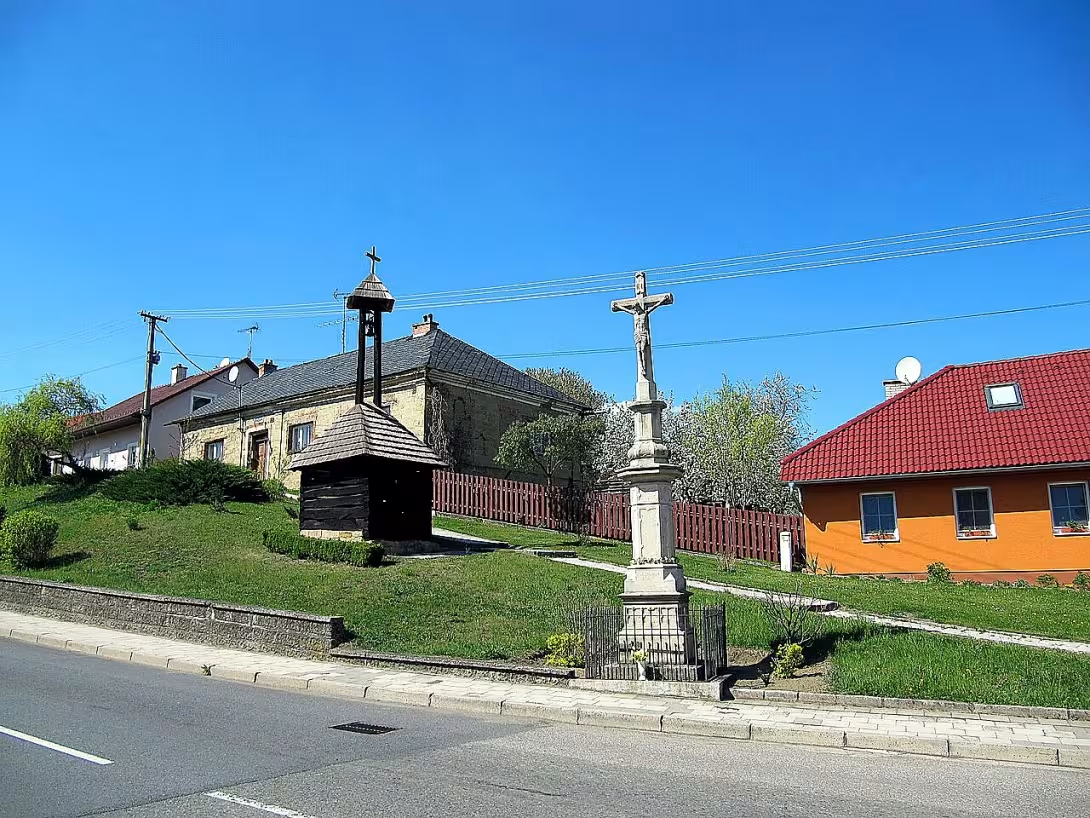
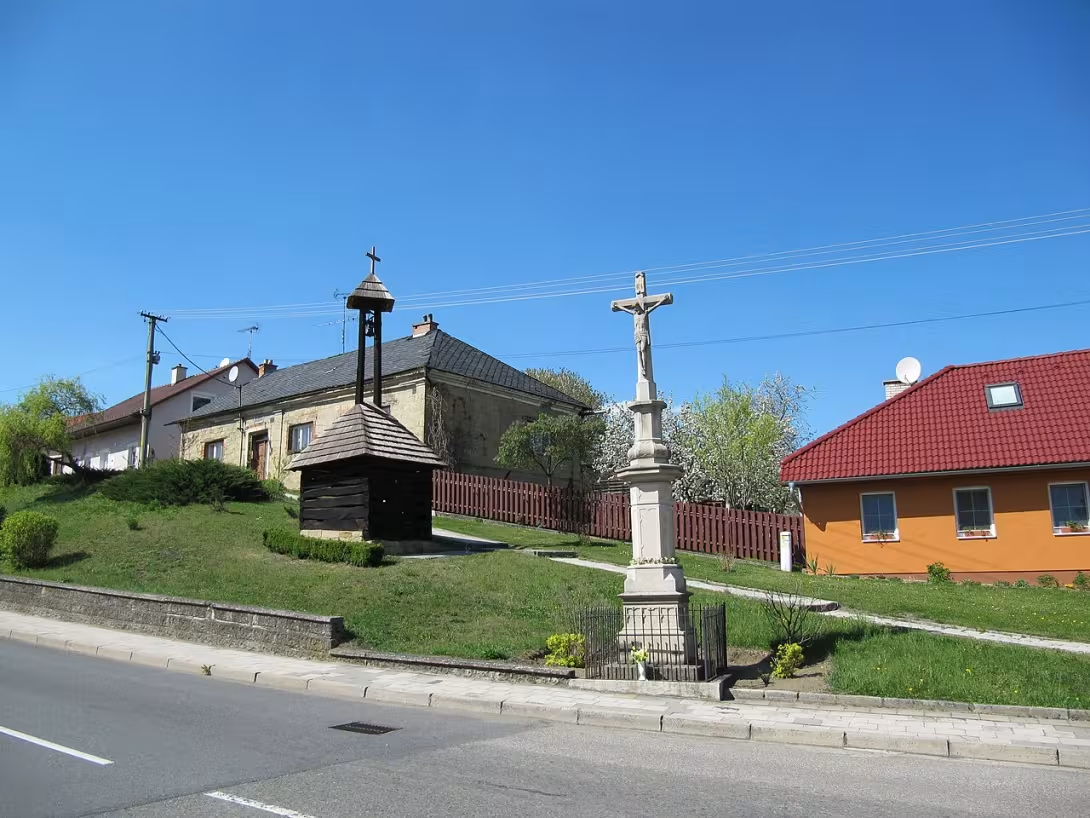
The wooden bell tower in the village of Doubravy in the district of Zlín is a self-standing grafted tower from 1848. This building is registered as a cultural monument of the Czech Republic and dominates the local village.
The present object was created as a replacement for the previous bell tower, which was destroyed by a fire in 1839. Construction was carried out in 1848. This was a period of extensive European revolutions leading to the abolition of absolutism, which accompanied efforts for national emancipation in Czech countries.
The tower has a square plan with base dimensions of 2 × 2 meters and reaches a height of 5 to 5,5 meters. It is a grafted construction made of two-sided decanter beams which are connected to the fish and stored on a suspected quarry stone. The front wall has a specific design of beams mounted on the seam, which are also marked with Roman numerals. A single-wing door is inserted into the beam lining.
The design of the bell uses a horizontal bar located between two wooden columns. These columns are fixed in a standing stool in the heel and the upper part ends with a cross-syllabus with an outer skeleton. At the highest point of the pin is placed the modern cross. The whole building is closed by a valb roof, which was originally tarred, but was replaced in 1973 by shingles cover.
In the newer history of the monument, a new bell was hung in 1994 from the workshop Tomášková-Dytrych in Brodk near Přerov. In 2009 the entire restaurant bell tower was held.
The object represents a valuable example of traditional folk construction. Thanks to its architecture and historical value, it is worth visiting every person interested in wooden buildings in the region.
Then and now
Drag the slider to compare how the landmark may have looked when it was built with the view today.
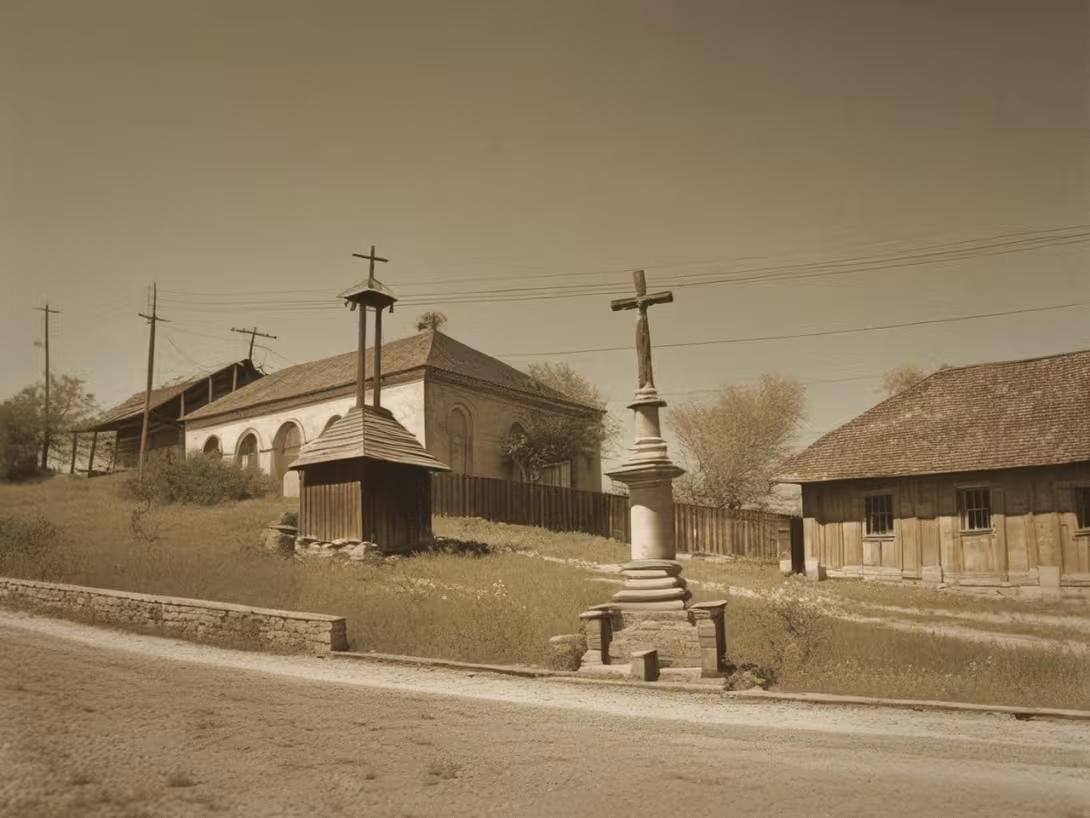
The historical appearance on the left is an AI-generated visualisation and serves as inspiration only.
Historical milestones
- 1848
- construction of the grafted bell tower
- 1973
- laying of a new shingles roof instead of the original dock
- 1994
- hanging a new bell from Tommy's workshop - Dytrych in Brod u Přerov
- 2009
- restoration of bell tower
Architectural development
The construction is grafted from two sides of carved beam beams connected to the fish on a stone suspect. The original canopy roof was replaced by shingles in 1973. The bell is fixed on a horizontal plank between two pillars with a needle cap.
Historical events
1839: original bell tower fire; 1848: construction of the current grafted bell tower; 2009: restaurant construction.
Points of interest
- It's a self-standing grafted tower from 1848 that dominates the local village. - The current building was created as a replacement for the previous bell tower, which was destroyed by a fire in 1839. - The tower has a square plan and reaches a height of 5 to 5.5 meters. - The original wooden wall roof was replaced with shingles in 1973. - In 1994 a new bell was hung from the workshop in Brodk near Přerov.
Guide
Show guide text
This text was created by artificial intelligence and has not been editorially reviewed. It may contain inaccuracies.
Welcome to the village of Doubrava, where time seems to be stopped for a while and where tradition still speaks in its clear voice. Right now, you're standing in front of one of the most significant parts of this community, the dominant part of it, who is proud to guard the local village. In front of you is a wooden bell tower, a building that tells its appearance and material the story of folk wisdom, patience and respect for the craft. Feel her presence, her scent of old wood and the way she fits into the landscape of Zlín County. It is a place that unifies the past with the present and reminds us how important the centre of life used to be in every Czech village.
When you look at this construction like this, you might wonder how the municipality got to it and why it stands here in this form. To understand its origin, we have to go back deep into the nineteenth century. This grafted tower you see was built in 1848. But it wasn't the first bell tower in this place. History tells us that the previous construction that served the inhabitants here was destroyed by a devastating fire in 1839. The fire, which was at that time the greatest enemy of the wooden communities, erased the previous work of the builders, but at the same time aroused the need to rebuild in people. After several years of adjustments and preparations, this current bell tower was born in 1848, which was to be a permanent symbol of recovery and stability.
Now I ask you to pay full attention to the architecture itself. Look at the foundation of the building. Note that the bell tower stands separately, not connected to any other building, which gives it a unique character and allows you to circumvent it from all sides. It's built on a square plan, which means its base is a regular square. This geometric simplicity is typical of folk construction, where functionality went hand in hand with aesthetics. Look at the walls. It is a grafted construction, which means that they are made of horizontally layered wooden beams, which are precisely embedded in each other in the corners. It is this technique of grafting that gives the construction its robustness and characteristic appearance, which we perceive as both cosy and firm.
Lift your view up now. You'll see the valb roof that ends the whole building. The valb roof is such that it falls from all four sides to the perimeter of the building, which ensures effective drainage of rain and snow. The total height of this tower ranges from five to five and a half meters. Although it may not seem to be a monumental height compared to the city's cathedrals, in the context of a village village village, this height is sufficient for the bell tower to dominate the surrounding area and for the sound of the bell to pass freely through the air and reach all corners of the village.
When we think about the people who created this building, we have to acknowledge that the names of particular architects have been forgotten in time. They were not famous builders from big cities, but probably local masters, folk carpenters who knew their craft from generation to generation. This is where the greatest value of this monument lies. It is not the work of one brilliant individual, but the result of the collective experience and tradition of folk construction. This bell tower is such a valuable example of its time that it was officially registered as a cultural monument of the Czech Republic, which means that the state recognises its historical and artistic value and protects it for future generations.
Now let's think about what makes up the soul of every bell tower, and that's its bell. The bells in the past were not just religious instruments, but they served as a communication system. They announced time, called people to prayer, but also warned against danger, like the fire that destroyed the previous tower. In 1994 a new bell tower was hung into this tower. This bell comes from a recognized workshop by Tomáškové-Dytrych in Brod u Přerov. Imagine the moment when the bell was called for the first time in this tower and its pure tone flew again over the Doubrava after years. It is a combination of traditional craft from the Moravian region with local space.
In addition to the bell, however, the bell tower has changed in other details over the years. Here we come to one interesting thing that requires a thoughtful view of the roof. If you could go back in time before 1973, you would see a completely different surface here. Originally the roof was Došková, i.e. covered with straw or reeds, which was a very common and functional solution in folk construction. However, there was a significant change in 1973 and the canopy roof was replaced by a new shingle roof. Shingles, i.e. small wooden plates, are more durable and better protect the grafted structure from moisture. This change of material may have slightly altered the appearance, but it helped the construction survive in a better condition.
In order for the bell tower to remain a proud symbol of the village, it was necessary to take care of it. Comprehensive restoration took place in 2009. Restoration of wooden structures is a very demanding process, which requires a sensitive approach in order not to destroy the original wood matter and preserve the authenticity of the building. Thanks to this care we can now admire the details of the grafting and stability of the entire structure, which carried us from 1848 to today.
Stop for a moment in silence. Imagine how many generations of people from Doubrav have passed this tower. How many times have they heard her bell at the wedding bells, at the funerals or the storm warning? This bell tower is not just a pile of wood and shingles, it is a silent witness to history who survived changes in regimes, wars and everyday worries of rural life. It's an example of how simple materials like wood can create something that can survive the century in the hands of skilled craftsmen.
Now that you know the story of this beautiful grafted structure, I suggest you go around it. Notice how light changes on wooden walls and how the roof profiles against the sky. Feel the geometry of the square and the stability that radiates from it. This bell tower is a reminder that even small buildings can be of enormous importance if the memory of the community is stored in them.
Thank you for accompanying me in this brief view to the history of the bell tower in Doubravy. I hope that you have found time to really see this memory and that its simplicity and its strength interest you. Now invited to further explore the surroundings of this beautiful village. Take a walk around the village, see the atmosphere of this place, and look for other traces of the past that carries the landscape of Zlín County. I wish you a pleasant rest of the journey and many new discoveries. Goodbye.
Tips for visitors
The best time to visit is late afternoon when the sun hits the grafted walls, highlighting the structure of the wood and the details of the construction from the mid-nineteenth century. For photography we recommend angles from the edges of the village, which capture the tower as the dominant of the whole village in the natural environment.
We recommend travelling by car or public transport to the place; Check the specific connections and stopping options in the current timetables. Since it is an object in a public area, it is not necessary to prepare special equipment, it is enough comfortable shoes to walk around the village.
Families with children can use a visit to explain how they used to build grafted buildings and what separate bellies served before modern systems were created. As the building stands free on the baits, it is safe for children to go around it from all sides.
There are various attractions of the Zlín district within a 30-minute drive around the monument, which you can incorporate into your entire day trip.
Frequently asked questions
Can the monument be visited?
This is a structure in a public space that can usually be seen from outside free of charge. We have not verified that this particular one is freely accessible.
Why is the monument protected?
It is listed in the Central List of Cultural Monuments of the Czech Republic as a cultural monument (register no. 1000150517).
Businesses nearby
Do you run a restaurant, accommodation, shop, museum, rental, wellness or other visitor service near this monument? Show yourself directly to the people heading to it — this is how they will see you in the app and on the web:
Nearby
🏰 Historic sites (182)
- 2. sv. válka - odbojáři 2.7 km
- Pomník Václava Mizery 2.8 km
- Pomník ruskému vojákovi 3.0 km
- Pomník obětem 1. sv. v. 3.0 km
- Památník obětem 1. sv. v. 3.2 km
- Zámek Velký Ořechov 3.6 km
- sv. Jan Nepomucký 3.6 km
- Mohyla padlým 4.0 km
- Šarov 4.2 km
- Památník Zdeňka a Ludvíka Dohnalových 4.2 km
- Rolnická usedlost č.p. 19 4.4 km web
- Pomník obětem 1. světové války 4.4 km
- Pomník obětem 2. světové války 4.5 km
- Památník obětem boje proti fašismu 4.6 km
- Pomník obětem 1. světové války 4.6 km
- sv. Jan Křtitel 4.8 km
- Pamětní kámen k příležitosti 100. výročí založení Československé republiky 5.1 km
- Rýsov 5.2 km
- Pomník obětem 1. sv. v. 5.3 km
- Pomník obětem 2. sv. v. 5.3 km
🍽️ Restaurants and dining (381)
- Hospoda na křížovatce 3.1 km
- Hospoda Na hřišti 3.5 km
- Šarovská hospoda 4.3 km
- Hospoda u KD 4.5 km
- Na Pinduli 5.4 km +420 731 616 870 web
- Hostinec na Maleniskách 6.0 km
- Hospůdka U Dubového stolu 6.3 km
- Hospoda U Hřiba 6.7 km
- Restaurace Koliba 6.8 km
- U Vajů 7.0 km
- Dobrá pivnice 7.1 km
- Sport bar U Zlaté kopačky 7.5 km
- U Suchánků 7.7 km web
- U Mata 7.7 km
- BůBů klub Jaroslavice 7.8 km
- Burger Brothers U Koňa 7.8 km +420 725 169 673 web
- Pizzeria Rimini 7.9 km Nádražní 249
- Hospůdka Na konci světa 8.0 km
- Bistro Princ Asie 8.0 km Nádražní 261
- Čokoládovna U Najády 8.0 km web
🏨 Accommodation (134)
- Penzion Apart Samont 3.1 km Hřivínův Újezd 190 +420 731 583 909 web
- Penzion Černý kocour 4.2 km
- Lesní hotel 6.7 km web
- Penzion Era 7.2 km
- Ogar 7.7 km web
- Vila Aneta 7.8 km Školní 674 725 965 506 web
- Lázeňský & wellness hotel Niva 7.9 km Antonína Václavíka 336 +420577131326 web
- Vila Vyšehrad 7.9 km
- Penzion Rodina 7.9 km
- vila Lipová 7.9 km web
- Penzion Romana 7.9 km Bezručova 414 +420 602 448 009 web
- Vila Vlastimila 7.9 km Betty Smetanové 244 +420577682248 web
- Vila Valaška 7.9 km
- Růžová vila 8.0 km
- Penzion Marie Macurová 8.0 km
- Penzion Riviera 8.0 km
- Miramare - Helena 8.0 km Bezručova 471 +420 577 659 111 web
- Lázeňský hotel Vila Antoaneta 8.0 km
- Miramare II 8.0 km Bezručova 338 +420 577 659 111 web
- Penzion Loreta 8.0 km
🚲 Rentals and sport (58)
- BIFU 7.9 km Nádražní 298
- Luha park 8.1 km
- Půjčovna lodiček a šlapadel 8.4 km web
- Radostova 8.5 km
- Městská plovárna Luhačovice 8.5 km web
- Sportovní hala Novesta 8.5 km
- COVER SPORToutdoor activities 8.6 km
- Sport365.cz 8.7 km
- Tenis badminton 8.7 km
- Online-sport.cz s.r.o. 8.8 km 577 440 151 web
- Lázně Zlín 8.8 km Hradská 888 +420 577 599 911 web
- BIKEMAX 8.9 km
- Sokolovna 9.1 km
- MOUNTAIN SPORT 9.3 km
- TK Fortuna 9.5 km
- Husky 9.6 km
- TJ Topolná 9.6 km web
- Intersport 9.6 km
- Sport Vision 9.7 km
- Decathlon 9.7 km třída 3. května 1170 +420326551700 web
🥾 Hiking and nature (176)
- Kamenec 1.3 km
- Doubí 1.3 km
- Losky 1.7 km
- Kamenná 3.0 km
- Za Dvorem 3.0 km
- Kamenec 3.4 km
- Lukáščena 3.6 km
- Vyhlídka Samuela Šroma 3.8 km
- Sirný pramen 3.8 km
- Sirčena 3.9 km
- Oberský 4.3 km web
- studánka U hadího smrku 4.3 km
- Hrabová studánka 4.7 km
- Rysov 4.8 km
- Vrchy 4.9 km
- Pod Pindulí 5.2 km
- Miroň 5.3 km
- Jardova vyhlídka 5.3 km
- Horní Radějůvka 5.3 km
- Klenčov 5.6 km
Accommodation nearby
Trips and activities nearby
Guided tours, tickets and activities nearby from GetYourGuide
Affiliate link: if you buy from the partner, we may receive a commission. The price for you does not change.
Search tours and activities →Themed route
Here is the route design focused on sightseeing:
1. Tanks - Space around the tower, which serves as the entrance part and allows first view of the building from below. 2. Zvonice (Doubravy) - The main destination of the trip where you can admire the architecture of this historical tower. 3. Inner spaces and exposition - Walk inside the building which represents the history and importance of this place. 4. View section of the tower - Output to the top for view of the surrounding landscape.
Seasonal recommendations
In spring, the tower surrounds the awakening nature and fresh greenery. Soft morning light will highlight the details of the construction. I recommend wearing more layers of clothing because the weather is variable. The ideal time to visit is in the morning when the air is the cleanest.
In the summer months, the monument is in contrast with thick leaves and sharp sun. The evenings are warm and the atmosphere around is relaxed. It is advisable to choose light summer clothes and a sun hat. The best time is the late afternoon when the shadows are longer and the temperature is more pleasant.
Autumn brings the golden colour of leaves and frequent fog to the surroundings, which give the place a mysterious mood. The light is finer and more golden in this period. Practical are waterproof shoes and a warm jacket. Visit the tower around noon to make full use of daylight.
In winter the tower silhouette stands out against the grey sky or white snow sheets. The atmosphere is calm and rough. Don't forget the warm thermal linens, gloves and hat. I suggest you come in early this afternoon before it gets dark fast.
Visualizations and artistic views


The visualisations are generated by artificial intelligence and serve as inspiration.
Photos from the area
Real photos taken near the monument


Zdroj a licence jsou uvedeny u každého snímku.
Tips from visitors
No tips yet. Be the first!
Log in and add your tip.
Sources and literature
Photos: palickap / CC BY 3.0 — Wikimedia Commons. The author and licence also appear when you hover over the image.
Faktickým podkladem tohoto textu byl článek na Wikipedii, jehož autory jsou přispěvatelé Wikipedie. Článek je dostupný pod licencí CC BY-SA 4.0.
Location on the map
Příběhy a pověsti
Legendy, pověsti a příběhy spjaté s touto památkou

Fotografie návštěvníků
Přidat fotografiiZatím žádné fotografie. Buďte první, kdo přidá fotografii z návštěvy!
Máte k místu vzpomínku nebo zajímavý příběh?
Log in a přidejte svou fotografii nebo hodnoťte.
Za ověřenou návštěvu v aplikaci získáte víc bodů — poznáme podle GPS, že jste na místě.
Reviews and comments