

Secrets of Rosenberg Český Krumlov: ciphers, alchemists and a theatre that changes scenes in seconds
Vilém of Rožmberk ruled from the age of sixteen, wrote in cipher during secret negotiations and kept alchemists at his court. The Schwarzenbergs later gave the castle stage machinery that still works today. The real history behind the game Lucerna času.
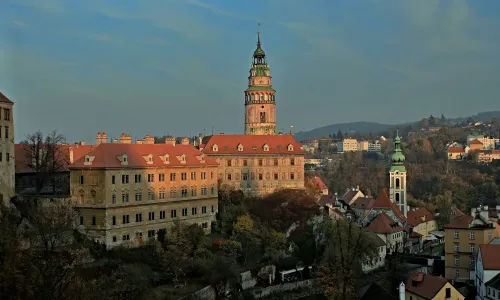
Behind the game Lucerna času · the real history of Český Krumlov Castle
In short: Vilém of Rožmberk took over the largest estate in Bohemia in 1551, aged sixteen. His motto was “Festina lente”, and he used ciphers in his secret negotiations for the Polish throne. Alchemists worked at his court, the longest of them Master Antonín Michael of Ebersbach, who died in 1593 imprisoned by the Bear Moat.
Two centuries later the Schwarzenbergs equipped the castle theatre with stage machinery that can still change an entire scene in a few seconds. This article explains which puzzles in the game Lucerna času are documented history and which are our fiction.
Vilém of Rožmberk: ruler at sixteen
Vilém of Rožmberk (1535–1592) was declared of age by a decree of Emperor Ferdinand I on 23 April 1551. In May that year he took over the Rožmberk domain, then the largest estate in Bohemia, and ruled it for forty years. During his era Český Krumlov Castle underwent major Renaissance rebuilding and the whole of South Bohemia reached its greatest prosperity.
As a student in Passau Vilém chose the motto Festina lente, “make haste slowly”, and used it all his life. A walking trail of the National Heritage Institute through Český Krumlov still recalls it. In the 1580s he received the Order of the Golden Fleece, the highest honour the Habsburgs granted to Catholic nobles. Its chain is visible in the portrait below.
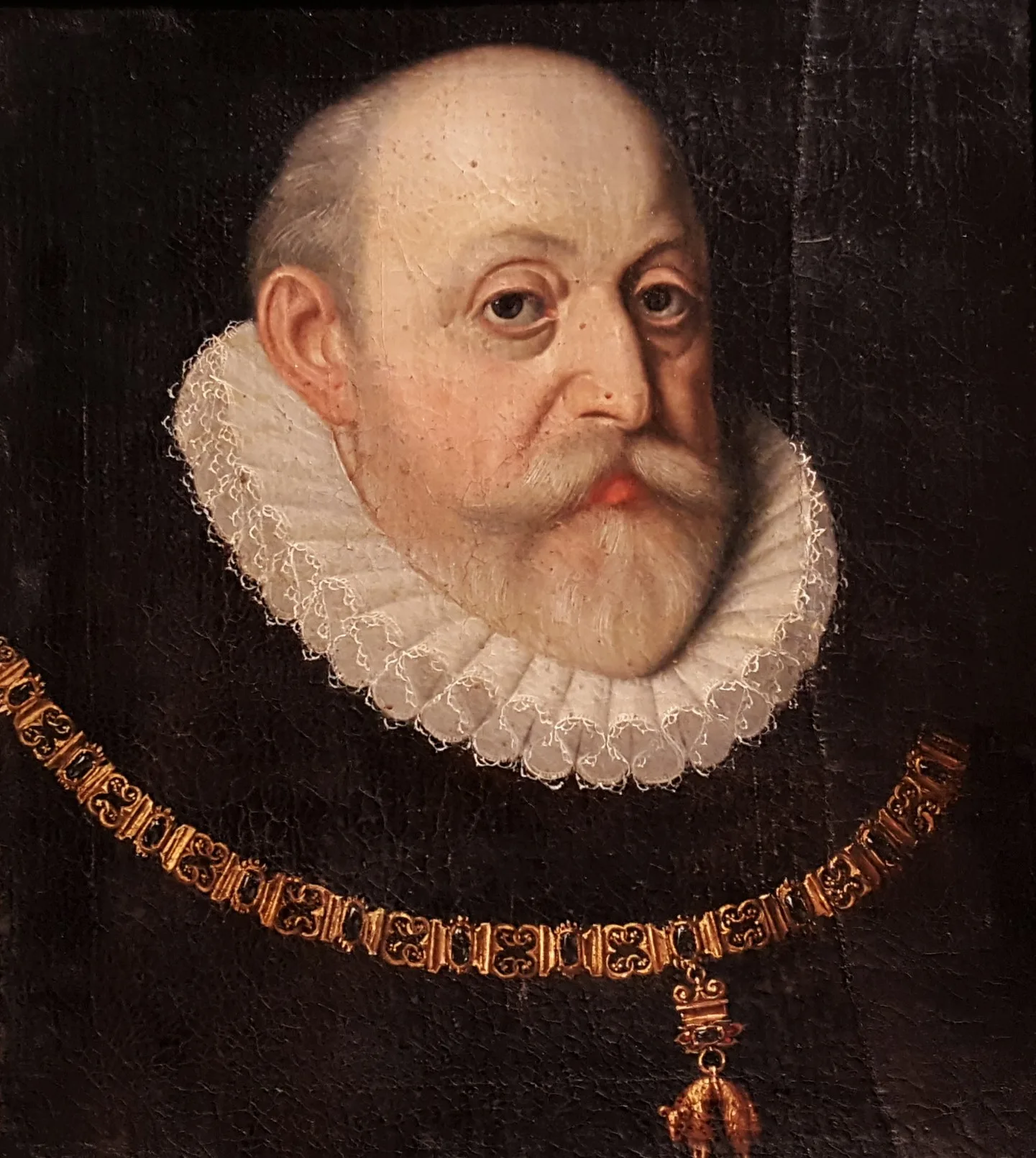

The Rožmberk coat of arms was a red five-petalled rose on a silver field. A family legend of the “division of the roses” tells that their ancestor Vítek split his estate among his sons and each received a rose of a different colour. A painting in the castle's Renaissance hall shows the legend, but it is not historically documented. After 1556 Vilém also used an augmented coat of arms referring to the family's supposed descent from the Italian Orsini.
Ciphers and the secret bid for the Polish crown
In 1573–1575 Vilém of Rožmberk sought the Polish crown. It was risky: he would have become a rival of his own sovereign and could have been accused of treason. He therefore negotiated in the utmost secrecy through trusted agents, Jan Netolický and Zdeněk Kavka, and according to his biographer Jaroslav Pánek used a system of ciphers. In the end the Transylvanian Stephen Báthory won the Polish throne.
What did such a cipher look like? 16th-century diplomats commonly used a nomenclator: a table in which symbols or numbers replaced individual letters, while other symbols stood for whole words and names, such as a ruler, a city or an ally. Without the key, a letter looked like rows of symbols. The actual Rožmberk key has not survived, so the cipher in the game is our reconstruction in the spirit of the period, not an original.
Alchemists at the court of the Lords of the Rose
Vilém was a typical Renaissance magnate and opened his court to alchemy. He had laboratories in Český Krumlov and in Třeboň. He expected the alchemists to provide precious metals, the philosopher's stone and an elixir to keep him healthy and young. In September 1586 the English scholars John Dee and Edward Kelley also arrived in Třeboň and stayed for over two years.
The one who served him longest, for twenty-seven years, was Antonín Michael of Ebersbach. He was to brew the elixir of life, managed the Rožmberk mines and lived in his own house in Široká Street. His career ended with Vilém's death in 1592. The last Rožmberk, Petr Vok, did not share his brother's interest in alchemy and had him imprisoned in a cell by the first castle gate, near the Bear Moat. Master Antonín died there on 15 May 1593. His tombstone is set into the wall of the cloister of the Minorite monastery.
Symbols of the metals. Alchemists knew seven metals and linked each with a planet: gold with the Sun ☉, silver with the Moon ☽, mercury with Mercury ☿, copper with Venus ♀, iron with Mars ♂, tin with Jupiter ♃ and lead with Saturn ♄. They wrote the same signs in recipes and on vessels. They also worked with Aristotle's four elements: the lightest, fire, rises upwards, beneath it is air, then water, and the heaviest is earth. They drew them as triangles.
The painted tower and the bears
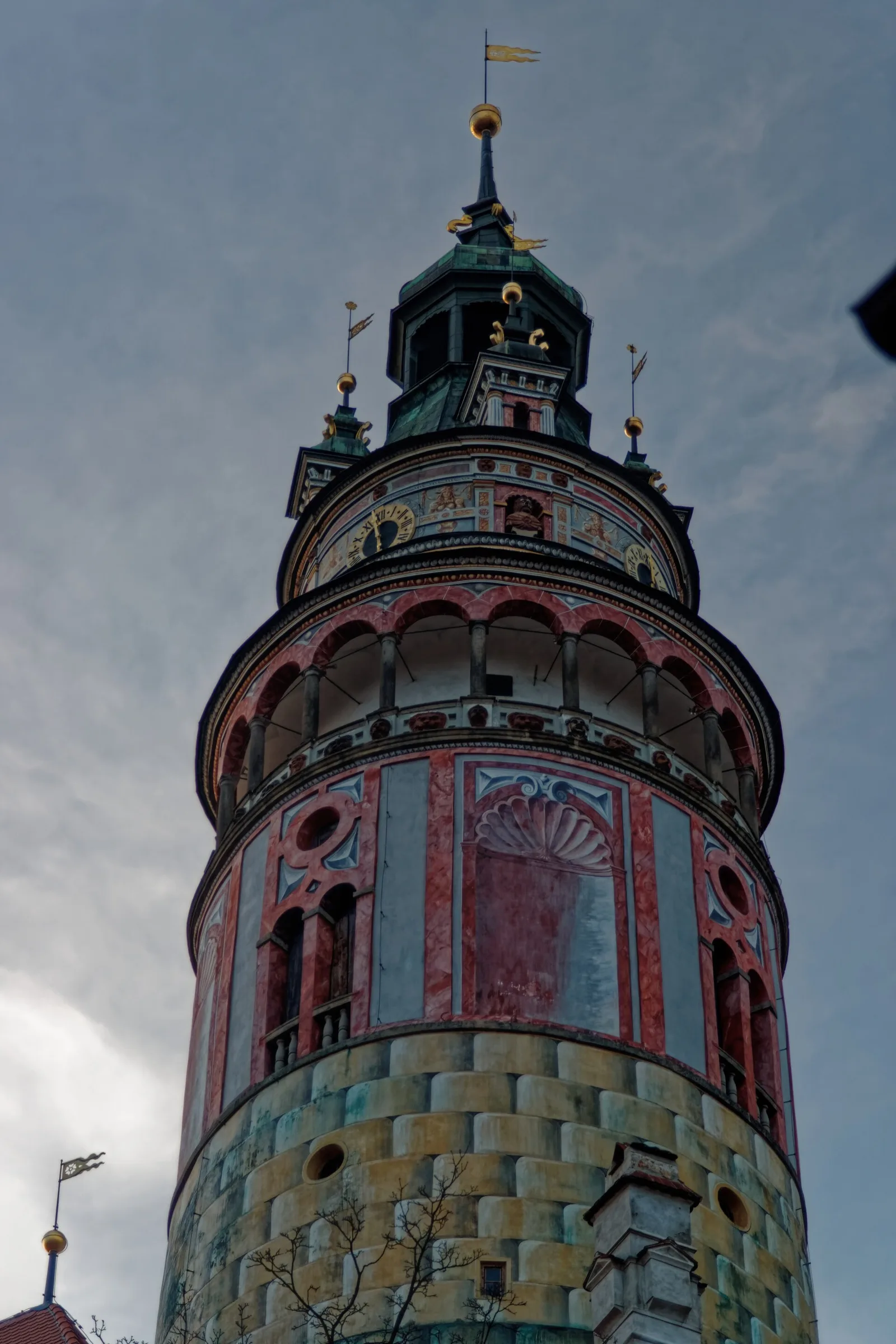

The cylindrical castle tower has a Gothic core from the mid-13th century. It was completed in its present form in 1581, probably to a design by Baldassare Maggi of Arogno, and in 1590 Bartoloměj Beránek-Jelínek painted it together with the adjoining Little Castle. A bell dated 1406 hangs in the belfry. Karel Čapek called it “the most towery tower”. The decoration reportedly includes figures of the four elements and busts of planets, which can be read as an alchemical programme. This reading appears only in a worksheet of the National Heritage Institute, so we treat it with caution.
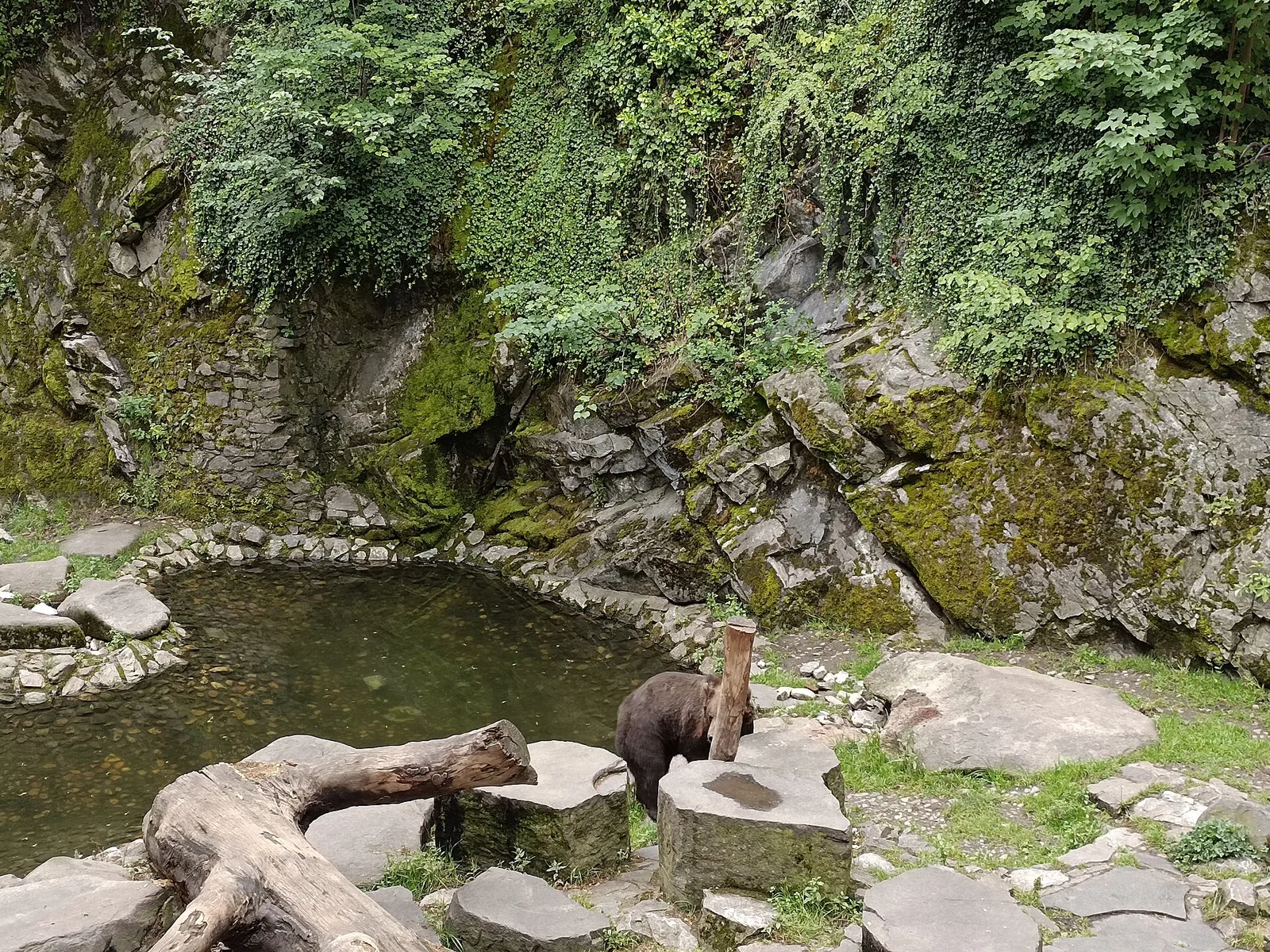
Below the tower lies the Bear Moat. The last Rožmberks kept bears at the castle in the 16th century, and bears have lived in the moat itself continuously since 1707. A stone bridge with statues of the Virgin Mary and St Joseph replaced the wooden drawbridge in 1760.

A theatre that changes the scene in seconds
Theatre was performed at the castle already under Vilém and Petr Vok. The Eggenbergs had a stage set up in the Deer Hall in 1675 and in 1680–1682 built a separate theatre building in the fifth courtyard. The Schwarzenbergs gave it its present form: in 1765–1766 Josef Adam of Schwarzenberg had it rebuilt and fitted with new scenery and machinery. The machinery was made by the Viennese carpenter Lorenz Makh, the paintings and sets by the Viennese painters Hans Wetschel and Leo Märkl. The often repeated claim that the machinery dates “from 1680” is therefore wrong: the building is from 1680, the machinery is eighty years younger.
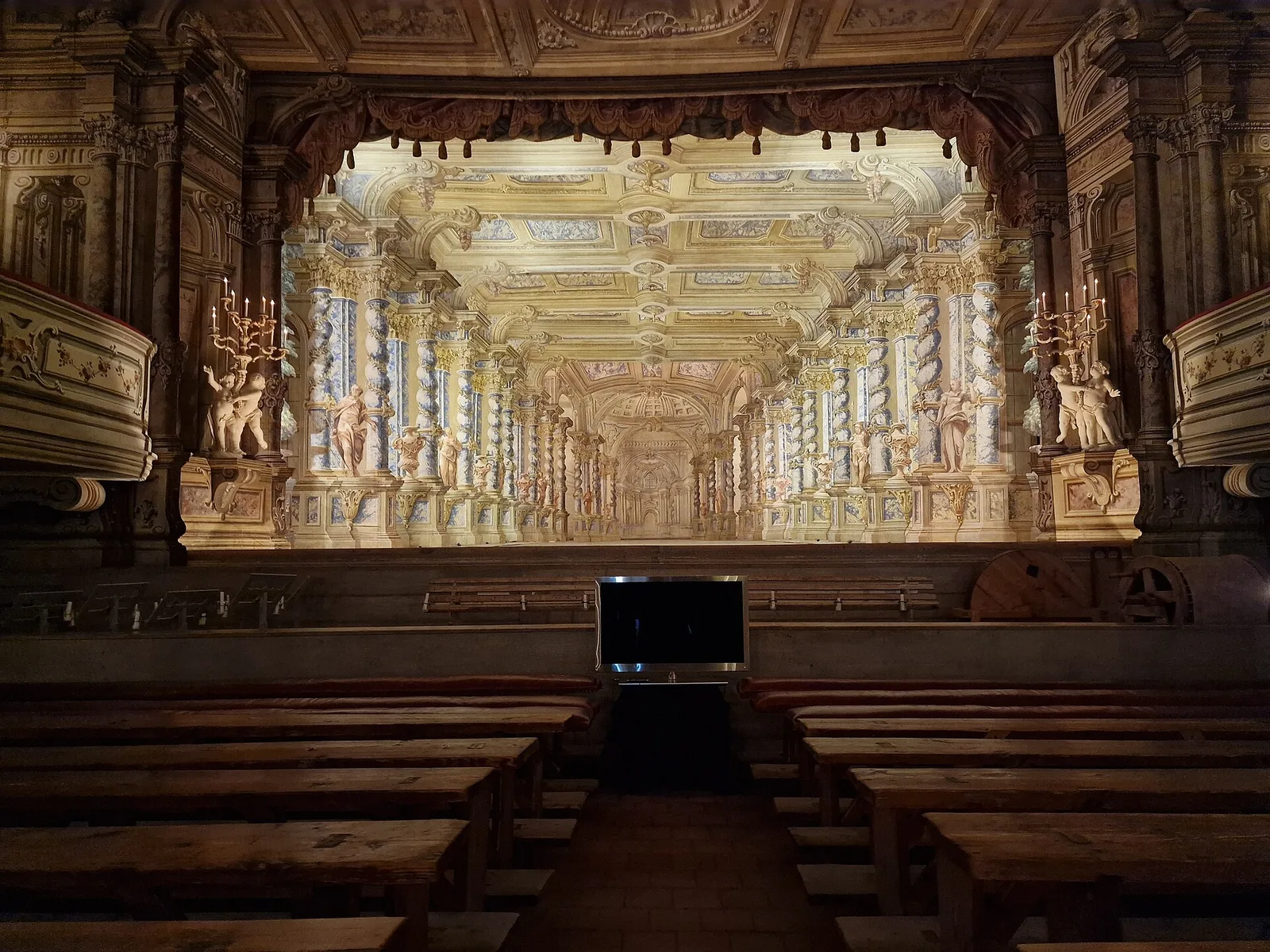

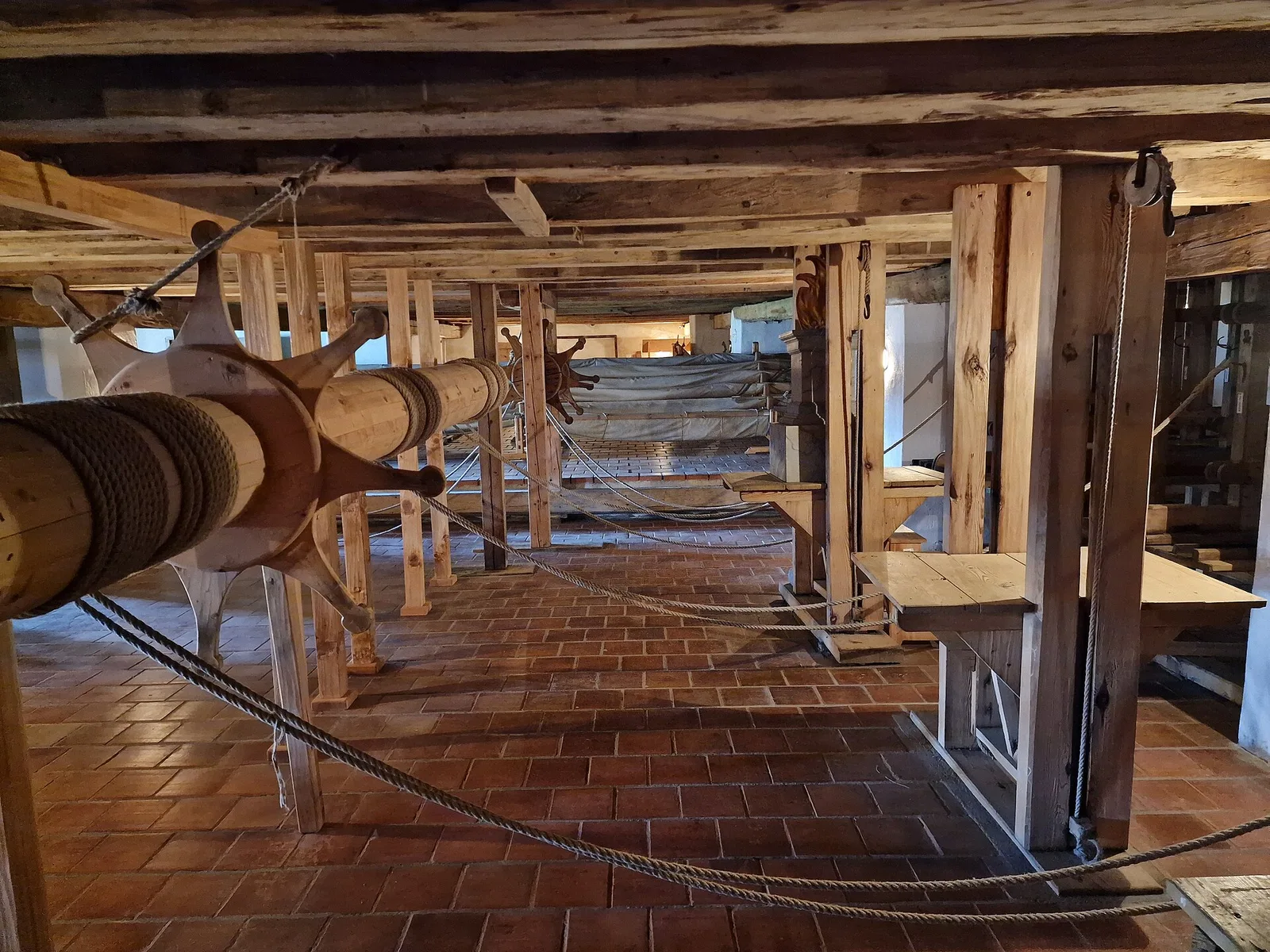
The wings hang in sliding frames that run on wooden rails beneath the stage. Three scenes could be prepared at once. The frames are moved by a massive wooden shaft with levers, from which ropes lead to the wings. Turning the shaft pulls one set of wings back while the next set slides forward. Five or six men can change the whole scene in six to twelve seconds. The stage also has four wooden lifts for actors, a wave machine, “flying machines” and devices for the sounds of thunder, wind and rain.

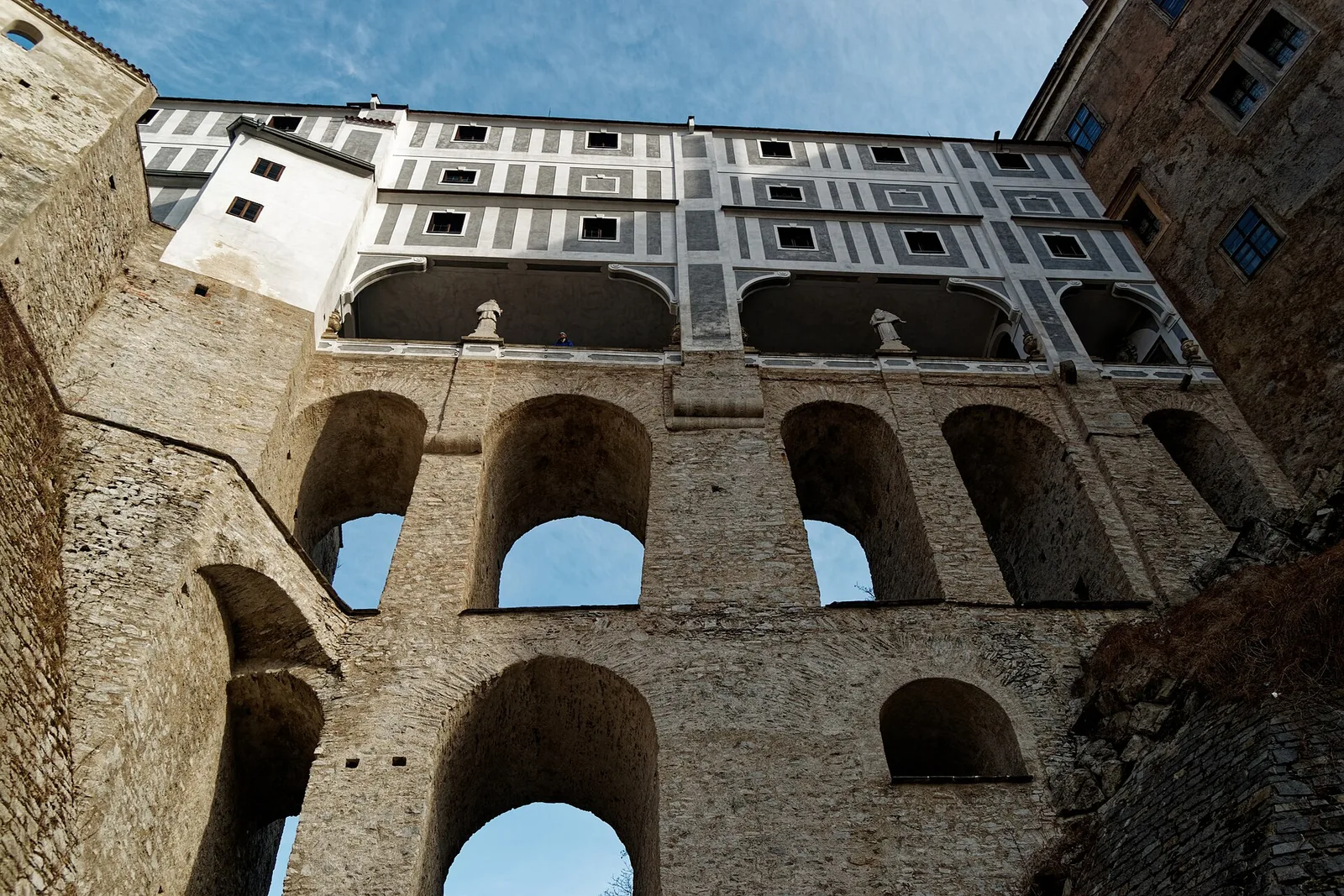
The theatre was closed to the public from 1966 to 1997. After restoration it reopened for tours, and only the Swedish court theatre at Drottningholm is comparable. The Cloak Bridge leads to the castle garden and the theatre: a multi-storey bridge over a rock-cut moat whose upper floors carry covered corridors from the Masquerade Hall to the princely box of the theatre.

Fact or fiction? The game Lucerna času
In the escape game Lucerna času (The Lantern of Time) you explore rooms of Český Krumlov Castle and use a lantern to switch between today and the past. What is real:
- Documented: Vilém of Rožmberk and the year 1551, the motto Festina lente, the Rožmberk rose, ciphers in the Polish negotiations, Master Antonín Michael of Ebersbach and his death in 1593, the planetary symbols of metals, Aristotle's four elements, the bears and the theatre machinery.
- Our fiction: the Rožmberk office as a specific room, the secret passage behind the Gothic cupboard, the particular ciphered letter and nomenclator, Master Antonín's recipe and his cellar workshop with a furnace. Beneath the theatre stage, the specific performance in the stage manager's book, the whale holding a weight in its mouth and the escape by the actors' lift are invented. The carriages with scenery, the main shaft, the wave machine, the thunder trough and the trapdoors are real.
You can visit the real castle on its guided tours. Current opening hours are on the castle's official website; more about the whole complex is on our page Český Krumlov State Castle and Chateau and about the town in the Historic Centre of Český Krumlov.
Sources
- Encyclopedia of Český Krumlov (encyklopedie.ckrumlov.cz): Antonín Michael of Ebersbach, alchemy at the Rožmberk court, the castle tower, the Bear Moat, the castle theatre and its machinery, the Cloak Bridge
- Wikipedia: Vilém z Rožmberka (citing J. Pánek, Vilém z Rožmberka; L. Veselá, Knihy na dvoře Rožmberků), Petr Vok z Rožmberka, Český Krumlov (castle), Alchemical symbol, Classical element
- National Heritage Institute: official castle website zamek-ceskykrumlov.cz, visitor worksheet for Český Krumlov
- Radio Prague International: John Dee and Edward Kelley in Třeboň