






arciděkanství Kutná Hora Parish house
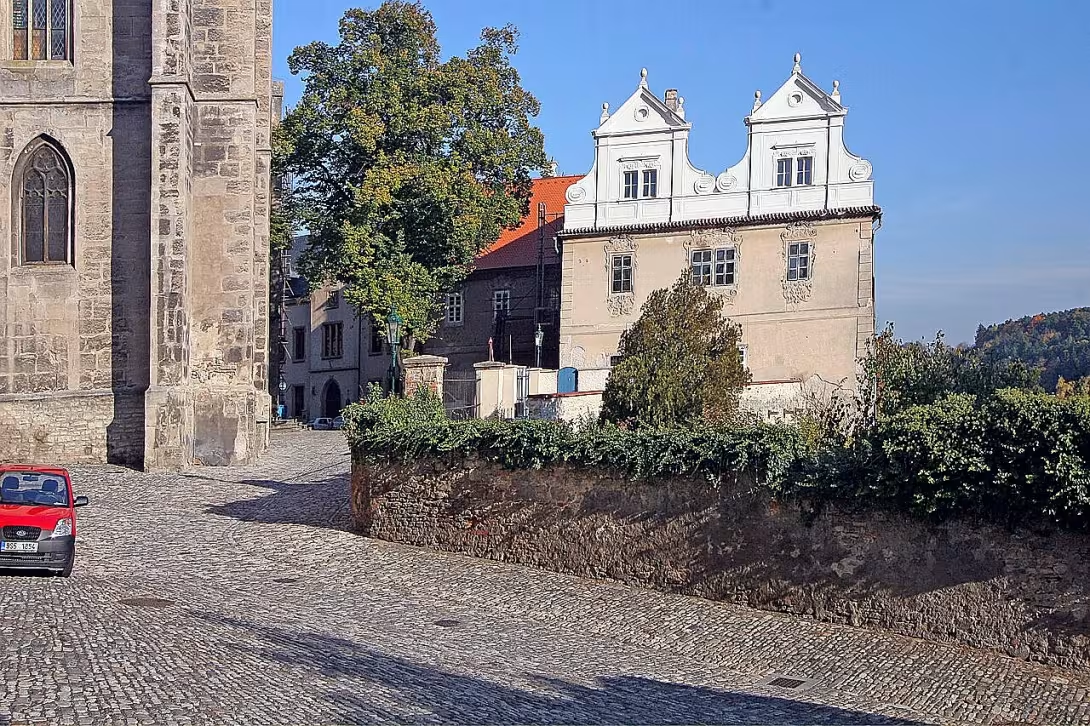
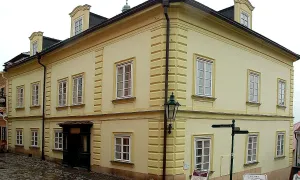
The archdeacon Kutná Hora, located in Jakubská Street near the church of St. Jacob the Elder and the Vlasšský Court, is a cultural monument of the Czech Republic with a rich history dating back to the 16th century. Originally built as a Renaissance school near the High Church in the years 1594- 1595, it became later a parochial archdeacon and is today protected as a historical monument. This building is a unique element of Kutna Hora with its architecture and history.
The history of the archdeacon dates back to the 14th century when the first school at the High Church was founded in Kutna Hora. The first written mention of this school dates back to 1363. After Hussite war years and two major fires that devastated Kutna Hora, the older school was gradually demolished in 1594 and a new Renaissance building started to emerge in its place. The construction was supported by the Mayor of Zikmund Kozel z Riesenthalu and the Royal Speedman of Mikuláš Vodňanský z Čazarova, who contributed financially to it. The funding was also made through public collections.
The new building was single storey and excelled with its architecture, which included a vaulted corridor on the ground floor and a large hall with a beam ceiling on the floor. It was decorated with paintings and above the Renaissance portal was placed a Latin quote from Cicero about the price of education along with the sign of Kutna Hora with a chalice and miners' keys. In 1600- 1603 he worked at the school as the "Chief Administrator" of M. Jan Campanus Vodňanský, which underlines the educational importance of this place.
In the second half of the 17th century, there was an exchange of the building between the school and the parish, which led to a change in its purpose to the parish archideism. In the years 1692-1695, there were extensive building modifications, which removed the atics and modified the facade. The building was adapted for a view from the Jesuit track and the east wing was expanded.
The building resisted several major fires, especially thanks to the bravery of the firefighters who saved the building in the fire in 1823 by taking down a burning roof with their bare hands on the neighbouring church of St. James. At the turn of the 19th and 20th centuries, further modifications were made to the overall monument restaurant under the direction of architects Mockera and Láblera, which included replacement of roof construction.
Today arciděkanství Kutná Hora is protected as a cultural monument of the Czech Republic and has gone to the Roman Catholic parish - arciděkanství Kutná Hora. In 1995- 2014, more than 4.5 million crowns were drawn from the Programme for the Rescue of the Architectural Heritage.
Kutná Hora is an important monument not only for its history and architecture, but also as a symbol of endurance and adaptability. Its rich past and present state represent an interesting example of how ancient buildings can be preserved for future generations. Exploring this monument offers not only a view of the past, but also an inspiration to recognise the value of historical buildings in our present life.
Historical milestones
- 1363
- The first written mention of an earlier town school at the High Church.
- 1594
- Opening of old school demolition and construction of a new Renaissance building.
- 1676
- A trade agreement is concluded between school and parish.
- 1823
- The building was protected from destruction in the fire of the city by the bravery of the fire.
Architectural development
Originally, the Renaissance one-storey building had a vaulted corridor on the ground floor and a large hall on the floor with a beam ceiling, covered by five saddle and two counter roofs. In 1692-1695, extensive building modifications took place in which the atics were removed, the facade was modified, the eastern wing was extended and new roofs laid. At the end of 19th and the turn of 19th and 20th century, the roof structure was replaced as part of the overall monument restaurant.
Historical events
The construction of a new Renaissance school took place between 1594- 1595. In 1673 there was an exchange of buildings between school and parish. In 1692-1695, the building was rebuilt for the purposes of the rectory and archdecanship.
Points of interest
- Kutná Hora is a cultural monument of the Czech Republic with a rich history dating back to the 16th century. - Originally built as a Renaissance school at the High Church in 1594- 1595, it became later a parish archdeacon. - The financing of the construction was also carried out through public collections and was supported by the mayor Zikmund Kozel z Riesenthalu and the royal speedster Mikuláš Vodňanský z Čazarova. - A Latin quote from Cicero about the price of education was placed on the Renaissance portal, along with the Kutná Hora sign with a chalice and a miner's key. - In the years 1995- 2014 more than 4.5 million crowns were drawn from the Programme for the Rescue of the Architectural Heritage.
Guide
Show guide text
This text was created by artificial intelligence and has not been editorially reviewed. It may contain inaccuracies.
Welcome to the picturesque streets of the historic heart of Kutna Hora. Right now, you're standing on Jakub Street, and in front of your eyes, there's an important historical building of the Kutnohora Archdeacon. Raise your head and look around you. You are located in a place where centuries of history breathes at every step, in the immediate vicinity of the mighty church of St. James the Elder and the famous Vlasch Court. Feel the peaceful atmosphere of a place that remembers the glory of the silver city, its expansion and dramatic moments.
Let's go back together in time to a time when this street looked quite different. The first written mention of this place dates back to the year 133,63rd, when the old and demented city school, which served the so-called High Church, stood here. However, with the advancing time, this original building was no longer sufficient for the needs of a growing city, and its condition was so bad that a radical solution had to be taken.
Between fifteen hundred ninety-four and fifteen hundred ninety-fifth, the old school was in a meltdown and a whole new building began to grow in its place. The city needed a representative space at the time, so the new building in its time was one of the largest and most spectacular in the whole city. The interesting thing is that the financing of this challenging building did not only take place from the city register, but was also contributed by residents through public collections and donations, which shows how much people cared about education and the form of their city. The names of the builders may have taken time, but the work itself survived.
Now pay attention to the facade of the building itself, which is right in front of you. This building was originally established as a Renaissance school. Stop for a moment and look at the proportions of this magnificent building, which still bears traces of Renaissance construction. If you look at the walls in more detail, you can imagine what the construction work looks like in the 16th century. During the second half of the seventeenth century, namely the year sixteen hundred seventy-six, an important exchange agreement between the school and the parish was concluded. Since then, the building has started to serve religious purposes as a parochial archdeacon, a function that it still performs today.
This house is connected with a number of interesting human destinies and historical personalities. Their tracks were left by personalities like Zikmund Kozel z Riesenthalu, Mikuláš Vodňanský z Čazarova or educated Jan Campanus Vodňanský. Later in the newer history, famous experts such as Mocker or Lábler were also interested in the design and preservation of monuments in the surroundings. Each of them has contributed to the fact that over the centuries this house has resisted all the trials of fate.
The stories associated with this place are not only about lists and treaties, but also about the great bravery of ordinary people. One of the most dramatic chapters took place in 18,000. That's when the city was hit by a big and devastating fire that threatened to devour the whole neighborhood. But it was the enormous bravery of the Kutnomountain firefighters who managed to save this valuable building from total destruction. Thanks to their use, we can stand here today and admire a monument that is officially protected as a cultural monument of the Czech Republic with a truly rich history dating back to the 16th century.
Before going on further walks in this beautiful city, look again for Jakub Street. Remember, you walk in the places where generations of students, priests and simple townspeople have gone. Thank you for your attention, I hope you enjoyed your walk with our audio guide, and I wish you many other wonderful experiences in discovering the secrets of Kutná Hora. Goodbye.
Tips for visitors
The best time to visit the surroundings of the Kutnohora Archdeacon is early in the morning or late in the afternoon, when the historic streets of the inner city are not crowded with people and sunlight creates ideal shadows on ancient facades.
The location is perfectly accessible both by car and public transport, the nearest parking areas are located at dedicated places within walking distance of the historical centre; We recommend to verify the specific connections and stand options in advance.
Take with you comfortable fixed shoes suitable for walking on historic tiles, a small bottle of drinking and a camera with a charged battery to capture unique architecture in Jakub Street.
For the best pictures, we recommend shooting from the area near the neighbouring church of St. Jacob the Elder, where morning or late afternoon light will highlight the Renaissance details of the building.
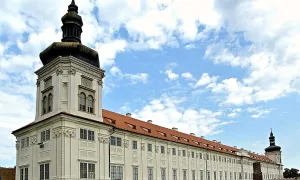
During a short walk in a 30-minute radius, you can visit the beautiful temple of St. Barbara, the historic Vlaschský court, the monumental Jesuit college and the already mentioned church of St. Jacob the Elder.
Businesses nearby
Do you run a restaurant, accommodation, shop, museum, rental, wellness or other visitor service near this monument? Show yourself directly to the people heading to it — this is how they will see you in the app and on the web:
Nearby
Kostel sv. Jakuba Staršího, Vlašský dvůr, jezuitská kolej, chrám svaté Barbory.
Accommodation nearby
Trips and activities nearby
Guided tours, tickets and activities nearby from GetYourGuide
Affiliate link: if you buy from the partner, we may receive a commission. The price for you does not change.
Search tours and activities →Themed route
1.arciděkanství Kutná Hora Type: monument Why is it worth a visit: This main objective represents an important historical building associated with the spiritual administration of the city. It is close to other famous sites and forms an important part of local architecture.
2. Church of St. Jacob the Elder Type: sacral construction Why is it worth a visit: This majestic church building with a high tower offers a view of the Gothic art and forms an invisible dominant feature of the urban panoramic scenery.
3. National Court Type: historical palace Why is it worth a visit: The former Royal Palace and Mint lures visitors with its rich history associated with grossing and medieval royal power.
4. Jesuit College Type: historical building Why it is worth a visit: The impressive Baroque building captures its expansiveness and serves as an important cultural centre with artistic exhibitions.
5th Temple of St. Barbara Type: Gothic temple Why is it worth a visit: A world-famous temple dedicated to the patron saint of miners dazzles everyone with its breathtaking Gothic architecture, interior decoration and unique atmosphere.
Seasonal recommendations
Spring in the historical core of Kutná Hora brings awakening nature, when the surrounding greenery and flowering trees form a wonderful contrast with the Gothic and Baroque architecture of ancient archdeanery. The light of the sun gradually gains strength and the long spring shadows underline the plasticity of stone walls and decorated portals, creating a calm and thoughtful atmosphere without distracting rush. During this period you will meet only a minimum of visitors, so you can enjoy the tour in complete silence. Wear layered clothes and solid shoes, because after rainy days, paving cubes can be slippery in the alleys. The best time to visit is in the morning, when morning herpes gives the place a mysterious touch.
Summer opens the main visiting season, when the whole inner city is filled with life and the sun's rays fall directly on the bright facades of buildings. Long days allow you to admire the details of the exterior of the archdeacon until late evening when warm air brings pleasant evening sitting outside and the atmosphere is vibrant and pulsating. The disadvantage is the larger crowds of tourists flowing to all the sights, so it is necessary to expect longer waiting. Choose light, breathable clothes, sunglasses and don't forget the headgear and bottle of drinking water. The best results for a quiet tour can be achieved early in the morning after opening or late in the afternoon when the main waves leave the city.
Autumn transforms the surroundings of Kutnohora Archdeacon into a painting canvas full of yellow, orange and red colours falling leaves. There are often fog clouds over the valley that cover the roofs of houses and supply the whole place with melancholy, up to fairy-tale character that excels on a mild autumn evening. Tourism is falling significantly, which guarantees a chamber atmosphere ideal for the perception of history. The weather is very variable, so we recommend a windbreaker, waterproof jacket and a warm sweater. The best time of day for a walk is around noon, when the warm rays of the sun at least disperse the cool morning air for a while.
Winter brings deep peace and quiet to the historic centre of Kutná Hora, which amplifies a layer of snow covering ancient roofs and paving. The lighting in the streets lights up early in the afternoon and creates a warm atmosphere in contrast to the freezing air, while the festive mood at the end of the year attracts peaceful walks around the monumental building of the Archdeacon. All you'll meet here are real landlords with no crowds. Winter clothes, i.e. warm feather jacket, hat, gloves and high-quality shoes with anti-slip sole are essential. Due to a shorter day, plan your arrival for the morning hours to arrive at all daylight.
Visualizations and artistic views


The visualisations are generated by artificial intelligence and serve as inspiration.
Photos from the area
Real photos taken near the monument

Zdroj a licence jsou uvedeny u každého snímku.
Tips from visitors
No tips yet. Be the first!
Log in and add your tip.
Sources and literature
Photos: Petr1888 / CC BY-SA 3.0 — Wikimedia Commons. The author and licence also appear when you hover over the image.
Faktickým podkladem tohoto textu byl článek na Wikipedii, jehož autory jsou přispěvatelé Wikipedie. Článek je dostupný pod licencí CC BY-SA 4.0.
Location on the map
More monuments – Kutná Hora-Vnitřní Město
Show all in the municipality

Příběhy a pověsti
Legendy, pověsti a příběhy spjaté s touto památkou
Fotografie návštěvníků
Zatím žádné fotografie. Buďte první, kdo přidá fotografii z návštěvy!
Log in a přidejte svou fotografii nebo hodnoťte.
Za ověřenou návštěvu v aplikaci získáte víc bodů — poznáme podle GPS, že jste na místě.
Reviews and comments