



Boží muka v Albrechticích Wayside shrine
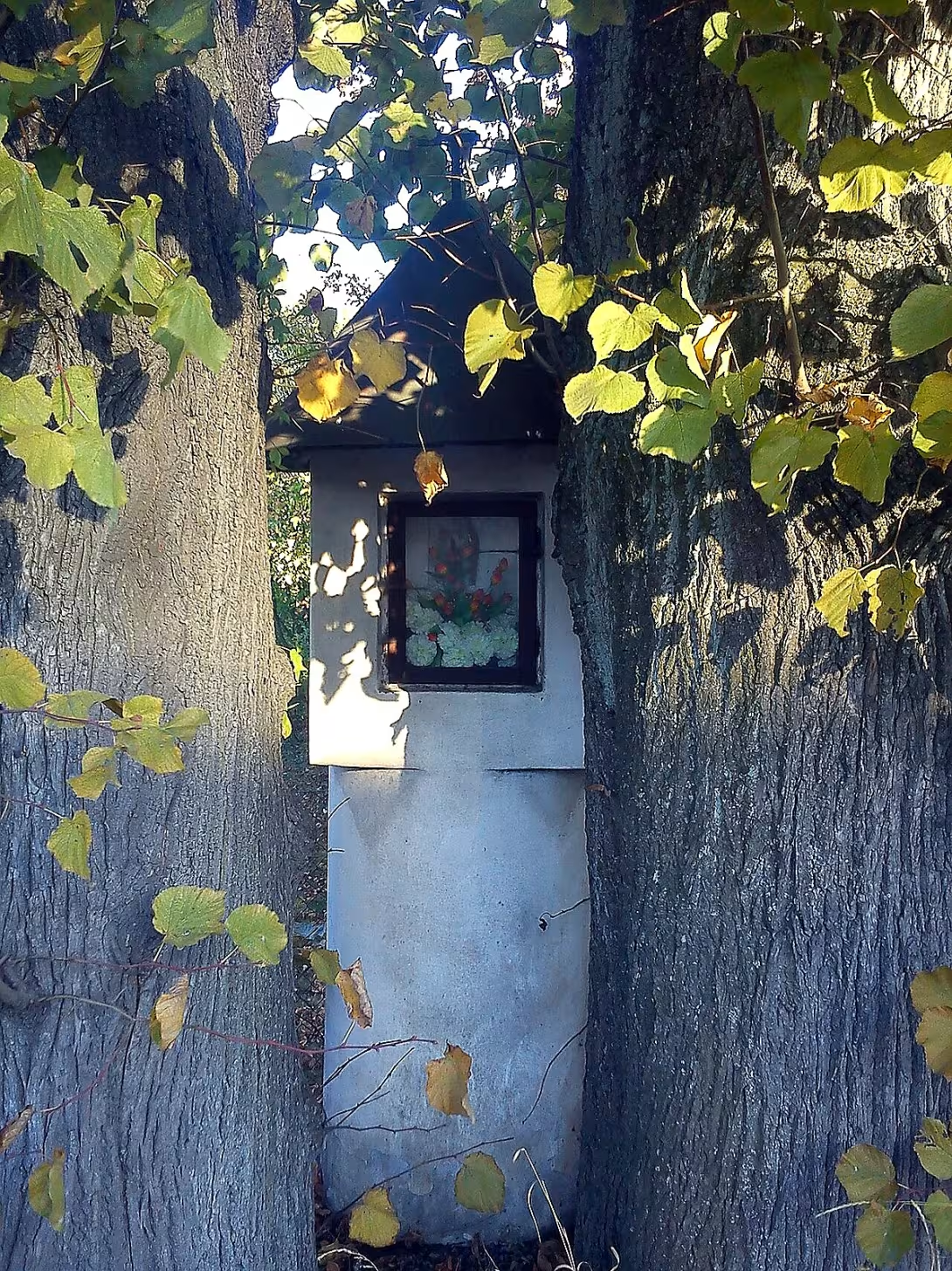
Boží muka v Albrechticích is a walled column object from the turn of the 18th and early 19th century. This cultural monument is located in the southern part of the village Albrechtice in the district of Karviná. It is an element of sacral architecture registered in the register of cultural monuments under heading 20304 / 8-779.
There are few reports about the circumstances of the creation, the founders or the precise reasons for the position. The construction dates back to the turn of the 18th and 19th centuries, which corresponds to a wider trend in the creation of similar small sacral structures in the Czech environment. These objects in the landscape traditionally served as an expression of faith, monuments of specific events or landmarks for passengers.
From an architectural point of view, it is a brick and plastered construction. The construction stands on a cylindrical blade forming the lower part. He's got a prism chapel with a cone cap on it. This geometric combination of cylinder, prism and cone forms a compact solid composition typical of the column variant of God's torture. The material used and surface plaster correspond to the standards of outdoor construction of the time.
The sights lie in the southern part of the village, where it adjacent to the main communication, namely the Main Street. The position was chosen so that the construction was easily visible to bystanders and served as a stop point. The exact position is defined by coordinates 49.78181 north latitude and 18.52480 east longitude.
At present, the monument is protected as a cultural monument, which means that its state and appearance are under the law. Thanks to the position on the main road, it is fully accessible to the public and visitors. It represents an authentic element of historical development in the Moravian-Silesian Region, which has preserved its original form.
The preservation of these tiny architectural elements is important for maintaining the identity of the cultural landscape and its historical strata. Visiting the site offers the possibility to see a concrete example of outdoor sacral architecture from the turn of the century. It is a suitable stop for anyone interested in the details of the historical layout of the village.
Points of interest
- Boží muka v Albrechticích is a brick column object from the turn of the 18th and early 19th century.
- This cultural monument is located in the southern part of the village Albrechtice in the district of Karviná and is registered in the register of cultural monuments under the number 20304 / 8-779.
- Architecturally it is a walled and plastered building with a prism chapel ended with a cone cap, which is a typical composition for the column of God's torment.
- Location of the monument at Main Street ensures its visibility and accessibility to the public.
She's protected as a cultural monument, which means her condition and appearance are protected by the law.
Guide
Show guide text
This text was created by artificial intelligence and has not been editorially reviewed. It may contain inaccuracies.
Welcome to Albrechtice. You just stopped by one of the quiet, but extremely important points in our country. You are standing right in front of God's torments, which exist here as a silent witness for many years that have passed by this place. You may have felt a strange calm looking at them or wondered what all these stone or wooden shapes experienced. Right now, when you have headphones in your ears, we can stop together and pay attention to this object, which is part of our cultural heritage. Feel the atmosphere of the place where you are now. Notice how this monument has been incorporated into the surrounding space and how its presence changes the perception of the whole area.
Let us now think together about why such objects are even located in Eastern Bohemia and in our Moravian-Silesian region. God's torment is not just ordinary buildings. These are pilgrimage points, milestones and spiritual anchors that were meant to provide people with orientation in the past, both in space and in their inner life. Although history has not revealed to us the exact year when these divine torments in Albrechtice were erected, and we do not even know the name of the man who designed them, their importance remains unquestionable. In times when there were no precise maps and digital navigation, these objects served as important signs on the road. They could have marked the boundaries of a village, a crossroads or a place where a significant moment took place. Even though their exact origin and original purpose in this particular place remains hidden from us, their existence is proof of the deep need of man to leave a trail in the landscape that will continue after his departure.
Now pay attention to the very form of this object. Although we do not know the name of a particular architect, you can perceive the effort and care with which this monument was created. Look at its structure, its shapes, and how it resists all elements. Notice how the surface of the monument touches the outside world. Even if I can't tell you every detail of its composition, I suggest you look very closely at it. Feel every inequality, every line and every trace of time that's formed on it. This monument is registered as a cultural monument, which means that its value is not only in its material, but above all in its ability to tell the story of the people who lived here before us. It's an object that deserves respect and attention because it's part of our common memory.
Let us now go to the people who are connected to this place. You might find it odd that we have no specific record of them. We don't know any historical personalities that would move here directly, or any names of families that would build these divine torments. But that's where their greatest strength lies. These divine torments are linked to anonymous heroes of everyday life. Imagine all the people that have been passing by them for centuries. Imagine the peasants leaning towards them in prayer after a difficult day in the field, imagine the pilgrims who have rested with them during their long journey or the locals for whom they were part of their everyday world. Each one of them brought to this place a piece of his life, his joy and his sadness. Even though their names have lost time, their presence here is still felt. This monument is like a silent reflection of all the unknown lives that have taken place here.
Now, I want to invite you to think about the interesting thing that has to do with this place. And it's just the biggest mystery. The greatest mystery of these God's torments is not what you see, but what you don't see. It's the emptiness in the information that forces us to imagine. Who was the person who decided that this object had to stand right here? What was his motivation? Was it an act of deep faith, expressing gratitude for the survival of any discomfort, or just a simple way to mark the path for generations to come? This ignorance, this lack of data, creates a mystical zone around the monument. This monument is not just a stone or wooden object, it is a question placed in a landscape to which we still do not know the answer. And that question is what makes us stop and perceive.
Remember that even though we do not know the exact chronology, this monument is a living element of history that is constantly supplemented by our own perception. Anyone who stops here like you adds another layer to her history.
Now that you've seen this memory and paid attention to it for a while, I suggest you continue your walk around Albrechtic. This area offers many other attractions and hidden treasures that await your discovery. Let yourself drift through the atmosphere of this region and try to find further traces of the past that are hiding here in the landscape. Thank you for spending this moment with us and for being interested in our common heritage. We wish you a beautiful and inspiring further journey through this territory. Goodbye.
Tips for visitors
The best time to visit is early morning or shortly before sunset, when soft light best highlights the texture of the stone and details of the monument.
Take comfortable shoes and plenty of drinking water for your journey, as it is an outdoor object in open terrain.
For the best photos we recommend focusing on the architectural details of God's torture and capturing them in the so-called golden hour when the light is most favourable.
For families with children, the visit is suitable as a short educational stop, which will present the basic elements of folk architecture and religious tradition of the region.
Frequently asked questions
Can the monument be visited?
This is a structure in a public space that can usually be seen from outside free of charge. We have not verified that this particular one is freely accessible.
Where is the monument?
Location: Albrechtice, Moravskoslezský kraj. The map on this page shows the exact spot.
Why is the monument protected?
It is listed in the Central List of Cultural Monuments of the Czech Republic as a cultural monument (register no. 20304/8-779).
Businesses nearby
Do you run a restaurant, accommodation, shop, museum, rental, wellness or other visitor service near this monument? Show yourself directly to the people heading to it — this is how they will see you in the app and on the web:
Nearby
➜ Zobrazit interaktivní přehled okolí – restaurace, ubytování, půjčovny a další místa v okruhu 15 km.
Data: OpenStreetMap contributors, okruh 15 km.
🏰 Historické památky
- Padlým letcům (7.5 km)
- Zajatcům tábora Stalag VIII B (7.8 km)
- Zámek Šumbark (7.9 km)
- Obětem 1.sv. války (7.9 km)
- Muzeum Těšínska (8.1 km)
- Zámek v Karviné-Fryštátě (8.1 km)
- Muzeum tiskařství (8.3 km)
- Mieszko I Książę Cieszyński (8.9 km)
🍽️ Restaurace a stravování
- Le Café (8.3 km)
- Adamo Restaurace (8.4 km)
- CykloRest Lučina (9.3 km – 387)
- U Šodků (9.8 km)
- Šenovská Bašta a Pizza od Krtečka (10.3 km)
- Horakůvka (10.6 km)
- Dřevjanka (10.7 km)
- Pohostinství Pod Zámkem - Pivovar Šenov (10.8 km)
🏨 Ubytování
- Hotel Impuls (5.3 km – U Hřiště 1324/13b)
- Vulture (5.7 km – U Pošty 371/4)
- Boršičanka (7.4 km)
- Penzion Flora (7.7 km – 19)
- Gambit (8.0 km – Nestora Bucewicza 18)
- Mercure Cieszyn (8.0 km – Motelowa)
- Hotel Central (8.2 km)
- Hotel Piast (8.3 km)
🚲 Půjčovny a sport
- RPH Fitness s.r.o (5.1 km – Šrámkova 1379/2)
- Bazén Delfínek (6.3 km)
- Městská sportovní hala (6.4 km)
- Domino Sport (8.0 km)
- Slovan Havířov (8.2 km)
- Bazén Šumbark (8.2 km)
- Biegshop.pl (8.2 km)
- Učebna plavání při ZŠ Pod Zvonek (8.7 km – Pod Zvonek 1865/30)
🥾 Turistika a příroda
- Nad Bučníkem (3.1 km)
- Babí Hora (3.9 km)
- Hory (4.7 km)
- Widok na Czeski Cieszyn (8.0 km)
- Havířov (ŽST) (8.0 km)
- Informacja Turystyczna (8.2 km)
- Cieszyńskie Centrum Informacji (8.6 km)
- Bobčok (10.2 km)
Accommodation nearby
Themed route
Thematic cruise route from Albrechtic
1.Boží muka v Albrechticích * Type: * Historical landmark It is worth visiting for its architecture and history, which resembles the history of the village. It's a unique element of local cultural heritage.
2. Chapel of the Virgin Mary * Type: * Religious construction The chapel is located near God's torture and offers a peaceful atmosphere for meditation and worship. It's a place of deep historical significance.
3. Local Church * Type: * Religious construction The church is the center of religious life in the village and offers beautiful interiors with rich historical exposition.
4. Church tank * Type: * Historical area Visitors can explore the courtyard, which is an ideal place for relaxation and knowledge of the history of the village. There are also various cultural events.
5. Park by the church * Type: * Green space The park offers an opportunity for a quiet walk and listening to local flora and fauna. It is an ideal place to relax after visiting other monuments.
This route offers a view of the cultural and historical aspects of Albrechtic, all of which are located in the village.
Seasonal recommendations
Spring brings new life and fresh colors to the Albrechtic area. The blooming vegetation around God's torture creates a pleasant environment and light is softer during this period, which is ideal for observing the details of the building. For a visit I recommend choosing the morning hours when the air is the cleanest and the most active nature. Dress well, because morning cold can still smell.
In the summer months the monument is surrounded by dense greenery and the sun lights it up all day long. The atmosphere is alive, but due to high temperatures, the journey to the memory can be difficult. The best time to visit is early morning or just before sunset to avoid the greatest heat and direct sun. Don't forget enough drinking water and a protective headgear.
Autumn season is very atmospheric for this location thanks to colour leaves and morning fog. Light is deep and dramatic at this time, which gives the memory a mystical touch. It is advisable to carry waterproof shoes and windbreaker as the weather can change rapidly. Afternoon walks are ideal for watching the change of the surrounding countryside.
Winter turns the surroundings into a quiet and snowy landscape, where God's torment acts as a symbol of peace. The atmosphere is raw but very impressive, especially in advent time, when there is a special spiritual mood. It is necessary to wear very warm clothes and firm shoes to move on possibly slippery surfaces. Due to the shorter time of day, plan to visit around noon hours.
Visualizations and artistic views


The visualisations are generated by artificial intelligence and serve as inspiration.
Photos from the area
Real photos taken near the monument


Zdroj a licence jsou uvedeny u každého snímku.
Tips from visitors
No tips yet. Be the first!
Log in and add your tip.
Sources and literature
Photos: OtaconCZ / CC BY-SA 3.0 — Wikimedia Commons. The author and licence also appear when you hover over the image.
Location on the map

Příběhy a pověsti
Legendy, pověsti a příběhy spjaté s touto památkou

Fotografie návštěvníků
Zatím žádné fotografie. Buďte první, kdo přidá fotografii z návštěvy!
Log in a přidejte svou fotografii nebo hodnoťte.
Za ověřenou návštěvu v aplikaci získáte víc bodů — poznáme podle GPS, že jste na místě.
Reviews and comments