



Divišova vila (Přelouč) Museum building
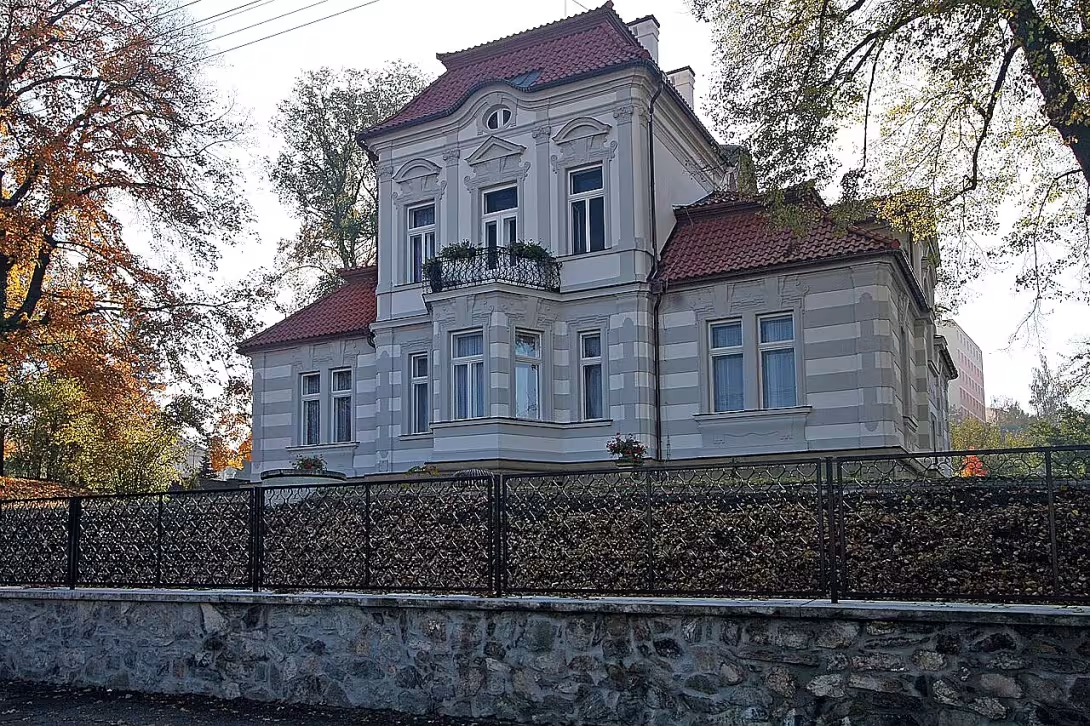
Diviš's villa in Přelouči is a neo-Baroque mansion built between 1905 and 1907. The building designed by architect Rudolf Kříženecký represents an important example of historical architecture in the village and has been protected as a cultural monument since 1958.
The construction was commissioned by Jan Vincenc Diviš, a chemist and director of the local sugar refinery, who was mayor of the city of Přelouč between 1914 and 1919. The villa was created as his family home. The project was developed by Prague architect Rudolf Kříženecký, whose work in this location includes the Civic Reserve building and the evangelical temple.
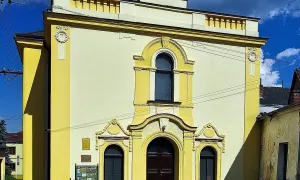
This two-storey, free-standing building has a mansard roof. The architecture is characterized by a rich Neo-Baroque stucco and sculpture decoration, whose significant element is the central balcony on the floor. There is also a garden with a wall. The interior of the villa was designed as luxuriously decorated.
After February 1948 the villa was nationalized and became state property. Over the years, the object changed its use. From 1974 until the beginning of the 1990s, he served as a space of the Přeštěch City Museum. Since 1993, there has been a multi-generational nursing home of the Czech Brotherhood Church. In 2010, the city of Přelouč sold the building to a private owner.
The declaration of the villa as a cultural monument in 1958 was an important moment to protect the building. After taking over the building, the current owner performed a reconstruction to preserve its historical character. The villa is located on the route of the educational trail Walk along Přelouči with František Filipovský.
At present, Diviš's villa is a renovated historical object that has preserved its original form. For historians, it is a valuable example of a city residence. The building is worth paying attention to within the overall architecture of the city.
Architectural development
The villa was built as a two-storey building with a mansard roof. It is famous for its richly decorated Neo-Baroque stucco and sculpture decoration, including the central balcony on the floor. After reconstruction by a private owner after 2010, she maintained her historical character.
Historical events
- 1905
- The construction of Divish's villa has begun.
- 1958
- The building was declared a cultural monument.
- 2010
- The city of Přelouč sold the building to a private owner.
Owners
- 1905-1948
- 1948-2010
- 2010-now
Points of interest
- Divišova villa in Přelouči is a neo-Baroque mansion built between 1905 and 1907 according to the design of architect Rudolf Kříženecký. - The construction was commissioned by a chemist and director of the sugar factory Jan Vincenc Diviš, who was the mayor of the city between 1914 and 1919. In 1958, the villa was declared a cultural monument and has since been protected. - After nationalization in 1948, it served first as a city museum (1974- beginning of the 1990s), then as a multi-generation nursing home and was sold to a private owner in 2010. - The villa is located on the route of the educational trail Walk on Přelouči with Franz Filipovský.
Guide
Show guide text
This text was created by artificial intelligence and has not been editorially reviewed. It may contain inaccuracies.
Welcome to Přelouči, a place where history joins every stone and every street. Right now, you're facing one of the most prominent architectural dots in this city. In front of you stands the villa of Divish, a building which, with its mere presence, tells the story of ambition, wealth and social rise in the early twentieth century. Stop for a moment, take a breath and just feel the general impression of the building. Can you feel the atmosphere of ancient times? It's a place that carries a trace of elegance and rigor, a trace of a private home that became part of a public historical monument.
Let's go back more than a hundred years together. Imagine Přelouč in the first decade of the twentieth century. It is a time of optimism, the boom of industry and the expansion of cities. It was during this period, between nine and five and nine and seven, that this building was created. But it was not an ordinary building, but a building designed for a man who, at the time, controlled a significant part of local economic and social life. Jan Vincenc Diviš, a man with a scientific degree in chemistry and an experienced director of the sugar işletty, wanted a home that matched his status and social status. At that time, sugar was one of the key engines of regional development, and Divish was the man who stood by the helm of this prosperity.
Now, if you look at the building itself, pay attention to its style. The architect Rudolf Kříženecký, who designed this villa, chose a neo-Baroque style. What does that mean for us today? Novobaroko was not just a copy of old patterns, but an effort to break into architecture a sense of nobility, dynamics and a certain luxury. Look at the facade and see how the building works in space. Notice the harmony and balance of the whole. Neo-Baroque elements are used here to make the house not only a functional residence but a representative residence. It's an architecture that was meant to inspire respect and admiration. Croženecký was able to combine the needs of modern housing at the time with an aesthetic tradition that referred to the period of magnificent palaces.
Now let's think about the personality for which this house was created. Jan Vincenc Diviš was not just the director of the sugar factory. He was a broad-minded man, as confirmed by his later political activity. In the years nine hundred and fourteen to a thousand nine hundred nineteen, i.e. in the period of the dramatic history of the First World War and the birth of the independent Czechoslovakia, he held the office of Mayor of Přelouč. Imagine what discussions were probably held in these walls. This is probably where the development of the city was planned, where the local authorities discussed the issues and where the then power workers met. The villa was not only a private sanctuary, but in many ways also an informal centre of power and decision making in Přelouči.
But the history of this building is not just a story of rise and elegance. Like many other important buildings in our countries, Diviš's villa had to undergo a period of major changes. After February of the year, nine hundred forty-eight, when the political system was fundamentally changed, the building was nationalised. This means that it has ceased to be privately owned by the Divish family and has gone into the hands of the state. Since then, the villa has started to serve various purposes, which is the fate of many former houses of rich industrialists. The building became a space for various institutions and at some point the city museum found its place. It is fascinating to think of how the character of places where previously lived in private and where visitors can now walk or work officials.
When you look at the villa, you might wonder why this building is so important that it was declared a cultural monument in the year nine hundred fifty-eight. The answer is that Divish's villa is an authentic testament to its time. It is an example of how the housing of a higher class of society at the turn of the century looked and how the development of cities affected industrial capital. It is a monument to a particular person, John Vincent Diviš, who has joined science, industry and public administration.
The interesting thing that can go through your mind is the transformation from home to museum. Imagine the contrast. On the one hand, the intimate atmosphere of the family estate, where the living rooms were breathed by calm and luxury, and on the other hand, the public space, where the exhibits are exposed and where people learn about the history of their city. This villa thus carries two layers of history. The first layer is its origin and the golden age as a private residence, and the second layer is its role as a public space and protected monuments. He's such a silent witness to all the social upheavals our country has seen in the last century.
Now that you know the story of this building, I suggest you take another look at its total silhouette. Try to imagine what the villa looked like in nine hundred and seven years ago when it was brand new and Jan Vincenc Diviš first entered its new home. Feel the details you find interesting, and think about how many secrets these walls keep. Each window frame, each facade line is part of a wider picture of Přelouče history.
Divish's villa is not just a brick and plaster building. It is the materialized ambition of one man and the reflection of the social structure of the time when sugar factories formed the backbone of the region's economy. It is a reminder that architecture is not only about aesthetics, but especially about the people who commissioned it and about the times that have left their mark.
Imagine what it must have been like to go through these spaces when the city of Přelouč was experiencing its industrial boom. What sounds came out of the street, what cars came in and who knocked everything in this door. This villa is like an open book that we can read from if we just know where to look.
You can now say goodbye to the building and continue to discover the beauty of this city. I hope that this short trip to history has helped you to see the Diviš villa in a new light and that you will carry a sense of respect for the architectural heritage that surrounds us. Don't forget to look around, because Přelouč has many other stories waiting to be revealed. I wish you a pleasant continuation of your journey and enjoy every moment you spend in this historic environment. Goodbye.
Tips for visitors
The best time to visit is during bright days when natural light can be fully used to observe the rich Neo-Baroque details of the facade. We recommend a visit in a period of pleasant weather, which will facilitate the tour of the exterior.
The monument can be reached by car and public transport.
For a comfortable survey we recommend to bring comfortable shoes and possibly own water. If you want to focus on detailed observation of architecture, the camera can be useful with optical zoom.
The most suitable places for photography are in front of the building, where decorative elements can be captured. The best light to highlight the shapes and textures of architecture offers time just before sunset.
Families with children can use the tour to develop ideas about history and architecture. Within the framework of the information provided, no other specific objectives for the visit are mentioned in close proximity.
Frequently asked questions
Can the monument be visited?
Some buildings of this kind are open for guided tours, others serve another purpose or are privately owned. We have not verified whether and when this monument is open – please ask the operator.
What are the opening hours and admission?
We have not verified the opening hours or admission. Current information is published by the operator.
Where is the monument?
Location: Přelouč, Pardubický kraj. The map on this page shows the exact spot.
Why is the monument protected?
It is listed in the Central List of Cultural Monuments of the Czech Republic as a cultural monument (register no. 1000141011).
Businesses nearby
Do you run a restaurant, accommodation, shop, museum, rental, wellness or other visitor service near this monument? Show yourself directly to the people heading to it — this is how they will see you in the app and on the web:
Nearby
🏰 Historic sites (186)
- City Museum Přelouč 0.7 km
- Memorial to the victims of World War II 0.8 km
- Memorial of the creation of the independent Czechoslovakia 0.8 km
- Zdenka Fuchs 0.9 km
- Zhrz Štěpánov 3.1 km
- 1914-1918 3.9 km
- sv Václav 5.8 km
- sv Jan Nepomucký 6.5 km
- Platoon Triple 6.7 km
- Castle Choltice 6.9 km
- Annual 100 Years of Creating CR 7.7 km
- Zdejovice 7.8 km
- victims of World War I 7.8 km
- Memorial of World War II victims 7.8 km
- Forest adjunkt Vladimir Milde 7.8 km
- Memorial to victims of war 8.3 km
- Hardness Krchleby 8.4 km
- Hards 8.4 km
- Julie Havlicek 8.4 km
- Pavel Sula / Josef Sulík 8.4 km
🍽️ Restaurants and dining (326)
- Restaurant V + M 0.2 km + 420 773 070 110 web
- Gavi 0.5 km Hradec 153
- FlorA 0.5 km 28 October 1488
- Pizza Florio 0.6 km 28 October 146
- Bakchus 0.6 km 28 October 1525
- U Judge 0.6 km
- Na Old Poště 0.9 km + 420 602 709 427 web
- Restaurant Na Sidlišt 0.9 km
- Tak Na Halde 3.9 km
- Guesthouse U Súspe 4.0 km + 420 606 206 662
- Guesthouse MASH 4.7 km
- Heda 5.8 km + 420 776 843 498
- Hossovka u Žabáka 5.8 km + 420775178971 web
- Císásání Hostinec 6.3 km
- Motorest On Alone 6.5 km
- Na Kopece 6.7 km
- Restoration castle Choltice 6.9 km nami. Saint. Three 1 + 420 603 155 426 web
- _ 7.5 km
- U Chochtana 7.9 km + 420777246515 web
- U chestnut 7.9 km
🏨 Accommodation (43)
- Hotel Fontána 1.0 km Pardubice 1422
- Autocamp Buňkov 2.0 km + 420 774 708 951 web
- Autocamp Buňkov 2.1 km
- NAK 3.1 km + 420604265576 web
- Autocamp Semín 3.2 km + 420 724 120 434 web
- U Trees 3.3 km + 420607912829 web
- Marin klub 3.5 km + 420 739 237 063 web
- Oaza 3.9 km + 420 605 809 410
- Pension Na Hrazi 4.9 km
- U Frog 5.8 km + 420775178971 web
- Resort Chochtan, camp Spa Bohdaneč 7.7 km + 420 777 246 516 web
- Guesthouse Kolesa 8.7 km
- Pension Tiller Vila 8.9 km Langrova 38
- Guesthouse Fajn 11.0 km Žižkova 770
- White Lamb 12.4 km
- Accommodation TCV Pardubice s.r.o. 12.6 km Brochíkova 550 + 420 736 651 156 web
- Marina Camp Stéblá 12.6 km + 420 732 474 025 web
- Autokempink Konopáč 12.7 km + 420602371768; + 420469695117 web
- Marina 12.7 km + 420602130074 web
- Hotel Trim 13.4 km Semtin 56 + 420 466 415 518 web
🚲 Rentals and sport (46)
- Sokolovna 0.8 km Pardubice 734
- Skaut Přelouč 1.1 km
- Natural swimming pool 2.0 km
- Valy u Přelouče 3.4 km
- Rental and sale two-kol 6.7 km + 420 705 206 404 web
- Sokolovna Spa Bohdaneč 8.4 km Dr. Tyre 262 web
- Sports hall Spa Bohdaneč 8.6 km web
- Sports relaxation area Popkovice 10.4 km
- Automotoclub Gold gain Pardubice 10.7 km Motorists 300 web
- Flat track Golden helba 10.8 km
- Sport Hall of the Høman's Town 12.0 km + 420 776 748 685 web
- Prospects 12.7 km + 420 608 500 608
- Sport Vision 13.0 km Palacky class 2748 web
- Husky 13.1 km Lab Palouk 495 + 420 469 779 897 web
- TJ BMX Pardubice 13.2 km + 420 725 593 649 web
- Area HBC Pardubice 13.2 km web
- Sport centre Doubravice 13.2 km web
- Skatepark Pardubice 13.2 km Kpt. Bartoše 2788 + 420 737 013 976 web
- BIKE-BOYS, s.r.o 13.2 km Doubravické 363 + 420 777 707 195 web
- Wanted sport s.r.o. 13.5 km Square Dukel Heroes 2233 + 420 732 650 792 web
🥾 Hiking and nature (69)
- Pernstein Square 0.5 km
- Kozinec 3.0 km
- Cancelled ammunition warehouse Valy - Veseli 4.0 km web
- Mělická labích 4.2 km
- Black Rock 4.2 km
- Lab arm Votoka 4.3 km
- Label under Count 5.1 km
- White kopec 5.4 km
- Lipoltic Rock 5.5 km
- U draw birds 5.5 km
- U cross 6.1 km
- Lhotka 6.3 km
- Chivic well 6.3 km web
- Study Dereznice 6.9 km web
- Na Skalce 7.2 km
- Morasice 7.5 km
- Na Hradec 7.7 km
- Castle well 8.2 km
- Rock 8.7 km
- Giant bed 8.8 km
Accommodation nearby
Trips and activities nearby
Guided tours, tickets and activities nearby from GetYourGuide
Affiliate link: if you buy from the partner, we may receive a commission. The price for you does not change.
Search tours and activities →Themed route
Thematic cruise route from the Diviš villa (Přelouč)
1. Divish's Villa * Type: * Historical villa * Why is it worth a visit: * Diviš's villa is a beautiful example of Baroque architecture and includes a rich history of the Divish family, who in the 18th century were significantly involved in the development of the village Přelouč. The villa offers visitors a view of the life of the noble family and their cultural contribution.
2. Park near the Divish Villa * Type: * Park * Why is it worth a visit: * Park around Diviš's villa is an ideal place to relax and walk. Its green spaces offer quiet corners where you can enjoy the natural beauty and view of the historical architecture of the villa.
3. Church of St. James * Type: * Church * Why is it worth visiting: * This church is one of the oldest and most important sacral objects in Přelouči. Its Gothic elements and history attract many visitors who want to know more about the spiritual life of the village.
4. Urban brewery * Type: * Brewery * Why is it worth a visit: * The local brewery offers not only quality beer, but also the opportunity to explore its history and production process. It is a great way to learn more about local traditions and enjoy a quality Czech beer special.
5. Square in Přelouči * Type: * Square * Why is it worth a visit: * The square is the heart of the city and offers a beautiful view of historical houses and architecture. It is an ideal place for relaxing, trading in local cafes or viewing shopping facilities.
This route offers a combination of historical, cultural and recreational experiences which represent the most significant aspects of the village Přelouč.
Seasonal recommendations
Spring: In the spring, the garden around the villa wakes up to life and the surrounding greenery start to feel very fresh. The lighting is delicate and does not shine during this period, allowing detailed observation of architecture without hard shadows. We recommend taking layered clothes because the morning cold can be accompanied by sudden afternoon heat. Visiting at this time is usually much calmer than in the main summer season.
Summer: The summer season offers the most light and full vegetation, which gives the monument a rich and lively look. The sun hits the facade directly, highlighting its shapes and details. Due to a higher number of visitors, it is best to arrive immediately after opening to ensure a more peaceful tour. Don't forget light substances and enough fluids to protect against heat.
Autumn: Autumn brings golden tones and nostalgic, calm atmosphere to the surroundings of the villa. Foggy morning air and soft light create ideal conditions for observing architecture. It is advisable to carry a waterproof jacket and comfortable shoes for walking on wet terrain. The morning clock is best for capturing the colorful beauty of the surrounding nature.
Winter: In winter the villa is very quiet and almost monumentally, especially if the surrounding area is covered with snow. The day is short, so plan a visit so that you can make it in clear hours before dark. The necessity is very warm and wind-free clothing. There are the least people in this period, which guarantees maximum privacy and peace.
Visualizations and artistic views


The visualisations are generated by artificial intelligence and serve as inspiration.
Photos from the area
Real photos taken near the monument


Zdroj a licence jsou uvedeny u každého snímku.
Tips from visitors
No tips yet. Be the first!
Log in and add your tip.
Sources and literature
Photos: Petr1888 / CC BY-SA 3.0 — Wikimedia Commons. The author and licence also appear when you hover over the image.
Faktickým podkladem tohoto textu byl článek na Wikipedii, jehož autory jsou přispěvatelé Wikipedie. Článek je dostupný pod licencí CC BY-SA 4.0.
Location on the map

Příběhy a pověsti
Legendy, pověsti a příběhy spjaté s touto památkou
Fotografie návštěvníků
Zatím žádné fotografie. Buďte první, kdo přidá fotografii z návštěvy!
Log in a přidejte svou fotografii nebo hodnoťte.
Za ověřenou návštěvu v aplikaci získáte víc bodů — poznáme podle GPS, že jste na místě.
Reviews and comments