






Dlouhá 32 House
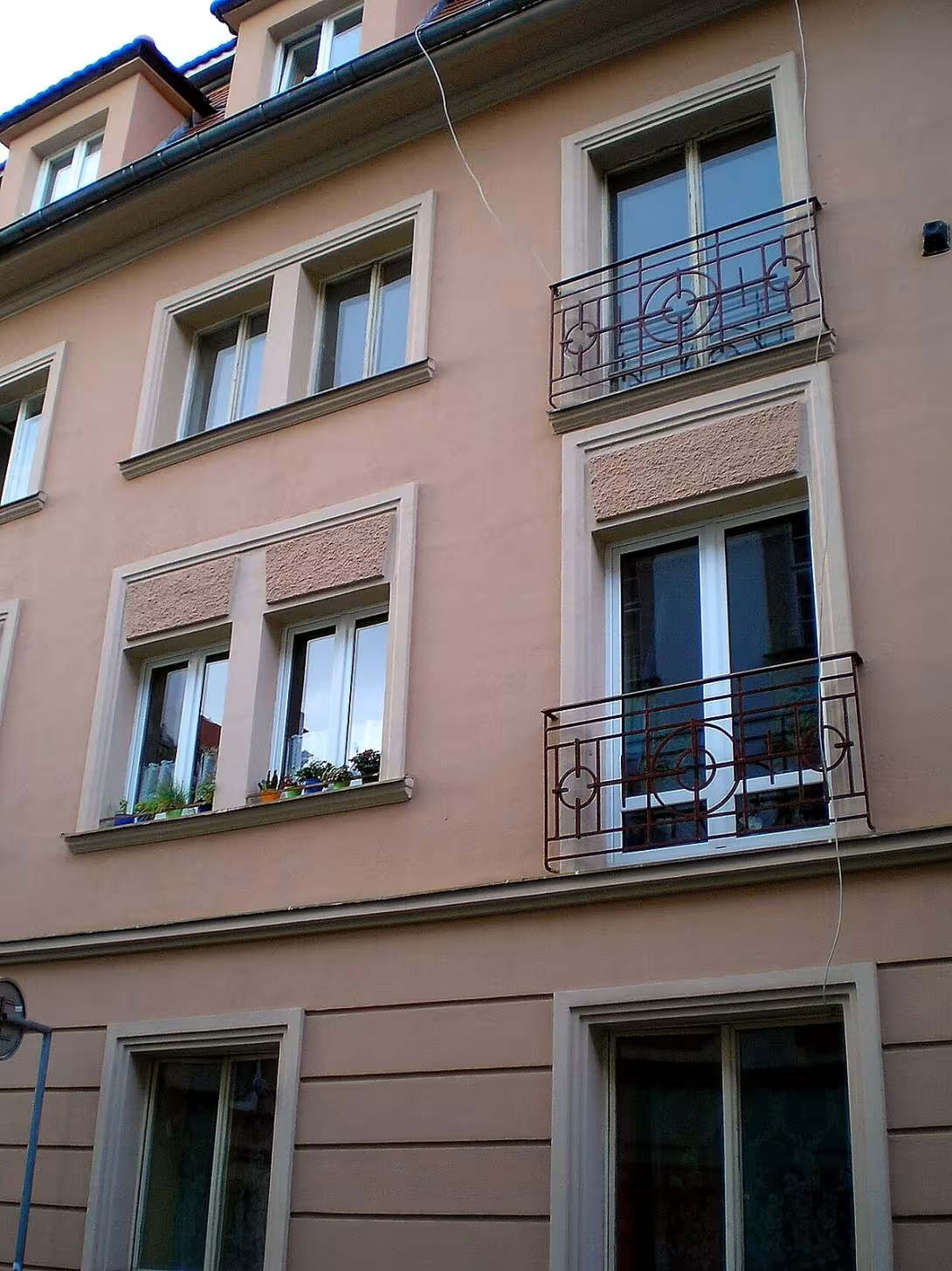
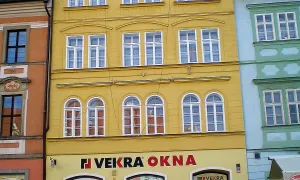
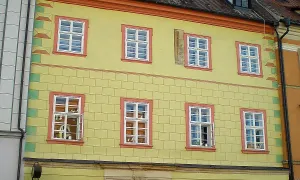
The House at Dlouhá 26 / 32 in Cheb is a historic residential building from the 16th century, protected as a cultural monument of the Czech Republic. The building is located in a series of buildings in the Karlovy Vary Region.
The construction represents a typical example of the urban residential house. It originated in the 16th century, but there are only limited reports of its oldest history and its specific founders.
Over the centuries, the house has undergone some major changes. The first significant construction adjustment took place in the late 18th century. Another significant renewal was followed in the second half of the 20th century by the rendering of the historical core of the city. This process meant systematic repairs in order to preserve the value of the centres and improve the technical state of the buildings.
In terms of protection, the house is registered in the register of cultural monuments under the number 38593 / 4-3668. Its location in the long street, where houses share common walls and form a continuous line, contributes to the preservation of the historical character of this part of the city.
The building is now a proof of the continuity of urban housing and building modifications from various epoch. It offers visitors a view of the layered history of Cheb architecture and shows how the needs of the population changed over the centuries.
The preservation of this house is important for the overall picture of the historical center. It is recommended to include it in the old town's walk so that visitors can perceive the authentic atmosphere of the original building.
Points of interest
- It is a historic residential building from the 16th century, which is protected as a cultural monument of the Czech Republic. - The first significant building modification took place in the late 18th century. - In the second half of the 20th century, there was a significant renewal of the historic core of the city. - The house is registered in the register of cultural monuments under the number 38593 / 4-3668. - The building is located in a series of buildings where the houses share common walls and form a continuous line.
Guide
Show guide text
This text was created by artificial intelligence and has not been editorially reviewed. It may contain inaccuracies.
Welcome to the historical heart of Cheb. You've just stopped in one of those streets that makes up the real soul of this town in Long Street. You're standing right in front of a building bearing the number 32, and even though it may seem like part of a larger whole, its existence is proof of incredible endurance. Look around you and feel the atmosphere of this place. This series of structures surrounding you is not just a set of walls and roofs, but a living chronicle that stretches before your eyes. Feel the feeling where you stop and realize that right now you're standing in a place that has experienced the fundamental history of the whole country.
Now let's go back to the past together to understand where this house comes from. Its roots date back to the 16th century. Imagine then Cheb, a city that was at that time an important centre, thriving thanks to its strategic location and business activity. In this period, the foundations of today's urban structure were created. Just then, in the 16th century, this building was built, probably as part of a growing and stable urban environment. Although life at that time was different from ours, the foundations they laid at that time still hold this object firmly in the ground and allow it to last until today.
But time continues to flow, and with it the needs of the people who lived in these houses change. Now pay attention to how the house changed over the centuries. At the end of the eighteenth century, this building underwent a major reconstruction. This was the time when urban architecture began to develop in a new direction, when more comfort and aesthetics were sought in line with that time. This reconstruction was the key moment that gave the house its form and prepared it for the next century of existence. It's fascinating to think about how everyday scenes were taking place in these premises at that time, how fashion, ways of doing business and the way the world looked at it, while the house remained a fixed point on a constantly changing street.
But now we have to look at the much more recent history that defined this object as you see it now. In the second half of the twentieth century the entire historical core of Cheb went through a process called rendering. For many, it was a difficult time for big changes and reconstructions, but for this house it was a chance for a new quite. It was during this city renewal that this building was re-preserved and modified to continue its role in urban development. Thanks to these works it was possible to preserve its historical character while ensuring that it was part of a modern, functional city. This house is today protected as a cultural monument of the Czech Republic, which means that its value for our common history is recognised and secured for future generations.
Now, if you look again at the facade and the way the house has been worked into a series of houses, notice its structure. Even if we don't know the names of the particular architects who designed these changes, we can read the story of layering from its form. It's not just one building, it's a sum of different epoch. Feel how different styles and building processes intersect in one mass. This house is not a lonely monument, but it is an important article in a chain that creates the rhythm of the entire Long Street. His presence here creates continuity that connects the 16th century to our present moment.
Although the historical records for this particular house do not contain the names of the famous figures that are directly linked to it, its secret lies precisely in the fact that it is witnessing unknown lives. Who owned the 18th century? What kind of families lived here during the city's greatest prosperity? These questions remain unanswered, but it is the unknown that gives the place some depth. Every house in this city hides thousands of little stories that have never been written into books, but that are still present in every stone and in every line of this facade. It is this quiet history of ordinary people who have formed the foundations of our world that make this place so authentic.
The interesting thing is that this house has endured centuries of political change, economic takeoff and decline, and yet it still stands there. It's like a quiet observer who saw everything, but himself remained faithful to his structure. This ability to adapt, the ability to change constantly to survive, is one of the greatest values of historical buildings. The house adapted to the sixteenth century, then to the eighteenth and finally to the demands of the twentieth century, without losing its essence.
Now I want to ask you not to let this brief look limit you. Let's move on. Long street and the entire historical centre of Cheb await you with other constant surprises. Every next step can lead you to another memory, another house that has its own unique history. Let yourself drift through this atmosphere, observe the details around you and continue to discover this beautiful city. Thank you for taking the time to pay attention to this small but important piece of history. We will brighten you another pleasant journey along the historic paths of Cheb.
Tips for visitors
For the best visual experience we recommend a visit on clear days, when morning light best highlights historical details of the facade. This time allows the best observation of building elements from the late eighteenth century.
You can reach the property by car and public transport. We recommend checking the current traffic connections and parking possibilities in the surrounding area in mobile applications or on the website of traffic.
When visiting, we recommend that you take only the necessities with you and choose comfortable shoes that are suitable for moving on historic streets and uneven surfaces.
For shooting are the most suitable places on the opposite side of the street, from where you can capture a variety of historical houses in their context. The best light for these images is in the morning.
Families with children can use a walk in this part of town to observe ancient architecture. It's interesting for children to watch houses change over the centuries.
Businesses nearby
Do you run a restaurant, accommodation, shop, museum, rental, wellness or other visitor service near this monument? Show yourself directly to the people heading to it — this is how they will see you in the app and on the web:
Nearby
ITEX Show interactive overview of the surroundings - restaurants, accommodation, rentals and other places within a 15 km radius.
Data: OpenStreetMap contributors, 15 km radius.
‡ Historical monuments
- Gallery 4 (0.0 km - Franciscan Square 30 / 1)
- Cheb Museum (0.2 km - King George Square of Podebrad 3)
- Cheb Castle (0.4 km)
- Memorial to victims of iron opony (4.2 km)
- Monument Johanna Wolfgang Goetha (4.6 km)
- Künstlerhaus (9.9 km - Egerstraße 3)
- Castle Vildstejn (10.2 km)
- hrad Hohenberg (10.5 km)
Restaurant and catering
- U Kata (0.1 km - Jewish 17)
- Dejavu (0.3 km - Liberties 543 / 7)
- Stop Caffe (0.7 km)
- Stone (6.8 km)
- Restaurant Seeberg (8.5 km - Island 2)
- Bronze ducat (10.5 km)
- Gasthaus Egertal (11.2 km)
- Pizzeria da Nunzia (12.1 km - Turmstraße 1)
Accommodation
- Blue Towers (1.1 km - Dylenská 1205 / 24)
- Resort Stein (2.6 km - 10)
- Tršnice (4.5 km)
- Otava (4.7 km)
- Retro-Camp Tršnice (5.2 km)
- Pension Selské dvovor (7.0 km)
- Kazduv Dvur - Spa & Wellnesshotel (8.4 km)
- Guesthouse Seeberg (8.5 km - Island 2)
› Rental and sports
- Better Fitness (0.3 km - Comenius 7)
- Sport Flori (0.3 km - Valdštejnova 8)
- Hervis (0.6 km)
- Swimming pool Chetes (0.7 km)
- Sportisimo (0.7 km)
- R (1.0 km)
- TJ locomotive (1.2 km)
- Hard Core Gym (5.5 km)
© Tourism and nature
- Chamber high (3.4 km)
- Rock body (3.4 km)
- Boundary / Die Grenze (5.6 km)
- Old Grapes (6.3 km)
- Imperial spring (8.2 km)
- Kapplblick (9.3 km)
- Wanderweg um Hohenberg (9.9 km)
- Grenzwandlerweg (9.9 km)
Accommodation nearby
Seasonal recommendations
Spring: During the spring season Dlouhá 32 in Cheb is transformed into a special place where newly opened flowers and trees begin to bloom. The sun rays illuminating the historic house add something warm and alive to the atmosphere, creating ideal conditions for exploring architectural details. Visitors can enjoy mild air without excessive crowds that are common in the summer. It is recommended to visit a monument in the semi-deck, when sunlight is the most advantageous for the photograph and exploring the details of the building. Clothes should be mild, with the possibility of adding a layer in colder wounds.
Summer: Summer season is the most popular time to visit Long 32. Sunny days and warm air attract many tourists who want to use long days to explore historical monuments. The atmosphere is full of life with diverse activities and actions that can take place mainly in the main summer season. Because of the great crowds, it is advisable to visit the memory early in the morning or later in the evening when people return home. It is recommended to wear light clothes and to carefully bring a protective tie or a sun-protected parasol.
Autumn: In autumn the Dlouhá 32 becomes melancholic charm when leaves of falling trees create a colorful carpet on the streets. Short days and cooler air bring a different atmosphere that is ideal for peaceful walks and exploring history without excessive crowds. Sun rays in late afternoon illuminate the building in a special way, which is the perfect time for photography. Visitors should be prepared for colder weather and wear multi-layer clothes.
Winter: Winter brings a specific atmosphere of Long 32, when the freezing air and the possibility of snow or ice borders give the memory something magical. The lighting is often designed to highlight architectural elements, creating an impressive night scene. In advent time, visitors can use themselves in a calmer environment because winter opening times are usually shorter and crowds are smaller. It is recommended to wear warm clothes and maybe even shoes with helmets for comfort during cold days.
Visualizations and artistic views


The visualisations are generated by artificial intelligence and serve as inspiration.
Photos from the area
Real photos taken near the monument


Zdroj a licence jsou uvedeny u každého snímku.
Tips from visitors
No tips yet. Be the first!
Log in and add your tip.
Sources and literature
Photos: Novojaro / CC BY-SA 3.0 — Wikimedia Commons. The author and licence also appear when you hover over the image.
Location on the map
Příběhy a pověsti
Legendy, pověsti a příběhy spjaté s touto památkou
Fotografie návštěvníků
Zatím žádné fotografie. Buďte první, kdo přidá fotografii z návštěvy!
Log in a přidejte svou fotografii nebo hodnoťte.
Za ověřenou návštěvu v aplikaci získáte víc bodů — poznáme podle GPS, že jste na místě.
Reviews and comments