






Dřevěná 5 House
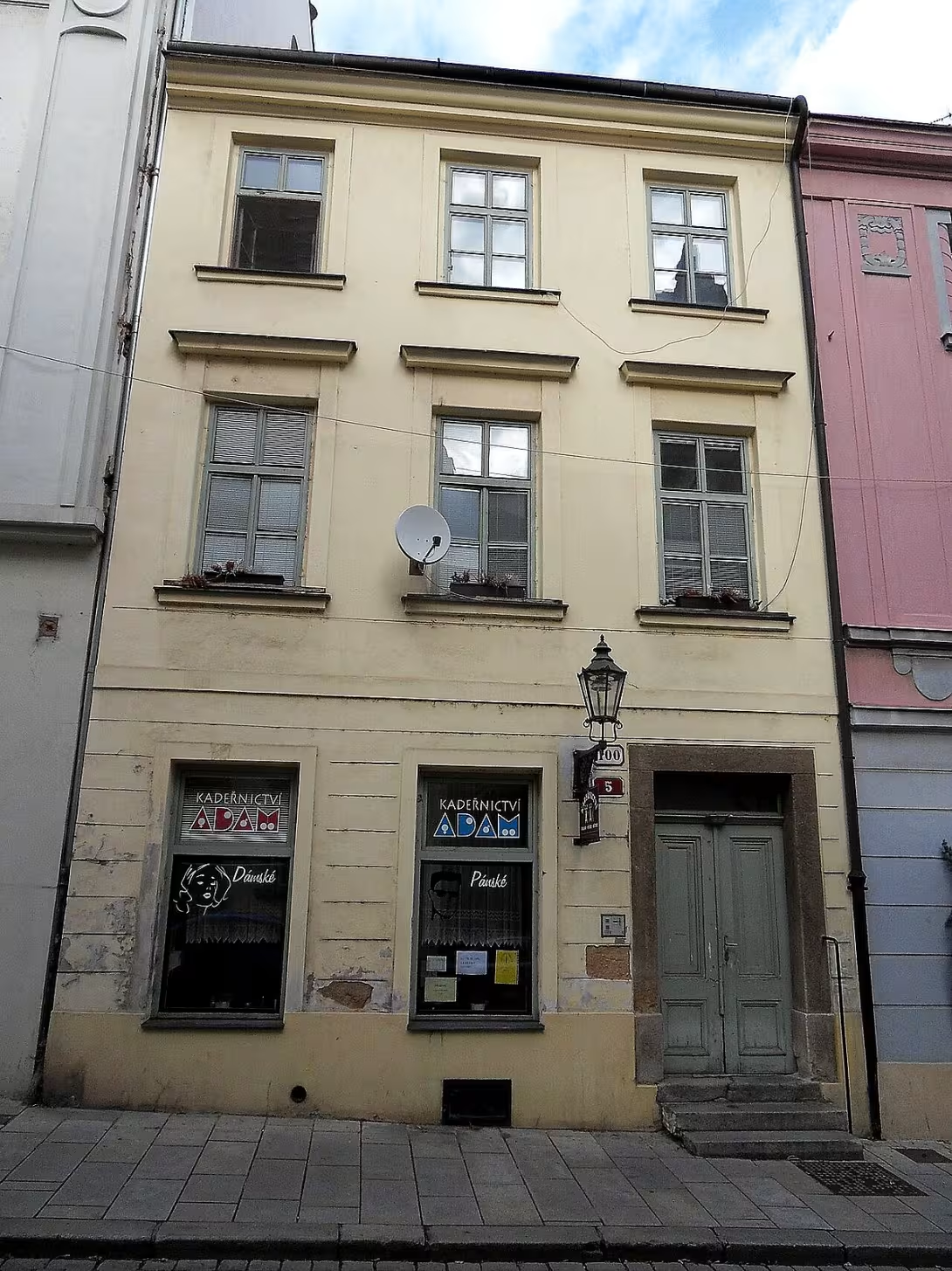
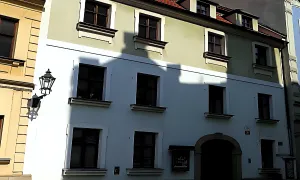
The House at the address of Woodná 100 / 5 in the inner city of Pilsen is a cultural monument of the Czech Republic. It is a classical building of medieval origin, characterized by its preservation and layered architecture. The building is located in Plzeň-město district in Plzeň county.
We have limited information about the oldest history of this house, but it is known that the building has medieval origins. This historical continuity is represented in the building mainly by a preserved Gothic cellar, which is the oldest part of the monument and testifies to the original location and age of the building.
The current form of the house dates back to the middle of the 19th century and is performed in a classical style. In part, the layout and elements of the former Baroque building, which stood on the site, were respected during its construction. This layery of styles makes the house a particularly valuable architectural document, in which the elements of various epoch intersect.
From the point of view of the history of Pilsen urbanism, it is important that he has escaped the sanitation. This process of extensive demolition of the old building took place in Pilsen at the turn of the 19th and 20th centuries in order to modernise the city centre. While many similar buildings in the area were removed at this time, this object was preserved.
The monument is now registered in the register of cultural monuments under number 44248 / 4-4693. For a curious visitor, it represents a concrete example of how the Pilsen Centre changed and which elements of the original architecture survived in the context of modern urban development.
The value of this house lies in its authenticity and ability to survive city planning interventions. Visiting this place allows you to perceive the continuity of history from Gothic to Baroque to classicism within one object.
Points of interest
- The house is a cultural monument of the Czech Republic.
- It is a classical building of medieval origin with layered architecture.
- The oldest part of the monument is a preserved Gothic cellar that shows the original location and age of the building.
- The contemporary form of the house dates back to the middle of the 19th century in classical style with elements of the former Baroque building.
- Important to Pilsen urbanism by escaping rendering at the turn of the 19th and 20th centuries.
Guide
Show guide text
This text was created by artificial intelligence and has not been editorially reviewed. It may contain inaccuracies.
Welcome to Pilsen, a city that stores layers of centuries, and I welcome you to one of its silent but important monuments. Please stop for a moment, take a breath and focus fully on what you see right in front of you. You're standing in front of the house on Wooden Street under number five. At first glance, he may act as an ordinary part of the urban development, but it is in that stealth that his special attraction lies. It's a place that carries a time imprint in it, and in mutually quiet dignity, it reminds you of what everyday building and living in ancient times looked like. Feel the atmosphere of this place and let yourself forget for a moment the hustle and bustle of the surrounding city.
When we think about the emergence of this house, we find ourselves in an area where the noble fog of the unknown begins. Unfortunately, historical records did not tell us the exact date of its construction, nor the names of the people who designed it or raised it with their hands. Architects remained anonymous, which is quite common in the history of cities. Most of the buildings we consider to be monuments today were not the work of famous masters, but the result of the craftsmanship of local builders who worked with the materials at their disposal and followed the customs of their time. It is this unknown that gives a house in Wooden Street a certain charm. It's a building without the author's name, but with a clear identity.
This house is not just an ordinary building, it is officially registered as a cultural monument of the Czech Republic. That's a very important fact you shouldn't ignore. The fact that the building is protected in this way means that the state in it sees an irreplaceable value for our national heritage. Although we do not know the exact chronology of its origin, the status of the monument tells us that this object is an authentic witness to the history of Pilsen and its surroundings. It is a fragment of the past that survived changes in regimes, war and modernization of the city, and stayed here for us to draw inspiration from.
Now I want to invite you to pay attention to the architecture itself. Please look carefully at the front of the house. Notice how the building fits into the street space and what relationship it creates with its surroundings. Follow the wall lines and the way the house is set in the field. Even if we don't find spectacular decorating or monumental columns here, I suggest you perceive the overall proportion and rhythm of the construction. Look at the surfaces, see the texture of the materials and watch the light hit them. It is in these details, in simplicity and functionality, that the true nature of this house is hidden. Try to imagine how many times these walls have been repaired, how many layers of paint or paint are hidden in them and how the house was changing along with the city around it.
When you stand before this monument, you inevitably wonder who lived here. Although history does not give us specific names of significant personalities that would be connected to the house in Wooden Street, that is where the greatest power of this place lies. This house belonged not to kings or famous warlords, but probably to ordinary people who formed the backbone of Pilsen society. Imagine generations of families who started their day here, children who played near these walls, and old people who watched the world change around them. Every threshold they've gone through and every window they've looked out tells their own, albeit unwritten, story. It's a history of thousands of little moments that together form the true soul of the city.
And now we come to the part that is perhaps most fascinating. This whole object is surrounded by a mystery. At a time when we're used to finding information about everything within seconds in digital archives, it's refreshing to run into a place that's silent. Why is this house a cultural monument even though we don't know so many concrete facts about it? That's a question that should impress any visitor. The answer probably lies in his typosity, in his preservation, or that he represents a particular way of building, which is no longer normal. This ignorance forces us to engage our own imagination and to explore the building more, rather than just passively accepting the facts from the board. It's an invitation to become history detectives and try to find clues of the past in the details of the house yourself.
Feel the contrast between the quiet house and the noise of the modern Pilsen. It's fascinating to think that while cars are passing by us and people are rushing towards their duties, this house is just there. It stands as a silent guardian of memory, reminding us that continuity is more important than immediate success. It's a reminder of modesty and perseverance.
I hope you've found room for your own reflection in these few minutes and that you've managed to build a personal relationship with this inconspicuous place. Although we did not have the lists of famous residents or the precise timeline, I believe it was this emptiness in the archives that allowed you to feel the very presence of the building. The House of Wooden Street under Number Five is proof that even what is unknown and inconspicuous can be of great importance and be a proud representative of our common heritage.
I now bid you farewell at this stop. I suggest you stay around for a while and try to give yourself some space to interpret what you just saw. Then please continue to explore other hidden corners of Pilsen, which has still many other stories in reserve, some written in books, and others, like the one here, engraved only into the walls of its buildings. I wish you a pleasant continuation of your discovery and enjoy every moment you spend in this beautiful city. Goodbye.
Tips for visitors
For the best experience of the tour we recommend a visit on bright days, when natural light best highlights the unique texture of wood. It is ideal to choose calmer days of the week when there are not so many visitors.
Traffic to the monument is possible both by public transport and by own vehicles. Please check the current traffic connections and parking options on the site in mobile applications or on the traffic website.
With us we recommend to take comfortable shoes suitable for walking in historical buildings and possibly protection against rain or sun.
The most appropriate period for photography is around sunrise or sunset, when light creates interesting shadows and depth on the wooden surface. The best angles offer views from opposite side of the street.
There are no other specific targets in the area. It is good for families with children to prepare a short interpretation of how wooden houses were built in the past, which will enhance the tour.
Businesses nearby
Do you run a restaurant, accommodation, shop, museum, rental, wellness or other visitor service near this monument? Show yourself directly to the people heading to it — this is how they will see you in the app and on the web:
Events nearby


Zdroj akcí: otevřená data měst a obcí ČR (Národní katalog otevřených dat) a kalendář akcí Národního památkového ústavu.
Nearby
ITEX Show interactive overview of the surroundings - restaurants, accommodation, rentals and other places within a 15 km radius.
Data: OpenStreetMap contributors, 15 km radius.
‡ Historical monuments
- Cathedral of St. Bartholomew [v okolí] (0.1 km - Pearl 64 / 6)
- St Bartholomy [v okolí] (0.1 km)
- Cathedral of St. Bartholomew [v okolí] (0.2 km - Republic Square 358 / 33)
- Monument of the magistrate Martin Kopecký (0.3 km)
- Memorial of Franz Joseph Smetany (0.4 km)
- Memorial to victims of communist terror (0.4 km)
- Monument Stanko Vodicky (2.3 km)
- Memorial to victims of gold (3.3 km)
Restaurant and catering
- Archa (0.2 km - Veleslavínová 51 / 20)
- Bar NITRO (0.2 km - Veleslavínová 52 / 18)
- Jazz rock café (0.3 km - Sedláčkova 226 / 18)
- Pizzeria San Marino (0.5 km - Palacký 101 / 9)
- Restaurant Alfa (0.5 km - American 663 / 17)
- ZACH'S PUB (0.6 km - Palacky Square 31 / 2)
- Restaurant Cardinal Club (0.8 km - Cardinal Berana 1027 / 10)
- Music Cafe Mlyn (1.1 km - Radčická 60 / 40)
Accommodation
- Hotel Rango (0.0 km)
- Wallis (0.5 km - Palacký 74 / 11)
- Astor (0.6 km)
- Hotel Roudna (0.6 km)
- Emma (0.8 km - Husova 430 / 22)
- Hotel Victoria (1.1 km - Borská 1155 / 19)
- U Source (1.4 km)
- College of Safranek Pavilon (2.5 km)
› Rental and sports
- Specialized Concept Store Plzeň (0.3 km)
- Kalikov Mill (1.1 km)
- Climbing wall Hannah (1.6 km)
- Fitnes centre (2.0 km)
- Scobike sharing (2.6 km)
- Ramala (2.6 km)
- Cyklo Atom (2.8 km)
- Koloseum (2.8 km)
© Tourism and nature
- Sel Court U Matoušů (3.2 km - Bolovecký nav 1 / 3)
- Plzeň-Doubravka (at the track) (3.4 km)
- Plzeň-Doubravka (public transport) (3.5 km)
- Plzeň-White Mountain (Guest.) (3.5 km)
- Plzeň-Bolevec (hostel) (3.8 km)
- Košinar (fish.) (3.9 km)
- Rybník Košinariar (3.9 km)
- Plzeň-White Mountain (Roc.) (4.0 km)
Accommodation nearby
Trips and activities nearby
Guided tours, tickets and activities nearby from GetYourGuide
Affiliate link: if you buy from the partner, we may receive a commission. The price for you does not change.
Search tours and activities →Themed route
Thematic cruise route: Dřevěná 5 and surroundings
1.Dřevěná 5 * Type: * Historical housing This monument is a unique example of wooden architecture from the beginning of the 20th century, which retains the authentic character and history of the Plzeň-město area. It's a great starting point for exploring local culture and architecture.
2. Plzeň Brewery * Type: * Historical building, brewery Breweries are not only the historical centre of beer in the Czech Republic, but also a place full of culture and tradition. Visiting them means exploring the rich history of the Czech brewery and looking at modern technologies used in beer production.
3. Plzeň Castle * Type: * Historical castle Although Plzeň Castle is a little further away, its historical and cultural value makes it necessary to visit every traveler. The castle offers a view of ancient architecture and the city of Plzeň, which is also an ideal place for relaxation and relaxation.
4. Plzeň Museum * Type: * Museum This museum offers a valuable insight into the history and culture of Pilsen, with emphasis on local traditions and art. This is a great opportunity for a deeper understanding of the historical development of the region.
5th Plzeň platform * Type: * Historical square, park The square is the centre of the city and offers many cultural activities and an opportunity to relax in the surrounding park. It is an ideal place to close the route where you can enjoy a view of historic buildings and maybe watch some cultural event.
This route offers a comprehensive view of Plzeň, from its architectural monuments to cultural institutions to historical sites.
Seasonal recommendations
Spring brings fresh air and fine sunlight to the surroundings, which beautifully highlights the details of wooden elements. Nature begins to bloom again, creating a pleasant and optimistic atmosphere. The ideal morning for a visit is when the light is softest and the color is the most lively. We recommend taking layered clothes because weather can still be variable in this period and morning temperatures can be surprisingly low.
In the summer months there is the most light and long days allow a longer tour. The atmosphere is lively and full of colours, but high temperatures can be challenging. Due to the greatest burden of visitors, it is best to arrive at the beginning of the operating time to avoid the biggest crowds and the most intense heat. Don't forget light summer clothes, headgear and plenty of fluids to drink.
Autumn season offers a fascinating view thanks to the golden and brown shades of surrounding vegetation. Morning fog gives the place a mysterious and peaceful mood that is ideal for photography. The number of visitors usually decreases, so you can enjoy more privacy. It is advisable to prepare a waterproof and windy jacket because the afternoon sun disappears faster and the air is getting wet.
The winter causes a monument in silence and calm, especially if the surrounding area is covered with snow or freeze. The lighting is weaker in this period and the days are short, so it is best to schedule a visit around noon. The atmosphere is rather thoughtful and quiet. Due to low temperatures it is necessary to wear very warm clothes and solid shoes. Before travelling, also check any changes in opening times that may occur during this period.
Visualizations and artistic views


The visualisations are generated by artificial intelligence and serve as inspiration.
Photos from the area
Real photos taken near the monument


Zdroj a licence jsou uvedeny u každého snímku.
Tips from visitors
No tips yet. Be the first!
Log in and add your tip.
Sources and literature
Fotografie: Jik jik / CC BY-SA 4.0 — Wikimedia Commons. The author and licence also appear when you hover over the image.
Location on the map
More monuments – Plzeň
Show all in the municipality

Příběhy a pověsti
Legendy, pověsti a příběhy spjaté s touto památkou
Fotografie návštěvníků
Zatím žádné fotografie. Buďte první, kdo přidá fotografii z návštěvy!
Přihlaste se a přidejte svou fotografii nebo hodnoťte.
Za ověřenou návštěvu v aplikaci získáte víc bodů — poznáme podle GPS, že jste na místě.
Reviews and comments