



Dům čp. 27 (Štramberk) House
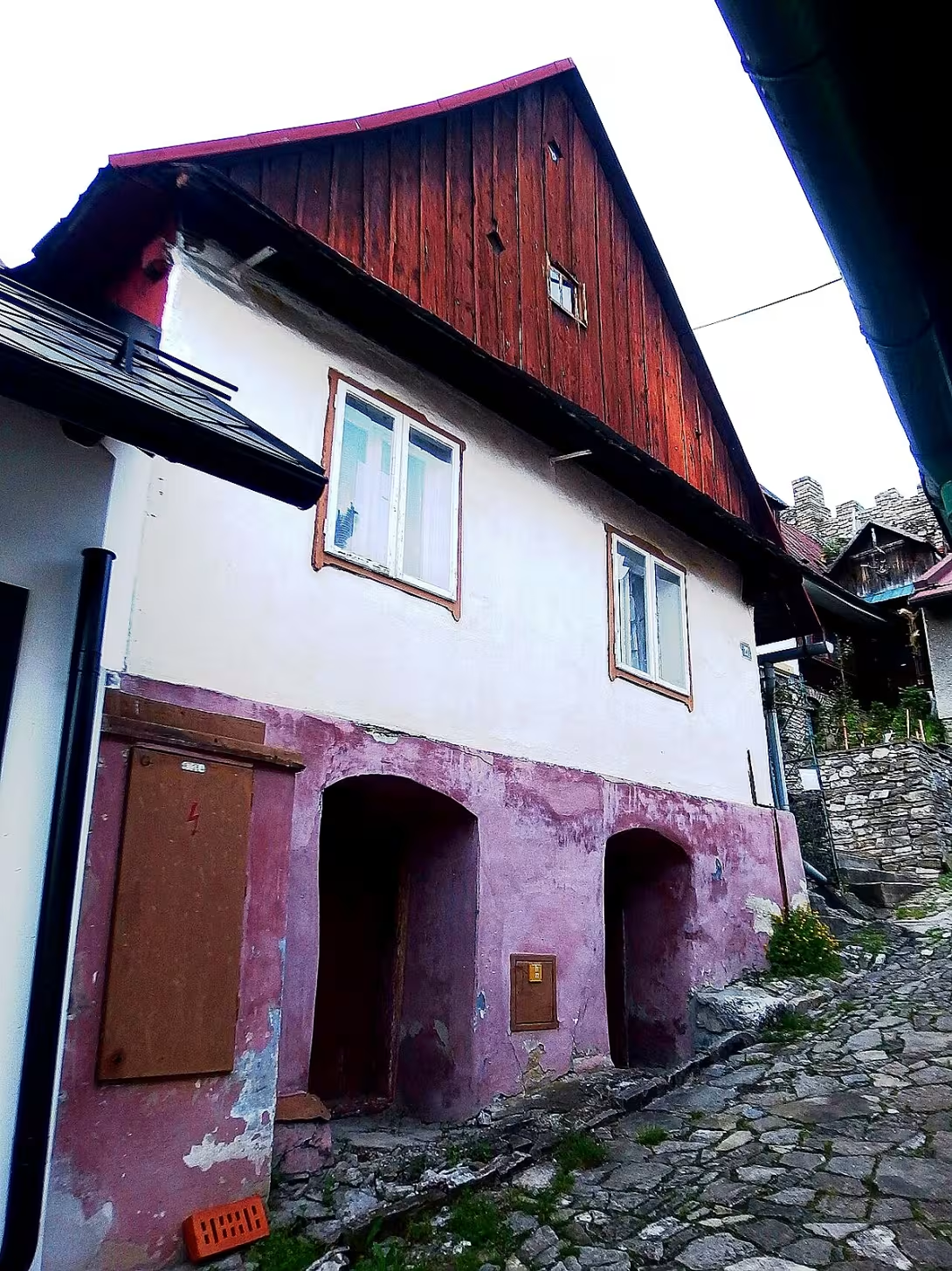
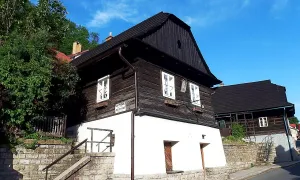
House No. 27 in Štramberk, located in the Square of Kuta, is a grafted object with plaster built at the turn of the 18th and 19th centuries. It is one of the cultural monuments of the Czech Republic and it is part of the city conservation, which underlines its historical and architectural importance. The original owner was Ignatius Neuwar's family, then Hrčkov's family held it, and today they are Hyklová's owners.
This building was created during the turn of the 18th and 19th centuries, when the industrial revolution in Bohemia took place. It was a time of great social and architectural change. Enlightenment and romance were spreading in Europe, which affected the cultural life of that time.
Architecturally, the house is a ground-floor grafted building with plaster, a rectangular ground plan and a saddle roof. It is built on a stone suspect that equates the rough slope inequality. The suspect contains a space with a vaulted vault, formerly used as a barn. The house has a shield side facing the street and is locked to the neighbouring house no. 422. The original two-space layout was changed by the reconstruction, which abolished the entrance hall and divided it by a cross-section.
House No. 27 occupies its historical value, which is reflected in the structure and architecture of the building. This is an example of the grafted houses of the time, built with regard to the needs of the people and local conditions. Today, the house is part of the monument reservation and its protection ensures the preservation of the historical character of Štramberka.
The state of the house today reflects its long history and changes to which it was subjected. It is an example of architectural adaptation to local needs and conditions. The house is available for a visit and its history and construction are interesting for all who are interested in history and architecture.
House No. 27 in Štramberk is an important cultural and historical element of the city. Its protection and preservation allow the following generations to recognize and appreciate the rich history of Štramberka. For those who want to explore this place, the house is an excellent example of the architectural art and history of the region.
Historical milestones
- around 1800
- The house No. 27 was created as a grafted building with plaster.
- 19th century
- The house belonged to Ignatius Neuwar's family.
- 19th century
- The house became the property of the Hrčkov family.
- 20th century
- Today the house belongs to the Hyklas.
Architectural development
The house has a rectangular plan and a saddle roof. It is built on a stone suspect that equates the rough slope inequality. The suspect contains a space with a vaulted vault, formerly used as a barn. The house has a shield side facing the street and is locked to the neighbouring house no. 422. The original two-space layout was changed by the reconstruction.
Owners
The house was built by the family of Ignatius Neuwar. The Hrčkov family followed the ownership, the current owners are Hyklas.
Points of interest
- House No. 27 in Štramberk is a grafted building with plaster built at the turn of the 18th and 19th centuries. - It is one of the cultural monuments of the Czech Republic and it is part of the town conservation. - The original owner was Ignatius Neuwar's family, then Hrčkov's family held it, and today they are the owners of Hyklos. - Architecturally, it's a ground floor building with a rectangular plan and a saddle roof built on a stone suspect. - The house occupies its historical value, which is reflected in the structure and architecture of the building.
Guide
Show guide text
This text was created by artificial intelligence and has not been editorially reviewed. It may contain inaccuracies.
Welcome to Štramberk. You're standing in one of those rare moments where time may seem to have stopped for a while, and you've fallen deeper into the history of this place through your journey. In front of your eyes is house number 27, which is not just an ordinary building, but a living witness to the many years that this region has lived. Please feel the strange atmosphere that radiates from the surrounding walls and from the entire space. You are in a part of the city known as Kuta, a place that keeps its historical face and unique character very carefully for centuries. Look at the house right in front of you. Feel his presence, his stability and how he harmoniously fits into the overall image of this square. It is a building that immediately welcomes you with its historical depth and tells the story of how it lived here in a time that is now a distant past for us.
Let's move further into time together and understand how this house came to be. Its history dates back to the turn of the eighteenth and nineteenth centuries, namely around the year eighteen hundred. This was the time when the world began to change, when old ways of building began to meet new ideas of durability and comfort. This house was built as a grafted building, a technique that requires tremendous skill and deep knowledge of wood work. Wood was a basic building block that provided strength and flexibility. But what makes this house really special and interesting is the fact that it is equipped with plaster. This combination of wooden structure and protective layer of plaster is very specific for this period and for this region. Feel the interesting interplay of two different materials. The plaster here serves as protective leather, which protects the wooden skeleton from the influences of the surrounding environment, while the grafted construction itself provides the construction of its soul and strength. This is proof of the high craft of the then builders who knew how to combine natural materials into a functional and lasting whole.
Now pay close attention to how this house is perceived in the wider context of the city. It's not just one of the many houses in the square. This building is recognized as a cultural monument of the Czech Republic. This means that its value goes beyond the borders of an individual or one family and belongs to all of us as part of our common heritage. The house is also an essential part of the city conservation. When you look at its walls and its location, remember that every part of this place is protected to preserve the true, historical form of Štramberka. This protection ensures that in the next hundred years people will stand in the same place and feel the same wonder of beauty that you feel right now. It is a great responsibility, but also a huge gift that history has given us.
Now let's think about the human stories that took place in these walls here. Every house has its own memory, which is matched by the lives of people who were looking for safety and a home in it. In the nineteenth century, this house was home to the family of Ignatius Neuwar. Imagine those times, back then, life in this town was rhythmic, driven by daylight and work, and the Neuware family here was creating its own world. The property of the house then moved into the hands of the Hrčková family, who also left their trail and experienced their own joys and difficult moments. And even though the centuries were changing, the house was still here. Today, the Hyklu family is the owner, who continue their tradition in this historic area and keep this house as part of a living city. It is fascinating to watch this continuity, this series of generations that have been alternating, but that all shared the same place under the same roof. These family names are like chapters in a book that is still written.
Notice how this house acts as a fixed point in time. There is a mystery about how this construction managed to survive for as long as it managed to preserve its original nature and how it managed to remain such an important part of this square. It is a combination of quality craftsmanship, correct selection of materials and, above all, constant human care that has been taking place over this place for centuries. Without the people who took care of these monuments, these stories would have died long ago.
Now that you've gone over the basic features and history of house number 27, I suggest you continue your next walk around this beautiful city. See other buildings in the part of Kuta, see their shapes, their colors and their atmosphere. Any next step can lead you to another surprise. The Štramberk is filled with hidden treasures waiting to be discovered carefully. Thank you for taking the time to stop at this very monument. We wish you your next steps in this historic city to be full of inspiration and new experiences. We'll say goodbye and look forward to seeing you again on some of the other routes. Enjoy the beauty of Štramberka.
Frequently asked questions
Can the monument be visited?
This is a residential or farm building, not a museum with opening hours. Please view it from public space and respect the owners' privacy. We have no information about access to the interior.
Where is the monument?
Location: Štramberk. The map on this page shows the exact spot.
Why is the monument protected?
It is listed in the Central List of Cultural Monuments of the Czech Republic as a cultural monument (register no. 1000123795).
Businesses nearby
Do you run a restaurant, accommodation, shop, museum, rental, wellness or other visitor service near this monument? Show yourself directly to the people heading to it — this is how they will see you in the app and on the web:
Nearby
🏰 Historic sites (193)
- Muzeum Zdeňka Buriana 0.1 km web
- Galerii lidového řemesla a umění 0.1 km web
- Štramberská trúba 0.1 km web
- Štramberk 0.1 km
- Muzeum loutek 0.1 km
- Muzeum Šipka 0.1 km
- Bohumír Jaroněk 0.5 km
- Karel Maska 0.6 km
- T.G. Masaryk 0.6 km
- Leoš Janáček 0.6 km
- Jan Žižka 0.6 km
- Památce padlým 0.7 km
- Památce padlým ve světové válce 0.7 km
- Sv. Václav 0.7 km
- Bratru Janu Čapkovi 0.7 km
- Alois Jirásek 0.7 km
- Bedřich Smetana 0.8 km
- František Palacký 0.8 km
- Hrstkova cesta 0.8 km
- Oldřich Bijok 0.9 km
🍽️ Restaurants and dining (353)
- Obecní hospůdka 0.1 km
- Občerstvení pod Trúbou 0.1 km
- Chata doktora Hrstky 0.1 km
- Pizzerie Piccollo 0.1 km
- Hrstka kafé 0.1 km
- Městský pivovar 0.2 km web
- Bistro Bašta 20 0.2 km
- Bar Ucho 0.5 km
- U Mámy 1.2 km
- Palárna 1.3 km Nádražní 167
- Maestro 1.3 km Nádražní 820 +420603830262 web
- Restaurace Na Sluneční 1.6 km Zdeňka Buriana 1350
- U Matesa 1.6 km
- Harlekýn 1.7 km
- PizzaKopr 1.7 km +420 737 056 950 web
- Hans 1.7 km
- Bubla City Ranč 1.8 km
- U Můstku 1.8 km
- Restaurace Na hřišti Bařiny 1.8 km
- Restaurace Pod Kaštany 1.8 km
🏨 Accommodation (110)
- Šipka 0.1 km
- Stará škola 0.1 km
- Hotel Štramberk 0.2 km Náměstí 8
- Ubytování U Tížků 0.2 km Horní Bašta 309
- Josef Petráš 0.2 km Zauličí 242
- Chaloupka pod náměstím 0.2 km Dolní Bašta 254
- Ubytování V Podhradí 0.3 km Dolní Bašta 366
- GONG 0.5 km
- Hotel Roubenka 0.6 km Dolní 327
- ubytovna U Matesa 1.6 km
- Rekreační středisko U Kateřiny 1.6 km
- Penzion pod Bílou horou 1.8 km web
- Hotel Stadion 2.0 km
- Hotel Olympia 2.0 km
- Tatra Hotel 2.0 km
- Interhotel Tatra 2.0 km +420 556 872 111 web
- Villa 603 3.5 km
- Penzion Borovec 5.1 km +420604525200 web
- U Nádraží 5.3 km
- U Náměstí 5.5 km
🚲 Rentals and sport (76)
- Koupaliště Libotín 1.7 km
- Cykloart 2.0 km
- Šitavanc 2.1 km
- Sportisimo 2.5 km
- Krytý bazén 2.5 km
- Sportovní hala SOU 2.5 km
- Tesco Kopřivnice 2.6 km web
- FC Vlčovice-Mniší 4.9 km
- Fit centrum 5.0 km
- Městská sportovní hala 5.5 km
- Koupak v Příboře 5.5 km +420 737 594 590 web
- dětský bazén 5.5 km
- TopOutdoor 5.6 km +420 556 723 138 web
- OutdoorKWAK 5.6 km +420 605 172 557 web
- Elkol 5.7 km +420 603 804 846 web
- Sportovní hala 5.7 km
- Tělocvična TJ Sokol Příbor 5.7 km
- Herna stolního tenisu 5.7 km
- Školní Basketbalová hala 5.7 km
- Tělocvična Veřovice 5.8 km
🥾 Hiking and nature (287)
- Vyhlídkové místo na Štramberk 0.2 km
- Kocvínek 0.4 km
- Šipka 0.5 km
- Kamenný ovál s 12 křesly 0.6 km
- 475 0.6 km
- Bílá hora 0.7 km
- Rozhledna Bílá hora 0.7 km
- Jeskyně pouťová 0.7 km
- Kamenný labyrint 0.7 km
- Botanická zahrada a arboretum 0.7 km
- Markétin pramen 0.8 km
- Studánka Míru 0.8 km
- Váňův kámen 0.9 km
- Studánka U Váňova Kamene 0.9 km
- Kotouč 1.0 km
- Studánka U Vodojemu 1.1 km
- Studánka Na Lisinské 1.2 km
- Bělá 1.7 km
- Železitý pramen 1.8 km
- Výstavní pavilon 2.1 km
Accommodation nearby
Themed route
Travel Route from Štramberka
1. Dům čp. 27 (Štramberk) - House This historic house is the starting point for our trip. It's an example of architecture from when Štramberk prospered as a city. Its preserved elements allow us to travel through time and understand the life of our ancestors.
2. Church of St. Jacob the Greater - Church There is a church about 200 metres from the house, which is the center of religious life in Štramberk. Its Gothic character and history make it necessary to visit anyone interested in spiritual and architectural monuments.
3. Štramberk - Historical Center After visiting the church we look at the historic streets Štramberka, which are full of ancient houses and buildings. Walking these streets allows us to feel the atmosphere of the past and notice the details that made Štramberk a previously living city.
4. Old Town Hall - Historical building It is not far from the historical centre located the Old Town Hall, which is another witness to the rich past of Štramberka. It's a place where our ancestors could decide the important things of the city.
5. Strasbourg Park - Park In order to relax after exploring historical monuments, let us find a park in Strasbourg. This park is an ideal place to relax and explore the natural beauty of the surrounding region. Its green areas are a welcome haven for anyone who wants to relax.
This route allows us to know not only the historical sights of Štramberka, but also its natural beauty and atmosphere.
Seasonal recommendations
Spring in Štramberk brings an awakening landscape that contrasts beautifully with the stone structure of the house No. 27. The surrounding area is gradually wooded by lush greenery, the trees are blooming and the air is fresh, creating a calm and harmonious atmosphere for observing historical buildings. Light is usually soft and scattered at this time, which is ideal for shooting facade without sharp shadows. Practical advice focuses on variable weather; Spring rains are common, so it is advisable to carry a light waterproof jacket and comfortable shoes that can handle any mud on the road. It is best to set off in the morning when the sky is often brighter and temperatures do not allow long standing in the direct sun.
Summer offers the longest days and brightest light, which excels at the texture of building materials of the house. Nature around is in full bloom, meadows are green and the air can be hot, which requires sufficient drinking mode and light, airy clothes. The sun is usually strong, which is why it is best to plan an outside tour for morning or evening hours when temperature is more tolerable and shadows are longer, which gives the scene depth. In the main summer season the city is more lively, but because it is a residential building, you will not encounter crowds inside, only passing tourists. It is recommended to wear hats and sunglasses to make observation of the facade comfortable even at noon.
Autumn brings a rich variety of colors to Štramberk, where leaves in the surrounding trees colour the scene in yellow, orange and red shades. This natural decoration creates a dramatic contrast with the neutral colors of the house and makes it a photogenic object. Light is usually lower and warmer, which underlines the historical nature of the building. The atmosphere is colder and quieter, ideal for slow walks and reflection. Practical advice includes layering clothes because the wounds and evenings are cold, while the noon can still be pleasant. Wet leaves on the pavement may be slippery, so you need shoes with good heel and anti-slip soles. It is best to go on dry days when visibility is good and the colour of nature is the most distinctive.
Winter in Štramberk brings a quiet, often snowy atmosphere that highlights the architectural line of the house. The white blanket on the ground and roofs creates a clean, minimalist framework in which historical construction excels. The light is pale and cold, which requires longer exposure during photography, but offers unique, calm aesthetics. The temperatures are low, therefore warm clothing is necessary, including gloves, scarf and cap to make standing outside tolerable. Days are short, so it is worth leaving early in the morning or late in the afternoon to use the maximum amount of daylight. Winter landscape is quiet and without leaves, which allows you to better see the details of the facade without obstacles. It is important to take care of dry and warm shoes because snow and ice can be dangerous.
Visualizations and artistic views

The visualisations are generated by artificial intelligence and serve as inspiration.
Photos from the area
Real photos taken near the monument

Zdroj a licence jsou uvedeny u každého snímku.
Tips from visitors
No tips yet. Be the first!
Log in and add your tip.
Sources and literature
Photos: Palickap / CC BY-SA 4.0 — Wikimedia Commons. The author and licence also appear when you hover over the image.
Faktickým podkladem tohoto textu byl článek na Wikipedii, jehož autory jsou přispěvatelé Wikipedie. Článek je dostupný pod licencí CC BY-SA 4.0.
Location on the map
More monuments – Štramberk
Show all in the municipality
Příběhy a pověsti
Legendy, pověsti a příběhy spjaté s touto památkou
Fotografie návštěvníků
Zatím žádné fotografie. Buďte první, kdo přidá fotografii z návštěvy!
Log in a přidejte svou fotografii nebo hodnoťte.
Za ověřenou návštěvu v aplikaci získáte víc bodů — poznáme podle GPS, že jste na místě.
Reviews and comments