



Hajany Chateau
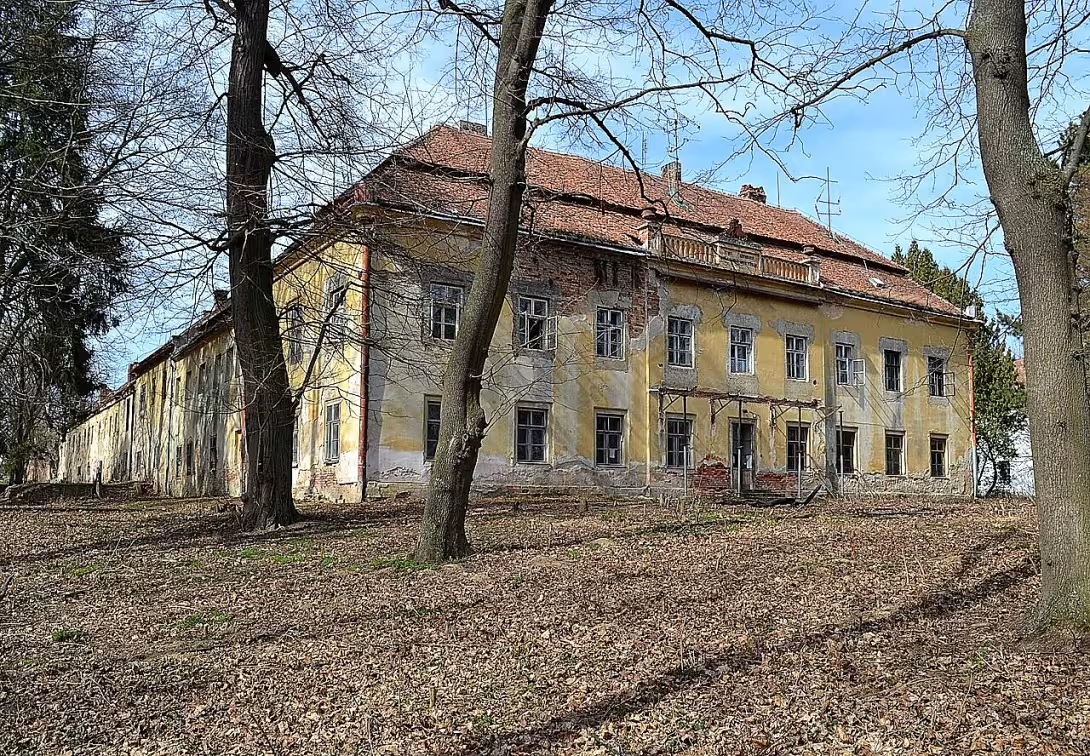
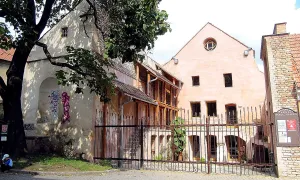
The chateau Hajany is located in a quiet village southwest of Brno in the district of Brno-venkov, surrounded by an extensive economic court. The building was probably in the Baroque style around 1714 when it was built by Johann Baptist Kaschnitz von Weinberg, the military treasury manager, who bought ten thousand and a hundred of Rhine gold from the monastery of the cigarillos in Old Brno in June 1714. Since its inception, the chateau has become the administrative seat of a small estate and has grown into a complex building complex over time.
Soon, the Hajani estate changed owners. In 1746 it was acquired by Jindřich Xaver Hájek z Waldstätten, the later highest country scribe in Brno, who probably had built the southern residential wing and started building the northern economic tract. The first written mention of the chateau dates back to 1772 from the inventory in the estate of Hájek - its modest content suggests that the building was mainly used for the accommodation of public officials, while the owners themselves lived in Brno.
In June 1790 the estate was purchased by Matyáš Smetana, tax controller of the Moravian administration, to whom was then awarded an hereditary knighthood. After his death, he was inherited by sons, from whom Leopold rytíř Smetana retained his share and devoted himself to extensive building development. The plans of 1792 and 1798 document the conversion of economic wings; The southern economic wing was encapsulated by the vaults and underwent both the reconstruction and the vaults of the main wing. Особita Smetana was due to the establishment of the first octárna in Moravia in 1797. In the 1930s, a sheepskin and an agricultural production area south of the chateau was established and a clock tower was built with a bell in the axis of the main courtyard.
In 1857 a large estate was purchased by Vladimír Mitrovský. In his possession, the chateau became more modern - already in 1859 his main building was adapted to the neo-classical form that he kept today. In 1877 Josephina d'Harnoncourt-Unverzagt, born Mitrovská (1852-1885), who lived here with husband Hubert, acquired the farm. The eastern facade was then supplemented by an attics with a family coat of arms and was built by a classicising family tomb along the road to Ořechov. After Josephine's death, the estate was inherited by Marie Ludmila's daughter, who married František Ferdinand Deym from Silver in 1902. The grandeur carried 560 hectares of land. Marie Ludmila was engaged in park modifications around the chateau and lived in Hayany until 1945.
The Czechoslovak State confiscated the property in 1948. The farm yard went under the State Farm Brno, the main building served as an office, both wings were insensitive adapted to the employees' apartments. Insufficient maintenance has led to gradual decay. Today the chateau has been protected as a cultural monument since 2026. The visitor will find here a living document of architectural changes, which accompanied the chateau from Baroque to Classicism until later, and proof of the rich history of the Moravian nobles bound to this landscape.
Then and now
Drag the slider to compare how the landmark may have looked when it was built with the view today.
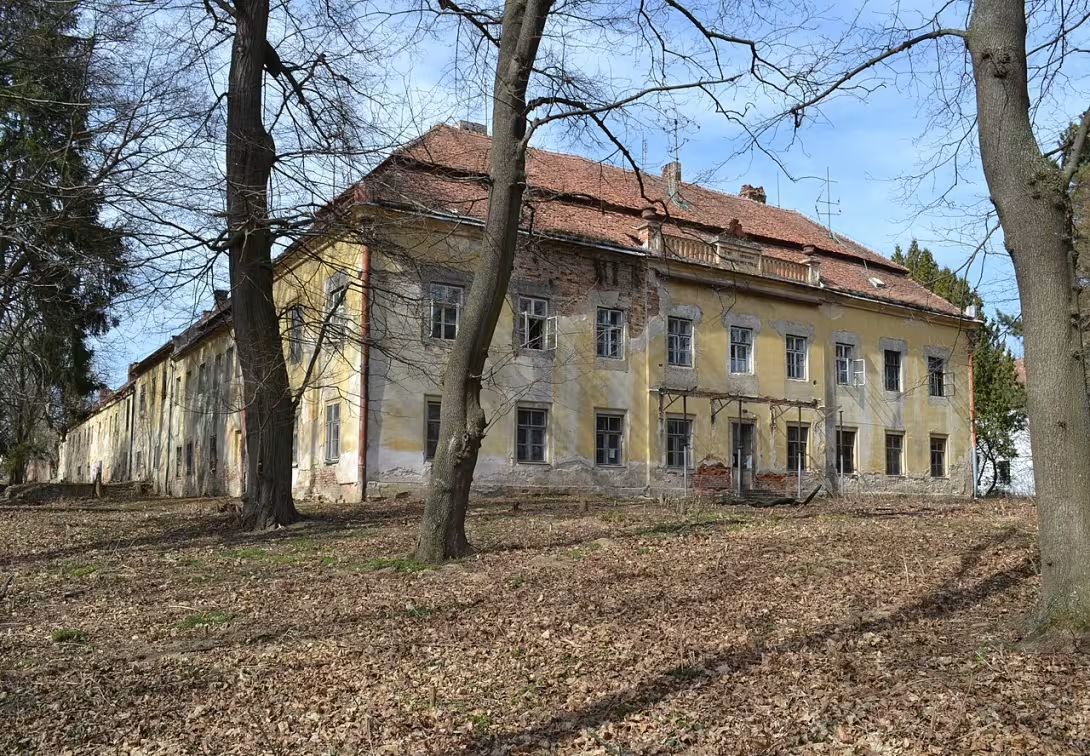
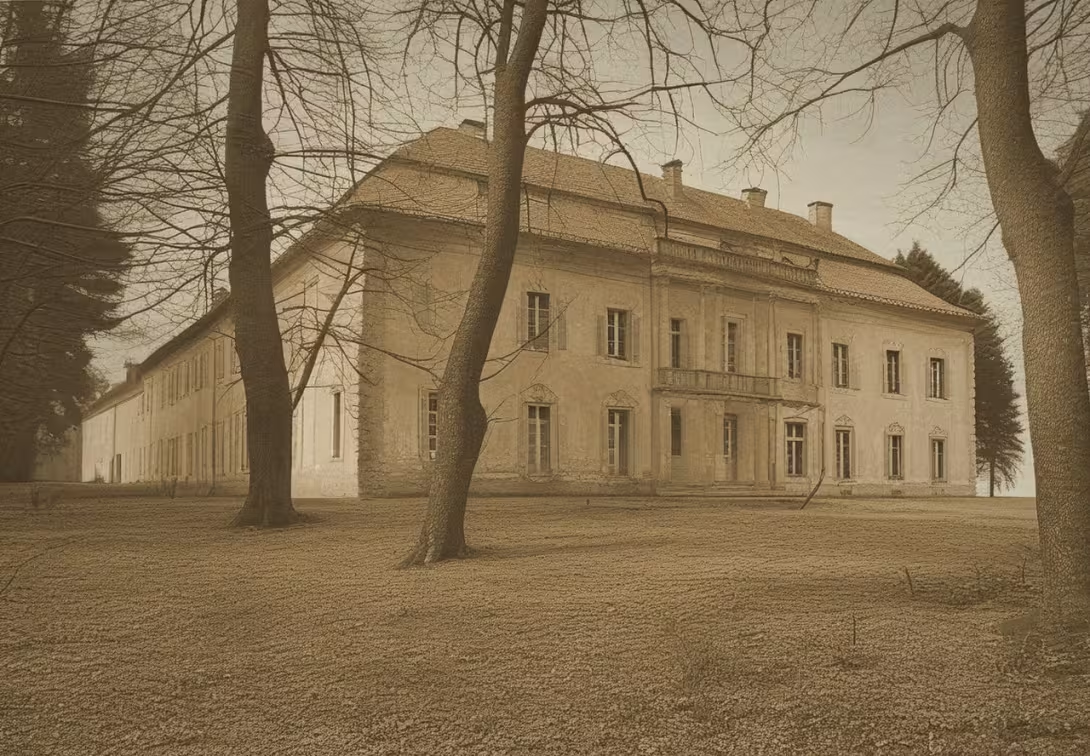
The historical appearance on the left is an AI-generated visualisation and serves as inspiration only.
Architectural development
Originally, the Baroque chateau underwent new classicism, especially for Vladimir Mitrovski. During the 19th century other construction activities were carried out, including conversion of economic wings and the establishment of a clock tower.
Points of interest
- The Hajany Chateau was probably built around 1714 by Johann Baptiste Kaschnitz von Weinberg. - In 1746 he acquired the estate Jindřich Xaver Hájek z Waldstätten, which had built the southern residential wing and started building the northern economic tract. - Matyáš Smetana purchased the manor in June 1790 and founded the first acetate plant in Moravia in 1797. - In 1859, the main building of the chateau was modified into a neoclassical form for Vladimir Mitrovsky. - The Czechoslovak State confiscated the property in 1948 and the economic court transferred to the State Farm Brno.
Guide
This guide is narrated by a synthetic voice generated by artificial intelligence.
Show guide text
This text was created by artificial intelligence and has not been editorially reviewed. It may contain inaccuracies.
Hajany Castle is located in the municipality of the same name southwest of Brno. It originated as a Baroque administrative seat of a small estate, but its present-day appearance was shaped by later Neo-Classical modifications. Around the castle extends an extensive farmyard complex, and since 2026 the entire complex has been protected as a cultural monument.
In the Middle Ages and early modern period, Hajany belonged to the Cistercian convent of the Poor Clares on Stará Brno. In June 1714, the convent sold Dolenice, Hajany and part of Syrovic for ten thousand one hundred Rhine gold coins to Johann Baptist Kaschnitz von Weinberg, administrator of the military treasury. He almost certainly built the two-storey castle around the same time, which is today's main eastern wing.
In 1746 Heinrich Xaver Hájek z Waldstätten acquired the estate. He later became the highest land clerk in Brno. He probably had the southern residential wing built and began constructing the farmyard buildings. An inventory list from 1772 comes from his estate, the oldest written mention of the castle. The modest furnishings suggest that it was mainly inhabited by manor officials, while the owner himself lived in Brno.
In 1790 Matthias Smetana, a tax inspector, purchased the estate and later acquired a hereditary knightly title. His son Leopold devoted himself to the agricultural and construction development of the estate. In 1797 the first vinegar factory in Moravia was established here. In the first third of the nineteenth century, a sheep pen was added, an agricultural area south of the castle, and a clock tower with a bell on the western side of the courtyard. The development of the complex reached its greatest extent at that time.
In 1857 Vladimir Mitrovský purchased the large estate and in 1859 had the main building renovated, probably into its present Neo-Classical form. From 1877 Josephina d'Harnoncourt-Unverzagt, born Mitrovská, lived here with her husband Hubert. As a commemoration of the connection between the two families, the eastern façade received an attic with family coats of arms. A family tomb was also built near the road to Ořechov.
The estate was then inherited by their daughter Marie Ludmila, married to František Ferdinand Deyma ze Stříteže. After 1919 the couple lived separately and she remained in Hajany, where she devoted herself mainly to park modifications. She lived in the castle until 1945.
In 1948 the state confiscated the large estate. The main building served as offices of the state farm and the wings were insensitively converted into employee apartments. The façades lost part of their decoration, the windows received different dimensions and insufficient maintenance led to gradual deterioration.
Tips for visitors
The best time to visit the chateau Hajany is spring and autumn months when the weather is mild and the surrounding landscape offers pleasant colors. In summer it may be hot in the interior, while in winter some parts of the monument may be less accessible due to maintenance or weather. We recommend planning a visit during the day to avoid the largest crowds that usually gather in the afternoon.
Transport availability of the chateau Hajany is ensured both by car and public transport. For passengers by public transport we recommend to check the current connections and timetables in the search engine, as the lines to smaller municipalities may be less frequent than in the metropolis.
When visiting a historical monument, bring comfortable shoes as you can meet uneven surfaces or stairs. We also recommend that you bring drinking water and light refreshments if you plan to take a long walk around. If you're planning on shooting, don't forget to charge your batteries on your phone or camera and have a memory card with sufficient space.
The Hajany Chateau is ideal for shooting morning or late afternoon light, which creates soft shadows and highlights the Baroque details of the facade. The best angles for photography are usually from the front of the building, where you can see the general appearance of the building, and from the vicinity of the window, where you can capture details of architectural elements. In the interior the light is often artificial, therefore set higher sensor sensitivity and be careful with the lightning that can be disabled.
Since there are no specific places in the area on the ground, we recommend to inform ourselves in advance about other attractions in the village Hajany or nearby Brno. It is important for families with children to consider the length of the tour so that it is not too demanding for smaller visitors. You can prepare some small things or games that children will entertain while waiting or taking a break. Always check in advance if there are facilities for families such as toilets or children's corners in the memory.
Frequently asked questions
Can the monument be visited?
Some buildings of this kind are open for guided tours, others serve another purpose or are privately owned. We have not verified whether and when this monument is open – please ask the operator.
What are the opening hours and admission?
We have not verified the opening hours or admission. Current information is published by the operator.
Where is the monument?
Location: č.p. 1, Hajany, Jihomoravský kraj. The map on this page shows the exact spot.
Why is the monument protected?
It is listed in the Central List of Cultural Monuments of the Czech Republic as a cultural monument (register no. 107515).
For kids
Hi! Now we're going on an adventure that took place exactly 312 years ago when the Hajany Chateau was built. Around 1714, when everyone loved the music of baroque music and beautiful decorative art, construction of this stunning place began. It was like building the biggest adult toy! The chateau was built as an administrative mansion of a small estate and was beautiful, just opened its gates.
Businesses nearby
Do you run a restaurant, accommodation, shop, museum, rental, wellness or other visitor service near this monument? Show yourself directly to the people heading to it — this is how they will see you in the app and on the web:
Events nearby


Zdroj akcí: otevřená data měst a obcí ČR (Národní katalog otevřených dat) a kalendář akcí Národního památkového ústavu.
Nearby
ITEX Show interactive overview of the surroundings - restaurants, accommodation, rentals and other places within a 15 km radius.
Data: OpenStreetMap contributors, 15 km radius.
‡ Historical monuments
- sv Florian (6.6 km)
- sv Jan Nepomucký (6.6 km)
- sv Jan Nepomucký (7.2 km)
- monument pally (7.3 km)
- Slavka Selection (8.1 km)
- Hradisko Bosonohy (9.1 km)
- Wild move 1945 (9.3 km)
- Mendel Museum (9.4 km)
Restaurant and catering
- Golden Noodle (6.4 km)
- Cukrlenka (7.1 km)
- U Soiko (7.1 km)
- Na Hristi (7.4 km)
- Moravian cottage (8.5 km - Křížkovsky 489 / 47a)
- YELLOW FISH Billiard club & coctail bar (9.2 km - Vanhalova 587 / 2)
- BLOKK (10.0 km - Husova 536 / 14)
- Morgal (10.1 km - Husova 18)
Accommodation
- On Air (5.8 km - Lip 340 / 16a)
- Guesthouse Kovarna (7.2 km)
- Guesthouse Nikol (8.2 km - Infantry 363 / 6)
- Myslivna (8.3 km)
- Quality Hotel Brno Exhibition Centre (8.4 km - Crožkovsky 496 / 20)
- Hotel Voro (8.5 km - Crožkovsky 488 / 49)
- Hotel Omega * * * (9.2 km - Wings 333 / 19b)
- R.C.P.R. - reality, s. r.o. (11.0 km - Cejl 469 / 71)
› Rental and sports
- Velo Hanák (5.3 km)
- Kola Sírer (5.3 km)
- Sokol (6.6 km - Boundary 301 / 5)
- ABC Cyclosport (6.8 km)
- TETA drugerie (9.2 km)
- Army Store (9.3 km)
- Juventus (9.5 km)
- Club of tourists and skiers Brno (10.2 km)
© Tourism and nature
- Forms (6.5 km)
- Stone top (8.0 km)
- U Marie (8.0 km)
- Locality Red Hill - Střířice - Writers (8.3 km)
- Hradisk (9.0 km)
- Klana (9.1 km)
- Vladimir Menšíka na Chánej (9.2 km)
- Brno- Typists (public transport) (9.3 km)
Accommodation nearby
Trips and activities nearby
Guided tours, tickets and activities nearby from GetYourGuide
Affiliate link: if you buy from the partner, we may receive a commission. The price for you does not change.
Search tours and activities →Themed route
Thematic cruise route chateau Hajany
1. Chateau Hajany * Type: * Historical lock * Why is it worth a visit: * Chateau Hajany is a beautiful example of Baroque architecture with a rich history dating back to the 17th century. Visit its impressive building, walks through gardens and exhibitions that bring a lively view of the past of this area.
2. St. Jilji Chapel * Type: * Chapel * Why is it worth a visit: * This chapel is not only a spiritual centre for the local community, but also an interesting architectural style. Its quiet atmosphere and history make it an ideal place to relax after a tour of the chateau.
3. Hajani Park * Type: * Park * Why is it worth a visit: * Park around the chateau offers beautiful walks between flowering orchards and historical paths. It is an ideal place to relax and enjoy the natural environment that complements the chateau culture.
4. Hajani vineyard * Type: * Vineyard * Why is it worth visiting: * Visit the vineyard and explore its history, which goes back centuries. Here you can not only enjoy the view of the large vineyards, but also appreciate the products of the region such as local wines and fruits.
5. Local Market * Type: * Market * Why is it worth visiting: * Local market in Hajany offers a wide selection of regional products, from food to handmade objects. It's a great way to dive into local culture and support local businessmen.
This route allows you to explore not only the historical chateau Hajany, but also its surroundings with a rich cultural and natural offer.
Seasonal recommendations
Spring: In the spring season, the Hajany Chateau is transformed into the vibrant colours of flowering shrubs and trees, which gives new shine to historic buildings. The sun's rays penetrating the misty clouds create a unique atmosphere that celebrates nature's restoration. At this time, it is advisable to visit the chateau in the early afternoon when the sun begins to warm and the crowds have not yet been set. Enough sun days means that clothes should be compact but still suitable for mild cold days.
Summer: Summer is the best time to visit the chateau Hajany when all its beauty opens fully. Nature of surrounding parks offers an ideal environment for picnic or relaxation under the shadow of old trees. In the main summer season it is recommended to come to the chateau at an early dawn in order to escape long fronts of tourists. Clothes should be light and light, with emphasis on sun protection such as hats and sunglasses.
Autumn: Autumn brings the Hajany Chateau a wonderful colour spectrum from yellow to red tree leaves, creating an idyllic atmosphere. Short days require adjustment of the planning of the visit; It is advisable to visit the chateau during the afternoon when the sun still illuminates the landscape. Clothes should be more layered to avoid sudden changes in temperature and cold winds that are typical of the autumn season.
Winter: Winter visit of the chateau Hajany offers unique views of the historic monument covered with snow. The atmosphere is calm and quiet, allowing the user to fully immerse himself in the history and architecture of the chateau without disturbing the crowds. Thanks to shorter opening times it is advisable to arrive earlier on the day to maximize the time for exploring. Clothes should be warm and waterproof, with emphasis on protection against cold autumn or winter conditions.
Visualizations and artistic views


The visualisations are generated by artificial intelligence and serve as inspiration.
Photos from the area
Real photos taken near the monument

Zdroj a licence jsou uvedeny u každého snímku.
Atmosphere of the place
This atmospheric visualisation of the place and period was generated by artificial intelligence. It is not real footage of the location.
Tips from visitors
No tips yet. Be the first!
Log in and add your tip.
Sources and literature
Photos: RomanM82 / CC BY-SA 4.0 — Wikimedia Commons. The author and licence also appear when you hover over the image.
Faktickým podkladem tohoto textu byl článek na Wikipedii, jehož autory jsou přispěvatelé Wikipedie. Článek je dostupný pod licencí CC BY-SA 4.0.
Location on the map


Příběhy a pověsti
Legendy, pověsti a příběhy spjaté s touto památkou

Fotografie návštěvníků
Zatím žádné fotografie. Buďte první, kdo přidá fotografii z návštěvy!
Log in a přidejte svou fotografii nebo hodnoťte.
Za ověřenou návštěvu v aplikaci získáte víc bodů — poznáme podle GPS, že jste na místě.
Reviews and comments