



hamr v Popovicích Hammer mill
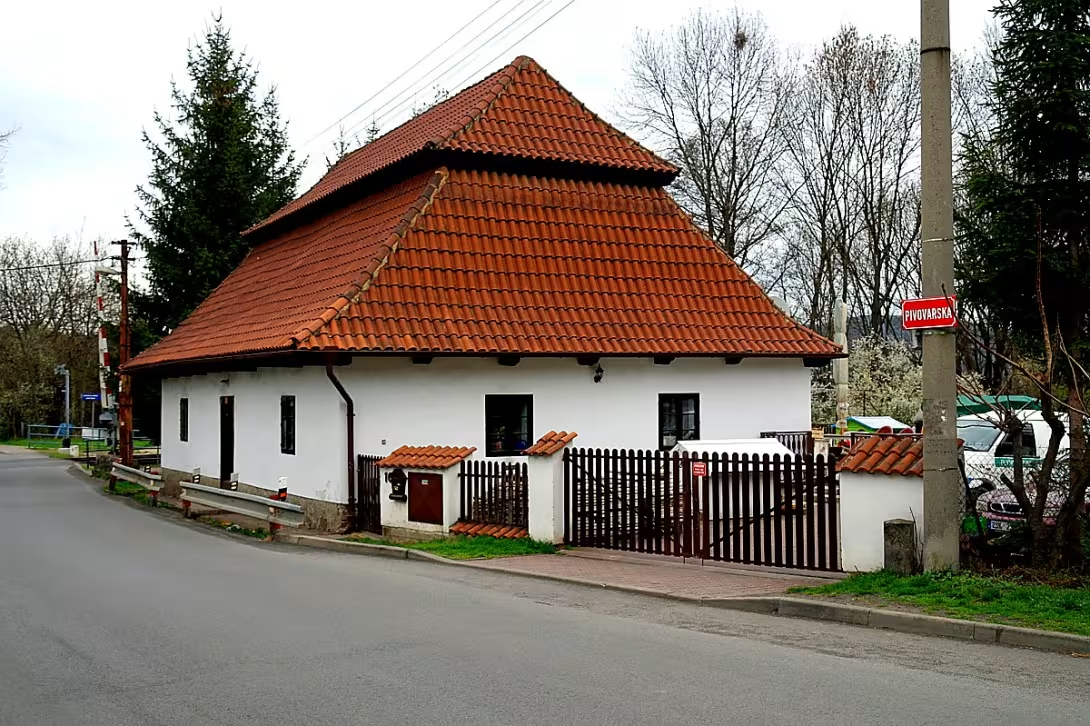
Hamr in Popovice is a Renaissance brick building with attached bridge. It is located in the cadastral territory of Popovice near the King's Court in the Beroun district. The object was used to process iron. Thanks to its historical and architectural value it is included in the Central List of Cultural Monuments of the Czech Republic.
The construction was built after 1519. At that time, mining and metallurgical flourished in the Czech countries, while Renaissance architecture also penetrated commercial buildings. In 1544, the Hamr is mentioned in the Earth's records as property of the Charles of Svárov. The plant processed iron from nearby Karl's hut.
The building has a rectangular floor plan, it's walled and plastered. The dominance is a high Mansard roof covered with bobbies. In the road front there is a central entrance with three degrees and two symmetrically placed windows. The shorter sides have two window axes and all windows are six-piece. There are piglets attached to the front of the yard, while the northern side of the building is bordered by a walled fence with planks. The interior consists of four rooms with a flat ceiling in the corners of the building and a central kitchen with a valed vault.
There is a characteristic bridge through the Hutsky Crouch. This grate was part of a complex system of water works on the river Litavec, built at the turn of the 15th and 16th centuries. The water was brought from a 2.5 meter high dam in Litavec over a four-kilometre long canal. He fed the ponds of Měřák and Hutský, the popovický mill and Charles' hut. The water drive for the hamr was obtained in a place between the Zdice and the Royal Court.
The activity of popovice hamra ended in 1887, shortly afterwards part of the facility was taken care of. However, the building itself was preserved and was recognised as a cultural monument together with the bridge in 1977.
The building represents a rare example of Renaissance industrial architecture. Indicates the historical significance of the metallurgical industry in this location. Visiting this place offers an opportunity to see the technical history of the region at King Dvor.
Historical milestones
- 1519
- construction of popovický hamru
- 1544
- mentioned in the earth's records in the property of the family Charles of Svárov
- 1887
- the cessation of the activities of hams
- 1977
- entry of hamru with bridge into the Central List of Cultural Monuments of the Czech Republic
Architectural development
The building is renaissance, walled and plastered. The front of the yard is surrounded by piglets and the north side is surrounded by a walled fence with plains. The interior consists of four rooms with flat ceiling and central kitchen with vault.
Historical events
1887 - the end of the work of hams and the subsequent demolishing of part of the facility.
Owners
in 1544 owned by the family of Charles of Svárov
Points of interest
- The building was built after 1519 and was used to process iron from nearby Karlovy Vary. In 1544, the hamr belonged to the Charles of Svárov. - The building is a rare example of Renaissance industrial architecture with a high Mansard roof. - The site is led by a bridge through the Hutsky Crouch, which was part of a system of water works from the turn of the 15th and 16th centuries. The plant ceased its activities in 1887.
Guide
Show guide text
This text was created by artificial intelligence and has not been editorially reviewed. It may contain inaccuracies.
Welcome to Popovice at the King's Court. Right now, you're standing in front of a building that carries hundreds of years of history and tells the story of an ancient craft that once determined the rhythm of life throughout this region. In front of you, there is a popovish hamr, a rare witness to the time when iron was formed in the thunder of fire and hammer noise. The first impression of this building is very strong, because there is a massive walled building in front of you that resembles a mansion rather than a factory. Take a look at its overall form and perceive the atmosphere of the place where the power of water, fire and human work has joined.
Let us now stop at how this building was created and why it is standing here at all. Let's go back more than 500 years in time. Hamr was built shortly after a year of 5,000 nineteen. At the time, it was not just an ordinary house, but a key element of the local industry. The main purpose of this place was the processing of iron, which travelled from nearby Karlovy Vary. So imagine the constant movement of cars, the transportation of raw materials, and the people who worked here day and night to create useful objects out of crude iron. It was a center of technology of its time, a place where knowledge of craft met with a natural source of energy.
Now pay attention to the architecture itself, because it is one of the rarest examples of Renaissance industrial construction. Look up on the roof. Notice its high-mansard form, which is covered by traditional bobbies. This type of roof gives the building its distinctive appearance and distinguishes it from ordinary buildings. The whole floor plan of the building consists of a simple but functional rectangle. If you could take a look at the inner space, you would find an interesting detail, which is a kitchen with a vaulted vault. It is these elements that show that the construction should not only be practical, but also durable and aesthetically successful, even though its authors remained in the time forgotten by the unknown.
When we talk about history, there's no forgetting the people who were connected to this place. Even though today we do not know the names of all the craftsmen who worked here in historical records, namely in the Earth records of the year one thousand five hundred forty four, the Hamr is referred to as the property of the family Charles of Svárov. So imagine this building as part of the large estate of the noble family, which managed its economic interests here. Over the centuries, the owners took turns, but the building remained a constant point in the landscape. The work of hams in this area lasted for a very long time, until the year one thousand eight hundred eighty-seven, when the era of these traditional ironworks finally ended and they were replaced by more modern factories.
Now I want to draw your attention to one very interesting detail, which you may miss at first glance, but it is absolutely essential to understand the functioning of this place. Take a look at the bridge that leads to the site through the Hutian Crouch. This small bridge is not just a transport link, but a symbol of the entire system. The Hutian gutter was the lifeblood of the entire operation. The water was driven from it by the mill wheels, which in turn carried the power to the hammers treading into iron. Without this water, the hamr could not exist. It is fascinating to think that such a small architectural element as this bridge is now as valuable as the main building itself. That is why in the year one thousand nine hundred seventy-seven it was registered together with the Hamr in the Central List of Cultural Monuments of the Czech Republic.
Now try to close your eyes for a moment and imagine the sound that existed here centuries ago. It wasn't the peace you're feeling today. It was the rhythmic sound of hammer falling, the noise of running water in the gutter and the workers' calls. It's strange how a place full of noise and heat became a silent monument to Renaissance architecture. This building has survived centuries, war and regime changes, and today it stands here as a reminder of the time when industry was closely linked to nature and craft was art.
When you look at these walls today, you see more than just an old house. You see evidence of human ingenuity and the ability to use the surrounding environment to create something lasting. The fact that we retained such a rare example of industrial architecture from the beginning of the sixteenth century is truly exceptional. Most of these buildings were demolished over time or so fundamentally rebuilt that they lost their original character. But the Popovsky Hamr is still telling the truth about its past.
Imagine what secrets these walls can hide. Who last visited the family of Charles of Svávor? What kind of conversations were held at the arched kitchen? Although history does not answer all our questions, the very presence of the building allows us to ask these questions and think about how our perspective on work and production has changed.
Now, let's invite you to take a quiet look at the surrounding area, walk to that bridge and take a closer look at the details of the walls and the roof. Feel the contrast between massive buildings and the fineness of beavers on the Mansard roof. Let the silence which today surrounds you where the power of iron once ruled.
Thank you for spending time with us at this unique piece of Czech history. We hope you're interested in popovsky hamr and that you're leaving feeling like you've touched a piece of the past. We wish you a pleasant further journey and many other discoveries during your walks in our region. Goodbye.
Tips for visitors
The best time to visit is late spring or autumn, when the surrounding nature of the river Litavka excels beautifully and the trees do not interfere with the view of the Renaissance façade and high roof with bobbies.
On the way we recommend to take your shoes suitable for the field, as the building lies close to water and ponds where the surface can be moist or muddy.
For the best photos we recommend to come in the morning or late afternoon light to highlight the details of the wall construction. Ideal angles are from the surroundings of the Měřák and Hutský ponds, where the relation of the building to water is evident.
As part of a short walk in the surroundings, visit the Pond of Měřák and Hutský, the River Litavka or the Charles Mound. For families with children it is ideal to explore the surrounding water and observe the history of iron processing in this area.
Frequently asked questions
Can the monument be visited?
We have not verified whether this monument is accessible. Please ask the owner or operator, or the local municipal office.
Where is the monument?
Location: Králův Dvůr. The map on this page shows the exact spot.
Why is the monument protected?
It is listed in the Central List of Cultural Monuments of the Czech Republic as a cultural monument (register no. 1000128282).
Businesses nearby
Do you run a restaurant, accommodation, shop, museum, rental, wellness or other visitor service near this monument? Show yourself directly to the people heading to it — this is how they will see you in the app and on the web:
Events nearby
Zdroj akcí: otevřená data měst a obcí ČR (Národní katalog otevřených dat) a kalendář akcí Národního památkového ústavu.
Nearby
Řeka Litavka, rybníky Měřák a Huťský, Karlova huť.
Accommodation nearby
Themed route
Here is the design of the thematic route:
1. Charles's hut (industrial monument) - The trip begins at this historic place, which is the basis of industrial development in the region. 2. Pond Meter (water surface) - A short walk to the water offers peace and opportunity to observe the surrounding nature. 3. Hamr in Popovice (main objective) - A visit to the old mill and forge where you can admire the technical equipment and history of metal processing. 4. Hutian pond (water area) - Another stop by the water, which complements the landscape near the Hutian areas. 5. River Litavka (water flow) - A walk along the riverbed, which was a key source of energy for the operation of the Hamru and the Huti.
Seasonal recommendations
In spring the surroundings of the monument awaken to life and the young greenery accompanied a visit to this place. Light is soft and pleasant in this period, which helps to observe the details of the construction. Moistable footwear is recommended as the road can be muddy after melting snow. The best thing is to come in the morning when the air is the cleanest.
In the summer months the landscape is dominated by green and bright, sharp sun that creates deep shadows. The atmosphere is warm and calm, typical of peak season. It is advisable to choose light and breathable clothes with a hat on your head for protection against heat. The ideal time for visiting is early morning or late afternoon to avoid the greatest heat.
Autumn brings colour leaves and fog to the surroundings, giving the place a mysterious and melancholy touch. The lighting is golden and milder, which is suitable for capturing the atmosphere of the old hamr. It's practical to wear layered clothes and a waterproof jacket for frequent collisions. A visit is recommended in October, when the colors of nature are the most distinctive.
Zimą calms the landscape and the monument can be covered with a layer of snow, creating a contrasting and clean image. The atmosphere is freezing and quiet, typical of advent time. Hot and waterproof clothing and quality winter shoes with anti-slip soles are essential. The best thing to do is to go out in the light of day so you can see everything before dark.
Visualizations and artistic views

The visualisations are generated by artificial intelligence and serve as inspiration.
Photos from the area
Real photos taken near the monument


Zdroj a licence jsou uvedeny u každého snímku.
Tips from visitors
No tips yet. Be the first!
Log in and add your tip.
Sources and literature
Photos: Horakvlado / CC BY-SA 4.0 — Wikimedia Commons. The author and licence also appear when you hover over the image.
Faktickým podkladem tohoto textu byl článek na Wikipedii, jehož autory jsou přispěvatelé Wikipedie. Článek je dostupný pod licencí CC BY-SA 4.0.
Location on the map
More monuments – Králův Dvůr
Show all in the municipality
Příběhy a pověsti
Legendy, pověsti a příběhy spjaté s touto památkou

Fotografie návštěvníků
Zatím žádné fotografie. Buďte první, kdo přidá fotografii z návštěvy!
Log in a přidejte svou fotografii nebo hodnoťte.
Za ověřenou návštěvu v aplikaci získáte víc bodů — poznáme podle GPS, že jste na místě.
Reviews and comments