






Hotel Cristal Hotel building
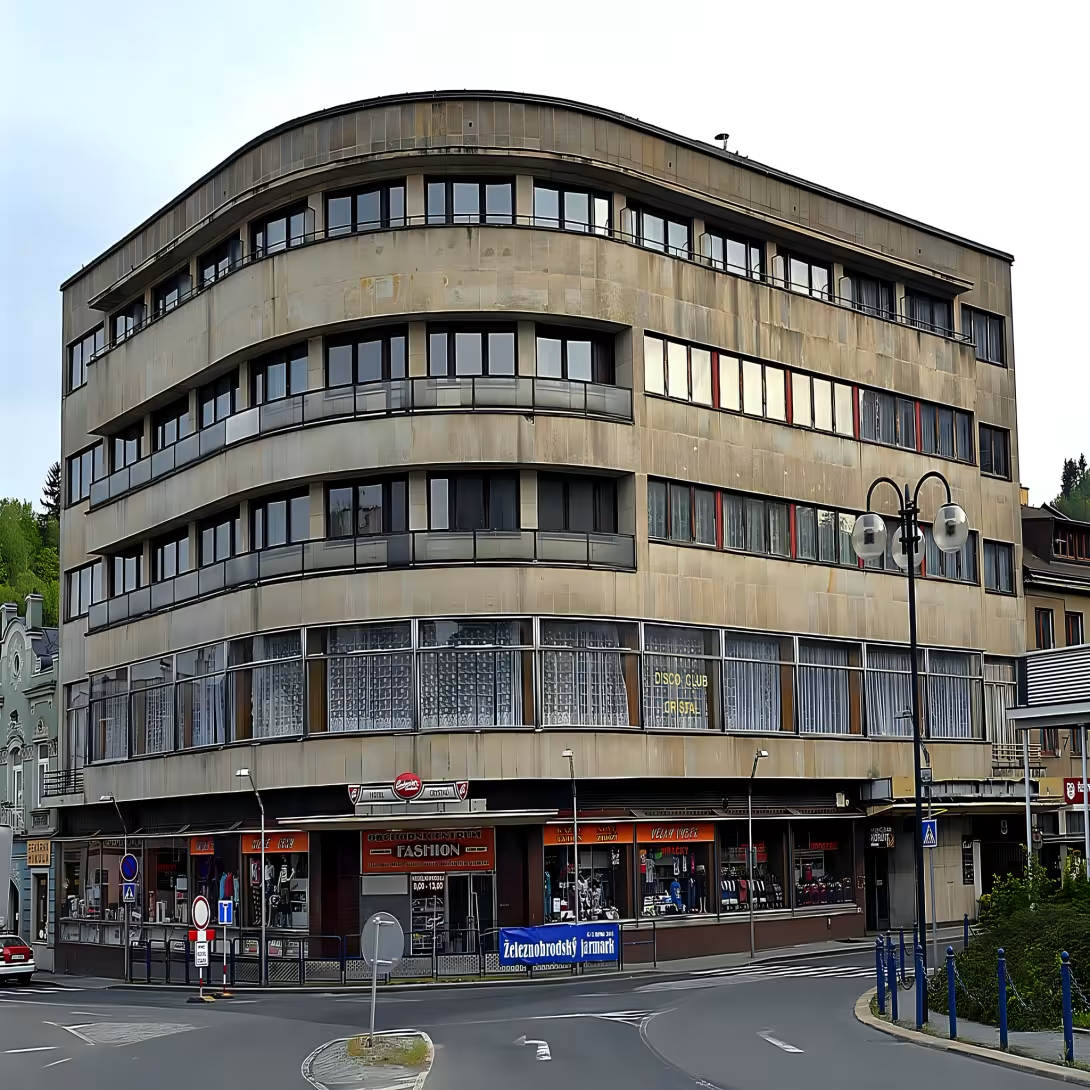
Hotel Cristal in Železný Broda is a late-functionalist building, which has been one of the cultural monuments since 2012. It dominates the south side of the Tří plazy and its architecture and past represents an interesting example of the adaptation of originally German building to the social centre of the city. It was built in 1942- 1943 as a replacement for the older building of the District Economic Reserve, with its creation related to the German occupation and subsequent military use.
Architects František Stalmach and Jan Hanuš Svoboda designed the building during World War II. It was originally served by the German Wehrmacht and its officers who were meeting here. There was a safe in the basement with stolen valuables. After the end of the war, the building became a social center of the city - first as a restaurant of the state enterprise, later as part of the Železnobrod glass. In the 1990s he was privatized and the hotel, disco and restaurant worked briefly. In 2011, the pipeline crash caused a flood of basement spaces.
It is an architectural corner building with a reinforced concrete skeleton and an irregular ground plan. The ground floor decorated with polished red granite and rhythmised interpreters contrasts with the purity of functionalist style. On the fourth floor was originally placed a large sign CRISTAL PALACE HOTEL. On the ground floor there was a self-service restaurant, on the first floor there were lounges, bar or dance floor. The interiors are decorated with glass chandeliers and travertine fireplaces which refer to the local glassmaking tradition.
The property fate of the building is dynamic. After the war, it was operated by the State and subsequently taken over by the company Železnobrod Glass. In the 1990s, the owners of Arab and Vietnamese origin took turns, while the building served as a hotel, disco and restaurant. In 2011, a pipe accident caused a flood of basement spaces. In 2014, the city considered buying the building for public purposes, but no steps were taken.
One of the most interesting events associated with Hotel Cristal is its cultural legacy. The poet Václav Lacina remembers him in his poem Hotel Cristal- Palace, which is part of the collection of Cemetery Bulls. The building represents not only an architectural, but also a literary place in local history.
Today the state of the building is problematic, yet it is worth visiting as an example of functionalist architecture and local history. Železný Brod offers an area rich in other cultural monuments such as the glass museum or the nature reserve of the Železnobrod beech. Hotel Cristal thus represents a unique combination of architecture, history and cultural heritage.
Then and now
Drag the slider to compare how the landmark may have looked when it was built with the view today.
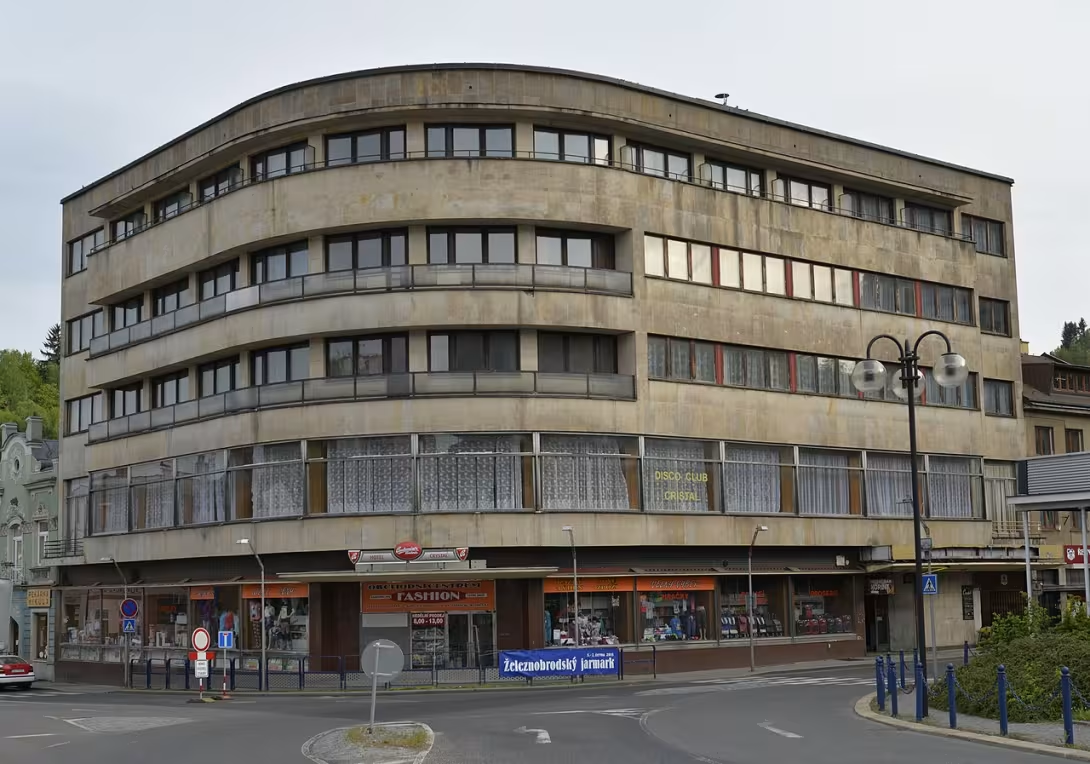
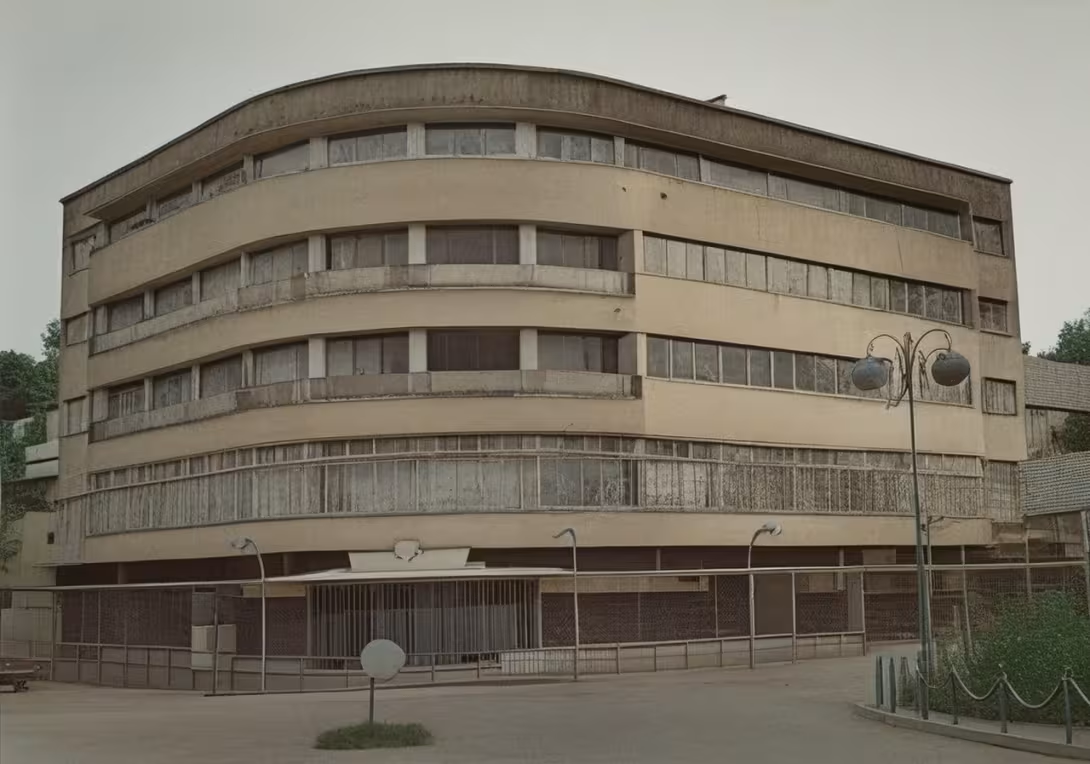
The historical appearance on the left is an AI-generated visualisation and serves as inspiration only.
Historical milestones
- 1942- 1943
- Built as a replacement for the Regional Economic Reserve, originally for the German Wehrmacht.
- after 1945
- Take over the building by the state, use as a restaurant of the state enterprise and later part of Železnobrodský glass.
- the nineties of the 20th century
- Privatization, short run as a hotel, disco and restaurant.
- 2011
- The pipe crash caused a flood of basement spaces.
- 2012
- Registered as a cultural monument.
Architectural development
The building was created as a late-functionalist building with a reinforced concrete skeleton and a tile made of polished red granite on the ground floor. After the war, it was adapted to hotel purposes, but the original function remained. In the 1990s, there were short-term traffic changes (discos, restaurants), subsequently privatisation and gradual deterioration.
Historical events
In 1942-1943 the building was built for German purposes during World War II. After the war she served as a social centre of the city, later went through privatisation and change of owners. In 2011, it was damaged by a pipe accident which caused a flood of basement spaces.
Points of interest
- The building was built in 1942- 1943 as a replacement for the older building of the District Economic Reserve.
- Originally served the German Wehrmacht and its officers who were meeting here.
- There was a vault in the basement with stolen valuables.
- In 2011, a pipe accident caused a flood of basement spaces.
- The poet Václav Lacina remembers the hotel in his poem Hotel Cristal-Palace.
Guide
Show guide text
This text was created by artificial intelligence and has not been editorially reviewed. It may contain inaccuracies.
Welcome to Iron Broda. Right now, thanks to your headphones, you're becoming part of the living history of this place. You are standing right in front of a building that, by its presence, determines the character of this whole part of the city. Look around you and see how this building dominates the south side of the square on May 3rd. It is a demanding object that immediately captures your view and dictates the rhythm of the entire square with its strength and scope. It's Hotel Cristal. Feel the weight, the stability that this building emits when you look at it from this angle. Its presence here is not random, it is a fixed point that has been standing here for many decades, and it shows the many changes that this region has undergone.
Let us now move further into time together and try to understand why this building was created. If we now return in our minds to the period when the first building blocks of this building began to lay down, we will reach the years one thousand nine hundred forty-two and forty-three. It was a period that was very difficult for the whole country and for this region and full of constant changes that affected not only architecture, but also the very life of people in this city. This building wasn't built as a random new object, but it was meant to have a specific purpose. It was created as a replacement for an older building, which served as a district economic reserve. However, its original use at the time was very specific and difficult for many perhaps. In these areas, German troops originally grew stronger. It was a place where German officers met, and the building was closely linked to the political and military situation in our state.
Now pay attention to the very form of the building that you are observing right now. Notice its shape and how it intersects with the square space. This is an excellent example of architecture known as functionalism. This style does not seek unnecessary ornaments, sculptures or complex ornaments to distract you from the essence of the matter. Instead, it focuses on the purity of the lines and on the building fully fulfilling its useful function. Look at the monolithic structure. It's made of reinforced concrete, which gives her the feeling of the impenetrable strength and uniformity that you're feeling right now. Notice how her floor plan is irregular. The building does not follow simple squares, but its shapes adapt to demanding corners and space around it. Look up at the flat roof. It's a typical sign of the time when architecture tried to make a modern and clean appearance without unnecessary roof-shaped surfaces. Two important men, architects František Stalmach and Jan Hanuš Svoboda, are behind this work, who have inserted their vision of modern and functional space into this project.
But when we look at how the fate of this building was unfolding after the war ended, we find that her life's journey was very varied. After a thousand and nine hundred forty-five, the building took over the state. At that time, his role changed completely. Instead of a military assembly site, it became part of the everyday life of the people. On the ground floor there was a self-service restaurant where people could find rest and food. The hotel rooms were located on the other floors. The building has also become part of a wider economic unit linked to the Ironbrod Glass, which is a crucial activity for this region. Later, in the 1990s, there was another big change in privatization. The building went through a period when it was used in the short term as a hotel, but also as a place for a restaurant and even as a place for dancing and entertainment, which gave it a completely different, more dynamic atmosphere.
Even though the building seems solid and unchanging, it has to face unforeseen events. Several years ago, a thousand and nine hundred eleven years ago, an unfortunate event took place in her premises. There was a failure in the pipes that caused a large flood in the basement areas. This event was a great test for the building, but fortunately it recovered from it. Thanks to its historical value and importance to the city, this building was officially registered as a cultural monument in the year one thousand and nine hundred and twelve, which allows us to see and protect it today.
But now I want to tell you something that you can't see at first sight, something that is hidden in the dark corners of history and in the depths of this building. This building is not only about concrete and architecture, but also about secrets. They say there was a safe in her basement once. And this safe wasn't ordinary. In his bowels were hidden valuables that were stolen. Imagine the tension, the constant question that really took place in those spaces and what fate was associated with these things. This mystery also gives the monolithic concrete mass a little unrest and fascination.
Now that you've been through the main milestones of the history of this place and you perceive its architecture and hidden stories, I suggest you continue your next walk around the square. Feel the history of the city intertwined with every detail you see around you. Hotel Cristal will still stand here as a silent witness for many years that have come and gone. Thank you for choosing to make this journey with us. We will brighten up the pleasant rest of your day and look forward to meeting you again at the next historical monument.
Tips for visitors
Best time to visit the hotel Cristal is early morning or late afternoon. In these hours the light is pleasant and you can see the facade of the building without direct sunlight, which could create unpleasant shadows. It is often hot in the summer, so visiting in these times can be unpleasant. If you want to see the building in full beauty, come here during spring or autumn, when the weather is pleasant and the building excels in the natural environment.
Mild temperatures and pleasant light improve the experience of the tour.
Parking in the vicinity of the Cristal Hotel is not directly in front of the building, but can be found in nearby parking lots. It is recommended to use public transport as Železný Brod has good bus availability. If you arrive by car, find the nearest free parking lot and then move on foot. The building is located in the city centre, so most places are available by walking.
Absence of problems with parking and environmental investigation.
When visiting the Cristal, wear comfortable shoes and comfortable clothes. The building is located in the square, so you will move along the sidewalk, which can be busy in the summer months. Next, prepare a mobile phone with a map to easily navigate the area. If you want to take photos, take a camera or smartphone with a high-quality lens.
Preparing for a comfortable and smooth visit.
Photography of the Hotel Cristal is possible from several suitable places. It is best to stand in front of the building on May 3rd, where the overall architecture is well seen. Other interesting angles are from around the glass museum or from the park areas nearby. The best light for photography is in the morning or in the evening when light is not too hard and creates pleasant shadows. Avoid shooting at noon when light can be too bright and create unpleasant sparks.
Getting quality photos without unpleasant light conditions.
There are several interesting places around the Cristal Hotel that are worth a visit. The first of these is the historical centre of Železný Brod, where there are many functionalist buildings. There is also a glass museum that deals with the history of glass art in the region. For natural enthusiasts, the natural reserve of Železnobrod beech is a suitable choice, located within five kilometres of the center. In addition, there are also historical glassworks nearby which are interesting for lovers of history and architecture.
Interesting activities and places nearby.
If you're visiting the Cristal Hotel with the children, prepare some activity they're interested in. In the vicinity there is a glass museum where children can see various glass objects and learn about their production. For a longer trip you can visit the nature reserve of Železnobrod beech, where children can observe local flora and fauna. In the city centre it is also possible to find a small playground or spaces where children can run and play. Don't forget to bring some refreshments and drinks to get everything you need for a comfortable trip.
Interesting activities for children and ensuring their entertainment.
Businesses nearby
Do you run a restaurant, accommodation, shop, museum, rental, wellness or other visitor service near this monument? Show yourself directly to the people heading to it — this is how they will see you in the app and on the web:
Nearby
V okolí se nachází historické centrum Železného Brodu s řadou funkcionalistických staveb, sklářské muzeum a památník sklářství. Do 5 km je také přírodní rezervace Železnobrodské bučiny a historické sklárny.
Accommodation nearby
Trips and activities nearby
Guided tours, tickets and activities nearby from GetYourGuide
Affiliate link: if you buy from the partner, we may receive a commission. The price for you does not change.
Search tours and activities →Themed route
1.Hotel Cristal Type: Modern hotel building with functionalist features. Why visit? As the dominant building of the Iron Brod, it represents an example of period architecture associated with the glass industry. The interior offers views of the historical centre and surrounding forests, ideal for short rest.
2. The Historical Center of Iron Brod Type: Alleys with functionalist houses and monuments. Why visit? The centre captures the industrial past of the village where glass and architecture intersect. Streets with stone houses and modern elements create a unique atmosphere.
3. Glass Museum and Memorial Type: Museum exposition and outdoor monument. Why visit? It shows the history of the local glass craft from the Middle Ages to the present. The outdoor part with historical tools and glass products is also interesting for children.
4. Natural Reservation of the Iron Brod Beech Type: Forest with beech trees and rare flora. Why visit? Protected area with unique nature, ideal for a short walk. The forest trail leads around the old glass smelters, which are part of local history.
5. Historical glassworks (within 5 km radius) Type: Residues and exposure of glass plants. Why visit? This was used to produce glass that affected the entire area. Some glassworks are accessible and show what production looked like in the past.
Seasonal recommendations
Spring in the vicinity of Hotel Cristal brings gradual warming and awakening of nature, when daylight rises and the surrounding area changes from winter grey to finer green tones. For a visit it is advisable to come in the morning when the lighting is less soft and crowds, but be prepared for the random showers that spring weather brings; suitable clothing combines light layers with umbrella.
Summer brings intense sunlight and heat, which on the facade of Hotel Cristal reveals details and its poor condition under strong lighting. In the main summer season the crowds are the most numerous, therefore the best time for an early morning or late afternoon tour when the sun is no longer the most intense; we recommend light clothes, head and plenty of water, avoid the midday mountain.
Autumn on the Iron Brod brings alternating rains and gradually shortening days when leaves on the surrounding areas contradict the rough construction of the hotel and the daylight becomes golden. The ideal middle day for visiting is when the lighting is sufficient to observe architectural details, but the temperature is still pleasant; suitable clothes combine warm layers with umbrella for sudden showers, crowds are less than in summer, but daily time is shorter.
Winter in the vicinity of Hotel Cristal is characterized by low sun, freeze and bare nature, when the facade of the building acts more harshly under ice lighting and its poor condition is visible at first sight. In winter the opening hours are shortened and visitors should take care of warm clothes, gloves and hat, the best time for a tour is noon when daylight is the strongest and the highest temperature; Avoid morning freezes and ice surfaces of the surrounding area.
Visualizations and artistic views


The visualisations are generated by artificial intelligence and serve as inspiration.
Photos from the area
Real photos taken near the monument


Zdroj a licence jsou uvedeny u každého snímku.
Tips from visitors
No tips yet. Be the first!
Log in and add your tip.
Sources and literature
Photos: Jirka Dl / CC BY-SA 4.0, rozlišení zvýšeno umělou inteligencí — Wikimedia Commons. The author and licence also appear when you hover over the image.
Faktickým podkladem tohoto textu byl článek na Wikipedii, jehož autory jsou přispěvatelé Wikipedie. Článek je dostupný pod licencí CC BY-SA 4.0.
Location on the map
More monuments – Železný Brod
Show all in the municipality
Příběhy a pověsti
Legendy, pověsti a příběhy spjaté s touto památkou
Fotografie návštěvníků
Zatím žádné fotografie. Buďte první, kdo přidá fotografii z návštěvy!
Log in a přidejte svou fotografii nebo hodnoťte.
Za ověřenou návštěvu v aplikaci získáte víc bodů — poznáme podle GPS, že jste na místě.
Reviews and comments