




Hradec u Hudčic Hillfort
Hradec u Hudčic, an ancient and early medieval fort on the top of Hradec hill (531 meters above sea level), lies in the cadastral territory of Martinique near Březnice. This protected area was already inhabited in the late period of Halštat and reused in the eighth to ninth century. Its importance lies in documentation of the transition from Celtic cultures to Slavic settlement, which is confirmed by preserved ceramic findings and landscaping.
The fort was established in the late period of the Halštatian, when Celtic cultures developed in our territory. Its original area was about 0.7 hectares and was probably oval-shaped. The settlement was destroyed during the Latin era, but the top of the hill was resettled during the Great Transformation, when Slavic tribes developed. This new peak is linked to the formation of the Welkomorac Empire, which has affected regional settlements.
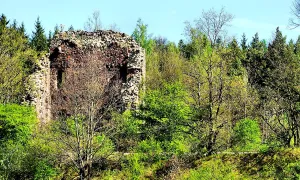
Archaeological research from 1947 and 1950 revealed ceramic findings which enabled accurate dating of settlement. The preserved fractions of Slavic ceramics are evidence of the existence of this place. The original fortification was probably stoneholly, but archaeologically it was not examined in detail. Only a section of the low wall and terraced on the southwest side has survived, indicating the original fortification. The mining of stone in the past has significantly damaged the original form of the site.
The fort was probably surrounded by a moat whose preservation is hampered by stone mining. The landscaping and terraces on the southwest side are the only preserved remains of the original fortification. Already in 1906, the local school director collected ceramics, but the findings were not sufficiently evaluated. Later research added knowledge of the settlement and its chronology.
Today Hradec u Hudčic is protected as a cultural monument, but its condition is neglected. Mining and long-term neglect have damaged the original form of the site. Public access is not directly allowed, yet its importance is undeniable for the study of prehistoric and early Middle Ages. The surrounding area offers other attractions such as Baroque castle Březnice or Gothic church of St. Bartholomew.
Hradec u Hudčic represents a rare example of the transition between Celtic and Slavic cultures. His preserved remains and findings provide valuable information on life in this territory. Despite the neglected state, it is worth visiting all those interested in history. This object recalls the importance of preserving cultural heritage.
Historical milestones
- the late period of the halštat (around 5th century b.c.)
- The foundation of the first fort on top of the hill.
- 8th-9th century
- Resettlement and use of the castle during the castle period.
- 1947
- The first archaeological research by Bedřich Dubský, which revealed Slavic ceramics.
- 1950
- A second research that added knowledge of settlement.
Architectural development
The fort was probably surrounded by a stone-clay wall, but it was not archaeologically examined. The preserved walls and terraces indicate the original fortification. The quarries and mining of stone in the past have damaged the original form of the complex. The oldest settlement dates back to the period of the Hallatians, while the later settlement from the 8th to 9th century was Slavic.
Historical events
- the late period of the halštat (around 5th century b.c.)
- The creation of the first settlement at the top of the hill, serving as a fort.
- early latin age (around 3rd century bc)
- The fort was probably still used, but the settlement was destroyed.
- 8th-9th century
- A new settlement and use of the peak as a castle during the castle period.
- 1947-1950
- Bedřich Dubský's archaeological research revealed ceramics and other remains of the settlement.
Points of interest
- The fort was created in the late period of Halštatian and was inhabited by Celtic cultures, with an original area of about 0.7 hectares and probably oval shape.
- The preserved ceramic findings and landscaping prove the transition from Celtic settlement to Slavic in the eighth to ninth century.
- Archaeological research from 1947 and 1950 revealed fractions of Slavic ceramics, which enabled precise dates of settlement.
- The only preserved remains of the original fortification are a section of low wall and terraced treatment on the southwest side.
- The mining of stone in the past has significantly damaged the original form of the site and prevented the preservation of the original ditch.
Guide
Show guide text
This text was created by artificial intelligence and has not been editorially reviewed. It may contain inaccuracies.
Audio Guide - Hradec u Hudčic
---
Welcome, dear visitors! You're standing in front of one of the oldest and most interesting places in our territory. Take a look at the top of the hill, which stands over the surrounding fields. This was the place where the settlements took place for centuries - from ancient Celtic cultures to Slavic people. It's a place where history and nature meet and tell you his story today.
The hill, which is called Hradec, reaches a height of fifty thirty-one meters above the surrounding landscape. It's a place where people started building forts centuries ago. The first settlement was created here in the late period of the Hallatians, around the fifth century BC. Celtic cultures have established the first inhabited place on top of the hill. It was a strategic place - it could have been well controlled by surrounding terrain and roads. The fort was probably oval-shaped, with an area of about 700 square meters. The terrain has been modified so that it can be easily defended and protected.
Now pay attention to the landscaping you see here. The remains of the valleys and ditches that served to defend themselves have been preserved. These elements show that people here were already thinking about protecting their home. In the eighth to ninth century, the castle was resettled. It comes from Celtic lifestyle to Slavic. This is also reflected in the ceramic objects found here by archaeologists. These findings show how people gradually adapted to new conditions and how their lifestyle changed.
In ninety-four and ninety-seven, the first archaeological research took place here. Bedřich Dubský was the head of the research. He and his team uncovered many important findings such as ceramic containers which show that people here lived already in the early Middle Ages. These findings help us to better understand how they lived here and what their customs were.
What are they noticing right now? Look at the terrain structures that are visible here. These trenches and ditches are not just defensive structures, but they also show how people used space. Note that the terrain is not straight, but it has a certain height adjustment that used to defend itself. These elements are proof that the people here were able to plan and build.
One of the most interesting mysteries of this place is the transition between two cultures. The Celtic settlement was followed by Slavic. How did this happen? What changes in people's lives have led to this transition? These issues are still not fully resolved. The archaeologists here found ceramics from both periods, which shows how people gradually adapted to new conditions. This is proof that people were able to adapt to change and go from one culture to another.
Now you can see the whole area. Look at the surrounding landscape - you see the top of the hill rising above it. That's probably why people started their forts here. Here it was easy to control the roads and protect your homes. Note also that the terrain is slightly curved here, which can be proof that people here were responsible not only for defence, landscaping, but also for the use of agricultural space.
If you feel like it, you can go for another walk around. The fort is well preserved and you can see the surrounding field straits and forests. The landscape here is still alive and can remind you of the life that people had here centuries ago. Don't forget to take time to observe because every detail here can hide some interesting story.
Dear visitors, this is where the settlement has been going on for centuries. The castle here is a witness to history, which is why it is important to enjoy it and explore it with great interest. Don't forget to take time with you to observe and examine all the details. Thank you for your visit and we wish that this story would leave you some memories.
If you are interested in more information or wish to learn more about the history of this place, do not hesitate to ask about our services. Let your walk around this place bring you much knowledge and joy. May you be able to discover and understand what secret this old hill is hiding. Thank you and when we meet again!
Tips for visitors
The best time to visit is in spring or autumn when the weather is pleasant and fewer visitors. In spring you can admire the blooming nature and look at the coloured leaves in autumn. In summer there is most sun, but also most people. If you want to escape the crowds, choose cooler days in June or September. The fort is the most pleasant morning or afternoon when the sun is not too strong and shadows help protect against direct sunlight.
Pleasant conditions for walking and observing archaeological sites without overheating.
Transportation by car is the easiest option because the places are scattered and public transport may not be too frequent. The road from Březnice to Hradec u Hudčic is about 3 kilometers, so take your time.
Take with you comfortable shoes and plenty of water because the path to the top is mostly pedestrian and the terrain can be uneven. It is also good to have a map or GPS on top, because orientation in nature can be difficult. If you want to photograph, take a zoom lens, because some details are far apart. Also remember the sunglasses and hat if the sun is strong.
Preparing for a visit will improve your stay and allow you to make better use of time on site.
The best places for photography are the top of the hill with a view and the archaeological site itself, where you can see the remains of the old fortifications. The ideal time for quality images is morning or afternoon, when the light is not too hard. If you want to capture a general view of the surroundings, choose a place outside the forest where you can see more surroundings. Also take photos of old stones and landscapes that reveal the history of the site.
The right light and location selection will improve the quality of your photos.
It is worth visiting the Baroque castle Březnice with a park that is only three kilometres away. Another interesting thing is the Gothic church of St. Bartholomew in Brno, which is also from the 13th century. For nature lovers is an interesting geological area of Benesov hill, where Hradec hill is located. If you like water areas, visit the Pond Hudčice, which is two kilometres from the castle.
These places will complete your visit and provide further historical and natural information.
For families with children, visiting the castle is a great opportunity to learn about the history of the game. Children can imagine what the settlement in the past looked like, and can play archaeologists in search of the site. There is also enough space in the surroundings for walking and exploring nature. On the Pudding Pond, children can observe water birds or relax while taking a short walk around the water. In castle Březnice, children can admire beautiful interiors and gardens that are suitable for short rest.
Preparing activities for children will improve their experience and ensure that they enjoy the visit.
Frequently asked questions
Can the monument be visited?
This is an archaeological site. Often there is little to see on the ground and the land may be private. We have not verified access. According to the heritage register the structure is in poor condition – do not enter it and take care nearby.
Where is the monument?
Location: Březnice, Středočeský kraj. The map on this page shows the exact spot.
Why is the monument protected?
It is listed in the Central List of Cultural Monuments of the Czech Republic as a cultural monument (register no. 1000132426).
Businesses nearby
Do you run a restaurant, accommodation, shop, museum, rental, wellness or other visitor service near this monument? Show yourself directly to the people heading to it — this is how they will see you in the app and on the web:
Events nearby

Zdroj akcí: otevřená data měst a obcí ČR (Národní katalog otevřených dat) a kalendář akcí Národního památkového ústavu.
Nearby
Zámek Březnice
3 km
Barokní zámek s parkem, postavený v 18. století.
Kostel sv. Bartoloměje v Březnici
3 km
Gotický kostel z 13. století s pozdějšími úpravami.
Benešovská pahorkatina
Geologické území, ve kterém se nachází vrch Hradec.
Rybník Hudčice
2 km
Místní vodní plocha s bohatou přírodou.
Accommodation nearby
Themed route
Daily archaeological and historical cruise route from Hradec u Hudčice * *
1. Hradec u Hudčic (archaeological site) Why? It is a significant medieval castle with well preserved remains of fortifications and nineyard buildings. It is interesting for research and reconstruction of medieval defense and life in the castle.
2. Castle Březnice * * (3 km) Why? Baroque castle with rich history, built at the site of the original fortress. The park with historic trees and remarkable architecture offers peaceful walks and an impression of old crops.
3. Church of St. Bartholomew in Brno * * (3 km) Why? Gothic church with beautiful facade and late Baroque modifications. The interior is richly decorated and historical furniture has been preserved here, which gives the place an authentic character.
Conclusion: The route focuses on archaeological and historical monuments around Březnice while avoiding unnamed locations. Recommended length: 2-3 hours.
Seasonal recommendations
Spring During the spring, when nature awakens to life, Hradec u Hudčic offers a unique combination of sunlight and green. Mild temperatures and flowering meadows around the archaeological site create a calm atmosphere, ideal for observing the remains of old walls and valleys. At this time, however, it is necessary to count on changing weather - rainy days can make it difficult to move around the terrain, while sunny morning illuminates the memory most beautifully. It is recommended to visit early in the morning to avoid more visitors who often come here on trips after Easter. Suitable is clothes that protect against cold morning winds, but also allows movement on uneven terrain - light shoes with good grip are necessary.
Summer Hot summer days bring a dry, golden atmosphere to the landscape around Hradec near Hudčice, where the sun is reflected from old remains and dry grass. The temperatures often exceed 30 degrees, so it is best to visit the memory in the morning, when the air is even colder and the shadows from the surrounding trees cool the terrain. In the main summer season the attendance is usually high, especially on weekends, so it is worth coming on Tuesday or Wednesday. It is recommended light but protective clothing - hat and sunglasses are a necessity as well as plenty of water, because there are no shadows or sources of drinking water in the area. In the summer months the monument is open in full, but some parts can be reduced due to drought.
Autumn Autumn brings leaves and cooler air to the landscape around Hradec near Hudčice, which gives a mysterious atmosphere. The sun sets earlier, creating dramatic lighting of the remnants of the walls, especially in September and October, when leaves turn green into yellow and orange. In this period the traffic is lower than in summer, but rainy days can make access difficult, so it is appropriate to monitor the weather forecast. Hot but moving clothing is recommended - it is cold in the morning, but after noon temperatures can climb to a pleasant 20 degrees. Boots with good grip are necessary again because wet soil can be slippery. The monument is open in full, but some parts can be closed for winter preparation.
Winter In winter, Hradec u Hudčic will turn into a quiet, snowy landscape, where old remnants of walls are lost in a white snow coat. Freezing air and short days create a calm, almost fairy-tale atmosphere, but the visit requires careful preparation. Temperatures often fall below zero, therefore warm, layered clothing is necessary to protect against wind and snow. It is recommended to visit the memory in the morning when the light is the most intense, but the opening time is limited - some parts can be closed for safety reasons. In winter the traffic is minimal, but the terrain can be slippery, so it is advisable to have a stick or shoes with good grip. Sometimes winter lovers come here in advent time, but no special events are planned.
Visualizations and artistic views

The visualisations are generated by artificial intelligence and serve as inspiration.
Tips from visitors
No tips yet. Be the first!
Log in and add your tip.
Sources and literature
Faktickým podkladem tohoto textu byl článek na Wikipedii, jehož autory jsou přispěvatelé Wikipedie. Článek je dostupný pod licencí CC BY-SA 4.0.
Location on the map
Příběhy a pověsti
Legendy, pověsti a příběhy spjaté s touto památkou
Fotografie návštěvníků
Zatím žádné fotografie. Buďte první, kdo přidá fotografii z návštěvy!
Log in a přidejte svou fotografii nebo hodnoťte.
Za ověřenou návštěvu v aplikaci získáte víc bodů — poznáme podle GPS, že jste na místě.
Reviews and comments