



Hřbitov Cemetery
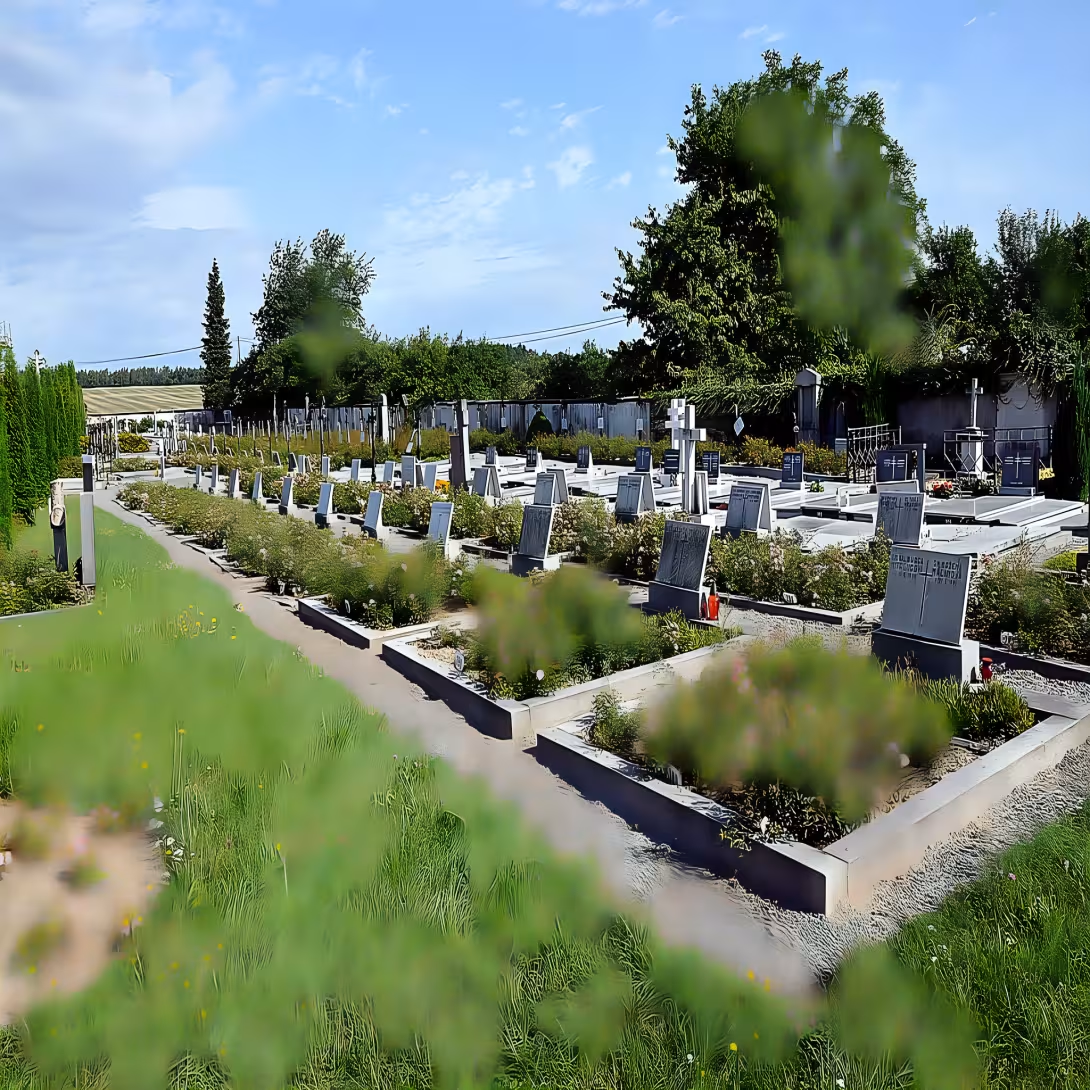
Hřbitov in White Water in the district of Jeseník is a classical burial ground which was declared a cultural monument of the Czech Republic in 2000. It is particularly remarkable as the last resting place of former owners of the local castle, members of the order of piarists and many sisters, which were interned here in the second half of the 20th century.
The history of the cemetery is closely linked to the events of 1950, when a woman's monastic synthema was abolished in Czechoslovakia. The Piarist monastery in White Water was subsequently designed for the elderly and the work of an incompetent sister. The first 148 beet trees arrived here on 28 September 1950. Over the years, up to a thousand nurses have been replaced from 14 different orders and congresses; 450 sisters lived here at the same time. This internment lasted until 2005, when the last sisters left the Vincent Order.
The Hřbitov is situated on the north edge of the village and has a cosdial plan. The whole area was surrounded by a low wall with an iron entrance gate. Near the entrance there is a cemetery chapel with a saddle roof and a sandbox. The chapel has an entrance with a segment enchantment oriented towards the main axis of the cemetery and a side facade with windows with a semi-round enchantment. The central part is dominated by two sculptures: a polychrome statue of the Victory Christ on a stage base and a classical cross with the crucified Christ on a high base. The green green is concentrated around the chapel and along the main axis.
The cemetery area includes marble tombstones of former castle owners, including the tomb of the rhythm master Louis Count d'Ambly, and tombstones of piarists and rectors of the college. A significant part is the graves of 700 nurses. These are arranged according to their order and show a specific method of adjustment.
In addition to religious and family graves, there are monuments of tragic events. Hřbitov contains a common grave of death victims from Auschwitz concentration camp in 1945. Two Soviet soldiers and one member of SS troops are buried in unmarked locations.
The current state of the monument is the result of extensive repairs. In 2010, a reconstruction of CZK 2,600,000 was carried out, financed by EU funds, the State Environmental Fund and the municipality. In 2014 another reconstruction of the cemetery and chapel from the Olomouc Region subsidy of CZK 300,000 followed.
Hřbitov in White Water serves as tangible evidence of religious oppression and a difficult period in the history of the country. Visiting this place offers insight into the fate of interned nurses and tragic events of the end of World War II.
Historical milestones
- 1950
- The arrival of the first nurses in White Water and the beginning of internment.
- 2000
- Declaration of the cemetery for cultural monument of the Czech Republic.
- 2005
- The departure of the last interned sisters from the Vincent Order.
- 2010
- Extensive restoration of the cemetery using both European and state resources.
- 2014
- Repair of the cemetery and cemetery chapel.
Architectural development
It includes a cemetery chapel with a saddle roof and a segmental enigma. The cemetery has a classic cross and a polychrome statue of Victory Christ. In 2010 and 2014, extensive reconstruction and repairs of the building took place.
Historical events
In 1950, women's monasteries were abolished and nurses were interned in White Water. In 2000 the cemetery was declared a cultural monument of the Czech Republic. In 2005, the last interned nurses left the Vincent Order.
Points of interest
- The burial ground in White Water is a classic monument, which serves as a resting place for former castle owners, piarists and many nurses. - In the cemetery, there are graves of up to 700 nurses, arranged according to their order. - Space contains a common grave of death victims from Auschwitz concentration camp in 1945. - In unmarked locations, two soldiers from the eastern state and one member of SS troops are buried. - The central part is dominated by two sculptures, namely a polychrome statue of the Victory Christ and a classical cross.
Guide
Show guide text
This text was created by artificial intelligence and has not been editorially reviewed. It may contain inaccuracies.
Welcome to White Water. You're standing just before the entrance to the local cemetery, which is much more than just a simple resting place. He is a silent witness to a stormy action, instead of deep sadness, but also immense faith and endurance. If you look around you now, you will see a space surrounded by a low wall that separates this sacred space from the outside world. Feel the peace and peace that rules here, and let us stop for a moment before we go deeper into the history of this place together.
Now let's look at how the people who are resting here today got to this cemetery. This place serves as a burial ground for different groups of people, each of whom brought a different story to White Water. Here you will find the graves of former owners of the local castle, who ruled and formed the social layer of the area in the past. Next to them, we will find piarists, spiritually educated men, who have left a mark in the region with their work and prayer. The whole area is connected to the history of the local estate and to the religious tradition that deep rooted in White Water.
Now pay attention to the architecture around you. Notice the cemetery chapel. It's a building that carries elements of Classicism, which you can tell by its purity, balance and moderation of shapes. Classicism tried to return to simplicity and harmony, which is very natural in this quiet environment. Also look at the polychrome statue of the Victory that stands in space. Its colorful design gives the place a certain dynamic element and reminds us of the victory of the spirit over death. The entire cemetery area has been carefully restored in recent years. In the year two thousand and ten there was extensive recovery using state and European resources, and in the year two thousand and fourteen the chapel itself was repaired to preserve itself for future generations. In the year two thousand the cemetery was officially declared a cultural monument of the Czech Republic, which confirms its high historical and artistic value.
Now, if we slowly move deeper between the graves, we'll come across one of the most moving parts of this place. Notice the tombs of the sisters. It's very distinctive here because up to 700 nurses were buried here. Their arrival in White Water began in a thousand and nine hundred and fifty years when they were essentially interned here. Imagine what it meant for these women to be in such a state, separate from the world, yet loyal to their profession. The sisters were arranged here according to their order, which creates an interesting system within the cemetery space. The last sisters of the Vincent Order didn't leave here until 2000. It's a place that talks about dedication and patience in times when religious life in our state was very complicated.
Among the personalities associated with this place, we can mention, for example, Louis d'Ambly, who is among those whose names are still listed here. Each of these graves is like an open book telling us about the people who lived in White Water, working and finally found their eternal peace.
Now I want to invite you to think about one very sad but important part of this cemetery. Notice the common grave of death victims from the year one thousand nine hundred forty-five. It's a place that confronts us with the darkest aspects of human history. The death march was the cruel end of World War II, when people were forced to walk for miles in utter exhaustion and fear. The fact that they are buried here together reminds us of the fragility of human life and the tragedy that has struck many innocent people. It is a place for silent prayer and respect for those who have never returned home from this march.
It's fascinating how different fates meet in this small space. On one side, we see the graves of the nobles and owners of the castle, on the other side of the order sisters who have spent decades here in isolation, and finally the victims of war terror. It's all connected within a single space that's now protected as a monument. This combination makes the White Water cemetery a unique place where the history of power, faith and suffering intersect into one whole.
Imagine what this place looked like ten years ago, before the big repair, and what it looks like today. Thanks to care and investment, today we can walk through the paths that are clean and see the chapel that shines its original beauty again. It's proof that even though the cemetery is a place of death, caring for it is an act of love and memory to those who are no longer with us.
Let us now quietly go through the rest of the cemetery. Note the details on the tombstones, feel the smell of the surrounding green and explore how the classical elements of the chapel match the surrounding landscape. Stop by the tombs of the sisters and think about their fates. If you're interested in the statue of the Victory, look at it from different angles and feel its colors.
I hope this short trip to history has helped you better understand the importance of this place. Hřbitov in White Water is not only a set of graves, but an archive of human lives that teaches us humility and respect for the past. Thank you for accompanying me on this walk. Now you can calmly continue your journey and discover the other beauty and mystery of this region. Goodbye.
Tips for visitors
The best time to visit is spring and autumn months, when nature's colour complements the atmosphere of a drinking place. Transport is possible by car and public connections; Check the current options in the search engine. For a visit we recommend to wear comfortable shoes suitable for the field and clothing appropriate to the respectability of the place. For photography are the best morning or late afternoon hours when low light highlights the details of the graves of former castle and nurse owners. In the immediate vicinity is the Castle in White Water, which is an ideal complement to the region's history. For families with children we recommend a visit as an opportunity to talk about the past and respect for the ancestors, while it is important for children to learn about silent behavior in the cemetery.
Frequently asked questions
Can the monument be visited?
Cemeteries and graves are usually accessible; please respect the dignity of the place. We have not verified the opening hours of this cemetery.
Why is the monument protected?
It is listed in the Central List of Cultural Monuments of the Czech Republic as a cultural monument (register no. 1000123993).
Businesses nearby
Do you run a restaurant, accommodation, shop, museum, rental, wellness or other visitor service near this monument? Show yourself directly to the people heading to it — this is how they will see you in the app and on the web:
Nearby
Zámek v Bílé Vodě.
Accommodation nearby
Themed route
Here is the design of the thematic route:
1. Castle in White Water (building) - The walk begins at this historical residence, which represents the architectural basis of the area. 2. Hřbitov (monument) - A visit to the main destination where local history and monuments of the deceased can be discovered in peace.
Seasonal recommendations
In spring, space awakens to life, underlining the contrast between flowering nature and the silence of graves. The light is fine and the air is fresh, which creates a sense of change and hope. We recommend moisture resistant shoes and a visit in the morning when dew is most visible on the grass.
Summer brings intense sun and deep shadows under old trees. The atmosphere is heavier and quieter, with greenery in full bloom. It is advisable to choose light, breathable clothes and a hat to protect from the jars. The best time to visit is shortly before sunset, when light is golden and lighter.
Autumn is the season of the highest atmosphere, when the fallen leaves form a colorful carpet on the road. Fog and grey skies highlight the piety of this place and give deep thought.
Winter turns the tomb into a quiet, freezing place where every sound sounds sharper. Snow often covers up the details of monuments, which creates a sense of purity and absolute peace. It is necessary to wear high-quality warm footwear with anti-slip soles and to dress in several layers of wool clothing.
Visualizations and artistic views

The visualisations are generated by artificial intelligence and serve as inspiration.
Photos from the area
Real photos taken near the monument


Zdroj a licence jsou uvedeny u každého snímku.
Tips from visitors
No tips yet. Be the first!
Log in and add your tip.
Sources and literature
Photos: Ben Skála, Benfoto / CC BY-SA 3.0, rozlišení zvýšeno umělou inteligencí — Wikimedia Commons. The author and licence also appear when you hover over the image.
Faktickým podkladem tohoto textu byl článek na Wikipedii, jehož autory jsou přispěvatelé Wikipedie. Článek je dostupný pod licencí CC BY-SA 4.0.
Location on the map
Příběhy a pověsti
Legendy, pověsti a příběhy spjaté s touto památkou
Fotografie návštěvníků
Zatím žádné fotografie. Buďte první, kdo přidá fotografii z návštěvy!
Log in a přidejte svou fotografii nebo hodnoťte.
Za ověřenou návštěvu v aplikaci získáte víc bodů — poznáme podle GPS, že jste na místě.
Reviews and comments