



Hrobka Pallavicinů s parkem Tomb
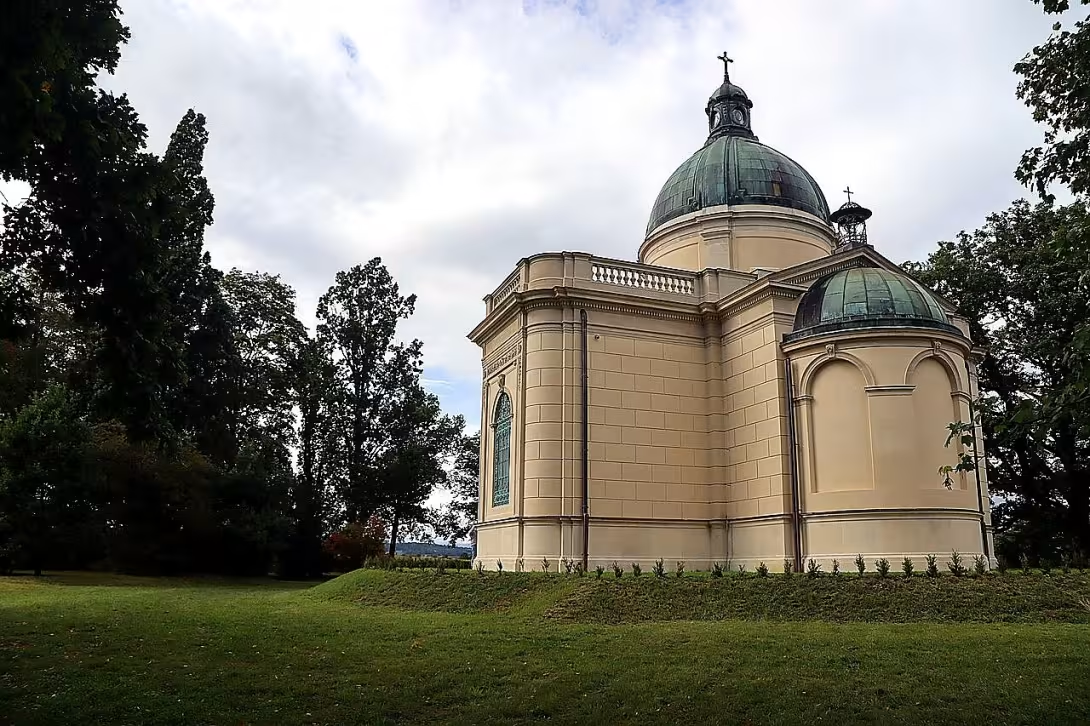
Hrobka Pallavicinů s parkem is a neoclassical funeral chapel built in the years 1901- 1902, located in a park 2.5 km north of Jemnice in the district of Třebíč. It served as the last rest of the Italian noble family of Pallavicini, who owned a fine castle between 1841 and 1945. Today the landmark is the property of the city Jemnice and is protected as a cultural heritage.
The history of the building is related to the arrival of the Pallavicini family into Jemnice, when the Margrave Alfons Pallavicini purchased the manor Jemnice-Old Hobzí from Terezia from Trauttmansdorff-Weinsberg in 1841 or 1842. Under the influence of his wife Gabriela, a large rebuilding of the castle grounds took place. The tragic death of Austrian-Hungarian diplomat Karl Pallavicini in January 1900 during a fox hunt in England inspired the position of the mausoleum which his mother wanted visible from the castle. The construction in 1901- 1902 was carried out by Alexandr Osvald markrabě Pallavicini.
The chapel was designed by Viennese architect Otto Hofer in the style of neoclassicism, after his death in 1901 she continued to design Wilhelm Zeeh. The construction was carried out by local craftsmen: Josef Faast and carpentry Jan Dvořák, Eduard Hauser and Andreas Francine led the masonry. The sculpture was designed by Vít Matoušek, Ignác Weirich and Johann Benk.
The building has a plan of an isosceles Greek cross with rounded corners. Above the crossing is a dome on a tambura with a pillar and lantern, which ends with a cross. The east end has a smaller ball in the front. The side spaces have a barefoot and a balustre attics. Crov consists of iron construction and the materials used include Italian marble and Lower Austrian sandstone.
The chapel stands on the terrace with six stone steps leading to it. Around the building there is a pavement made of granite, the entrance is decorated with columns and fronton with acantic resolution and letters APX. The statue of the Virgin Mary adorns the top of the front.
The interior contains one room with stone floor. There are statues of St. Alfonso and St. Charles Boromei by Ignac Weirich at the entrance. The central altar is decorated by the bronze sculpture of Christ on the cross with the inscription Consummatum est created by Weirich in Rome in 1902. The altar architecture is attributed to Joz Plečnik and the reliefs of four evangelists decorate the central part. Side spaces have segmental windows and white marble sarcophagus.
Originally eight members of the family were buried in the mausoleum, whose remains were embalmed by the doctor Josef Švedoda. The original tomb in Anyas was destroyed because of the tisa river flood. In the 20th century, the mausoleum suffered several robberies, while in 1991 sarcophagus were opened and bodies destroyed. The remains were later returned to the descendants of Hungary, where a new family tomb was built in 2013. Only the body of Countess Gabrielle Pallavicini remained in the fine chapel.
Mausoleum is surrounded by a park with a square plan and a wall with a grid fencing. In the east corner are the remains of the house of the caretaker, known as the grove house, designed by Wilhelm Zeeh.
The outer part of the tomb was reconstructed between 2020 and 2023, including roof cover, balustrad, plaster, plastering and stairs. The statue of the Virgin Mary was restored with a complete cross. Upon completion of the reconstruction, it is considered to make the building available and to set up an exhibition on the genus Pallavicini.
This monument represents a rare example of neoclassicist funeral architecture with high artistic value, which allows us to look into the history of the noble family and appreciate craftsmanship from the early 20th century.
Then and now
Drag the slider to compare how the landmark may have looked when it was built with the view today.
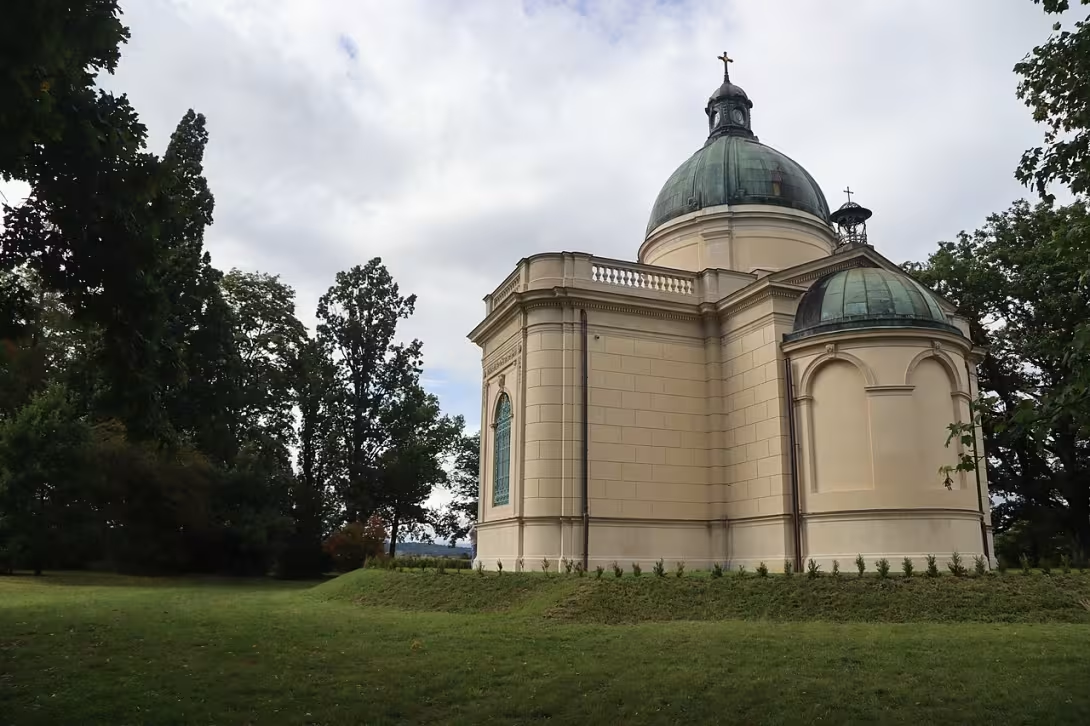

The historical appearance on the left is an AI-generated visualisation and serves as inspiration only.
Historical milestones
- 1901
- Construction of the family tomb according to the project from 1900.
- 1902
- Completion of construction of local craftsmen.
- 2001
- Serving the Holy Mass for the deceased in the presence of Alfonso Pallavicini.
- 2023
- Completion of reconstruction of plaster, plywood and stairs.
Architectural development
The chapel was built in neoclassical style using a third-mountain sandstone from Lower Austria and marble from Italy. Crov is made up of iron construction. The building is decorated with barefoot, balustre and sculptural decoration of Vít Matoušek, Ignatius Weirich and Johannes Benko.
Historical events
In 1900, Karl Pallavicini tragically died hunting in England, leading to the construction of a mausoleum. In 1954 and 1991, the tomb was robbed. In 2020- 2023 a gradual reconstruction of the external part of the construction took place.
Owners
Rod Pallavicini (until 1945), city Jemnice (current owner).
Points of interest
- The chapel served as the last rest of the Italian noble Pallavicini family. - To build the mausoleum was inspired by the tragic death of Austrian-Hungarian diplomat Karl Pallavicini during the fox hunt. - The altar architecture in the interior is attributed to architect Jožem Plečnik. In 1991, the sarcophagus were opened and the bodies were destroyed. - Only the body of Countess Gabrielle Pallavicini was left in the fine chapel after returning the remains to Hungary.
Guide
Show guide text
This text was created by artificial intelligence and has not been editorially reviewed. It may contain inaccuracies.
Welcome to Jemnice. You have just stopped in a place that requires not only a visitor's sight, but above all a moment of silence and inner peace. You are standing before the monumental tomb of the Pallavicini family, which dominates the whole area with its presence in this park. In front of your eyes is a building that is extremely dignified and at the same time noble. Feel the atmosphere of peace surrounding you while you look at this neoclassical entity, which stands here as a silent witness to ancient times and fates. Feel how this building floats over the earth and how its presence in this green environment creates space for memories and reflections about the fleeting of life.
Let us now return together to the time when this project began to be born. Imagine the year 1901, when the plans that were to change this part of the park were first implemented here. This tomb was not only built as an ordinary place to store the remains, but as a monumental expression of respect for one of the important Italian noble families, the Pallavicini family. The whole construction process lasted two years and was completed in 1902. But it is important to know that a deep personal tragic story is behind the creation of this place. The inspiration for this mausoleum was the sudden and unexpected death of Austrian-Hungarian diplomat Karl Pallavicini. His death during the fox hunt was such a profound shock to the family that they decided to create this dignified place that would forever resemble his name and the importance of his family. In this way, the tragedy has become the architecture that stands before you today.
Now pay attention to the architecture itself and to what you can see right now. Look at the overall structure of the building. Its neoclassicist style is evident in harmonious proportions and balances that trigger a sense of stability and eternity. If you look at the floor plan, which is typical of this type of chapel, you realize it's based on the shape of a Greek cross. This geometry adds a whole symmetry that your eye easily captures. Above your heads is a massive central dome, which is the top of the entire building. Note how the dome is finished with a lantern that is designed to bring light into the inner chapel. The whole building looks very firm and monumental. It is fascinating to realize that although the great architects Otto Hofer and Wilhelm Zeeh were behind the proposal, the actual implementation of this demanding work was entrusted to local craftsmen. It was in 1902 that their hands breathed the final form of this building. As time changes, the tomb remains. Before the recent completion of the reconstruction in 2023 you saw plastering, plastering and stairs in a different state, but thanks to this reconstruction we can now perceive the construction in today's, repaired and dignified form.
When you look at these walls, imagine people whose lives were inextricably linked to this place. This chapel served as a final rest for the Italian noble family of Pallavicini. There are names in her history that carry the weight of history. We're talking about Karl Pallavicino, whose fate resonates here, the Margrave Alexander Osvalvacini, or Alfonso Pallavicini. The history of this place is not just the history of stone, but the history of people. For example, in 2001, there was a holy mass for the deceased, which was attended by Alfons Pallavicini, which shows that this place remained a living point for the family even long after its creation. Every name you can find here is a chapter in the history of the nobility that has chosen its permanent residence here.
And now I want to invite you to think about one of the most interesting details that's hidden inside this building. Although the main project is attributed to the architects Hofer and Zeeho, there is an element in the interior that causes great fascination with all art lovers. The architecture of the altar inside the chapel is attributed to the famous architect Jožem Plečnik. Imagine the incredible connection - a monumental neoclassical tomb that carries a handprint of one of the most important architects in our countries. This idea gives the place another layer of mystery and artistic value to be perceived with respect.
I hope that this brief insight into the history of the Pallavicini tomb has interested you at least a little bit and helped you better understand the importance of this place. Do not be taken away from the building itself, but continue to walk through this park and feel the calm this place offers. This monument, which is today owned by the city of Jemnice, remains a living witness to ancient nobility and human destiny. I wish you a pleasant rest of your visit and other beautiful moments in this beautiful park.
Tips for visitors
The best time to visit the Pallavicine tomb is autumn or spring, when vegetation in the park is in full bloom and sunlight gives the chapel a romantic fate. Parks are usually calmer visited during these months, which allows you to enjoy a quiet atmosphere.
Transportation through the park is a beautiful way to get there.
When visiting, bring a hat or protective clothing against the sun or rain. Photos can be very attractive, so it is a good idea to bring a camera or a mobile phone with a good camera. In addition, you can also take a map of the park for better orientation.
Photography of the Pallavicin tomb offers the best possibilities at noon when the light is ideal for capturing architectural details of the chapel. The best places are usually at the west and north entrance, where the sun's rays are best reflected on the facade.
In the vicinity of the Pallavicin tomb you can visit the historical park with its beautiful garden and nice walking trails. It is advisable for families with children to plan a visit on Saturday or Sunday when various events and educational programs for younger people are often organised.
Frequently asked questions
Can the monument be visited?
Cemeteries and graves are usually accessible; please respect the dignity of the place. We have not verified the opening hours of this cemetery.
Where is the monument?
Location: Jemnice, Kraj Vysočina. The map on this page shows the exact spot.
Why is the monument protected?
It is listed in the Central List of Cultural Monuments of the Czech Republic as a cultural monument (register no. 1000126929).
Businesses nearby
Do you run a restaurant, accommodation, shop, museum, rental, wellness or other visitor service near this monument? Show yourself directly to the people heading to it — this is how they will see you in the app and on the web:
Nearby
The tomb is located in a park-modified area 2.5 km north of the city Jemnice near the road to Chotebudice.
Accommodation nearby
Trips and activities nearby
Guided tours, tickets and activities nearby from GetYourGuide
Affiliate link: if you buy from the partner, we may receive a commission. The price for you does not change.
Search tours and activities →Themed route
1. City Jemnice (Default Point) - Start your journey in this place, where you're going north. 2. Roads on Chotebudice (Route) - This path will take you about 2.5 km to the main monument. 3. Park modified area (Green space) - Explore the peaceful atmosphere of this area surrounding the destination of the trip. 4. Hrobka Pallavicinů s parkem (Chapel) (Main objective) - Visit this important monument and see its architecture.
Seasonal recommendations
Spring: During the spring season Hrobka Pallavicinů s parkem in Jemnice is strangely attractive with its flowering floral design and warm sunny days that illuminate the chapel and surrounding areas. Green tree leaves are finely coloured with new shoots and flowering bushes, creating a lively atmosphere full of hope. For the visit it is advisable to equip yourself with light clothes with the possibility to add a warm layer to colder days because temperatures can be variable. The best time to visit is at noon when the sun lights up the park and increases its beauty while avoiding the morning cold.
Summer: Summer season brings the Grave of Pallavicins with a park in Jemnice full of sunlight and long days, making it an ideal place for afternoon walks or relaxation on benches under the shade of trees. The park is full of people seeking refuge from the heat of the city, so avoid noon and you better visit in the morning or late afternoon to avoid crowds. Don't forget the sun protection and plenty of drinking water, because temperatures can be very high.
Autumn: In the autumn months Hrobka Pallavicinů s parkem in Jemnica gets melancholic beauty by coloring leaves that vary from living yellow and orange to deep red and purple. Sunshine days are warm, but in cold nights you need to be ready for falling temperatures. This time of year offers a quieter visit without large crowds, so you can enjoy mild weather and quiet moments in the park. We recommend wearing layered clothing to adapt to changing conditions.
Winter: Winter visit of the Pallavicine Tombs with the park is special thanks to the quiet environment when the trees are without leaves and the chapel is hidden under the snow coat. Sunlight creates a beautiful contrast with pale colours of winter, giving the park a melancholy but attractive atmosphere. The park is less visited, so it offers a quiet visit without crowds. When planning a winter visit, choose warm clothes and wind protection as the park is often closed in the evening and temperatures can be very low.
Visualizations and artistic views


The visualisations are generated by artificial intelligence and serve as inspiration.
Photos from the area
Real photos taken near the monument


Zdroj a licence jsou uvedeny u každého snímku.
Tips from visitors
No tips yet. Be the first!
Log in and add your tip.
Sources and literature
Photos: Jiří Sedláček / CC BY-SA 4.0 — Wikimedia Commons. The author and licence also appear when you hover over the image.
Faktickým podkladem tohoto textu byl článek na Wikipedii, jehož autory jsou přispěvatelé Wikipedie. Článek je dostupný pod licencí CC BY-SA 4.0.
Location on the map

Příběhy a pověsti
Legendy, pověsti a příběhy spjaté s touto památkou

Fotografie návštěvníků
Zatím žádné fotografie. Buďte první, kdo přidá fotografii z návštěvy!
Log in a přidejte svou fotografii nebo hodnoťte.
Za ověřenou návštěvu v aplikaci získáte víc bodů — poznáme podle GPS, že jste na místě.
Reviews and comments