



Jadrníčkova vila Villa
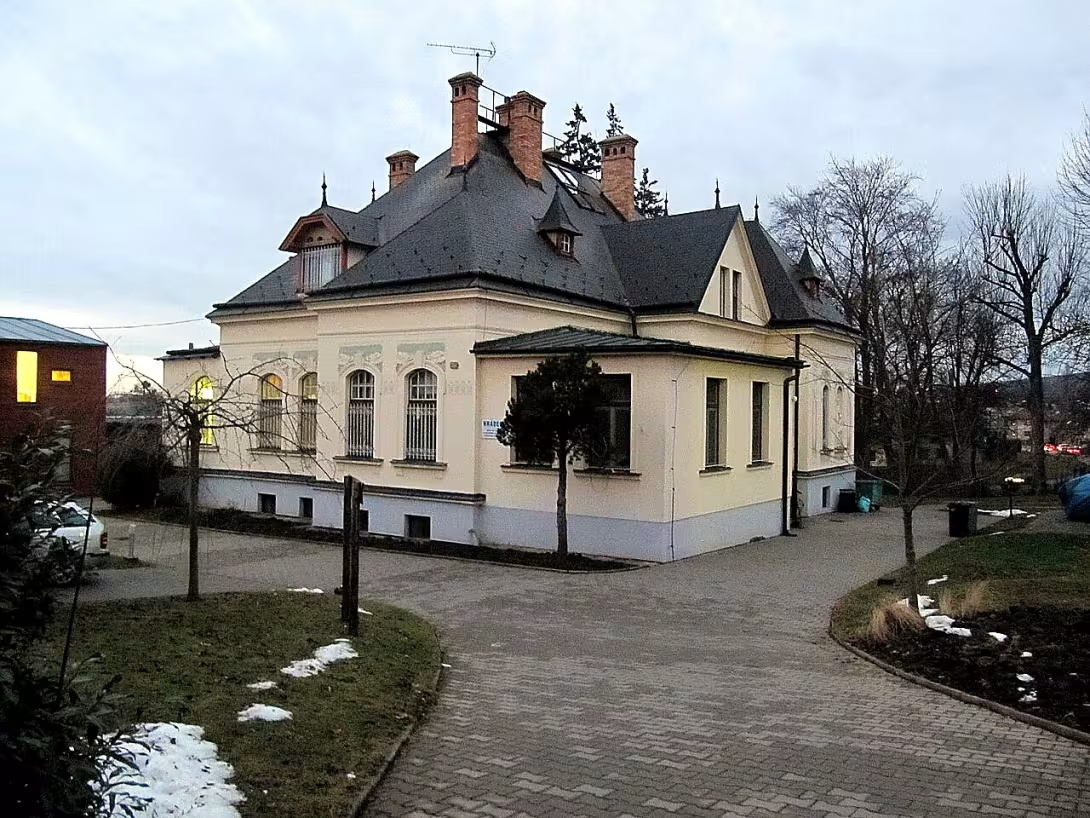
Jadrníčkova vila is an Art Nouveau building from the beginning of the 20th century in the street Na Hradek in the village Fryšták. The building is important in its architectural design and has been protected as a cultural monument since 1997.
The villa was built for the family of Jadrníčková in 1910, although on the facade there is a roasting of Villa Rozena 1912. The building comes from a period of expansion of the European Art Nouveau, which placed emphasis on decorative and organic shapes.
The construction stands on a narrow plot and has a square plan. The facades made of light yellow plaster with grey plinth complement green and red decorative elements. Segment-sealed windows are placed in shambas with ears, a jewel in the top and a floral decoration in the suprafenestra. The Valb roof was originally covered with green glazed bobbies and red wooden roof elements. On the facade there was a previously visible relief peacock, which now covers attached staircases.
The interior of the villa was a two-storey staircase hall with wooden staircase and gallery. The space was illuminated by a ceiling glass grid. In almost original condition, the guest room was preserved in the style of a peasant scar and library with original forging and Art Nouveau panelling made of light wood.
In 1946, the villa underwent structural modifications for static reasons. They removed the tower with an open view and originally the two-storey hall was horizontally divided by the ceiling. However, the upper part of the hall and the ceiling skylight were preserved in their original form.
Currently the object serves as a stationary for clients with disabilities. In 2023 a modern, wood-lined extension was attached to the villa, which increases the capacity of the facility.
Jadrníčkova vila represents a valuable example of regional Art Nouveau architecture with preserved interior details. Her visit allows an insight into the aesthetics of the early 20th century.
Historical milestones
- 1910
- Building a villa for the family of Chest
- 1912
- Arrival on the facade Villa Rozena
- 1946
- Construction and removal of towers
- 1997
- Protection as a cultural monument
- 2023
- Opening of modern wooden extension
Architectural development
Originally an Art Nouveau villa with a tower and a two-story hall. In 1946, the tower was removed and the hall was divided horizontally. In 2023 a modern wooden extension was added to the building.
Historical events
In 1946, construction modifications were made for static reasons. In 1997, the building was declared a cultural monument. In 2023 a modern wooden extension was opened.
Owners
The family of Chestnut (since the beginning of the 20th century).
Points of interest
- The construction from 1910 has on the facade mentioned the roasting of 1912. - There used to be a relief peacock on the facade, which now covers attached staircases. - The building preserved a guest room in the style of a peasant scar and a library with original panelling. In 1946, a tower with an open view was removed from the building. - The building serves as a stationary for disabled clients today.
Guide
Show guide text
This text was created by artificial intelligence and has not been editorially reviewed. It may contain inaccuracies.
Welcome to Fryšták. You're standing in front of a building that tells the story of ambition, family happiness and constant changes in time. In front of you is Jadrníčkova vila, a permanent witness to the history of this city, which, by its form of perceptive style of the early twentieth century, still attracts the attention of bystanders. If you look at it now, you'll see a building with a square plan that naturally fits into the narrow terrain on which it stands. It's a place where the elegance of the old days joins practical adjustments to the new times.
Let us now stop at how this building was built and for whom it was intended. At the very beginning of the twentieth century, namely in the year of the nine-ten, this villa was built for the family of Jadríček. At that time, it was customary for successful families to build homes that not only served for living, but also expressed their social status and taste. They built their own family nest here when new decorative directions were being promoted in architecture. Although we do not know exactly who was the author of the project today, it is clear that the builders wanted to create something extraordinary that would stand out in the surrounding landscape.
Now pay attention to the architecture itself and the details that you can observe right in front of you. Note the characteristic elements that are typical of the Art Nouveau period. Look at the windows that are segmented, which means they have a round top. These details provide the building with its lightness and specific rhythm. Look at the facade and feel the decorative elements that decorate the facade. Although the building has undergone several modifications over the years that have changed its original face, the charm of the old school is still there. If you look at the newer parts, you will see a modern wooden extension from the year two thousand twenty-three, which shows how the historical substance can intersect with modern materials and the needs of the present.
When we think about the people who lived here, let's think about the family of the pomegranates. For them, this villa was the center of their world. Imagine how the family celebrations were held here or how the books were printed in the library silence. Although today the building serves as a stationary for clients, traces of indigenous people are still preserved within it. If you had the opportunity to look inside, you would find a guest room that is still preserved in the form of a peasant scar, which is a very rare element in such a city house. Just as fascinating is the library with the original panelling that transmits us directly into the atmosphere over a century ago.
Now I want to take you to a few interesting things and little mysteries that relate to this villa. Look carefully at the facade. Notice the growling. You will see the year nine hundred twelve and the name Villa Rose. And this is where the first little mystery begins. According to historical records, the construction was built in the year nine hundred and ten. So why is there a date on the house two years later? Perhaps it was the date of completion of the internal work, or perhaps the ceremonial initiation of the house that took place later. It's a little detail that makes us think about how the construction was being completed at the time.
Another secret is hidden in a place you can't see anymore. Notice the staircase that brings visitors to the building. Did you know that this very staircase is covering something very beautiful today? Previously, there was a relief peacock on the facade, which was a symbol of beauty and elegance. The peacock was a very popular motif in the Art Nouveau period. Unfortunately, due to later modifications, he hid behind a new structure, but in our imagination we can still see him as an ornament to this house.
One more major change happened in nine hundred and forty-six. If you're looking at the silhouette of the villa right now, maybe it feels like something's missing. And you're right. At that time, a tower with an open view was removed from the building. Imagine what an experience it must have been to go up to the tower and look around Fryšták. Removing the tower has fundamentally changed the appearance of the house, but it was also part of the larger building modifications that took place in the middle of the century.
So the villa went a long way from the family residence to the period of great changes to recognition as a cultural monument, which occurred in the year nine hundred and ninety-seven. This means that the state recognised its historical and architectural value and decided to protect it for future generations. It's fascinating to see one building adapt to the times. From the luxury living of the Jadrníčková family to the removal of the tower to today's use as a stationary where the building still serves and provides shelter to people.
Now, if you look again at the overall form of the villa, try to combine all these fragments. You see segmental windows, you see the sloping surface, you imagine the peacock relief hidden behind the stairs, and the missing tower that once reached the sky. This building is not just a pile of bricks and mortar, but a living organism that breathes through history. It is an example of how in a small town like Fryšták preserved traces of great architectural style.
I hope this short trip over time helped you better understand what you're seeing right now. Jadrníčkova vila is a place where the elegance of secession meets practical modern and where every detail tells its own story. Now you are invited to explore the surroundings in peace, to perceive the atmosphere of this place, and perhaps in your mind you have tried to complete the missing tower or peacock ornament on the facade.
Thank you for your attention and I wish you a pleasant further journey along Fryšták. Don't forget to notice other details in the area, because history is often hidden in the smallest things that we miss at first sight. Goodbye.
Tips for visitors
The best time to visit is late spring or summer, when the surrounding green beautifully complements the details of Art Nouveau architecture. The building stands on a narrow plot, which offers interesting points of view.
We recommend to travel by car or use public transport to the place; Check the specific connection and stop options in the current search engines.
We recommend that you wear comfortable shoes suitable for hilly terrain so that you can get around the house better.
For the best photos we recommend to come in the morning or late afternoon lights that highlight the plastic elements of the facade. The most interesting pictures will come from lower points of the sloping plot.
Families with children can use walks around the villa to observe old architectural details and search for decorative elements on the facade.
Frequently asked questions
Can the monument be visited?
This is a residential or farm building, not a museum with opening hours. Please view it from public space and respect the owners' privacy. We have no information about access to the interior.
Where is the monument?
Location: Fryšták. The map on this page shows the exact spot.
Why is the monument protected?
It is listed in the Central List of Cultural Monuments of the Czech Republic as a cultural monument (register no. 1000124004).
Businesses nearby
Do you run a restaurant, accommodation, shop, museum, rental, wellness or other visitor service near this monument? Show yourself directly to the people heading to it — this is how they will see you in the app and on the web:
Nearby
🏰 Historic sites (221)
- Busta Břetislava Bakaly 0.2 km
- Socha sv. Jana Nepomuckého 0.2 km
- Busta Jaroslava Kvapila 0.2 km
- Busta Ignáce Stuchlého 0.3 km
- Památník obětem světové války 0.4 km
- Pomník padlým v 1. sv. v. 1.9 km
- Muzeum lidových řemesel 2.0 km
- Pomník T. G. M. 2.0 km
- Pomník Ireny Veselkové 2.6 km
- Zámek Lešná 2.9 km web
- Památník obětem světových válek 3.2 km
- Pomník Karla Galíka 3.2 km
- Památník obětem světových válek 3.5 km
- obětem 1. světové války 3.5 km
- Socha sv. Jana Nepomuckého 4.0 km
- 1945 4.2 km
- Tanečnice (obléhací bašta) 4.3 km
- JUDr. Joseph Ctirad Vrána 4.3 km
- 1914 - 1938 4.3 km
- Zřícenina hradu Lukov 4.5 km web
🍽️ Restaurants and dining (391)
- Pizzeria U Fíka 0.2 km web
- Veka 0.2 km
- DIS 0.3 km P. I. Stuchlého 27
- Restaurace Continent 0.3 km
- U Žáků 0.5 km
- Lepa 0.9 km
- Šenk 1.6 km
- Občerstvení u vody 2.4 km
- Farma u Koaly 2.4 km
- Kookabura 2.4 km
- Neapolitano 2.7 km
- Mopani bar 2.9 km
- Lešná 2.9 km
- Tyrolský dům 2.9 km
- Limpopo 3.0 km
- Limpopo 3.0 km
- Pizzerie U ledňáčka 3.4 km 777 20 30 41 web
- Restaurace U Komendů 3.5 km web
- U Staňků 3.6 km
- Lázně Zlín-Kostelec 3.8 km
🏨 Accommodation (77)
- Penzion 66 1.5 km
- penzion Silvie 3.5 km
- Tuskulum 4.3 km
- AfricaHouse 4.4 km +420 737 212 395 web
- Penzion U Ráztoky 5.5 km
- U Kůlu 5.5 km
- Marek Horák 5.6 km
- RZ ČS Rusava 5.7 km web
- RS Jestřabí 6.0 km web
- Apartmány Rusava 6.0 km web
- Elko 6.2 km
- Saloon 6.2 km
- Hotel Rusava 6.3 km
- Nad přehradou 6.4 km +420 603 238 776 web
- Apartmán Úlehla 6.4 km Úlehla 684 +420735106046 web
- Baltaci 6.4 km
- Ondráš 6.7 km
- Sole 6.7 km
- Sportovní hala Zelené 6.8 km
- Oneness Centrum 7.1 km
🚲 Rentals and sport (45)
- Sokol 0.2 km
- Lanové centrum 2.4 km web
- Koupaliště 6.1 km
- Emseko bike 6.2 km
- HUDY sport Zlín 6.5 km
- Stolní tenis 6.6 km
- Vertikon 6.6 km web
- Husky 6.6 km
- Intersport 6.6 km
- TK Fortuna 6.7 km
- MOUNTAIN SPORT 6.8 km
- Kuci 7.1 km web
- Lázně Zlín 7.3 km
- Tenis badminton 7.5 km
- COVER SPORToutdoor activities 7.6 km
- Sport365.cz 7.7 km
- Sportovní hala Novesta 7.8 km
- Sokolovna 7.9 km
- Online-sport.cz s.r.o. 8.0 km 577 440 151 web
- BIKEMAX 8.1 km
🥾 Hiking and nature (250)
- studánka Alenka 1.8 km
- Ovčírna 2.3 km
- Vodní ptactvo 2.4 km
- Jihoamerické ptactvo 2.4 km
- Papoušci kea 2.4 km
- Ara 2.4 km
- Kivi 2.4 km
- Chápani 2.4 km
- Kotulové 2.5 km
- Australské ptactvo 2.5 km
- Klokani 2.5 km
- Labutě černé a pelikáni australští 2.5 km
- Psi novoguinejští 2.5 km
- Kasuáři 2.5 km
- Zoborožci 2.5 km
- Kapybary 2.6 km
- Asijská step 2.6 km
- Čertovy skály 2.6 km
- Tygři 2.6 km
- Jaguar trek 2.6 km
Accommodation nearby
Trips and activities nearby
Guided tours, tickets and activities nearby from GetYourGuide
Affiliate link: if you buy from the partner, we may receive a commission. The price for you does not change.
Search tours and activities →Themed route
Here is the route design for the tour of the main object:
1. Jadrníčkova vila (building) - The main destination of the journey where you can admire the architecture and history of this house. 2. Villa area (outdoor area) - Walk in the immediate vicinity of the house, which allows you to perceive the atmosphere of the whole building. 3. Interior of the villa (interior) - A tour of rooms and rooms that reveal the way of life in this monument.
Seasonal recommendations
In spring, the surroundings of the villa awaken to live colours and fresh greenery, which beautifully complements the appearance of the building. The best time to visit is in the morning when light is soft and natural. We recommend shoes suitable for wet grass and a light jacket against the wind.
In the summer months, the atmosphere is dominated by bright sun and hot air, which highlights the details of the facade. It is advisable to come in early morning or late evening to avoid the greatest heat. Don't forget the cap and comfortable summer clothes.
Autumn brings golden shades of leaves and melancholy mood to Fryšták, which approaches the historic house. A tour from the outside is the most beautiful time in the setting sun that casts long shadows. Practical is layered sky and waterproof footwear.
Zimą operates a villa in a quiet and quiet environment, often covered with snow or freeze. The atmosphere is cramped and mysterious, especially in short days of advent time. It is necessary to wear warm winter clothes, gloves and a firm sole to safely move around the house.
Visualizations and artistic views

The visualisations are generated by artificial intelligence and serve as inspiration.
Photos from the area
Real photos taken near the monument

Zdroj a licence jsou uvedeny u každého snímku.
Tips from visitors
No tips yet. Be the first!
Log in and add your tip.
Sources and literature
Photos: palickap / CC BY 3.0 — Wikimedia Commons. The author and licence also appear when you hover over the image.
Faktickým podkladem tohoto textu byl článek na Wikipedii, jehož autory jsou přispěvatelé Wikipedie. Článek je dostupný pod licencí CC BY-SA 4.0.
Location on the map
Příběhy a pověsti
Legendy, pověsti a příběhy spjaté s touto památkou
Fotografie návštěvníků
Zatím žádné fotografie. Buďte první, kdo přidá fotografii z návštěvy!
Log in a přidejte svou fotografii nebo hodnoťte.
Za ověřenou návštěvu v aplikaci získáte víc bodů — poznáme podle GPS, že jste na místě.
Reviews and comments