



Janákova vila (Pelhřimov) Villa
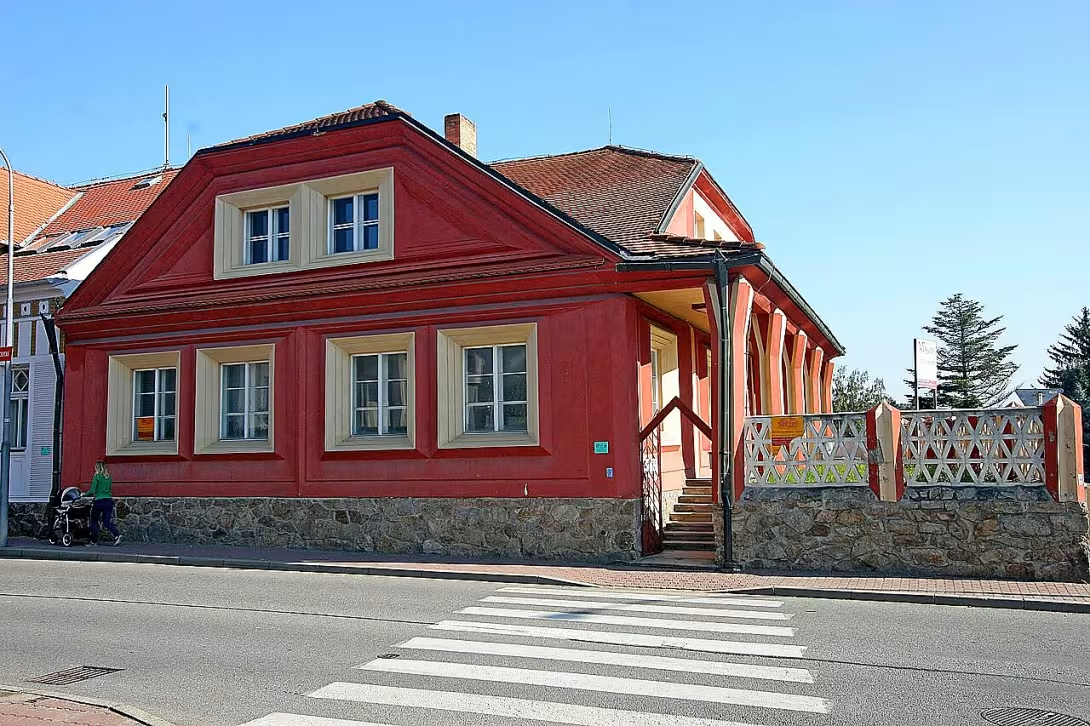
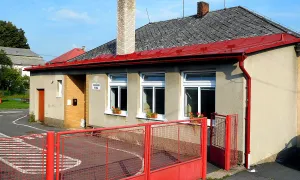
Janák's villa, also known as Vila Jan Drechsel, is a cubist building located in Pelhřimov at Strachovská 331, outside the historical centre of the city. It was created in 1912 and 1913 according to the design of architect Pavel Janák for the then Pelhřimovský district supervisor and local council Jan Drechsel. It is one of the two preserved cubist objects in this city, defining the important local tradition of avant-garde architecture of the First World War.
The foundation of the villa is connected with the stay of architect Pavel Janák in Pelhřimov, where he was invited by teachers Karel Polesný, who was in contact with the upcoming generation of modern architects. Based on Janák's project, the local bricklayer Karel Postránecký built an elegant one-story villa in a purely cubist style between 1912 and 1913. The construction was created during the period when the Czech region was a part of Austria-Hungary and went through the phase of intense cultural and artistic flowering. Cubism as an avant-garde direction was gaining popularity and Janák was one of his leaders. At the same time, Europe was approaching the First World War, which fundamentally changed the political and social situation in the region in the coming years.
The architecture of the building is based on a purely cubist solution with sophisticated details. The red-brown building with almost square ground plan has four windows on the facade with ochre yellow, inclined edge. The color of the house facade is proof of Janák's interest in the colour of the cubist building. Two combined windows of similar type are also placed in broken shields. The dominance of the exterior is an indoor terrace consisting of five cross-shaped columns which extend to the characteristic cubist chalices at the top. Similarly profiled columns carry a small front garden fence whose overall image of vertical, horizontal and diagonal lines resembles a crystal grid. Even small elements such as handles or gutters are cubistically shaped. The colour of the facades and overall exterior appearance contradict the sober arrangement of the interior. The representative rooms on the ground floor - the dining room and living room - are oriented towards the street, the bedroom facing the garden. On the ground floor there was also a guest room, kitchen and bathroom. The entrance area of the corridor connects the staircase to the first floor where two other rooms were located.
The original owner and investor was Jan Drechsel, who was one of the key figures of the local administration in the position of district supervisor and local council. The basis does not provide information about other owners or dramatic changes in ownership during the 20th century, so the fate of the building after 1913 is not fully documented from available sources.
Among the key attractions are the fact that the villa is one of two preserved cubist realizations in Pelhřimov; The second is the Fár house from 1914, standing at Masaryk Square in the city centre. Janák's villa thus documents the exceptional concentration of this style in a small town in Vysočina. Specific details - red-brown façade, yellow ochre window frame, five columns with chalices on the terrace and crystalline structured fence - form a file in which the architectural motif is repeated throughout the property and illustrates Janák's consistent approach to decoration and utilitarian elements.
Today, the construction stands at the original location in Strachovská Street, separated from the density of the historical centre. Its value lies in the authentic preservation of the cubist expression in both massive and detail, which makes it a rare example of Czech modern architecture before the war. The visit allows direct confrontation with the work of one of the fathers of Czech cubism in the context of a smaller regional centre, where the second Janakov trail in the form of the Faeroe House can be explored nearby.
Historical milestones
- 1912
- Opening of the building of the villa according to the design of Pavel Janák
- 1913
- Completion of the Cubist villa for Jan Drechsel
- 1914
- The creation of the second cubist object in PelhřimovA (Faar House)
- 1918
- Establishment of Czechoslovakia, change of political regime
- 1948
- Communist coup, possibly nationalization of private property
- 1989
- Velvet Revolution, launching restitution processes
Architectural development
The construction was designed by Pavel Janák and realized by Karel Postránecký in purely cubist style. The facade is red-brown and decorated with yellow ochre windows, while the terrace is supported by five crucially profiled columns that spread to cubist chalices at the top. The interior is sober, with representative rooms oriented towards the street and garden. The entire object is surrounded by a fence with vertical, horizontal and diagonal lines resembling a crystal grid.
Points of interest
- Janák's villa is one of the two preserved cubist objects in Pelhřimov, the other is the Para house from 1914 in Masaryk Square. - The construction was built in the years 1912 and 1913 according to the design of architect Pavel Janák for the then captain and counsel of John Drechsel. - It is one of the two preserved Cubist realizations in Pelhřimov, which defines the important local tradition of avant-garde architecture of the First World War. - The architecture is based on a purely cubist solution with details such as red-brown construction, square floor plan and four windows with yellow ochre and inclined sides.
Guide
Show guide text
This text was created by artificial intelligence and has not been editorially reviewed. It may contain inaccuracies.
Welcome to Pelhřimov, the city that will guide you through extraordinary architecture today. Right now, you're standing in front of one of the most distinctive houses in the city. Stop for a moment, take a breath and look straight ahead. You see the building that immediately caught your eye with its colour and shapes? It's Janak's villa. Note the deep red-brown façade, which in contrast to the surrounding area seems very confident and at the same time elegant. It's a building that refuses to be just an ordinary house. It's basically a geometric image in space. Look at its overall form. It is a single-storey object that carries the unrest and energy of the early twentieth century.
Let us now move back more than a hundred years in time. Imagine 1912. The world was different then, but there was a big break in architecture. It was this year that the building of this villa began. The author of this bold design was the famous architect Pavel Janák. Janák was not just a builder, he was a visionary who wanted to bring new dynamics and modern thinking into architecture. The villa was not created just for the pleasure of the architect. It was custom-built for a very important man of the time, District Chief John Drechsel. Jan Drechsel was in Pelhřimov a respected personality, board and official, and wanted to have a housing that would discourage his position but also his taste for new, modern solutions. The construction was completed in 1913 and has since become a silent witness to everything that has happened in the region.
Now pay attention to the architecture itself. If you look closely at the walls and the details, you will see that there is no right angle in the sense that we are used to ordinary houses. This villa is a representative of cubism. You may have heard about this word in connection with painting, but in the Czech Republic, cubism has uniquely entered construction. Notice the distinctive geometrical decoration. Look at the lines that form the facade. They're clean, sharp, and they remind you exactly of crystalline shapes. That's where the magic of this building lies. Janák wanted the building not to be flat and boring, but to play light and shadow on these edges to create constant movement. Feel how red-brown color changes depending on how the sun hits it. The whole house is a combination of color and original details that make it a real piece of art. It's an architecture that speaks the language of mathematics and geometry, but at the same time you feel a human hand and a desire for beauty.
This villa is not only a beautiful object, it is also a symbol of a certain era. Jan Drechsel, for which it was built, found a refuge in it that matched his ambitions. Imagine how visits took place here in the first years of existence, as discussed in the policy and administration of the district. The villa thus associated the world of high-level civil engineering with the world of state-of-the-art art. But the history of the villa is also the history of our state. Shortly after it was completed, the First World War came and in 1918 a separate Czechoslovakia arose. The political regime changed, the society changed, but Janák's villa continued to stand and provoked the conservative surroundings with its modernity. Later, in 1948, a communist coup came. That was the time of great change and fear. Many private assets were nationalized at the time, i.e. taken over by the State. It is very likely that this villa, too, has felt the effects of this regime and has ceased to serve as a private home for the governor. It must have survived decades in a system that has often suppressed modern individuality. Only in 1989, when the Velvet Revolution came, things began to happen again. The recovery processes of the original owners or their heirs have been launched, which in many cases has helped to save these unique buildings.
Now I want to impress you with one interesting thing that makes this villa a real treasure. Notice how many old houses are in Pelhřimov, but how many of them look like this? The answer is, almost none. Janák's villa is one of the only Cuban buildings in the city. The second building is Fár's house, which was built a year later in 1914, and is located in Masaryk Square. Imagine it as a couple of rare jewels in the crown of the city. The fact that these two objects have survived in Pelhřimov underlines the huge importance of modern architecture in this region. This is proof that even in smaller cities there was a very progressive thought and was not afraid to experiment with new shapes. It's a little architectural mystery why you're just building two such brave houses in such a short time span. Perhaps it was the influence of Pavel Janák himself, or the courage of the owners at the time who wanted to be the first to bring a new era to their city.
Now that you're standing in front of this red and brown construction, try to imagine what role she played in the lives of the people who lived and worked in it. See the clean lines and the geometrical edges? These are traces of one of the best Czech architects who wanted to change the way we perceive space. The villa is not just a pile of bricks and plaster, it is the embodied idea of a modern world, of order and beauty that stems from mathematical precision.
Before we say good-bye and you go on, I suggest you take another look at the whole facade. Try moving slowly from left to right and see how the geometrical detail changes. Feel the atmosphere of the place and think about how many generations of people have passed around this villa and how many stories these walls have hidden. Janák's villa is a silent but proud witness to a century of storms, wars and hope.
Thank you for stopping by this unique piece of architecture. I hope this short journey into the world of cubism and history of Pelhřimova interests you. Now invited to further explore the city. If you have time, don't forget to visit the House of Fár in order to compare these two rare objects. I wish you a pleasant walk and many other discoveries in our beautiful city. Goodbye.
Tips for visitors
The best time to visit is early morning or late afternoon when light is soft and highlights geometric details of the red-brown facade. There are also fewer visitors in these hours, which allows for a quieter tour of the interior and exterior.
The location is available by car and public transport, check the current connection in the search engine or on the carrier's timetable.
Take with you comfortable shoes suitable for walking on uneven surface, sun protection (hat, sunscreen), water bottle and possibly a camera or mobile with sufficient memory for façade images and surrounding details.
For photography, choose the places of the front facade and corner of the street overlooking Masaryk Square, where the light in the morning or late afternoon creates interesting shadows and highlights cubist elements. Avoid direct midday sun, which can cause hard shadows and lose fineness of ornaments.
Within 30 minutes of the villa, you can visit the historical centre Pelhřimova with Masaryk Square and Fár House - the second cubist building in the city. In the surroundings there are also a number of smaller historical buildings and natural landscape Vysočina, which offers quiet routes for walks and the possibility of observing local flora and fauna.
For families with children it is advisable to prepare a simple game to search for geometric shapes on the facade, to take with you a notebook for drawing and crayons so that children can record their observations. It is recommended to plan more frequent rest and snack breaks to keep the trip pleasant even for the smallest visitors.
Frequently asked questions
Can the monument be visited?
This is a residential or farm building, not a museum with opening hours. Please view it from public space and respect the owners' privacy. We have no information about access to the interior.
Where is the monument?
Location: Pelhřimov, Kraj Vysočina. The map on this page shows the exact spot.
Why is the monument protected?
It is listed in the Central List of Cultural Monuments of the Czech Republic as a cultural monument (register no. 1000125317).
Businesses nearby
Do you run a restaurant, accommodation, shop, museum, rental, wellness or other visitor service near this monument? Show yourself directly to the people heading to it — this is how they will see you in the app and on the web:
Nearby
V okolí vily se nachází historické centrum Pelhřimova s Masarykovým náměstím, kde stojí Fárův dům – druhá kubistická stavba v městě. Do 5 km leží také řada menších historických objektů a přírodní krajina Vysočiny, která poskytuje klidné prostředí pro procházky.
Accommodation nearby
Themed route
Thematic cruise route from Pelhřimova
1.Janákova vila (Pelhřimov) - Villa The main objective of this route is Janák's villa, an architectural pearl located in Pelhřimov. It is an example of modern design from the beginning of the 20th century and is worth visiting thanks to its unique construction and historical importance.
2. Masaryk Square - Historical Center About 500 metres from Janák's villa is the Masaryk Square, the heart of Pelhřimova. This place is ideal for exploring historic buildings and the city's atmosphere. Here is the house of Fár, the second cubist building in the city, which adds architectural interest to the centre.
3. Para House - Cuban Construction On Masaryk Square is the house of Fár, which is one of the most famous cubist buildings in the Czech Republic. It's a role model for 20th century architecture and art lovers. His visit offers a view of a unique style that influenced many other buildings in the region.
4. Walk in Highlands - Natural Landscape After exploring the historical centre, it is recommended to take a short walk around the surrounding natural landscape of the Highlands. This area offers a quiet and comfortable environment, ideal for relaxing and enjoying the rural climate. It's a great way to disconnect after visiting the city's sights.
5. Historical Objects around Pelhřimova - Local attractions In the area around Pelhřimova you can find a number of smaller historical objects that are important for understanding local culture and history. These places provide insight into life in the region over the past centuries and are worth visiting for interested people about history.
This route offers a combination of architectural art, history and nature, making it ideal for a day trip to Pelhřimova.
Seasonal recommendations
In the spring, Janák's villa shines with fine light, leafy trees begin to bloom, and fragrant flowers create a calm atmosphere. It is recommended to come in the morning when the crowds are still small, and wear a light top layer and comfortable shoes suitable for wet soil.
During the summer season, strong sunlight brings bright eyes and lush green, creating a vibrant and energetic atmosphere. The best thing to do is to leave early in the morning to avoid crowds, and wear a hat, sunglasses and breathing clothes that protect from heat while allowing comfortable movement.
Autumn colours appear in Janák's villa with golden and red leaves, slowly falling to the ground, which gives the place a poetic and peaceful atmosphere. It is convenient to visit in the late afternoon when the crowds decrease, and dress in warmer layers such as sweater and scarf, so that it is comfortable to walk through colder days.
In winter, Janák's villa is presented with light, but slightly scattered light and bare branches, which highlight a quiet and calm atmosphere.
Visualizations and artistic views


The visualisations are generated by artificial intelligence and serve as inspiration.
Photos from the area
Real photos taken near the monument


Zdroj a licence jsou uvedeny u každého snímku.
Tips from visitors
No tips yet. Be the first!
Log in and add your tip.
Sources and literature
Photos: Petr1888 / CC BY-SA 4.0 — Wikimedia Commons. The author and licence also appear when you hover over the image.
Faktickým podkladem tohoto textu byl článek na Wikipedii, jehož autory jsou přispěvatelé Wikipedie. Článek je dostupný pod licencí CC BY-SA 4.0.
Location on the map

Příběhy a pověsti
Legendy, pověsti a příběhy spjaté s touto památkou
Fotografie návštěvníků
Zatím žádné fotografie. Buďte první, kdo přidá fotografii z návštěvy!
Log in a přidejte svou fotografii nebo hodnoťte.
Za ověřenou návštěvu v aplikaci získáte víc bodů — poznáme podle GPS, že jste na místě.
Reviews and comments