






Kadov Granary
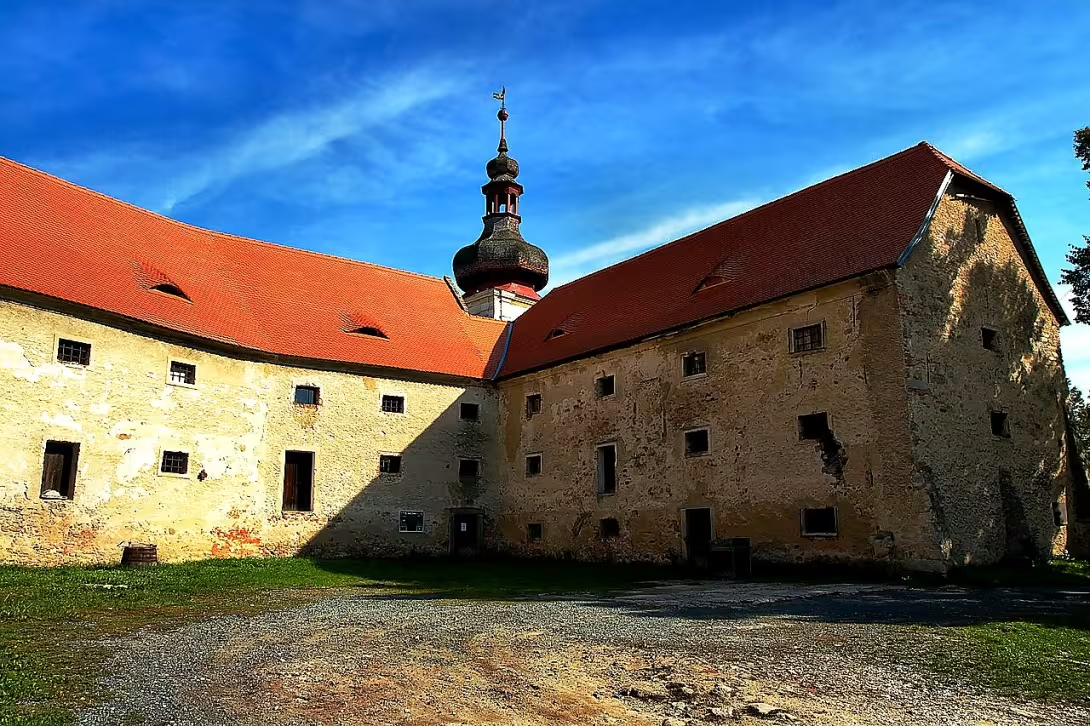
Kadov is a fortress converted into a granary in a village of the same name in Strakonice district. From the 14th to 17th century it served as a mansion and administrative center of the small estate. The building is today protected as a cultural monument. It documents architectural developments from medieval fortress to Renaissance mansion to Baroque granary.
The oldest traces of the mansion dates back to the 14th century, when there was a wooden fortress protected by a moat. The first documented owner was Racek ze Žihobec, referred to in 1362 as patron saint of St. Wenceslas. It belonged to the royal family of the Řesanski of Kadova, whose coat of arms was a bicycle. In the following decades the property was owned by Vintíř and Jaroslav from Kadova, then Jan Šelmberk. According to historical sources Vintíř was in Lnáří in the years 1418 to 1420. It was probably the last member of the original family resident in this village.
The current building is a three-storey building consisting of an eastern and northern wing. The building is entered by stairs with flat vaults, which were created when the granary was converted at the end of the 18th century. The oldest part is the eastern tract with a rectangular plan and a half roof. There are ventilation holes in the shape of the oxen eye. The smooth facades of this tract end with a Fabion ledge. In the splendor facade there is a brick semi-circular portal with a superior saddle portal.
The north wing has a Gothic origin. It is followed west by a tilted Renaissance wing, built in the late Middle Ages in the space of the original ditch. In the northwest corner, there is a prism bay on massive crackers, which is an element of the maturing gothic influence. The building is closed by triangular shields with massive semi-columns and corrugated ledge; their contour was originally volute. The facades are now broken down by granary windows. On the south side are preserved signs of 16th century writing sgrafts.
In 1527 he acquired Kadov Bušek Záborský z Brloha, which in 1543 he had registered his seat in the renewed plates of the earth. They followed John, Alexander and Henry of Záborský. The Renaissance reconstruction of the fortress was carried out by the brothers Albrecht a Ladislav Záborský. They participated in the state uprising between 1618 and 1620, for which they were tried in 1624 by a confiscation commission. But they were freed and kept the property. Ladislav Záborský became the sole owner of the whole complex in 1633.
In 1650 he sold the farm Václav Záborský from Brloha Jan Moon from Vyškov. After his death, the estate was divided between the son of Karl and the widow Dorota Horčicova, but later the whole was transferred to Karl. In 1670 he sold it to the Countess Catherine Khuen of Belasa. After 1677 Kadov belonged to Jiří Vojtěch Janovský from Janovice and subsequently Maxidara Františka Vratislav from Mitrovice. In 1682 the building was acquired by Tomáš Černín of Chudenice, who joined it to the Innářský estate.
Among the attractions associated with the object are the reputation of Bíbík from Kadova, who was to blind Jan Žižka during the siege of the Rabi Castle with his shot. A significant break in the history of the building was the loss of the function of the mansion in the 18th century. The useless fort was converted into a granary, which fundamentally changed its internal availability and appearance of facades.
In the second half of the 20th century the area was used by a local single agricultural cooperative. Today, the object is protected as a cultural monument. In its immediate surroundings is St. Wenceslas's church.
The Kadov Fortress is a valuable witness to the development of capital buildings and their subsequent transformation into agricultural buildings. The visit offers insight into the region's layered history from the Middle Ages to the Renaissance.
Then and now
Drag the slider to compare how the landmark may have looked when it was built with the view today.
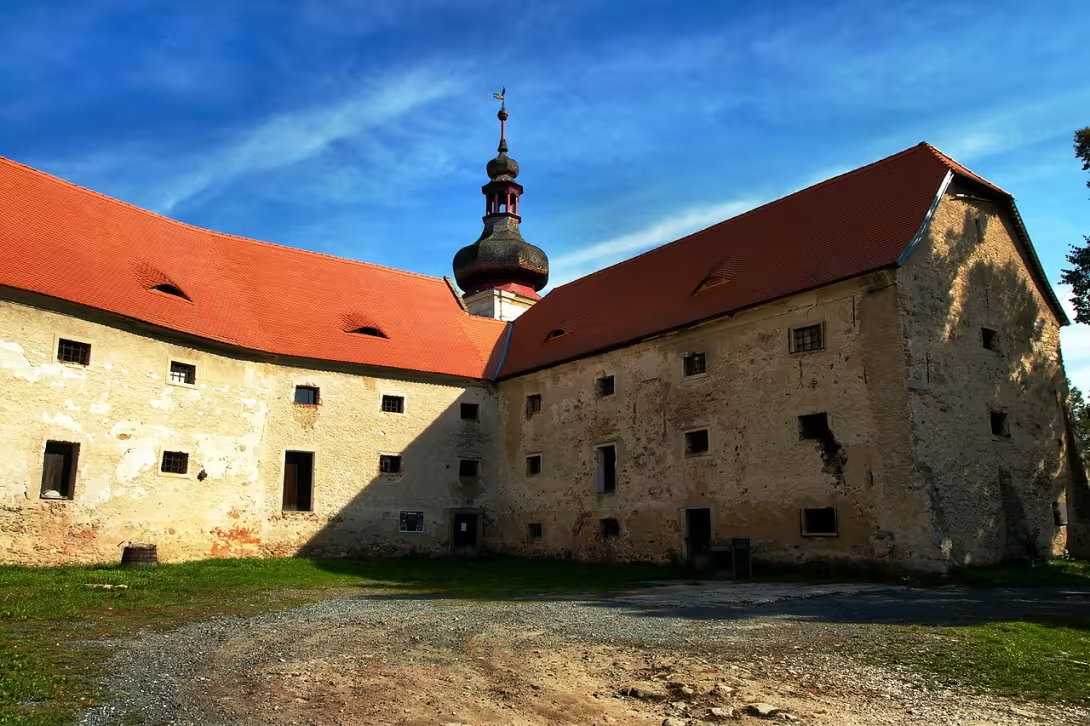
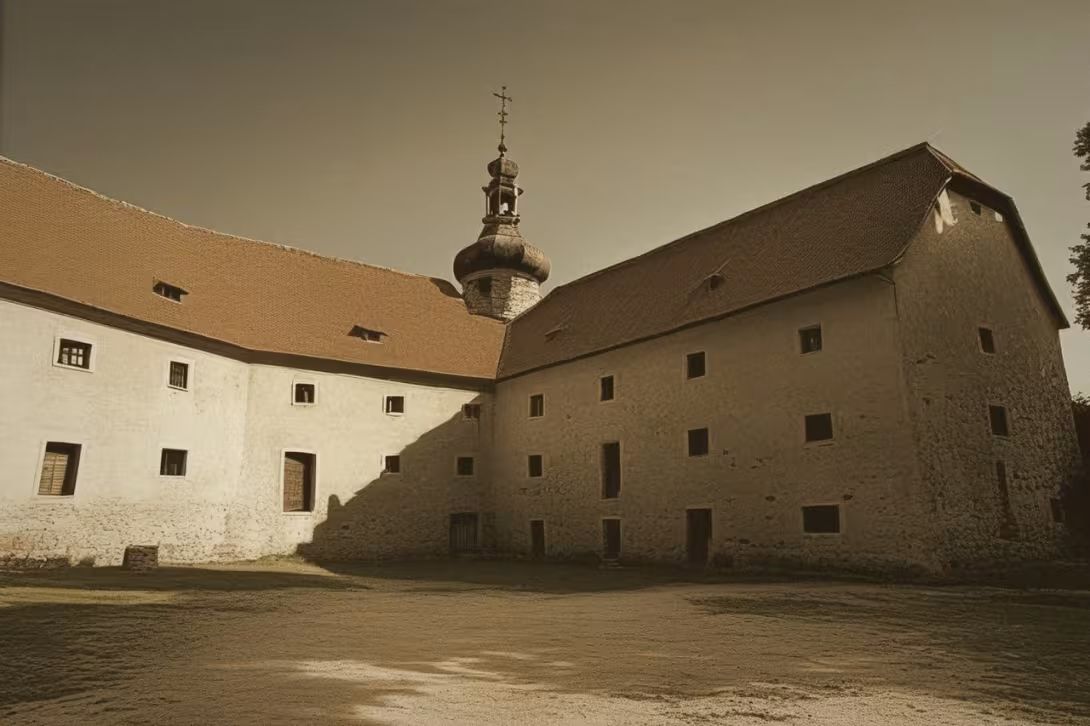
The historical appearance on the left is an AI-generated visualisation and serves as inspiration only.
Historical milestones
- 1362
- Racek ze Žihobec is listed as patron saint of St. Wenceslas.
- 1527
- Bušek Záborský z Brloha receives Kadov and writes it in the Earth's plates.
- 1618
- The beginning of a state uprising whose participation was influenced by the fate of the fortress owners.
- 1670
- The sale of Countess Catherine Khuen's estate from Belasa.
Architectural development
Originally a wooden fortress with a moat was rebuilt in the Renaissance period into a stone form. At the end of the eighteenth century, there was a major rebuilding of the granary, which added flat vaults and ventilation holes in the shape of a wasp eye. The oldest part remained the eastern tract with a halibut roof.
Historical events
1362 - Racek ze Žihobec is remembered as a patron saint of the church; 1618-1620 - participation of the brothers Záborský in the state uprising; 1624 - confiscation and subsequent exemption of owners; End of the 18th century - rebuilding the fort into a granary.
Owners
Racek ze Žihobec (1362), Vintíř and Jaroslav z Kadova (1380), Jan Šelmberk z Kadova (before 1395), Bohuslav z Lukavice (1447-1461), Petr Osecký z Brlok (1517), Bušek Záborský z Brloha (1527), Jan Záborský (until 1564), Alexander Záborský (until 1591), Ladislav Záborský (from 1633), Jan Moon z Vyškov (1650), Kateřina Khuenová z Belasy (1670-1674), Jiří Vojtěch Janovský z Janovice (1677), Tomas Černín z Chudenice (1682).
Points of interest
- Kadov is a fort converted into a granary, which documents the development from the medieval fort to the Renaissance mansion to the Baroque granary. - The oldest traces of the mansion dates back to the 14th century, when there was a wooden fortress protected by a moat. - The Vladice family of the Řesanski of Kadova had a bicycle as his coat of arms. - The north wing has a Gothic origin and in the late Middle Ages the Renaissance wing built in the original trench space follows. - There's a legend about Halik from Kadova, who was about to blind Jan Zizka with his shot during the siege of the Rabi Castle.
Guide
Show guide text
This text was created by artificial intelligence and has not been editorially reviewed. It may contain inaccuracies.
Welcome to Kadov. You're standing right in front of a building that at first glance can seem very calm, not complicated, but its walls carry mast for many centuries. Take a look at this three-storey structure that extends before your eyes. Feel its robustness and the special combination of the mansion and utility building. It is this form that teaches us today to read the story of how the needs of the people who lived here change and how the world around them changes. There is something in it from a noble mansion, but also from a practical, solid structure that was intended to serve generations.
To understand why this building looks like this, we have to go back deep into the past until the 14th century. Imagine where you're standing now, over 600 years ago. At that time, there was no such place as this stone house. Instead, there was a wooden fortress that was protected by a deep moat. It was a building primarily defended, functional and much more modest than it is today. Imagine the sound of the water in the trench and the smell of the wood that formed the foundation of this place. The first traces of the existence of this mansion go back to this very period. Already in 1362, Racek ze Žihobec is listed in historical records, which was the patron of the local church of St. Wenceslas. This tells us that even then this area was an important cultural and religious centre, which required a certain level of governance and care.
Now pay attention to the very structure of the object you are currently observing. You see a building in front of you that has its east and north wing. It is important to realize that what you see is the result of a very long and fascinating transformation. This building is not just one type of construction, it's a living document of history. In the Renaissance period, when the needs of the nobles changed from purely defensive to representative, the fort was fundamentally rebuilt by the Záborský brothers. At that time, one of the most important changes in its architecture took place here - the fortified mansion became a noble mansion and the administrative centre of the small estate. If you look at the north wing now, you can feel traces of an earlier era in its structure. Although the building has undergone many changes, it is in this wing that the Gothic elements are still hidden, which resemble the oldest stone foundations on which the building was gradually built.
Let us now move forward in time to a period that has fundamentally affected today's appearance of this monument. There was another big change in the eighteenth century. The fort was no longer needed as a representative seat and was therefore converted into a granary. This decision, which may have seemed purely practical at the time, fundamentally transformed the character of the building. It is thanks to this reconstruction that the object has today's very robust and closed appearance. The granary you perceive is proof of how noble places must adapt to new economic realities.
To better understand the weight of this place, we need to think about the people who left their mark. The history of this place is closely linked to powerful family lines. In 1527, Bušek Záborský z Brloha acquired Kadov and entered it into the ground boards, thereby strengthening the position of this place within the then state order. Later, at the time of the Renaissance blossom, the Albrecht a Ladislav Záborský brothers were operating here, who had just brought a new style into the building and turned it into the center of their estate. But history wasn't just about building and flourishing. In 1618 a state uprising broke out, which also affected the fate of the owners of this fortress. This was the time of uncertainty and great changes that could change the fate of this place at any time. Later, in 1670, the owner moved into the hands of Countess Catherine Khuen of Belasa, which signalled another chapter in the history of this estate.
Now, I want to invite you to think a little bit about one interesting thing that will help you better perceive the atmosphere of this place. Every family who ruled here carried its own identity, which it expressed in its character. For example, the royal family of the Řesanski of Kadova had a bicycle in his coat of arms. Imagine the wheel as a symbol of the constant movement, rotation of time and constant changes experienced by this object - from the wooden fortress to the Renaissance palace to the Baroque granary. This building is actually a symbol of this constant cycle. Nothing is immutable, everything changes, adapts and converts to survive.
Look at the walls and try to reconstruct the older forms that once stood here. Feel every part of the building as part of this long and rich story. Now, you're not expecting more recordings, but the whole history that's right in front of you. I suggest you continue your search and try to perceive the invisible link between the past and the present when you look at the individual parts of the building. I wish you a pleasant walk through the history of Kadova.
Tips for visitors
For the best experience we recommend a visit in spring or autumn months when the surrounding landscape is the most picturesque and weather friendly for walks. There are also fewer visitors at these times, which allows more peaceful observation of historical architecture.
Transport to the fort is possible both by car and through public transport. Please check the current parking options and traffic connections in advance in the transport information or on the official website.
When preparing for the trip, do not forget the comfortable shoes suitable for historical areas and uneven terrain. For photo lovers, the best places with a view of the building in the morning or evening light are where the Renaissance details are highlighted.
If you travel with families with children, it is recommended to choose the early morning when the atmosphere at the monument is the quietest. As part of a short walk you can also visit the nearby church of St. Wenceslas in Kadov.
Businesses nearby
Do you run a restaurant, accommodation, shop, museum, rental, wellness or other visitor service near this monument? Show yourself directly to the people heading to it — this is how they will see you in the app and on the web:
Nearby
St. Wenceslas Church in Kadov.
Accommodation nearby
Themed route
1. Church of St. Wenceslas in Kadov (sacral monument) - A tour of the historical architecture and interior of the church. 2. Kadov (fortress) (historical monument) - A visit to the building itself and a knowledge of its history. 3. Kadov (fortress) - courtyard (monument area) - Walk within the inner space of the fort.
Seasonal recommendations
Spring in Kadov brings the awakening of nature and fresh greenery that surrounds the ruins of the fortress. The soft spring light highlights the details of stone walls and the surrounding meadows are full of colours. We recommend moisture-resistant shoes, because the roads can be muddy after thawing. An ideal visit in the morning is when the air is the cleanest.
The summer season offers a rich green landscape and long days that allow for walks even at dusk. The atmosphere is warm and the sun illuminates the memory in full intensity. It is advisable to come first thing in the morning to avoid the biggest groups of visitors. Don't forget light clothing and plenty of fluids for the journey.
Autumn in this location is melancholy thanks to golden leaves and morning fog, which give the fort a mysterious touch. The contrast of colors in the surroundings creates ideal conditions for photography. Due to the variable weather, select layered clothes and plan to arrive in the afternoon hours when the light is most mild.
Winter brings to Kadova peace and quiet, while the snowy landscape highlights the raw beauty of historical buildings. The atmosphere is moderate and peaceful. It is necessary to wear warm and waterproof clothes. Before travelling, check the opening hours, which are usually shorter during this period, and prepare a warm drink for the thermos.
Visualizations and artistic views


The visualisations are generated by artificial intelligence and serve as inspiration.
Photos from the area
Real photos taken near the monument


Zdroj a licence jsou uvedeny u každého snímku.
Tips from visitors
No tips yet. Be the first!
Log in and add your tip.
Sources and literature
Fotografie: ZdendaK / CC BY-SA 3.0 — Wikimedia Commons. The author and licence also appear when you hover over the image.
Faktickým podkladem tohoto textu byl článek na Wikipedii, jehož autory jsou přispěvatelé Wikipedie. Článek je dostupný pod licencí CC BY-SA 4.0.
Location on the map
Příběhy a pověsti
Legendy, pověsti a příběhy spjaté s touto památkou
Fotografie návštěvníků
Zatím žádné fotografie. Buďte první, kdo přidá fotografii z návštěvy!
Přihlaste se a přidejte svou fotografii nebo hodnoťte.
Za ověřenou návštěvu v aplikaci získáte víc bodů — poznáme podle GPS, že jste na místě.
Reviews and comments