



Klatovy Railway station
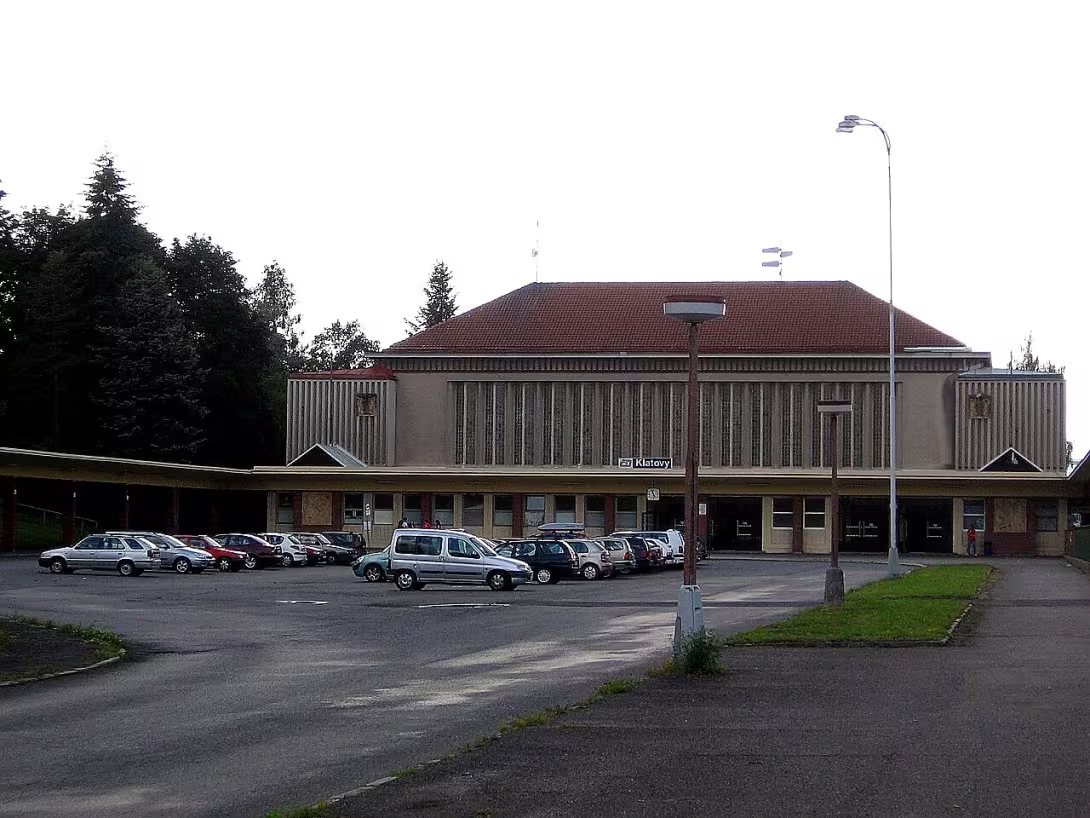
The railway station Klatovy is a hub in the northwest part of the city Klatovy in the Pilsen region. It connects Pilsen, Domazlice and Iron ore. The current monument-protected cruise building from the late 1950s is a remarkable example of the architecture of the Brussels style with interior in the spirit of socialist realism.
The station was created as part of the Plzeň-March track, which was intended to connect Duchcov, Pilsen and Nýrsko. The original building was built according to the company's typical design of groove structures. A whole new section of the route from the terminal station in Pilsen to Nýrsko was launched on 20 September 1876. Since 1877 it was possible to continue by rail through the border crossing of Železná Ruda-Elizabeth to Bavaria. In the same year the line was closed to the railway yard of Pilsen railway station.
In 1884, the Pilsen-March Railways were nationalized and the Imperial-Royal State Railways took over. Later, on October 1, 1888, the state company Českomoravská transversive track opened the connection from Domažlic to Horadějovice. Within this route Klatovy city was built in Klatovy stop. After 1918, the operation of the station and the adjacent transverse tracks were taken over by Czechoslovak State Railways.
The change of appearance of the building occurred in the late 1950s. In order to increase transport capacity, a complete rebuilding of the railway and buildings was carried out. Instead of the original railway station, a new transport building was created, the architect Josef Danda was the author. The construction was influenced by the Brussels style. The visual rendering of the interior consists of a sgraphite decoration by Václav Matas, performed in the spirit of socialist realism.
The railway yard is now one level platform at the station building and two covered island platforms to which underpasses lead. The station is electrified by 25 kV system, 50 Hz AC. The electrification was carried out on 21 September 1996 and the management does not continue from this point. Near the building flows river Úšula.
The monument presents an interesting clash of two epoch railway construction and architecture. Her visit offers the possibility to see the applied style of Brussels in practice and unique sgraffiti decoration from the period of socialism.
Historical milestones
- 1876
- Setting up a new section of the route from Pilsen to Nýrsko.
- 1884
- The nationalization of the Pilsen-March railway and the takeover of the Imperial-Royal State Railways.
- 1918
- Taking over the operation of the Czechoslovak State Railways station.
- 1996
- Bringing the electrical traction system to the station.
Architectural development
The original building was built according to the typical design of the EPPK railway buildings. In the late 1950s, a complete reconstruction took place in the Brussels style. The interior is accompanied by a graphic decoration in the spirit of socialist realism.
Historical events
20 September 1876 putting into service of the section to Nýrsko; 1884 nationalisation of the line; September 21, 1996, the electrical traction system.
Owners
Pilsen-March Railways (EPPPK / PBD), since 1884 Imperial-Royal State Railways (kkStB), since 1918 Czechoslovak State Railways
Points of interest
- The current monument-protected cruise building from the late 1950s is an example of the architecture of the Brussels style. - The interior of the building is decorated with sgraffiti decoration by Václav Matas in the spirit of socialist realism. - A new building from the late '50s was designed by architect Josef Danda. - A whole new section of the route from the terminal station in Pilsen to Nýrsko was launched on 20 September 1876. - The monument presents a clash of two stages of railway construction and architecture.
Guide
Show guide text
This text was created by artificial intelligence and has not been editorially reviewed. It may contain inaccuracies.
Welcome to Klatovy. You are standing in front of the building of the local station, which is much more than just ordinary stops for passengers. It's where the history of the railway meets the bold architecture of the last century. Now, if you look at the building in front of you, you see the main dispatch hall, which serves as the heart of the transport node for connections to Pilsen, Domazlic or Iron Rudy. Feel the atmosphere of this place, which has been connecting people from different corners of Pilsen region for over a century.
Now let's go back a little bit in time to understand how they got to this place. The first railway track was struck here in the year eight hundred and seventy-six. It was then built within the so-called Pilsen-March track and a new section of the route from Pilsen to Nýrsko was launched. Imagine what a coup meant to Klatovy at the time when the first steam engines enter the city and speed up trade and travel. A few years later, eight hundred and eighty-four years later, this runway was nationalized and the operation was carried over by the Imperial-Royal State Railways. With the advent of the new century and the creation of a separate state in the year nine hundred and eighteen then the station's control went into the hands of the Czechoslovak State Railways.
Now pay attention to the construction itself that you are facing. It is true that the railway began to work here in the nineteenth century, but what you see today is the result of a complete reconstruction from the second half of the twentieth century. At that time the appearance of the complex was completely changed, including the tracks and buildings. The current expedition building, which is today protected by the monuments, dates back to the late 1950s. Look carefully at its shapes and lines. This building is a very rare and distinctive example of the so-called Brussels style. It is an architecture that at that time meant modernity, lightness and a new view of space. The whole project was designed by the architect Josef Danda, who wanted to create a space functional but at the same time aesthetically appropriate to his time.
Now, when you think about who's been working on the form of this place, you come across the name Václav Matas. If you can see inside the building, I suggest you pay attention to sgraffiti decoration. Václav Matas created a work here in the spirit of socialist realism. Sgraffito is a technique in which layers of surface material are removed to create an image. These decorative elements in the interior are today an important testimony about how the role of art in the area of public transport was understood at that time. It is a fascinating combination of the architecture of Josef Dandy and the artistic expression of Václav Matas, which together form the unique character of the Klatov railway station.
You might be interested to know how the station evolved in the newer times. Although the building looks stable and traditional, the technique inside must have kept up with the times. An important milestone was the year one thousand nine hundred ninety-six when the electrical traction system was brought into the station. This meant the end of the era of older locomotives and the transition to more modern, cleaner and faster electric traffic, which further strengthened Klatovy's position as a key transport point in the northwest part of the region.
It's fascinating to think how many thousands of people have come through here in all these years. From passengers in the times of Austria-Hungary, to people in the times of the first republic, to passengers in the times of today. This Brussels-style building with its sgraffiti is a silent witness to all these changes. It's a place where the old railway tradition meets the bold design of the '50s.
Now that you know the story of this place, I suggest you examine the building in peace again. Take note of the details that Dando and Matas left behind, and try to imagine what the station looked like in a thousand eight hundred seventy-six compared to what you see today. Klatovy is a beautiful city with a rich history and this station is one of its important entry portals.
Thank you for your attention. I hope you're interested in this short trip to the history of the Klatovy Railways. Now I will no longer delay you and invite you to explore the city and its monuments. Have a nice day and a good trip.
Tips for visitors
The best time to visit is spring or autumn, when the colors of nature are around the Orb River and the stream of water looks natural. Transportation to the city centre is possible by car and public connections, specific possibilities can be verified in current search engines.
On the way we recommend to bring comfortable shoes for walking along the river and in case of bad weather a collision jacket. The building serves as an official space, so it is advisable to keep calm and respect the people who work here.
For photo lovers, the best places around the building are in the morning or late afternoon, when soft light hits the historical details of the facade. An interesting theme is also the connection of architecture with the surrounding landscape.
Frequently asked questions
Can the monument be visited?
The building is in use (offices, a school, shops and the like). The interior is generally accessible only during operating hours and tours are not usually offered; we have not verified the details. You can see the exterior from the street.
Where is the monument?
Location: Klatovy III. The map on this page shows the exact spot.
Why is the monument protected?
It is listed in the Central List of Cultural Monuments of the Czech Republic as a cultural monument (register no. 1884477998).
Businesses nearby
Do you run a restaurant, accommodation, shop, museum, rental, wellness or other visitor service near this monument? Show yourself directly to the people heading to it — this is how they will see you in the app and on the web:
Events nearby
Zdroj akcí: otevřená data měst a obcí ČR (Národní katalog otevřených dat) a kalendář akcí Národního památkového ústavu.
Nearby
V blízkosti stanice protéká řeka Úhlava a v jižní části města se nachází zastávka Klatovy město.
Accommodation nearby
Themed route
Here is the design of the cruise route:
1. Klatovy - Capital city. Walk through the city centre and admire local architecture. 2. River Head - Water flow. Nature near the station that offers peace and space for rest. 3. Stop Klatovy city - transport node. A point in the southern part of town that serves as a practical end or beginning of the journey.
Seasonal recommendations
In spring, the surroundings of the buildings awaken to the green, and the fresh air accompanies the first warm rays of the sun. It is advisable to choose light but layered clothes and visit the place in the morning when light is fine and nature around the most colorful.
In the summer months it dominates intense heat and bright, sharp lighting, which highlights the details of facades. It is recommended to look for shade, wear breathable substances and arrive in the early morning hours to avoid the greatest heat of the main season.
Autumn brings golden leaves and a misty, mysterious atmosphere to the space. For walks is ideal warm sweater and shoes resistant to moisture, while the best time for observing the colors of the landscape is the afternoon before sunset.
Zimą is surrounded by calm and the freezing air often creates the vizna surfaces. It is necessary to wear warm winter clothes and tight shoes, while it is best to watch buildings jealous in short days and long nights.
Visualizations and artistic views

The visualisations are generated by artificial intelligence and serve as inspiration.
Photos from the area
Real photos taken near the monument


Zdroj a licence jsou uvedeny u každého snímku.
Tips from visitors
No tips yet. Be the first!
Log in and add your tip.
Sources and literature
Photos: PetrS. / CC BY-SA 4.0 — Wikimedia Commons. The author and licence also appear when you hover over the image.
Faktickým podkladem tohoto textu byl článek na Wikipedii, jehož autory jsou přispěvatelé Wikipedie. Článek je dostupný pod licencí CC BY-SA 4.0.
Location on the map
Příběhy a pověsti
Legendy, pověsti a příběhy spjaté s touto památkou
Fotografie návštěvníků
Zatím žádné fotografie. Buďte první, kdo přidá fotografii z návštěvy!
Log in a přidejte svou fotografii nebo hodnoťte.
Za ověřenou návštěvu v aplikaci získáte víc bodů — poznáme podle GPS, že jste na místě.
Reviews and comments