



Klauza k plavení dříví Water channel
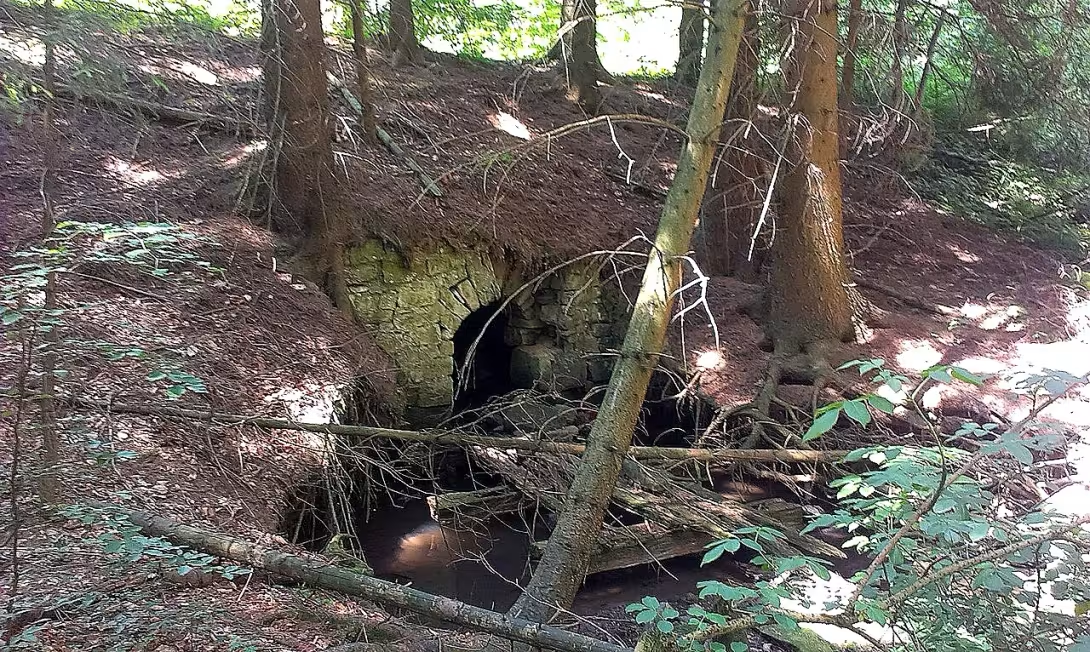
Water-flow clown Juhyna in the village Rajnochovice is a technical monument from the second half of the 19th century, which was used for water retention for wood. The building is registered as a cultural monument of the Czech Republic and is currently on the list of endangered monuments.
This building was built in 1860 in the valley under the hill Hrubá fir in Kroměříž district. Its construction responded to the needs of the then forest economy, which required efficient transportation of wood from the inaccessible mountain areas of Hostín hills to industrial centres. For centuries, the forest has been floating in this area and the intensive use of spring or torrential waters lasted until 1914.
The technical solution of the clause was to build a sprinkled dam of a height of 4.4 metres, which created a retention tank. In the middle of the dam was placed an embossed discharge of stone. Due to the difficult terrain and the numerous curvature of the Juhyna flow, it is assumed that there were mainly logs and shorter pieces of logs, not long tribes. Part of the exit was a steel-plated fence with a screw spindle. A wooden shelter with a tent roof covered by shingles was erected above this facility in 1911. The installation date is still visible on one of the horizontal beams.
Historical sources show the existence of another clause on the Rosošné creek, built in 1846. While this object underwent repairs in 1998 and 2008, the Juhyni clause remains in dismal condition and gradually decaying. The cast-iron lifting device has not been preserved until today.
Today the location is accessible after the 5053 cycling route, which connects the area of Troika and Fang. The object represents an important document of historical management in the forests and technical maturity of its time. Visiting this place offers insight into the history of the forest industry and recalls the need to protect the technical monuments that are increasingly subject to the tooth of time in the landscape.
Historical milestones
- 1860
- Construction of a clown on the upper stream of Juhyna.
- 1911
- The date carved on the roof of the shed.
- 1914
- Termination of the timber swimming in this location.
Architectural development
The original structure consisted of a sprinkled dam of a height of 4.4 metres with a stone discharge. Part of the device was a wall with a steel fence controlled by a screw spindle which was protected by a wooden shelter with shingles roof.
Historical events
In 1911, a wooden shelter was installed above the stadium. The timber swimming in this area was definitively completed around 1914.
Points of interest
- The clauza on the river Juhyna is a technical monument from the second half of the nineteenth century, which is registered as a cultural monument and is on the list of endangered monuments. - The building was built around 1860 in the valley under the hill Hrubá fir and was used for water retention for the sails of mountain areas. - The technical solution included a sprinkled dam of four and four tenths of a metre and a conned stone discharge. - A wooden shelter with a tent roof covered with shingles was built above the wall in 1911, with the installation date still visible on the beam. - There was another clause on the Rosošné creek, which was built in 1846 and underwent repairs in 1998 and 2008.
Guide
Show guide text
This text was created by artificial intelligence and has not been editorially reviewed. It may contain inaccuracies.
Welcome to Rajnochovice. You are standing at one of the most surprising and interesting places in this valley. In front of your eyes, there's a clown on the river of Juhyna. Feel the strange atmosphere of peace that now surrounds this place, but at the same time try to imagine how it was here over a century ago. Do you hear the constant noise of water? That sound is like the voice of history that has been flowing here for centuries. You see the constant force of nature that dominates here, and at the same time the human effort to control it in a sense and use it for its own benefit. It's a place where a man's work combines with the ruthlessness of a mountain stream.
Let us return together to a time when this region seemed much wilder and people had to look for very clever ways to deal with it. It's about 1860. At that time, the road to transport heavy materials was not easy at all. At that time, people needed to transport a huge amount of valuable wood from mountain areas located below the peak of the Gross fir tree down towards human settlements. But the terrain in this valley is very demanding. The river Juhyna is constantly rolling around, creating many dangerous curvature and narrow points that would make the normal transport of wood difficult or completely impossible. In order to safely and effectively transport logs and shorter pieces of strains, it was necessary to create a way to control water levels. That is why this clause was built. It was not just an ordinary building, but an important technical tool that allowed the water to be contained and then rapidly released, thereby creating enough stress to carry heavy wood bodies through the entire length of the stream.
Now pay attention to what you see right in front of you. This building is not only made up of one material, but is the result of a combination of natural elements and human skill. Look at the sprinkled dam. It is a massive structure that must withstand the constant pressure of water and variable flooding. Now look closer at the stone release. This particular element was absolutely crucial for the whole function of the work. The stone work you see here must have been very precise at the time of construction, so that the water could flow exactly as it needed to be, without damaging the entire dam or causing an unwanted disturbance. Now, if you look at the shelter that is above the floodgates, you can see one very important clue from the past. The date 1911 is carved here. This small, but significant detail tells us that even in the early twentieth century, it took care of this place and kept it in good condition so that it could continue to perform its function.
Although history has not given us the names of the particular architects or the names of those who planned this construction, we can easily imagine the people who actually lived and worked here. Imagine those lumberjacks and lifeguards who spent their hours here every day. They had to be very strong, but above all they had to be incredibly skillful and constantly vigilant. Working with the floating of wood in such a rugged terrain, full of dangerous turns, was a constant struggle with the element of water. Every log that swam through this section was the result of very hard work in the woods beneath the Hruba fir. This clown was like the heart of the whole system that controlled the rhythm of their daily lives and their hard work.
You may have a question as to why this place seems so quiet and lonely today. There's one interesting thing that might surprise you and make you think. This era of wood sailing had its clear and relentless end. 1914 was a huge change for this site. In that year, the timber swimming in this place was definitively stopped. The world began to change, new modes of transport were coming in, and people's needs moved completely away. This clown remained a silent witness to the old world, who will never return. And that's why this monument is so important today. It is a cultural monument, but it is also on the list of those we must protect from oblivion and extinction. It's an endangered piece of our common heritage that reminds us of how people once had to work closely with nature to survive and prosper.
However, do not stay in view of this construction. Continue along this beautiful valley, perceive the richness of the surrounding nature and let yourself be carried away by this calm. Every stone and every wave in the river of Juhyna has its own hidden story. Thank you for stopping by and paying attention to this historic monument. We wish you a nice and peaceful walk around.
Tips for visitors
The best time to visit is during the spring thaw or after heavy rains, where there is plenty of water in the riverbed of the Crossstream and the river Juhyna, which better depicts the original purpose of the technical work. However, avoid a period of extreme precipitation due to the emergency state of the dam.
You can easily get to the memory by car on second class road number four three seven.
Due to the terrain and emergency condition of the building, take the fixed shoes to nature and the repellent. For photography we recommend the morning hours when the sun penetrates between the trees of the Hostinská hills and illuminates the stone release, which creates interesting shadows on a covered dam.
In the immediate surroundings, you can take a hike on the top of the Hrubá fir, which offers views of the forest landscape of the Hostinská hills. The route is suitable for hiking and offers a quiet environment for nature observation around the water stream.
For families with children, the location is suitable as a stop on a bicycle trip of five thousand fifty-three. Due to the emergency state of the dam, it is strongly recommended to stick to the marked paths and not let children move in the immediate vicinity of an unstable structure.
Frequently asked questions
Can the monument be visited?
We have not verified whether this monument is accessible. Please ask the owner or operator, or the local municipal office. According to the heritage register the structure is in poor condition – do not enter it and take care nearby.
Where is the monument?
Location: Rajnochovice. The map on this page shows the exact spot.
Why is the monument protected?
It is listed in the Central List of Cultural Monuments of the Czech Republic as a cultural monument (register no. 1000138691).
Businesses nearby
Do you run a restaurant, accommodation, shop, museum, rental, wellness or other visitor service near this monument? Show yourself directly to the people heading to it — this is how they will see you in the app and on the web:
Nearby
Hostýnské vrchy, vrch Hrubá jedle, Rosošný potok, cyklotrasa 5053, silnice II/437.
Accommodation nearby
Trips and activities nearby
Guided tours, tickets and activities nearby from GetYourGuide
Affiliate link: if you buy from the partner, we may receive a commission. The price for you does not change.
Search tours and activities →Themed route
Road II / 437 - transport connections, starting point of the route. Here you can park and easily reach other stops.
Klauza k plavení dříví (water work) - historical monument, technical work of the 19th century. It shows the old water flow control method and is the center of the whole trip.
Rosebud stream - natural water flow, flows just near the clown. A remarkable slope and clean water provide a pleasant walk and the possibility to soak up the peace of nature.
Peak Hrubá fir - sightseeing mountain, about 1.5 km up the Rosošné brook. It offers panoramic views of the Highlands of Hostín and the clause itself.
Hostinská hills - large natural area, about 2 km from the hill Gross fir. Ideal for expanding the trip by light trails and observing local flora and fauna.
Seasonal recommendations
In spring, the power of the melting snow and the steep flow of water, which resembles the original function of the work, reigns here. There's fresh green bubbling around the clown and the air smells of moisture. We recommend a shoe that can withstand mud and water because the surrounding terrain is drenched. The best thing is to come in the morning when the light is fine.
The summer months bring thick shade of foliage and bright sun, highlighting the details of the decaying masonry. The atmosphere is calm and sleepy. Because of the higher attendance rate in the high season, select earlier hours to avoid heaps of people. Don't forget the light clothes and enough fluid to drink.
In autumn, the landscape is dyed in gold and brown tones, while morning fog above water gives the place a mysterious touch. The fallen state of the monument in combination with the fallen leaves is very melancholy. Suitable is layered clothing and a visit in the afternoon when the sun falls at a sharp angle.
In winter, frost and snow cover the building's shortcomings and create a quiet, white environment. The ice crust on the water surface underlines the immobility of this historic place. It is essential to have warm shoes and gloves. Due to the short day, plan to arrive immediately after sunrise and watch out for slippery surfaces.
Visualizations and artistic views

The visualisations are generated by artificial intelligence and serve as inspiration.
Photos from the area
Real photos taken near the monument

Zdroj a licence jsou uvedeny u každého snímku.
Tips from visitors
No tips yet. Be the first!
Log in and add your tip.
Sources and literature
Photos: Patka / CC BY-SA 4.0 — Wikimedia Commons. The author and licence also appear when you hover over the image.
Faktickým podkladem tohoto textu byl článek na Wikipedii, jehož autory jsou přispěvatelé Wikipedie. Článek je dostupný pod licencí CC BY-SA 4.0.
Location on the map
More monuments – Rajnochovice
Show all in the municipality

Příběhy a pověsti
Legendy, pověsti a příběhy spjaté s touto památkou

Fotografie návštěvníků
Zatím žádné fotografie. Buďte první, kdo přidá fotografii z návštěvy!
Log in a přidejte svou fotografii nebo hodnoťte.
Za ověřenou návštěvu v aplikaci získáte víc bodů — poznáme podle GPS, že jste na místě.
Reviews and comments