



Kostel svatého Bedřicha (Bedřichov) Church
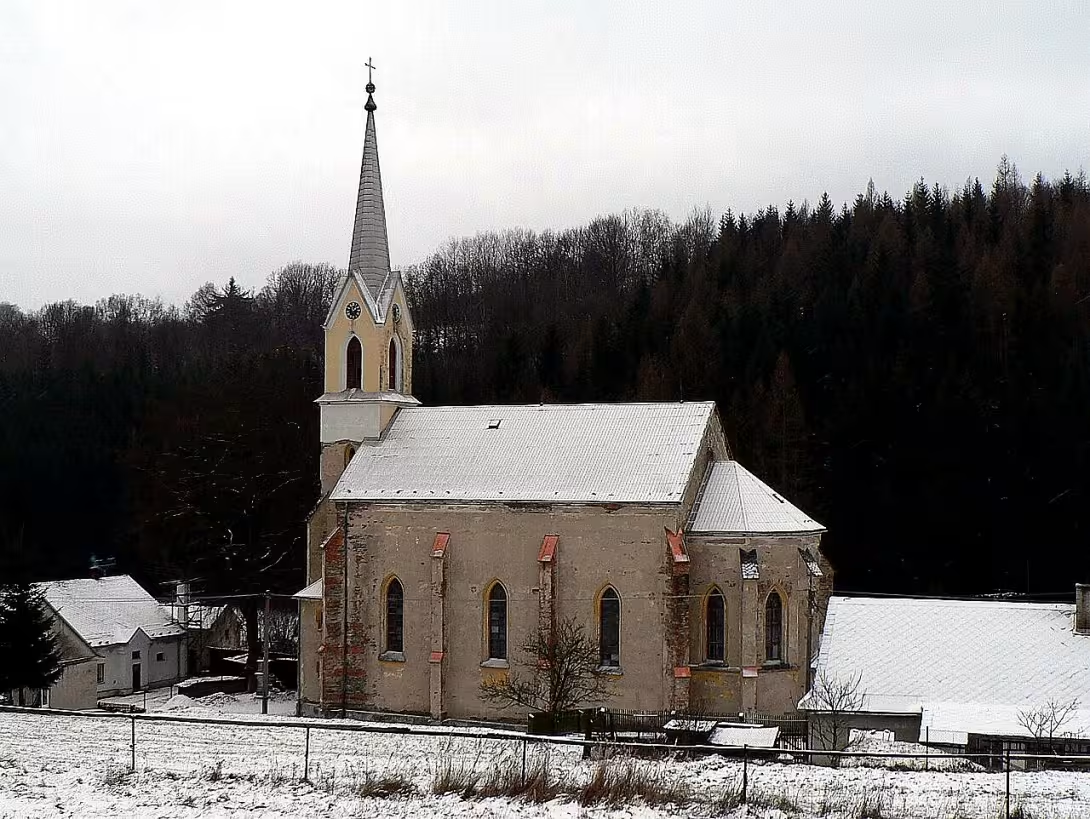
The Church of St. Bedřich in Bedřichov in Šumpersk is an interesting example of the neo-gothic architecture of the second half of the nineteenth century. It is a one-boat construction of a rectangular plan with a narrower and lower presbytery, which stands along the road passing through the village.
The genesis of the building goes further into the past. The village originally belonged to the parish Upper Town in the district of Rýmařov, which meant distance and administrative dependence. In 1804, Bedřichov established its own cemetery, thereby showing the will to become more independent. Over time, the local community applied for permission to build their own church. This wish was fulfilled in 1869 when the church was built in a neo-gothic style. Two years later, in 1871, a separate parish was established at the church, which served the village until 2004 when it was attached to the parish of Oskava.
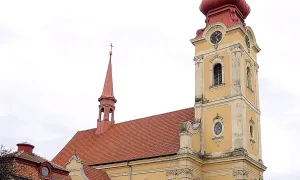
The architecture of the building expresses the Gothic ideals of the second half of the nineteenth century. The presbytery has a characteristic polygonal ending, to which a square sacristy with a valb roof is attached in the longitudinal axis. The dominance is the quadratic tower ended with a high slender jellied finish with a poppy and cross. The letters W.S. and K.R. are fired in the cross itself, the initials of the builders, which thus remained in the highest place of the church until eternity.
On the sides of the tower, one-storey ports are added to the main ship. On the west side there is a spiral staircase leading to the circle and into the body of the tower, on the opposite side a cross-arched chapel. The main entrance on the ground floor of the tower is lined by a portal with a broken arch and a circular window above it. The last floor of the tower closes triangular shields with clock numbers and gothic windows.
The outer walls of the ship and the presbytery are broken down by high, oblique-ended backrest with gothic windows between them. The roof above the main ship is saddled, above the presbytery of the Valba. The inside of the church is indicative of caring equipment. The presbytery with the rib arch preserved the original paintings on the walls and ceiling. Wooden altars in a neo-gothic style are dedicated to St. Bedřichovi, the Holy Heart of Jesus and the Immaculate Heart of Mary. By the bark, there is a grave of God decorated with two great angels made of tiny glass mosaic. An important part of the church is the organ from 1879, made by František Rieger of Krnova. It is a fully mechanical one-handed tool with 12 registers that underwent a general repair in 2015. The bell originating in 1878 bears the relief of the Holy Trinity and comes from the litters I. and P. Hilzer.
Then and now
Drag the slider to compare how the landmark may have looked when it was built with the view today.
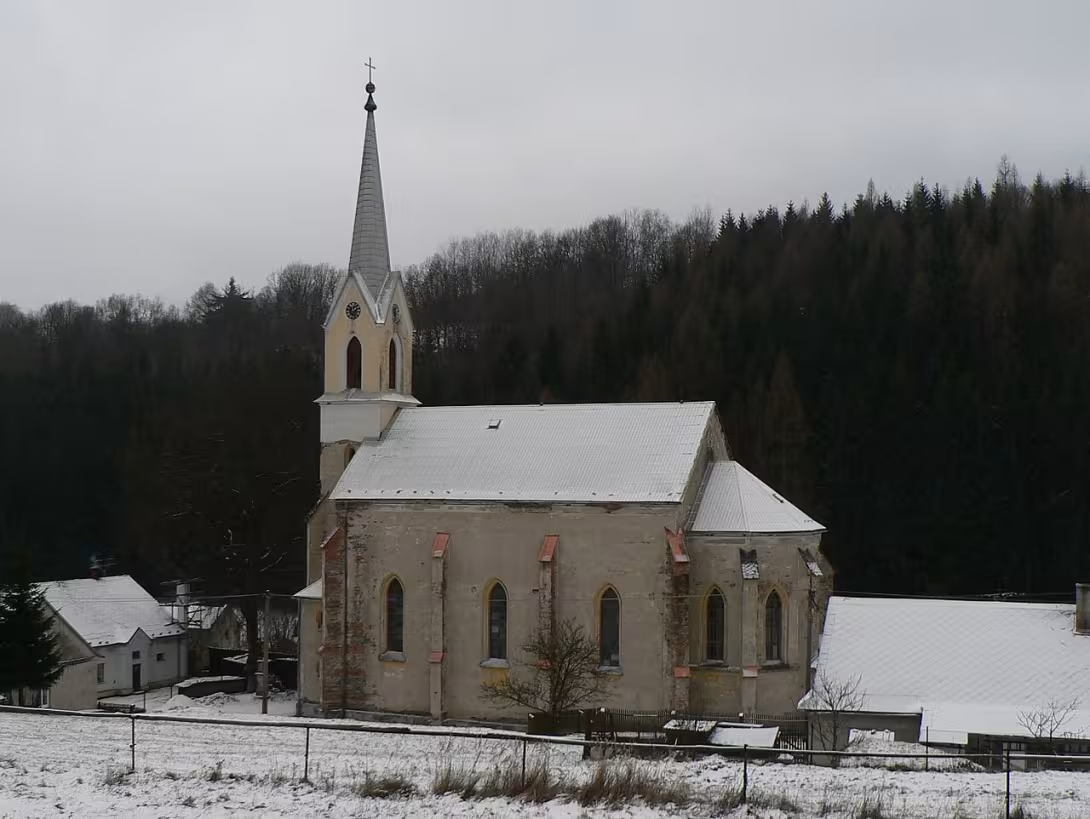

The historical appearance on the left is an AI-generated visualisation and serves as inspiration only.
Historical milestones
- 1804
- Establishment of the own cemetery by the municipalities Bedřichov
- 1869
- Completion of the construction of St. Bedřich church
- 1871
- Establishing a separate parish at church
- 1878
- A bell with the relief of the Holy Trinity
- 1879
- Installation of organ from Franz Rieger from Krnova
- 2004
- Connection of the parish Bedřichov to the parish Oskava
Architectural development
The church was built in a neo-gothic style according to the architectural trends at the time. The construction is a single boat with polygonal presbytery and sacristy. The tower with the needle and the head dominates the entire building. The outer walls are broken down by backrest and broken by gothic windows. The interior contains original paintings, neo-Gothic altars and organ from 1879.
Historical events
In 1804 the village established its own cemetery and later applied for permission to build a church. In 1871 a separate parish was established at the church of St. Bedřich, which existed until 2004 when the parish Bedřichov was attached to the parish of Oskava.
Points of interest
- St. Bedřich's Church is an example of neo-gothic architecture from the second half of the nineteenth century.
- In 1804 the village established its own cemetery, which showed an effort for greater independence from the parish Upper Town.
- The church was built in 1869 and two years later, in 1871, it created a separate parish.
- At the top of the church, in the cross of the tower, the letters W.S. and K.R., the initials of the builders, are burned.
- The interior preserved original paintings on the walls and ceiling of the presbytery.
Guide
This guide is narrated by a synthetic voice generated by artificial intelligence.
Show guide text
This text was created by artificial intelligence and has not been editorially reviewed. It may contain inaccuracies.
The Church of Saint Henry in Bedřichov in the Šumperk region is a Neo-Gothic building from 1869. The village formerly belonged to the parish of Horní Město in the Rýmařov district. In 1804, it established its own cemetery and later requested permission to build a church. An independent parish was created here in 1871 and lasted until 2004, when it was merged with the parish of Oskava.
The church stands along a road that runs through the village. It has a single nave with a rectangular ground plan, followed by a narrower and lower presbytery with a polygonal termination. Behind it, along the church's axis, a low square sacristy with a hipped roof was added. The façade is formed by a square tower, topped with a high slender pyramid with a finial and a cross. The letters W S and K R, the initials of the builders, are burned into the cross.
On both sides of the tower, where it connects to the nave, stand narrow single-storey annexes. The western one contains a spiral staircase leading to the gallery and the tower, while the opposite one has a cross-vaulted chapel. The main entrance in the ground floor of the tower is framed by a Neo-Gothic portal with a broken arch, and above it is a circular window. The highest storey of the tower ends with triangular gables with clock faces, and below them are tall Gothic windows. The walls of the nave and presbytery are articulated by tall, diagonally-topped buttresses, with Gothic-shaped windows between them. The nave is covered with a saddle roof, and the presbytery with a hipped roof.
Inside, the presbytery with its ribbed vault has preserved original paintings on the walls and ceiling. The altars are wooden and Neo-Gothic. The main altar is decorated with an image of Saint Henry, while the side altars are dedicated to the Most Sacred Heart of Jesus and the Immaculate Heart of Mary. In the arcades beneath the gallery is a Holy Sepulchre with two large angels made of fine glass mosaic.
The organ from 1879 by Franz Rieger from Krnov stands in the gallery. It is fully mechanical, has one manual and twelve stops, and underwent a complete overhaul in 2015. The bell from 1878 bears a relief of the Holy Trinity on its surface and was cast by the bellmakers Hilzer.
Tips for visitors
The best time to visit St. Bedřich's church is during the spring and summer months when the outdoor environment of Šumperska is the most beautiful and sunny weather creates ideal conditions for the tour. In June and July it is also possible to experience local cultural events that often accompany a visit to historical monuments. The morning clock is calmer, which allows you to focus on the details of architecture without disturbing crowds of tourists.
It is recommended to arrive at the place sufficiently in advance, especially in the summer months. The location is also connected by public transport, but the specific connection needs to be verified in the transport search engine before the journey. There are several stops in the area that allow easy access on foot.
When visiting, wear a comfortable shoe because the church and surrounding area offer several paths and the terrain can be uneven. In the summer months bring plenty of water and sun protection.
Photography is allowed in the church, the best places for images are especially the exterior facade with neo-gothic elements and interior with historical equipment. For quality photography is ideal natural light during morning or afternoon hours, when light falls favourably on the details of the building. In the interior it is advisable to follow the instructions of the staff regarding photography.
Around the church is worth visiting the village of Upper Town and Oskava, which also have a rich history. These locations are within 30 minutes' drive of the church.
For families with children, a visit to the church of St. Bedřich is interesting because of its historical importance and surrounding nature. In the vicinity it is also possible to find places for picnics where children can play and family rest.
Frequently asked questions
Can the monument be visited?
Religious buildings are usually open mainly during services; at other times a visit is normally arranged with the parish or the operator. We have not verified specific times.
Where is the monument?
Location: Bedřichov, Olomoucký kraj. The map on this page shows the exact spot.
For kids
Imagine coming back 157 years and finding yourself in a small town in Sumperland. The town was called Bedřichov and it was like a small kingdom where people lived with a throat and a heart.
The church of St. Bedřich was the heart of the city. It was a beautiful church with high towers and a glass ceiling that was built in 1869. Whenever someone got to church, it felt like they were part of something bigger.
Businesses nearby
Do you run a restaurant, accommodation, shop, museum, rental, wellness or other visitor service near this monument? Show yourself directly to the people heading to it — this is how they will see you in the app and on the web:
Events nearby


Zdroj akcí: otevřená data měst a obcí ČR (Národní katalog otevřených dat) a kalendář akcí Národního památkového ústavu.
Nearby
The surrounding church is a natural landscape of Šumperska with forests and field eels. There are other villages such as Upper Town and Oskava, which also have historical significance. There is a nature reservation and a protected area nearby, such as the Great and Small Špičák Nature Reserve.
Accommodation nearby
Themed route
Thematic cruise route: Bedřichov and its surroundings
1.Kostel svatého Bedřicha (Bedřichov) * Type: * Sacral monument, Baroque church from the 18th century. * Why visit? * Unique architecture with remarkable bell tower and historical significance for the region. The interior with valuable paintings and statues offers a quiet environment for relaxation.
2. Natural Reservations Large and Small Pointy * Type: * Protected area with rich flora and fauna. * Why visit? * Near the church there are picturesque peaks with views of the surrounding landscape. Ideal for short tourism and nature observation, especially in spring and summer periods.
3. Municipality of Upper Town * Type: * Historical village with traditional development. * Why visit? * The picturesque houses and quiet atmosphere reflect typical Šumper countryside. Suitable for walking and photography.
4. Municipality of Oskava * Type: * Ancient residence with cultural monuments. Why visit? The local church and historical houses resemble a rich past area. The local museum (or exhibition) offers a view of the life of the local population.
* The route is designed to combine sacral memory with nature and historical heritage of Šumperska. *
Seasonal recommendations
Spring brings a gradual revival of nature to the surroundings of St. Bedřich's Church in BedřichovA, which creates a calm and refreshing atmosphere. The sunlight hitting the historical masonry during this period is soft and emphasizes the texture of the stone without sharp shadows, which are typically typical of the summer sun. Since temperatures still vary significantly depending on the time of the day, it is advisable to bring with you layered clothes, especially a light jacket or sweater. Tourist crowds are minimal this season, allowing a tour of the sights in total silence and privacy. The best time to visit is the late morning when the air is already warm and the surrounding gardens or meadows are beginning to acquire green colours, which provides a pleasant contrast to the architectural structure of the church.
Summer is the time of the highest attendance for this memory, especially in the main summer months, when groups of tourists and locals come here. Strong sunlight can be unpleasant, therefore it is crucial to wear light, breathable clothes, hat and always have plenty of drinking water at hand. In order to avoid the largest crowds that can disturb the calm atmosphere inside and outside the church, it is recommended to arrive as early as possible in the morning, ideally just after opening, or on the contrary late in the afternoon, when temperatures fall slightly. Green vegetation is in full bloom and provides a pleasant shade for short rest.
Autumn offers a unique color game where the leaves of the surrounding trees change their shade into golden and orange tones, creating a dramatic and photogenic background for historical construction. The light in this period is lower and warmer, which underlines the dignity and seriousness of space. The atmosphere is often colder and wetter, therefore it is necessary to wear waterproof shoes and warm layers of clothing, including scarf. Visitors are less than in the summer, but there are still enough of them to maintain a live, but undemanding frequency. It is best to visit the memory on a dry and sunny autumn day when visibility is high and the roads around are dry and safe. Be careful, however, on slippery paving blocks in the case of morning dew or rain.
Winter brings the church of St. Bedřich a specific, quiet and introspective character, often reinforced by a snow blanket that softens the shapes of the building and surrounding landscape. Short days and low sun create long shadows and a cool, blue atmosphere that requires firmer clothes, including winter jackets, gloves and warm shoes. In advent time, the interior or surroundings can feel the Christmas mood, although specific events may differ. Opening times are often shortened in winter, so it is necessary to check the current operating times in advance to avoid unnecessary travel. Visiting in winter is ideal for those who seek escape from the hustle and bustle and want to experience the memory in its quietest form, when external tourism is almost non-existent and can be fully focused on historical context and architectural details.
Visualizations and artistic views


The visualisations are generated by artificial intelligence and serve as inspiration.
Photos from the area
Real photos taken near the monument

Zdroj a licence jsou uvedeny u každého snímku.
Atmosphere of the place
This atmospheric visualisation of the place and period was generated by artificial intelligence. It is not real footage of the location.
Tips from visitors
No tips yet. Be the first!
Log in and add your tip.
Sources and literature
Photos: Martin Vavřík / Public domain — Wikimedia Commons. The author and licence also appear when you hover over the image.
Faktickým podkladem tohoto textu byl článek na Wikipedii, jehož autory jsou přispěvatelé Wikipedie. Článek je dostupný pod licencí CC BY-SA 4.0.
Location on the map
Příběhy a pověsti
Legendy, pověsti a příběhy spjaté s touto památkou
Fotografie návštěvníků
Zatím žádné fotografie. Buďte první, kdo přidá fotografii z návštěvy!
Log in a přidejte svou fotografii nebo hodnoťte.
Za ověřenou návštěvu v aplikaci získáte víc bodů — poznáme podle GPS, že jste na místě.
Reviews and comments