



Kostel svatého Jana Křtitele (Nová Seninka) Church
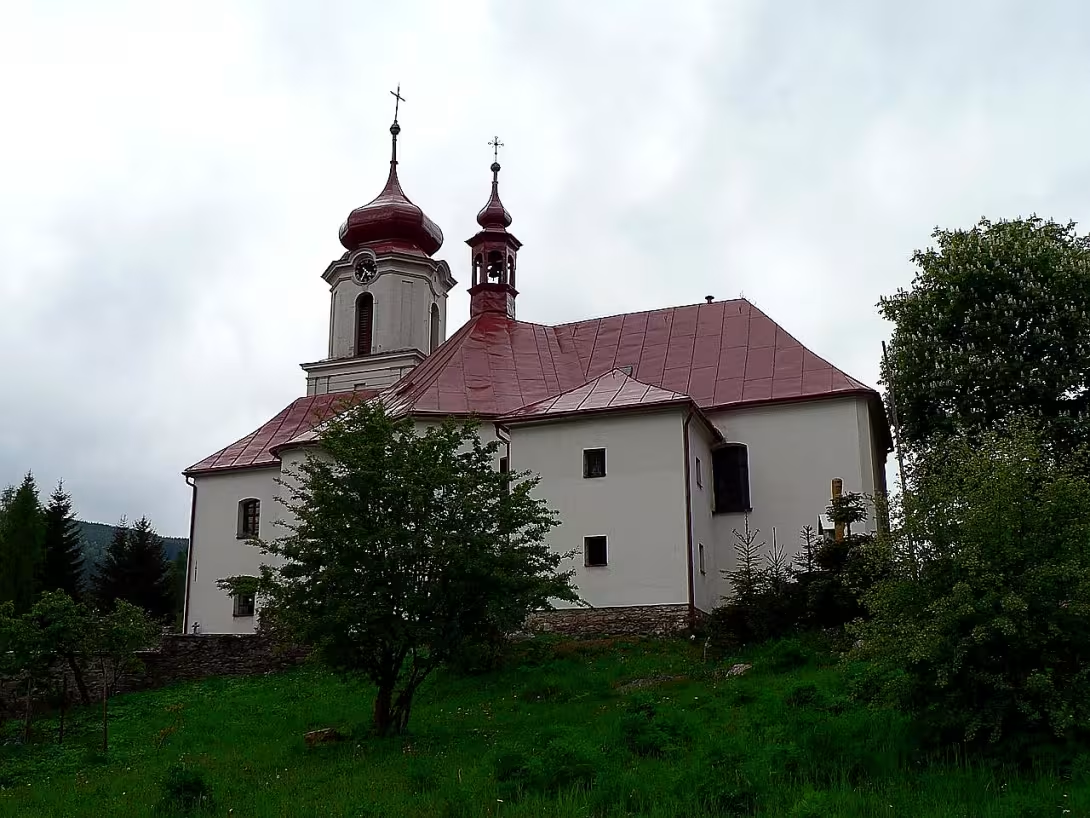
The church of St. John the Baptist in Nové Seninka is a unique Baroque building from 1689. It is located on the hillside cemetery terrain in the village Nová Seninka, which previously carried the name Špiclice. Its unusual disposition, rich decoration and location in the cemetery are among the most important cultural monuments of the Valachian region.
The church was created after the 30-year war, when the Baroque style was extended to Czech sacral architecture. Originally, the single-boat structure was gradually supplemented. In 1766 the church acquired a locale, which meant that a chaplain was established here. Four decades later, in 1784, a rectory was established here, confirming its importance to the local Catholic community. At the turn of the 19th and 20th centuries, a tower was added, which still dominates the surrounding landscape.
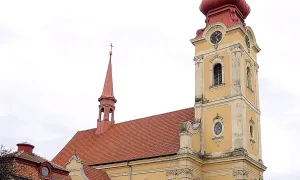
Architecturally interested the church with its original disposition. The single-boat building is coated with a white plaster and covered with a red valb roof with a sandbox. The ship has a rectangular plan with a straight conclusion. On the south and north side are added chapel in the form of a right triangle. In front of the western front, there is a storey hall with a circle, accessible by a snail staircase. The tower, built around 1901, is four-sided and four-storey. It ends with onion fighting, poppy and cross, with clock on the top floor.
The interior of the church is richly decorated. The hall has a compressed arch with lunnets, the ship is flat-ceiling, while the presbytery, separated by a full victory arch, has a full vault with lunettes. The windows in the ship and presbytery are equipped with stained windows with figures of saints. The main altar of St. John the Baptist is wooden, polychrome and gilded. In a tabernacle with two-wing doors, ciborium is stored with a statue of Jesus. On the epistle side of the ship is the side altar of the Virgin Mary from 1901. The cathedral is decorated with a statue of a woman in life size from the 1930s. There's an organ on the bark from 1900.
The church was listed in 1958 on the list of cultural monuments. Religious services are mainly held on pilgrimage days, especially on the feast of St. John the Baptist in June. Yet the church is open to visitors who can view its interior and admire the work of art.
Then and now
Drag the slider to compare how the landmark may have looked when it was built with the view today.
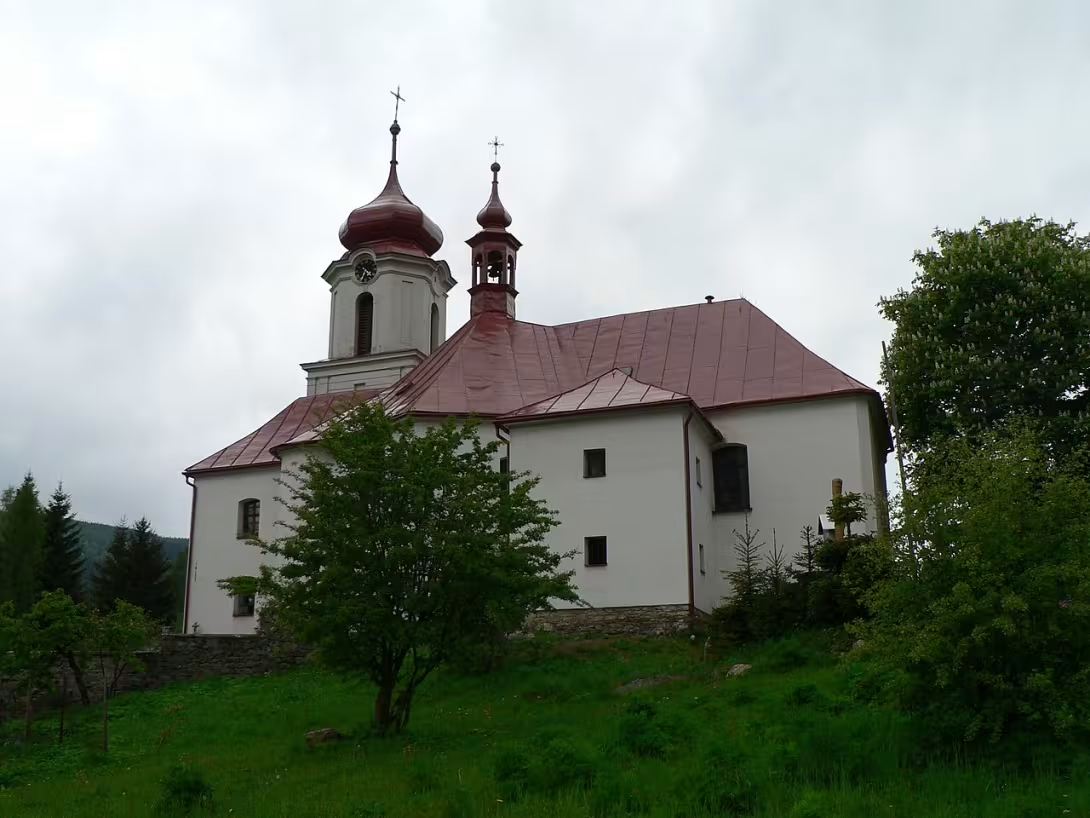
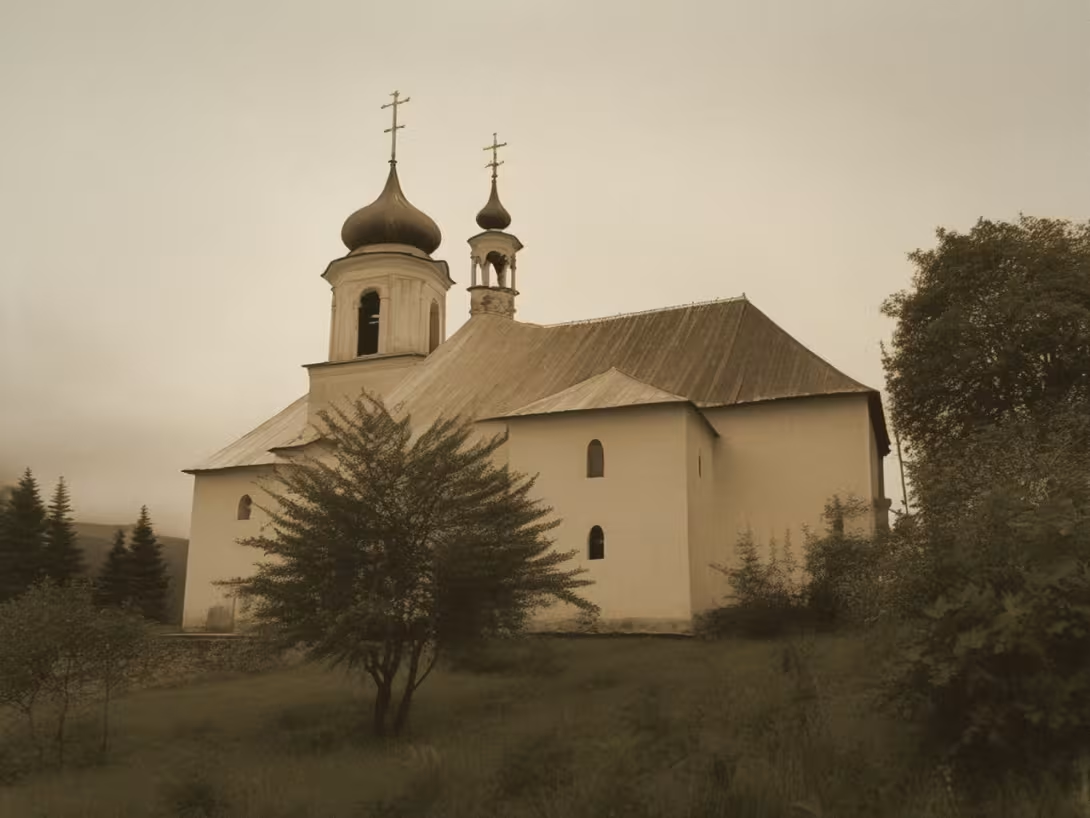
The historical appearance on the left is an AI-generated visualisation and serves as inspiration only.
Historical milestones
- 1689
- The foundation of the church of St. John the Baptist in the village of Špiclice (today Nová Seninka).
- 1901
- The position of the tower on the north side of the hall.
- 1958
- Putting the church on the list of cultural monuments.
Architectural development
The original single-boat church from 1689 was gradually supplemented with chapel and hall. The tower was built around 1901 according to the design of builder Fr. Gröger from Jeseník. The facade was restored in the mid-1990s. The construction is plastered and covered with a wall roof with a sandbox.
Historical events
- 1766
- Granting a locale where the church was assigned a separate chaplain.
- 1784
- Establishing a rectory in New Seninka.
- 1958
- Putting the church on the list of cultural monuments.
Points of interest
- The Church of St. John the Baptist is a unique Baroque building from 1689, built after a 30-year war.
- Originally a single-boat church was gradually supplemented, in 1766 it acquired a local area and in 1784 there was a parish.
- The original layout is architecturally marked: the boat has a rectangular floor plan with caples on the north and south side and in front of the western front is a storey hall with a crust.
- The tower, built around 1901, is four-sided, four-storey, and ends with onion fighting with poppy and cross.
- The interior is richly decorated, for example the main altar of St. John the Baptist, which is wooden, polychrome and gilded.
Guide
This guide is narrated by a synthetic voice generated by artificial intelligence.
Show guide text
This text was created by artificial intelligence and has not been editorially reviewed. It may contain inaccuracies.
The Church of Saint John the Baptist in Nová Seninčka is a single-nave Baroque structure from the year 1689 with an originally designed layout. Since 1958 it has been a cultural monument.
When the church was built, the village was called Špiklice, or Spieglitz in German. It was renamed Nová Seninčka only after 1945 by settlers from Valašsko. The church's foundation deed dates only from 1766. At that time the church acquired what is called a lokálie, meaning its own chaplain. In 1784 a rectory was established here. The bell tower was added at the turn of the nineteenth and twentieth centuries and the facade was renovated in the mid-nineties. Today the church belongs to the parish of Staré Město and services are held there only exceptionally, for example during the June pilgrimage on the feast day of John the Baptist.
The church stands on a sloping cemetery. It is whitewashed and covered with a red hipped roof with a sanctuary. The rectangular nave has a straight choir on both sides. A peculiarity are the side chapels on the southern and northern sides, which have the ground plan of a right-angled triangle. In front of the western facade is a two-story vestibule. On its floor is a gallery, reached by a spiral staircase in a cylindrical extension. A stone staircase leads up to the main entrance. A four-story bell tower with a clock was later added to the north side of the vestibule, topped with an onion dome, a finial and a cross. Next to the presbytery is a two-story extension with a sacristy on the ground floor and an oratory on the upper floor.
The nave inside has a flat ceiling, the presbytery is vaulted with a barrel vault with lunettes. The windows are decorated with stained glass depicting saints. In the presbytery they are John Nepomucene and Francis Xavier, in the nave Aloysius, Theresa, Barbara and Boniface.
The wooden, polychrome and gilded main altar was created at the turn of the nineteenth and twentieth centuries by sculptor Korsitzký. In the center is a group of Christ and John the Baptist, on the sides statues of Saint Joseph and the Virgin Mary. The side altar of the Virgin Mary from 1901 was carved by Adolf Langer.
The most remarkable piece of furnishing is the pulpit from the thirties of the eighteenth century. Its base is a white polychrome figure of a woman in life-size, who bears the pulpit with raised arms. From the same period comes a painting of Saint Francis Xavier by Jan Drechsler. On the gallery stands an organ from the year 1900 from the workshop of Franz Kolb and sons from Pekařov.
Tips for visitors
The best time to visit the church of St. John the Baptist is during the morning hours after Saturday or Sunday Mass, when the interior is illuminated by pleasant light and there is a quiet environment. In the summer months it is ideal to visit the church early in the morning or in the evening when the weather is pleasant outside while avoiding the heat. The Baroque interior comes out best in the natural light that passes through the window windows. In winter, the visit is suitable after mass, when the church is often free and you can see detailed decorations without crowds.
It is recommended to arrive by road from New Seninka towards the church where you will find the signs. The location can also be reached by public transport; the current connection can be found in the traffic search engine. The stops are usually in the centre of the village, from where the church is only a short walk along the walking path.
When visiting, take comfortable shoes because the church is standing on a narrow cemetery terrain and the path to it may be slightly uneven. Next, bring a small umbrella or a light umbrella raincoat because the church is located in a rural location where the weather can be unpredictable. Prepare a macro lens to capture details of Baroque decoration such as statues or paintings on the ceiling.
The best places for photography are the entrance portal of the church, where the sculpture decoration is located, and the interior with side caples. For quality images it is ideal to use natural light from window holes, especially in the morning. Internal photography is allowed, but avoid lightning to damage sensitive surfaces. The exterior looks best at sunset when lighting white plaster church.
In the vicinity of New Seninka is worth visiting the parish church of St. Jacob the Greater in Old Town near Jablunkov, just about five kilometers from the church of St. John the Baptist. This Baroque church from the 18th century offers a similar atmosphere and is part of the same parish. It is advisable for families with children to visit both places as they offer a combination of cultural and natural experiences.
For families with children, a visit to St. John the Baptist Church is interesting because of its historical importance and the possibility of exploring Baroque architecture. Children can see the statues of the saints and try to identify them or listen to the stories associated with the church. In the surroundings it is possible to play in the cemetery, which is part of the area, so that children can enjoy a small adventurous walk. When visiting the church of St. Jacob the Greater in Old Town near Jablunkov, the children can also see its large tower, which is an interesting dominant feature for them.
Frequently asked questions
Can the monument be visited?
Religious buildings are usually open mainly during services; at other times a visit is normally arranged with the parish or the operator. We have not verified specific times.
Where is the monument?
Location: Nová Seninka, Olomoucký kraj. The map on this page shows the exact spot.
Why is the monument protected?
It is listed in the Central List of Cultural Monuments of the Czech Republic as a cultural monument (register no. 39302/8-1140).
For kids
About 337 years ago, in a small village of Nová Seninka, a wonderful church began to appear as if from a mysterious dream. It was in 1689 when craftsmen and masters of the building worked with love and enthusiasm for what eventually became the beautiful church of St. John the Baptist. This church was like a big game where every stone block had its place and everything together formed one stunning work.
Businesses nearby
Do you run a restaurant, accommodation, shop, museum, rental, wellness or other visitor service near this monument? Show yourself directly to the people heading to it — this is how they will see you in the app and on the web:
Nearby
- Baroque church from the 18th century, which belongs to the same parish.
- Protected land with rich flora and fauna.
Accommodation nearby
Themed route
Thematic tour around the parish church of St. John the Baptist in Nová Seninca
1. St. John the Baptist Parish Church (Nová Seninka) * Type: * Religious monument * Why is it worth visiting: * This Baroque church from the 18th century is not only the spiritual centre of the village, but also architectural pearls with rich historical layers and significant artistic value.
2. Parish Church of St. Jacob the Greater in Old Town near Jablunkov * Type: * Religious monument * Why is it worth a visit: * About 5 km from Nové Seninka is located this Baroque church from the 18th century, which shares a historical and spiritual connection with the parish church in Nové Seninka.
3. Natural Reserve Black Mountain * Type: * Natural landmark * Why is it worth a visit: * This protected area, about 7 km from Nové Seninka, offers a beautiful view of the diverse flora and fauna. It is an ideal place to relax in nature and explore local ecosystems.
This route combines a visit of spiritual monuments with a natural experience, allowing travelers to know both the cultural and natural wealth of the region.
Seasonal recommendations
Spring During the spring, the church of St. John the Baptist in Nové Seninka is dressed in a green dress, when its surroundings turn into a blooming landscape with young leaves and first flowers. The sunlight penetrates through the stained glass and creates a color game on the stone walls, while the bell tower rises over flowering trees. The atmosphere is quiet and refreshing, ideal for walking around the surrounding fields where the summer crowds have not yet appeared. It is recommended to visit the church early in the morning when the air is clean and light softer, and avoid rainy days when roads can become muddy. Suitable is light but warm clothes - spring weather is usually variable, and even when the sun shines, evenings can be cold.
Summer In the summer months, the church becomes a centre of living atmosphere, where visitors come not only for its historical value, but also for pleasant sitting in its shadow. The warm sun illuminates the facade and creates warm reflections on the stones, while the interior has a pleasant semi-shade, ideal for a short relaxing moment. The surrounding area is green and full of life, but in the main summer season (July-August) may form queues at the entrance, especially in the noon hours. It is recommended to come early in the morning or late in the afternoon when the church is calmer and warmer. Light, breathable clothes and comfortable shoes, or a sun hat are suitable.
Autumn Autumn brings golden and red colors to New Seninka, which are reflected in the church windows and create a magical atmosphere. The sun sets earlier, and so the church is besieged by a soft, radiant light that highlights its architectural details. The air is clean and cold, ideal for quiet tours without summer crowds. At advent time, there is a quiet pre-Christmas mood around the church, but without disturbing markets. It is recommended to visit the church in the morning, when the light is the most beautiful, and prepare your warmer clothes - evenings are cold, and even when the sun is shining, the wind can be piercing.
Winter The winter landscape around the church of St. John the Baptist turns into a white desert, when the snow cover highlights its sober shapes and the bell tower stands as a guardian of peace. Freezing air creates ice patterns on the stained glass that give the church a mysterious atmosphere. It is recommended to visit it in the afternoon, when the sun still shines long enough, and dress up in warm but comfortable layers - temperatures may fall below freezing. It is also convenient to visit the church before Christmas, when the surrounding area is spread quiet, Christmas mood without large crowds.
Visualizations and artistic views


The visualisations are generated by artificial intelligence and serve as inspiration.
Photos from the area
Real photos taken near the monument


Zdroj a licence jsou uvedeny u každého snímku.
Atmosphere of the place
This atmospheric visualisation of the place and period was generated by artificial intelligence. It is not real footage of the location.
Tips from visitors
No tips yet. Be the first!
Log in and add your tip.
Sources and literature
Photos: Martin Vavřík / Public domain — Wikimedia Commons. The author and licence also appear when you hover over the image.
Faktickým podkladem tohoto textu byl článek na Wikipedii, jehož autory jsou přispěvatelé Wikipedie. Článek je dostupný pod licencí CC BY-SA 4.0.
Location on the map
Příběhy a pověsti
Legendy, pověsti a příběhy spjaté s touto památkou
Fotografie návštěvníků
Zatím žádné fotografie. Buďte první, kdo přidá fotografii z návštěvy!
Log in a přidejte svou fotografii nebo hodnoťte.
Za ověřenou návštěvu v aplikaci získáte víc bodů — poznáme podle GPS, že jste na místě.
Reviews and comments