



Kostel svatého Jiljí (Dvorce) Church
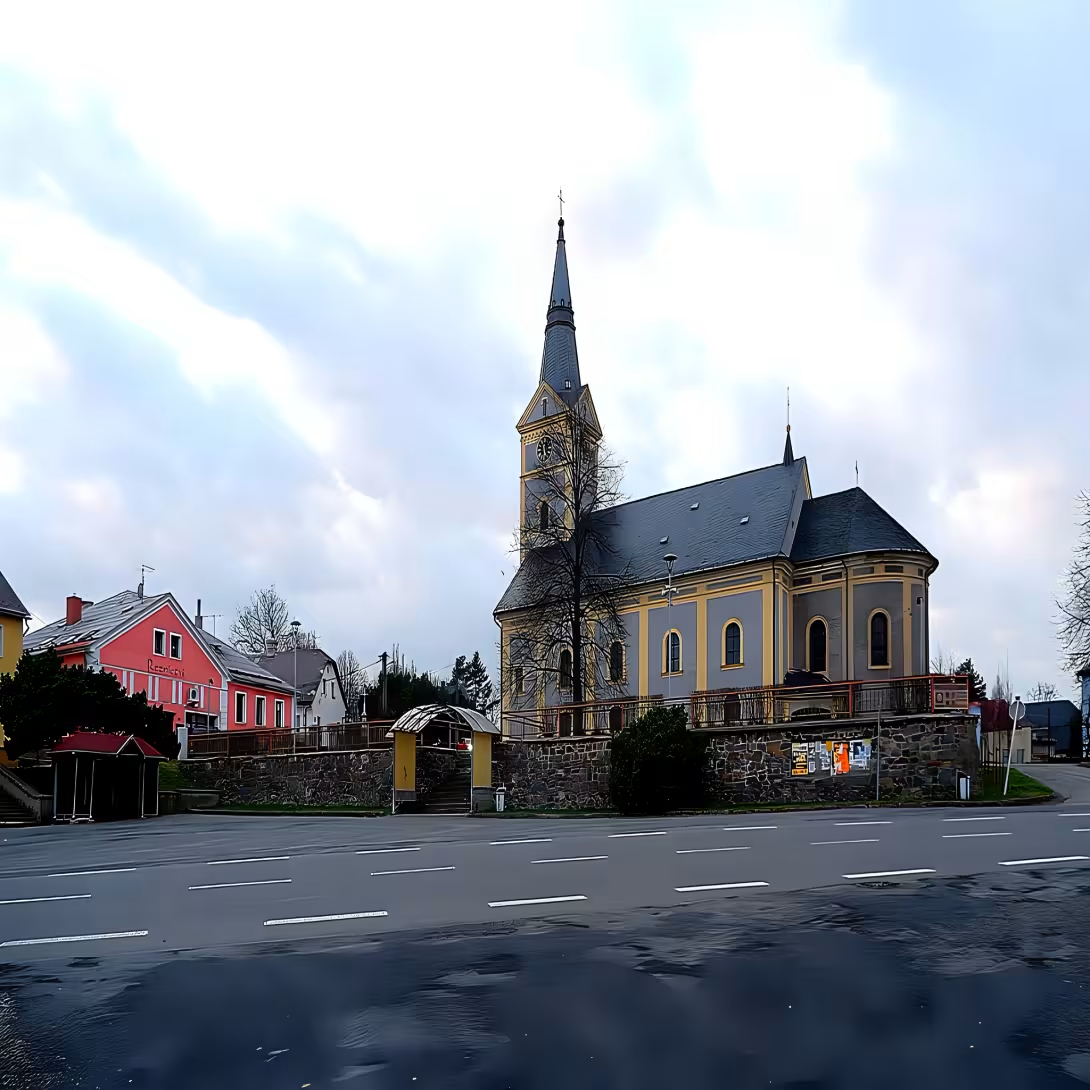
The Church of St. Jilje is located in Dvorce near Bruntál. According to the written reports, Dvorce had a rectory since 1339. During the 16th century Lutheranism was established here - since 1538, the Lutheran priest Jan Taufer has been vicar. From the same time came the tower, which later became part of the western facade of the church. The process of reCatholisation began in 1630 when a Catholic vicar was added to the village.
The decisive turning point came in 1751, when a massive fire destroyed the entire city, including the older church. In his place, a new temple was built between 1753 and 1755 under the patronage of Prince Václav Liechtenstein. The construction represents a single-boat, classicist, oriented building with a half-circle priesthood. The north side is adjoining the sacristy with an oratory on the floor. In the priesthood there is a stone with the year 1753, which resembles the time of origin.
During the next century, the church again faced an attempt at destructive force. Another fire hit him in 1834. The reconstruction was financed by Prince Jan Josef Liechtenstein and in 1858 the temple was reconsecrated. In 1888 the original tower from the 16th century was increased by the bell floor in the neo-gothic style and equipped with a new clock machine from the workshop F. X. Schneider from Bruntál.
The interior is richly equipped. The organ from 1757 comes from the Lobgesanga workshop from the Angel Mountain and has 14 registers. In 1840 they were supplemented by new organamas from Franz Harbich of Brno, in which the carvers Antonín Sabinský of Budišov and Josef Jahn of Dvorce participated. The bells went through transformations - the original bells of 1837 from Wolfgang Stanka of Olomouc were recited for military purposes during the First World War. In 1925 they were replaced by new bells from the Chomutov company Richard Herold. The main altar made in 1897 by Ferdinand Stufflesser was replaced at the beginning of the 21st century by an altar transferred from the church of St. John Nepomucký from Karlovy Vary.
The last significant renewal took place between 2011 and 2012, when the roof of the tower, the facade and the tower clock were restored. The work took down the historical standard on which the dates of earlier repairs were engraved (1698, 1826, 1837) and 1755. The replica of the boulder was returned to its original place and a box with contemporary documents and coins was inserted into the tower. The church keeps the memory of centuries of local history.
Then and now
Drag the slider to compare how the landmark may have looked when it was built with the view today.
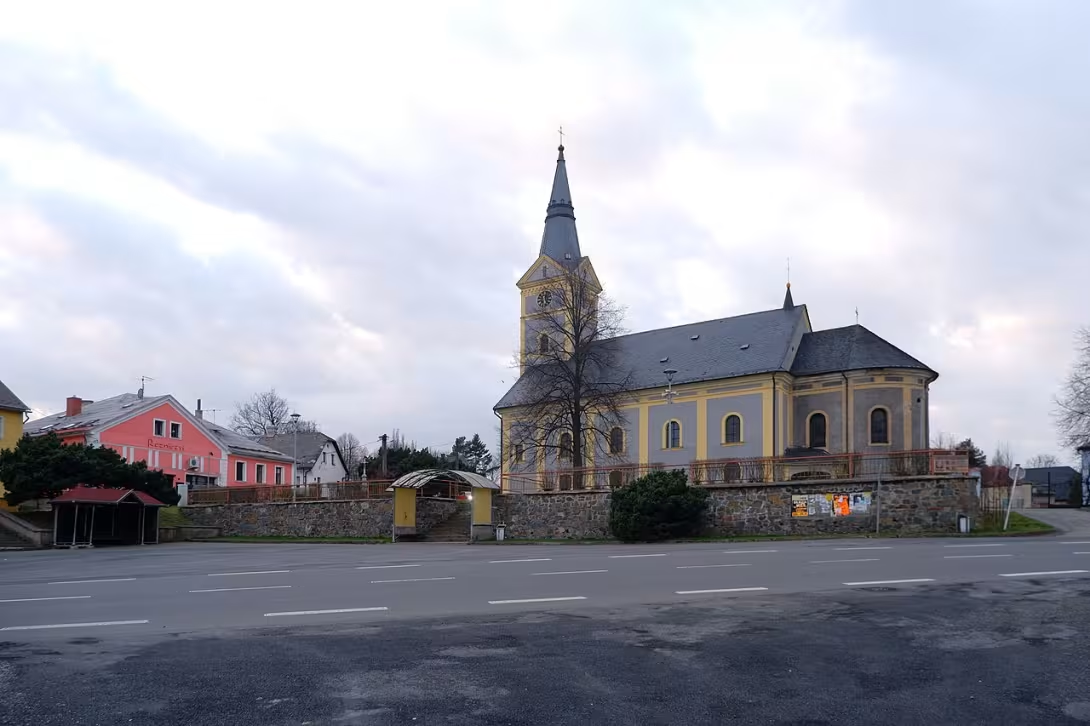

The historical appearance on the left is an AI-generated visualisation and serves as inspiration only.
Historical milestones
- 1339
- First written mention of the parish in Dvorce
- 1538
- Introduction of Lutheranism in Dvorce, vicar Jan Taufer
- 1630
- Start of reCatholisation, establishment of a Catholic priest
- 1751
- Big fire destroyed old church and town
- 1753-1755
- Status of the new Classicist Church of St. Gilji
- 1834
- Fire and subsequent repair of the church
- 1888
- Increase tower by bell floor and installation of clock
- 2011-2012
- Restoration of tower, facades and tower clock
Architectural development
The church was built in 1753-1755 as a classicist one-boat building with a half-circle priesthood. The tower dates from the second half of the 16th century and was later extended by the bell floor in the neo-gothic style (1888). The interior contains an organ from 1757 and several altars, the last of which dates back to the 21st century. The roof and facades underwent extensive reconstruction in 2011- 2012.
Historical events
- 1339
- First written mention of the parish in Dvorce, originally wooden construction
- 1751
- Big fire destroyed old wooden church and the whole city
- 1834
- The fire damaged the church, followed by repairs for the patronage of Prince Jan Josef Liechtenstein
- 2011-2012
- Restored tower, facades and tower clock was restored
Points of interest
- The church was built between 1753 and 1755 after a great fire from 1751 which destroyed the older temple.
- In 1834 he was once again destroyed by a fire, after which he was financed by Prince John Joseph Liechtenstein.
- In 1888, the original 16th century tower was expanded with a neo-gothic bell floor with clock machine from Master F. X Schneider from Bruntál.
- The organ from 1757 comes from the Lobgesanga workshop from the Angel Mountain and has 14 registers.
- The historical tower bays are engraved with repair data from the years 1698, 1826, 1837 and 1755.
Guide
This guide is narrated by a synthetic voice generated by artificial intelligence.
Show guide text
This text was created by artificial intelligence and has not been editorially reviewed. It may contain inaccuracies.
The Church of Saint Aegidius in Dvorce near Bruntál was built between 1753 and 1755 on the site of an older church. Today it is a cultural monument of the Czech Republic.
According to written records, a parsonage in Dvorce is documented as early as 1339. The original church was wooden and was later replaced by a stone structure. In the second half of the sixteenth century, a tower was added to it. At the same time, Dvorce was Lutheran. Lutheranism was introduced there from 1538 by the vicar Jan Taufer. A turning point came in 1630 when a Catholic vicar took office in the town and began the recatholization.
In 1751, the entire town burned down, including the church. A new church then arose under the patronage of Prince Václav Liechtenstein. It too did not escape fire. In 1834 it was damaged by another fire. This time the repair was overseen by Prince Jan Josef Liechtenstein, and in 1858 the church was reconsecrated. In 1888, the tower received a new bell chamber.
Between 2011 and 2012, the roof of the tower and the façades were repaired. Restorers also put the tower clock back into operation. During this work, a weather vane was removed from the tower. Dates of earlier repairs were carved onto it, 1698, 1826, and 1837, and the year 1755 was engraved. Documents from 1888 were found in a box in the cupola. A replica of the weather vane was then returned to the tower, and a new box with period documents and coins was placed in the cupola.
The church is a single-nave neoclassical structure, oriented to the east, with a semicircular choir. A sacristy with an oratory on the upper floor adjoins it from the north. A stone with the date 1753 is placed in the choir. A prismatic tower from the sixteenth century stands in front of the western façade. Its neo-Gothic bell chamber from 1888 was also fitted with a clock mechanism manufactured by the Bruntál company Schneider.
New bells were cast in 1837 by Wolfgang Stanek from Olomouc. However, the army confiscated them during the First World War for military purposes. Further bells were made in 1925 by the company Richard Herold from Chomutov.
The first organ with fourteen stops was built in 1757 by Lobgesang from Andělská Hora. In 1840, it was replaced by a new instrument by Franz Harbich from Brno. The woodcarving work on it was carried out by Antonín Sabinský from Budišov and Josef Jahn from Dvorce.
The main altar was moved in 1897 to the Chapel of Saint Catherine. A new altar by Ferdinand Stufflesser was created in its place. At the beginning of the twenty-first century, it was replaced by an altar from the Church of Saint John of Nepomuk in Karlovec.
Tips for visitors
The best time to visit the church of St. Jilje in Dvorce is during the spring and summer months when the outdoor light is pleasant and nature around the monument is full of beauty. In summer there are often services outside that offer a unique atmosphere. In winter the church is suitable for a visit in sunny weather, where the light better illuminates the interior and highlights its classicist details.
The church is accessible by car and public transport. The church is easily accessible from Bruntál as it is located only ten kilometres from the city.
Take comfortable shoes when visiting because the church and its surroundings are partly outdoor and the terrain can be uneven. It is often cold in the interior, so bring a light sweater or sweater. If you are planning photography, do not forget the mobile charger because some parts of the church may be less illuminated.
Photography in the church of St. Jilji is permitted, but it is recommended to search for places with natural light such as window holes or entrance space. The best time to take pictures is in the morning or in the afternoon when the light is softer and does not flash directly into the lens. In the interior avoid flashing of lightning to avoid damage to sensitive surfaces.
The city of Bruntál, located just ten kilometres from the Dvorce, is worth visiting around the church of St. Gilji. Here you will find the historical castle Bruntál and the Church of the Assumption of the Virgin Mary.
For families with children, a visit to the church of St. Gilje is interesting thanks to its simple architecture and quiet atmosphere. Children can see the interior of the church and learn more about its history. In Bruntál you will find other interesting places that can take children, such as the local museum.
Frequently asked questions
Can the monument be visited?
Religious buildings are usually open mainly during services; at other times a visit is normally arranged with the parish or the operator. We have not verified specific times.
Where is the monument?
Location: Smetanova, Dvorce, Moravskoslezský kraj. The map on this page shows the exact spot.
Why is the monument protected?
It is listed in the Central List of Cultural Monuments of the Czech Republic as a cultural monument (register no. 11154/8-3902).
For kids
Imagine coming back 273 years, until the church of St. Jilji was still young and full of life in the Dvorce near Bruntál. Back then, there were many people who worked in the fields and in the woods, and those who came to town to buy or sell things.
The church was like a small wooden building back then, but it was already so amazing that people from around here came to pray and celebrate their anniversary. And then, in 1753, it was time to build a new church that could consume everyone who lived here.
Businesses nearby
Do you run a restaurant, accommodation, shop, museum, rental, wellness or other visitor service near this monument? Show yourself directly to the people heading to it — this is how they will see you in the app and on the web:
Nearby
- Historical city with a number of cultural monuments such as the castle Bruntál or the Church of the Assumption of the Virgin Mary.
- Protected area with rich flora and fauna, ideal for tourist trips.
- Baroque church with significant historical value.
Accommodation nearby
Themed route
Thematic cruise route from the village Dvorce
1.Kostel svatého Jiljí (Dvorce) * Type: * Church * Why is it worth visiting: * This church is an imaginable example of sacral architecture in the area. Its history and artistic elements, such as statues and interior, offer a view of the past of this part of Moravia.
Bruntál * Type: * City * Why is it worth visiting: * Bruntál is a historic city with a rich cultural offer. Visit the chateau, which attracts attention with its architecture and history, or the Church of the Assumption of the Virgin Mary, whose important building is an important part of the city's face.
3. New Hermes * Type: * Natural reservation * Why is it worth a visit: * This protected nature offers an unforgettable experience of meeting rich flora and fauna. It is an ideal place to relax in nature, where you can enjoy beautiful views and quiet moments.
This route offers a combination of cultural and natural experiences that are easily accessible from Dvorce.
Seasonal recommendations
Spring: In the spring season, the Church of St. Jilje in Dvorce will turn into a shining flower paradise when the surrounding meadows and groves come to life with a diverse flora. Sun rays illuminate the architectural details of the church, creating a magical atmosphere for visitors. Nature is in full bloom and if you visit the church in spring, you can enjoy a quiet moment without too many crowds.
Summer: The Church of St. Jilje is becoming a popular destination for visitors looking for shelter from the summer sun smell. Fully lit by the sun church offers impressive views and creates a pleasant environment for relaxation on its surroundings. In this season it is advisable to visit the memory early in the morning or late in the evening to avoid the peak of the crowds at noon. Light and light clothing is recommended along with sun protection as a hat or a parasol.
Autumn: In autumn, the Church of St. Jilje offers a unique view when tree leaves in the surroundings turn into golden and red shades. The sunny days are warm and pleasant, but the nights can cool quickly, so it is good to remember a suitable suit for changing weather. The atmosphere this season is calm and intimate, allowing you to enjoy the church without obstacles to crowds. Visiting a memory in autumn, you can also notice wonderful light effects, when the sun's rays light through the leaves.
Winter: Winter brings a mild atmosphere of peace and quiet to the Church of St. Gilya in the Court. The sun illuminates the church with fine rays, which are projected on a snowy background. Hot clothes with solid protection against cold are essential, especially if you visit the church on a freezing winter day. Despite a shorter time of openness, the winter offers a quiet and intimate environment for the use of the sights without obstacles to crowds.
Visualizations and artistic views


The visualisations are generated by artificial intelligence and serve as inspiration.
Photos from the area
Real photos taken near the monument


Zdroj a licence jsou uvedeny u každého snímku.
Atmosphere of the place
This atmospheric visualisation of the place and period was generated by artificial intelligence. It is not real footage of the location.
Tips from visitors
No tips yet. Be the first!
Log in and add your tip.
Sources and literature
Photos: Kamil Czaiński / CC BY-SA 4.0, rozlišení zvýšeno umělou inteligencí — Wikimedia Commons. The author and licence also appear when you hover over the image.
Faktickým podkladem tohoto textu byl článek na Wikipedii, jehož autory jsou přispěvatelé Wikipedie. Článek je dostupný pod licencí CC BY-SA 4.0.
Location on the map

Příběhy a pověsti
Legendy, pověsti a příběhy spjaté s touto památkou

Fotografie návštěvníků
Zatím žádné fotografie. Buďte první, kdo přidá fotografii z návštěvy!
Log in a přidejte svou fotografii nebo hodnoťte.
Za ověřenou návštěvu v aplikaci získáte víc bodů — poznáme podle GPS, že jste na místě.
Reviews and comments