






Malá Dobrá Granary
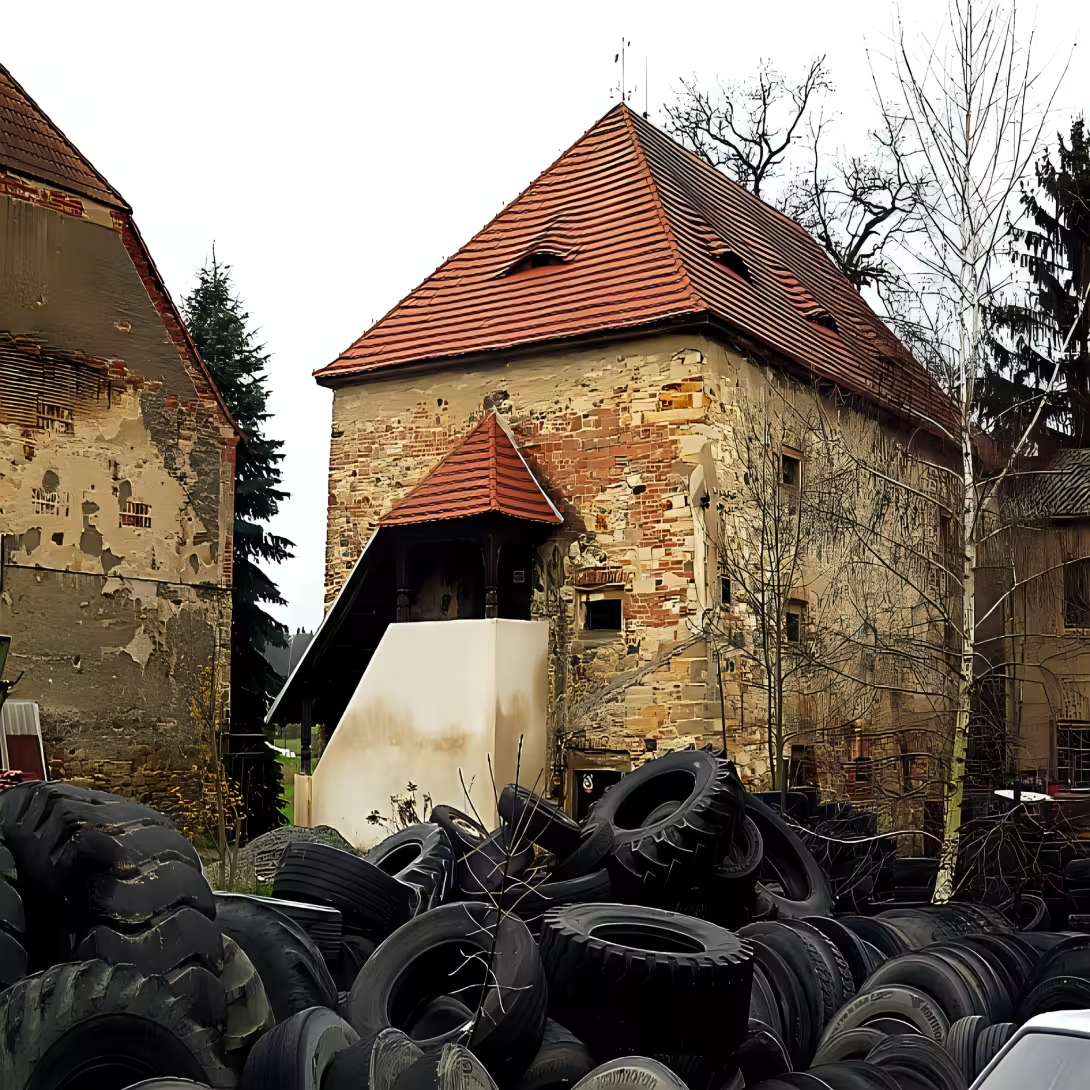
Malá Dobrá is a granary in the municipality of Velká Dobrá in Kladno district. Originally there was a medieval fortress serving as a mansion. The building is a significant transformation from the residential fortress into an agricultural building and since 1978 it has been protected as a cultural monument.
In historical sources, the history of the villages Great and Malá Dobrá cannot be unequivocally separated from the fates of local flags. The first written mention of the fort in Malá Dobra dates back to 1396, when it belonged to Drach from this place. Jan Chípan from Malá Dobrá also appeared in 1406. During the Hussite wars, Bohuslav ze Tmáně became the owner, who in 1453 obtained death after Drch from King Ladislav Pozrok. His descendants, called Dobrsky of Dark, owned the village until 1499.
After Bohuslav of Dark in 1499, William Hromada of Boršic was based on the fort and Jiří Kfelíř of Zakšov since 1519. After his death, the estate was managed by guardian Peter Malý of Chrast. In the 1930s he sold part of Malá Dobrá Zdeněk Kladenský z Kladno, which subsequently joined the castle to the Kladno estate. In 1544 the forts in the Small and Great Good were listed as desolate in the inscriptions to the Earth's boards. Later the rest of the village was acquired by the brothers Jiří and Kryštof Žďarský z Žďár. The first, Jiří, had the fort restored in the second half of the 16th century in the Renaissance style. The last mention of it dates back to 1613. During the 30-year war, the building was desolate. In the 1880s, or after 1696, when Karel Jáchym of Breda acquired it, it was converted into a granary.
The original building of the fortress dates from the pre-Hussite period. It was made up of a tower with a square ground with a side of approximately ten meters. The ground floor of the tower was ventilated by a single shooting window and the entrance to the building led to the first floor. It is assumed that the second and probably third floor were also residential. The form of the fortifications is not exactly known, but the presence of a stream and a nearby pond suggests that water played an important role in defence. At the time of the Renaissance, the tower on the south side was extended with an extension with its own entrance on the ground floor. During this reconstruction, the south wall of the tower was weakened, which led to its reduction for the height unification of the new building.
The current three-storey granary has a rectangular surface and a valbic roof covered with bimos. The first floor is accessible by a stone-covered staircase with a rectangular entrance to the ground floor. On the ground floor, there are two rooms: the north is equipped with a vaulted arch with sections, while in the south there is a cross vault with a central pillar. Both upper floors have beam ceilings and were used to store grain; They are connected by the inner wooden staircase.
The monument presents an interesting example of architectural transformation from the mansion to the farm building. It is an important witness to the historical development of the region and offers insight into building processes from the Middle Ages to the Renaissance. The building is worth visiting anyone interested in the transformation of historical construction.
Historical milestones
- before 1419
- The creation of the original residential tower of the fortress in the prehussite period
- 1396
- First written mention of the fort in Malá Dobrá
- 1453
- _
- 1544
- The hardships in Small and Great Good are listed as desolate in the inscription of the Earth's plates
- Second half of the 16th century
- Restoration of the fort in Renaissance style for Jiří Žďarský z Žďár
- Around 1696
- Rebuilding the building into a granary after obtaining the Charles Jáchym building from Breda
Architectural development
The fort in Malá Dobra originally had a tower form which was extended during the Renaissance. After the fortification of the fort, it was converted into a granary with three floors and a valb roof covered with bobbies. The architecture reflects the transition from the defensive original state to the purpose of storing the grain.
Points of interest
- Originally there was a medieval fortress that turned into an agricultural building. The first written mention of Malá Dobrá's fort dates back to 1396. - In the second half of the 16th century, the fortress was restored in the Renaissance style. - After a 30-year war, the building was desolate and converted into a granary in the 1880s or after 1696. - The current three-storey granary has a rectangular surface and a valb roof covered with bimos.
Guide
Show guide text
This text was created by artificial intelligence and has not been editorially reviewed. It may contain inaccuracies.
Welcome to one of the most fascinating monuments in the village Velká Dobrá. You're standing in front of a building that looks like a simple granary at first glance, but its walls contain layers of history that go back hundreds of years. Stop for a moment, take a breath and feel the atmosphere of this place. What you see before you is not just an ordinary agricultural structure, but a silent witness to the transformations that our landscape, power struggles and everyday lives of people who lived here long before us.
When you look at this building today, you see a granary, but in your spirit, try to go much further, until before the Hussite wars, that is, the end of the 14th century. Just then, in the pre-Hussite period, there stood the original tower of the fortress. Imagine there was no place for grain in this place, but there was a symbol of power and security. The fort in Mala Dobrá was at that time a manor, a fortified home of nobility, to protect its inhabitants while demonstrating their position in the region. The first written mention of this place dates back to 1396, giving us a clear idea of how deep the roots of this monument are embedded in our history.
Now let's think about who lived here over the centuries. The history of this place is closely linked to the names of personalities who left a mark in the history of the region. Among them was Drch z Malé Dobré, who shared his fates with this place. Later, in 1453, Bohuslav ze Tmáně appeared here, which won the fort from King Ladislav Poztomek. At that time, the fort was still an important point on the map, a place where the management of the surrounding countries was decided. In later times Zdeňek Kladenský z Kladna joined the site here. Each of these men brought their own energy and influence to Little Good, reflecting the wider historical development of the entire region.
Now pay attention to the building itself. Although today it is protected as a cultural monument in the form of granary, its architecture is like a book in which it can be read. Take a look at the overall design and feel the robust construction. Although we do not know the names of the particular architects who worked on it, their work can be seen in the very essence of the object. In the second half of the sixteenth century, the fort underwent a significant renewal. At that time it was controlled by Jiří Žďárský ze Žďáru, which had the building rebuilt in Renaissance style. The Renaissance was a time of bloom, light and new aesthetics, and although the construction was primarily defensive and residential, it gained more elegant features during this period.
However, history is not only about flourishing, but also about decline. If you look at the 1544 records, you'll find something disturbing. In the records of the Earth's boards, the fortresses in the Small and Great Good are listed as desolate. Imagine the silence, the empty halls and the neglected walls that must have been seen at that time. It was a period of uncertainty when the nobility collapsed or was abandoned. Even though they were followed by Renaissance renewal, there was another big break, which was a devastating 30-year war. It was this conflict in the seventeenth century that perfected the fate of a fortress as a mansion. The building has become desolate again and its original functions as a castle or fortress have finally disappeared.
And here comes the most interesting transformation you can observe today. Around 1696, after the object was acquired by Karel Jáchym from Breda, there was a radical change. A building that once served to defend and represent the nobility was converted into a granary. It's a fascinating contrast, don't you think? Instead of knighthood armour, swords and gentlemen's feasts, a bag of grain began to compose here. Instead of strategic meetings, there was a discussion about how best to preserve the crop for the whole village. This transformation from military-residential building to an agricultural building is a unique example of how architecture adapted to the new economic and social needs of the time.
Stop at the walls and try to imagine the transition. Imagine how there could still be remnants of Renaissance details in one part of the building, while flour and grain dust began to accumulate around them. This granary is basically a layered archive. Under its present form, a medieval residential tower and a Renaissance residence sleep. It's a place where high nobility meets hard work farmers.
This transformation can create a certain mystery. Why was this building chosen to be converted into a granary and not completely demolished? Probably thanks to its robustness and quality of the original construction design, which survived even the worst period of wars. What we see today as a simple granary is actually a winner over time. She survived centuries, owners, wars, and regime changes.
Now that you know the story of this place, I suggest you go around the building from several sides. Feel its weight and think about how many generations of people have passed it. From knights in canvas armour to Renaissance aristocrats to village landlords who settled crops here in the 1880s. All these fates are encoded in these walls.
Malá Dobrá is today a silent witness to history that teaches us that nothing is permanent. Power changes, building functions transform, but the monuments remain to tell us the truth about our ancestors. It's a place that reminds us that even from ruins and wastelands, something useful can be created to serve the community for hundreds of years.
Thank you for joining me on this short journey in time. I hope you are interested in the story of this granary and that you are now looking at this building with different eyes. Now invited to further explore the surroundings of the village Velká Dobrá. Discover, perceive and look for clues of the past that surround us at every turn. I wish you a pleasant continuation of your journey and a beautiful day spent in our region. Goodbye.
Tips for visitors
The best time to visit Little Good is autumn or spring when the surrounding green and sunny days provide ideal light for photography. These periods also offer a calmer visit without large crowds of tourists.
Parking is possible to find near Great Good, where parking is available. For those travelling by public transport, the place can be reached by bus or tram; the exact connection should be checked in the current search engine.
When visiting, take a quality camera with you to capture historical details of the granary. It is also important to carry protective clothing and shoes suitable for walking on the lawn or rocks, especially in unfavourable weather.
The best place for shooting is for the granary to choose a time near dawn or dusk when light offers softer and warmer colors. When visiting you also notice panoramic views of the surrounding landscape.
In the vicinity of Malá Dobrá you can visit other historical monuments that are available within 30 minutes walk. These places offer an interesting view of the past and allow deepening knowledge of the region.
A short walk around the granary is suitable for families with children, where children can enjoy nature. Children can also enjoy a game of searching for historical details or imagining life at the time of the fortress.
Businesses nearby
Do you run a restaurant, accommodation, shop, museum, rental, wellness or other visitor service near this monument? Show yourself directly to the people heading to it — this is how they will see you in the app and on the web:
Nearby
XXXHistorical monuments (118)
- Saint Jan Nepomucký 0.1 km
- mohyl burial ground Hora 0.9 km
- monument to archaeological research 0.9 km
- Tomb of the maid 2.7 km
- Victims 3.2 km
- Tower Museum 3.2 km web
- Memorial to the victims of World War II 3.5 km
- Anton J. Cermás 3.8 km
- Ván Kamen 3.8 km
- sv Jan Nepomucký 4.1 km
- Memorial of the Soviet Army 4.2 km
- Bedřich Smetana 4.2 km
- Antonín Dvořák 4.2 km
- _ 4.3 km
- Marian sculpture 4.4 km
- Adéla Bondy 4.4 km
- Josef Bondy 4.4 km
- Gertrude Bondy 4.4 km
- Edita Bondy 4.4 km
- Bachrovna 4.7 km
Restaurant and catering (326)
- McDonald 's 0.5 km
- KFC 0.8 km
- Stop CaffexZ5ZX 0.8 km web
- Stop CaffexZ5ZX 0.8 km web
- Under Stars 1.7 km web
- Refreshments Na compostu 1.9 km
- Kožová Hora 1.9 km web
- U Chalupó 1.9 km Dukel 51 + 420312247035 web
- U Glasses 2.3 km
- Restaurant Maštal 2.3 km web
- Café of Mr Theodor 2.4 km Karlovy Vary 37 web
- Café Cake by Lucky 2.5 km
- U Šefčiček 2.5 km
- Sleták 2.8 km + 420 702 176 453 web
- Tyrol pubs 2.8 km
- Slovan 2.9 km
- Luckybooy - Daddy's Kitchen 2.9 km Ke stadionu web
- Novobar 3.0 km + 420 731 171 135 web
- Restaurant on Garage 3.0 km web
- Na Plutu 3.0 km
Accommodation (33)
- Sport Hotel Sletiště 2.8 km + 420 312 249 465 web
- Hostel U Konvalinků 2.9 km
- Hostel On the bell 3.0 km
- Golden selenium 3.1 km
- Hostel RacandaxZ4ZX 3.1 km
- Guesthouse Villa Sítna 3.3 km
- Hotel Kladno 3.4 km
- Area Botanika 3.5 km
- Guesthouse Tonichka 3.5 km
- _ 3.5 km web
- Guesthouse Iris 3.7 km
- Hotel Merkur 3.9 km
- Tourist hostel Centrum 4.2 km Váňova 322 + 420603816906 web
- Astra 4.3 km
- Guesthouse 68 4.5 km
- Ponte 4.5 km
- Hoffmann 4.6 km
- U Sajdl 6.4 km
- Bechner state 9.2 km
- Valek 12.3 km
▶ Rental and Sport (55)
- Horse sports grounds 2.7 km
- Kladno 2.7 km
- City Stadium Slevests 2.8 km
- Lane park 2.8 km
- Vavřinec, Beach club Kladno 2.8 km web
- Adventure Golf Upper Unthanks 2.8 km
- Tennis DLI Silečl 2.9 km
- TJ Slovan Kladno 2.9 km
- LTC Slovan Kladno 2.9 km
- Kladen sports hala 2.9 km
- Fitcentrum 2.9 km
- TJ New Town Kladno 3.0 km
- Sport hall BIOS 3.0 km
- SK Kladno 3.1 km
- Snowboard - skis - boty 3.1 km
- Sympa Sport2000 3.3 km + 420774829852 web
- Live in paintings 3.7 km
- Intersport 3.7 km
- Decathlon 3.8 km American 3252 web
- Sportisimo 3.9 km Petra Bezruče 3388 + 420226292590 web
© Tourism and Nature (205)
- Horax4ZX 1.1 km
- Veselov 1.6 km
- Kožová hora 1.9 km web
- Kožová hora 1.9 km
- Former barracks Kladno 3.0 km
- LEGO train stop 3.1 km
- Park Kovarna 3.2 km
- Radio Relax 3.4 km
- Jama Zippe 3.4 km
- Park Siten Valley 3.5 km
- Jama Amalia 3.6 km
- Park u Kauflandu 3.7 km
- square 17. 3.8 km
- nu. Karla Kindla 3.8 km
- Jama Bresson 3.8 km
- Park Zoological 3.8 km
- nu. Edvard Beneše 3.8 km
- Horka 3.8 km
- Jama Herget 3.9 km
- Svody 3.9 km
Accommodation nearby
Trips and activities nearby
Guided tours, tickets and activities nearby from GetYourGuide
Affiliate link: if you buy from the partner, we may receive a commission. The price for you does not change.
Search tours and activities →Themed route
1. Tank granaries Malá Dobrá, area: The first stop that allows you to view the exterior architecture and the entrance part of the monument. 2. Internal exposure of granary Malá Dobrá, museum space: A tour of historical rooms where interesting objects are exposed. 3. Tower granary Malá Dobrá, prospect: Final point of the route offering a view of the surrounding landscape from a height.
Seasonal recommendations
In spring, the surrounding area of the granary is blooming in Malá Dobrá and Velka Dobrá, which creates a fresh stage for the tour. The soft spring light highlights the details of the buildings and the awakening nature gives new energy to the place. We recommend to dress in layered clothes, so that you don't get caught by the weather, and set off in the morning when the air is the cleanest.
Summer months bring bright sun and rich green meadows that contradict historical stone and wood. The atmosphere is playful and full of life, ideal for long walks around villages. Due to the increased attendance in the high season, come early in the morning to avoid the clumps of people, and don't forget light clothing and plenty of fluids.
Autumn season is characterized by golden leaves and morning fog, which give the monuments a mysterious and melancholy touch. Nature changes colors around the granary, which is the perfect time to photograph in warm afternoon light. The practical recommendation is to wear moisture resistant shoes and a warm sweater because it can be colder in the autumn wind.
In winter, the landscape in the Small and Great Good is often covered in snow, creating a calm and minimalist atmosphere. Historical buildings in the white duvet seem majestic and the surrounding area is simple of noise. It is necessary to choose warm clothes and count on shorter opening times, therefore we recommend a visit in the morning when the most light is.
Visualizations and artistic views

The visualisations are generated by artificial intelligence and serve as inspiration.
Photos from the area
Real photos taken near the monument

Zdroj a licence jsou uvedeny u každého snímku.
Tips from visitors
No tips yet. Be the first!
Log in and add your tip.
Sources and literature
Fotografie: Sovicka169 / CC BY-SA 4.0, rozlišení zvýšeno umělou inteligencí — Wikimedia Commons. The author and licence also appear when you hover over the image.
Faktickým podkladem tohoto textu byl článek na Wikipedii, jehož autory jsou přispěvatelé Wikipedie. Článek je dostupný pod licencí CC BY-SA 4.0.
Location on the map
Příběhy a pověsti
Legendy, pověsti a příběhy spjaté s touto památkou
Fotografie návštěvníků
Zatím žádné fotografie. Buďte první, kdo přidá fotografii z návštěvy!
Přihlaste se a přidejte svou fotografii nebo hodnoťte.
Za ověřenou návštěvu v aplikaci získáte víc bodů — poznáme podle GPS, že jste na místě.
Reviews and comments