



Mauzoleum rodiny Kleinů Tomb
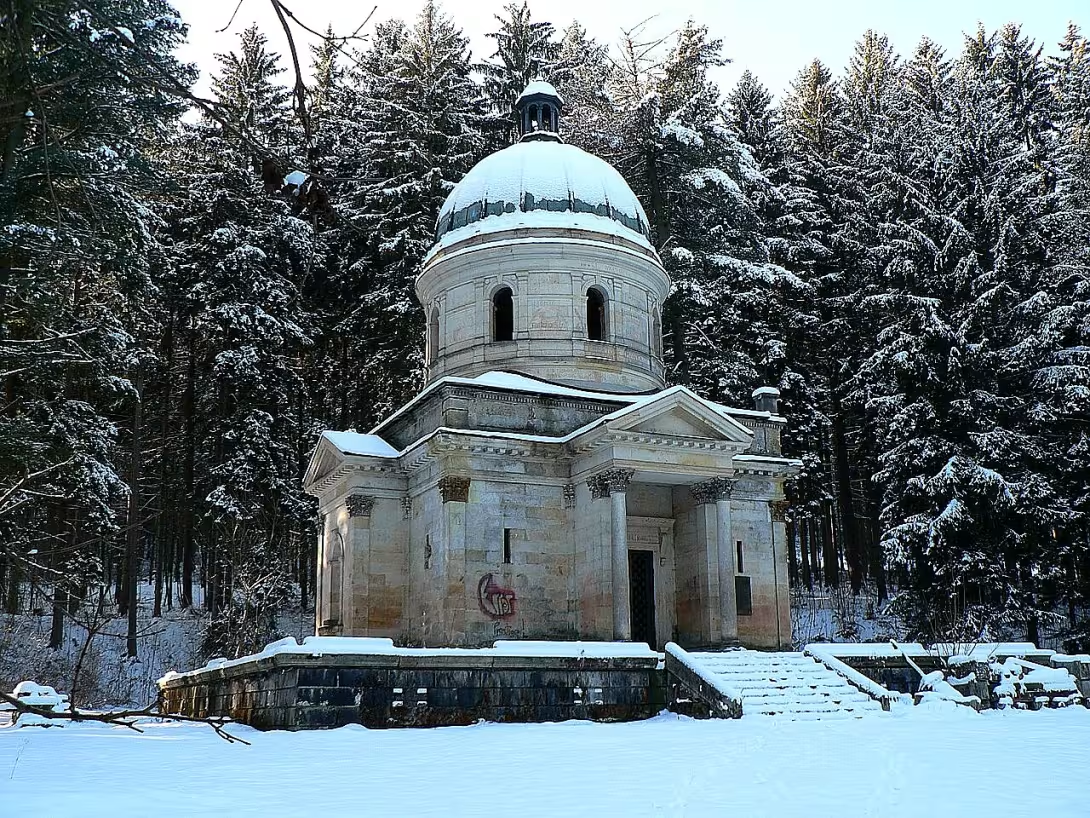
Mauzoleum rodiny Kleinů in the municipality of Sobotín in the district of Šumperk is a monumental tomb built in the historical style between 1881 and 1887. This monument served as a family burial site for the important Klein business family in North Moravia and is today a valuable document of secular architecture in the second half of the 19th century on the list of cultural monuments.
The original burial ground of the family based in Sobotín used to be a cemetery near the local church of St. Vavrnice. The family took over the patronage in 1844 when buying the Visberg estate. In the cemetery Albert Klein was buried, who died in 1877 as the first owner of the castle and one of the most successful members of the family. Although his heir Friedrich Klein did not have such a strong economic position, he showed his social status associated with a noble title. That's why he went to build a family tomb. Project documentation of the mausoleum and the park landscape was developed by the Vienna architect Wenzel S. Baumheyer in 1880. Due to the high financial costs, the construction extended to 1881 to 1887 and was not implemented in all the original details. There was no planned round pool with flower beds behind the entrance gate. The historical context of the late 19th century in Europe characterized the boom of industrial business and the rise of rich bourgeois families. At that time historism dominated architecture, which effectively highlighted the social position of owners.
The construction is located in an elevated area approximately half a kilometer south of the Saturday castle and consists of two parts. The crypt on the square plan is mostly embedded in the ground. A terrace with balustrade railing and four metal statues of angels that were destroyed after World War II ended above the surface. Above the crypt stands a brick chapel lined with granite and sandstone, carrying elements of Palladian architecture. The chapel has a square plan with two side capes, a chorus and a port under the main entrance; The dome on the tambura is closing it from the top. The pile is divided by pilasters, tambur breaks flat pilasters and the roof of the dome is metal, finished with lantern with cross. The entrance to the chapel led through the main staircase from the terrace, while the crypt entered from the back of the mausoleum. The interior of the chapel had relatively modest equipment and its artistic elements were mostly destroyed. However, the ceiling fresco with four scenes from the cycle The Torture of the Lord by Austrian painter Franz Jobst was well preserved. The crypt formed a central space, supplemented by a marble statue of an angel of life size and nothing intended for coffins.
The members of the Klein family remained owners of the building until 1945. In the autumn of 1887, the county police department in Šumperk allowed the remains of Albert Klein and his children to be placed in the mausoleum, transported from the cemetery at St. Lawrence's church. From there, the coffins of other members of the family buried in Prague or Krnov were gradually transported. The capacity of the tomb was set at 40 coffins, but due to excessive moisture, it stopped burying in 1919. Between 1927 and 1928, Klein had a costly reconstruction of the tomb, but the burial of the crypt was not restored.
The year 1945 became the key milestone in the fate of the monument, when on the basis of the Beneš Decrees the property of the Klein family was confiscated. The tomb remained freely accessible and became the target of thieves and vandals who completely destroyed the interior. In the 1950s, the entrance to the crypt was walled up at the order of the county hygienist. Yet people continued to infiltrate the building, opening coffins and trying to sell jewelry from stolen graves. In 1958, the tomb was listed on the list of cultural monuments. In the early 1960s, the National Museum in Šumperk showed an interest, which ensured the ultimate security of the tomb and the disposal of the remains of Klein into new coffins. In 1989 the municipality Sobotín took control of the construction. In 1999, with financial participation of the descendants of Klein living abroad, the remnants were transferred back to the cemetery at St. Lawrence's church, where the names of buried family members today resemble a commemorative plaque.
The National Monument Institute today classifies this monument as endangered because of its long-term unsatisfactory state. In the direction of the village Sobotín, long-term reconstruction takes place and the interior of the chapel is occasionally made available to the public. Visiting this place offers a view of the fated fates of a once influential business family and helps maintain awareness of the historical development of secular architecture in northern Moravia.
Then and now
Drag the slider to compare how the landmark may have looked when it was built with the view today.
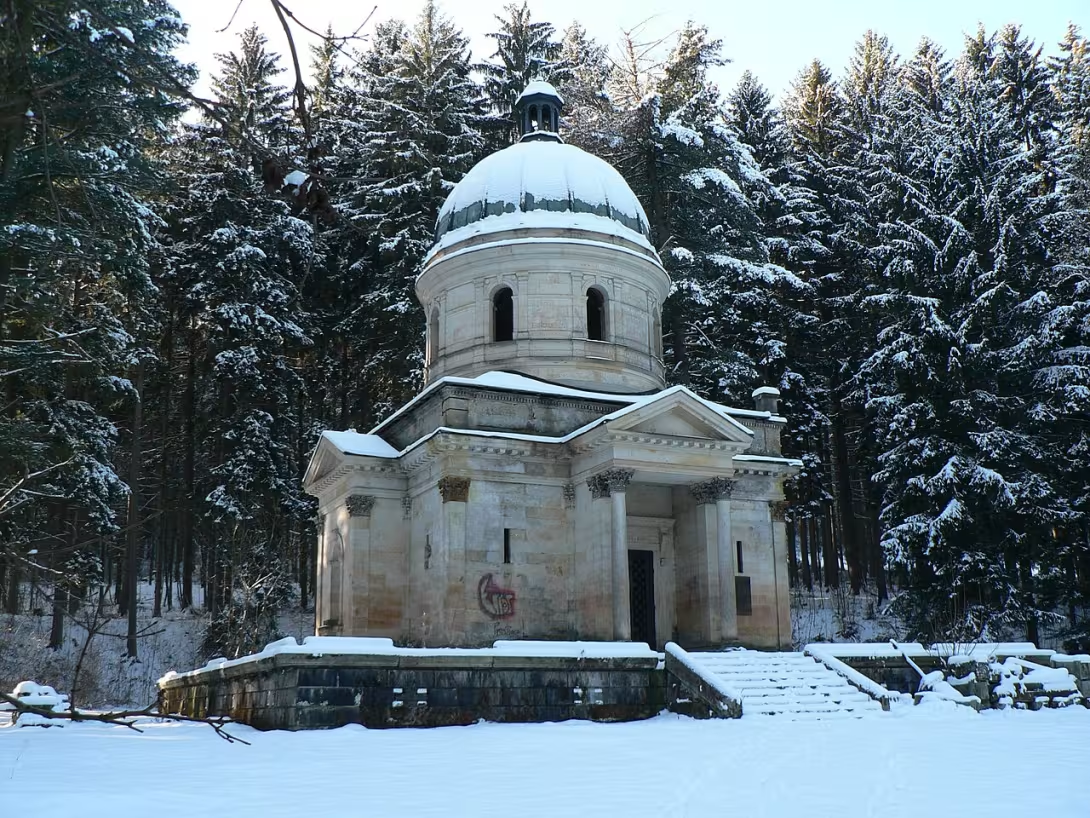

The historical appearance on the left is an AI-generated visualisation and serves as inspiration only.
Historical milestones
- 1880
- Development of project documentation by architect Wenzel S. Baumheyer.
- 1881
- Start of construction work.
- 1887
- Completion of craft work and permission to store the remains of Albert Klein and his children.
- 1919
- Termination of burial in the crypt due to excessive moisture.
- 1927
- Commencing expensive reconstruction of the tomb.
Architectural development
Construction in a historic style with elements of Palladian architecture. It consists of a square crypt embedded in the ground and an overhead brick chapel lined with granite and sandstone. The chapel is finished with a dome on the tamburo.
Historical events
1945: Confiscation of property based on Beneš's decrees and family relocations. 1958: Writing the building into the list of cultural monuments. 1999: Relocation of the remains of the Klein family to the cemetery at St. Lawrence's church.
Owners
The Klein family (until 1945), the municipality of Sobotín (since 1989)
Points of interest
- Mauzoleum rodiny Kleinů in Sobotín is a monumental tomb built in a historic style between 1881 and 1887. - Project documentation of the mausoleum and the park landscape was developed by the Vienna architect Wenzel S. Baumheyer in 1880. - Four metal statues of angels on the terrace above the crypt were destroyed after World War II. - The capacity of the tomb was set at 40 coffins, but due to excessive moisture, it stopped burying in 1919.
Guide
Show guide text
This text was created by artificial intelligence and has not been editorially reviewed. It may contain inaccuracies.
Welcome to Sobotín, where history touches the present and where silence speaks louder than words. Right now, at this peaceful moment, you're standing right in front of the Klein family's monumental mausoleum. Before you take another step, let yourself stand for a moment and perceive the atmosphere of this place. In front of your eyes is a building that immediately draws attention and requires respect with its size and dignity. It is a place that does not only act as a common grave, but as a powerful symbol of family pride and lasting legacy. Feel the weight of the history that is emitted from this place, and imagine all the moments that have happened here for decades.
This building is not a random work of architecture, but a deliberate expression of the importance of one of the most important families in the region. The Mausoleum was built between 1881 and 1887 as a family burial ground for the Klein family, which was in the nineteenth century a key player in the business world of North Moravia. These people shaped the economic face of the neighborhood and wanted to write their success in history in a way that would survive centuries. So they chose a monumental tomb that would prove their position and respect for their ancestors. The whole process started in 1880 when the first project documentation was prepared. The implementation itself then lasted several years and required a huge craftsmanship effort that we can only bend to today.
Now pay attention to the very form of the construction. If you look at her overall face, you'll see that she's built in a historical style. This style was very popular in the second half of the nineteenth century and was chosen precisely to give the construction a sense of grandeur and connect it to the traditions of the past. The whole project, including modifications to the surrounding park, was prepared by a significant Viennese architect Wenzel S. Baumheyer. His vision was ambitious and monumental, which is evident in how the building dominates its surroundings. Notice how this tomb is trying to act invincible and how harmonically it fits into its environment, even if it is absolutely exceptional in size. Architecture is not only a functional purpose here, but it is primarily a work of art that is meant to evoke emotions and honor the memory of those who rest here.
When you look at this place, you can try to get close in spirit to people whose names are inextricably linked to this tomb. Key personalities include Albert Klein and Friedrich Klein. It was for Albert Klein and his children that this place was designated as their last rest when they were first stored in the crypt in 1887. The Klein family was a symbol of growth and prosperity, and this mausoleum became their monumental signature in the landscape. Each stone and every line of this building bears a reflection of their ambitions and efforts to create something that takes longer than their own lives.
But there is also one fascinating and sad aspect of this place that gives its story depth. If you look at the terrace above the crypt, you can imagine what this place looked like at the time of its greatest glory. Once upon a time there were four beautiful metal statues of angels, which probably supplied an even greater spiritual and aesthetic nobility to the complex. Unfortunately, these statues were destroyed and are no longer there today, leaving a certain void in the overall effect of the construction, as if the site was still searching for its lost part. Another mystery chapter is the story of fighting the invisible forces of nature. In 1919 it turned out that the crypt had too much moisture, which made it impossible to continue burying. This problem was so serious that in 1927 it was necessary to start a very expensive reconstruction so that the tomb could continue to be used. It is a reminder that even the most monumental human creations must face a constant collision with the elements.
Today this mausoleum is protected as a cultural monument, which gives it another layer of meaning. Since 1958, this place has been recognised as an untouchable proof of our historical legacy. It is a place that teaches us about human ambition, about rise and decline, but also about trying to preserve the memory for future generations. You stand before a work that has survived its own era and that still stands as a silent witness to the changing world.
I hope this brief insight into the past has helped you better understand the importance and weight of this place. Continue to explore the surroundings, perceive the beauty of this park and let yourself be carried away by the atmosphere that this monumental mausoleum creates. Thank you for your visit and for taking the time to pay attention to this history. Goodbye.
Tips for visitors
For the best visual experience we recommend a visit on bright days, when natural light better accentuates the architecture of the monumental chapel. The ideal time is the morning when the light falls into the interior at an angle that underlines the historical character of the tomb. For photography it is best to choose the position of the external spaces, which will allow capture of the overall size of the construction.
You can reach the monument by car and public transport.
Since the mausoleum is described as bad, it is necessary to bring with you comfortable shoes suitable for uneven terrain. We also recommend having our own water.
After the tour you can visit Sobotín Castle or St. Vavranice Church, which are in close proximity. For families with children we recommend to prepare a short story about the history of the important business family of Klein, so that the visit is for the smallest interesting educational experience.
Frequently asked questions
Can the monument be visited?
Cemeteries and graves are usually accessible; please respect the dignity of the place. We have not verified the opening hours of this cemetery. According to the heritage register the structure is in poor condition – do not enter it and take care nearby.
Where is the monument?
Location: Sobotín, Olomoucký kraj. The map on this page shows the exact spot.
Why is the monument protected?
It is listed in the Central List of Cultural Monuments of the Czech Republic as a cultural monument (register no. 1000132832).
Businesses nearby
Do you run a restaurant, accommodation, shop, museum, rental, wellness or other visitor service near this monument? Show yourself directly to the people heading to it — this is how they will see you in the app and on the web:
Events nearby


Zdroj akcí: otevřená data měst a obcí ČR (Národní katalog otevřených dat) a kalendář akcí Národního památkového ústavu.
Nearby
Sobotín Castle (approx. 0.5 km north) and the Church of St. Lawrence.
Accommodation nearby
Themed route
Thematic cruise route to Sobotína
1.Mauzoleum rodiny Kleinů (chapel) * Type: * Historical landmark This chapel is a key part of the history of the village Sobotín, serving as a local tomb for important personalities. Its architectural elements and historical importance offer a view of the history of the region.
2. Sobotín Castle * Type: * Historical building Known for its beautiful architecture, this castle is located just 500 metres north of the chapel. It offers visitors an opportunity to explore historical interiors and enjoy views of the surrounding landscape.
3. Church of St. Lawrence * Type: * Religious object This church is an important religious monument that attracts attention from its history and architecture. It is an ideal place for those who want to understand more about the spiritual life of the village.
4. Castle tank * Type: * Historical area Visiting the majors offers the opportunity to explore the exterior of the castle, where you can enjoy quiet moments and appreciate historical building elements in the natural environment.
5. Park along the castle * Type: * Green area The park is an ideal place to relax after visiting other sights. It offers beautiful walks and an opportunity to enjoy a quiet atmosphere near historical buildings.
This route offers a comprehensive view of the cultural and historical wealth of Sobotína, with an emphasis on the main monuments of the village.
Seasonal recommendations
In spring, the chapel comes alive due to the awakening vegetation, which creates a strong contrast to the drunken state of the building. The soft spring light gently emphasizes the facade details and brings a sense of hope to neglected space. We recommend moisture resistant shoes for wet journeys and a visit in the morning when the air is the cleanest.
The summer season brings a sharp sun that reveals every crack in the wrong surface of the monument, while the thick leaves of the surrounding trees provide a pleasant shade. Due to high season and high attendance, it is best to come early in the morning to avoid crowds. Choose light, breathable clothes and don't forget enough fluids.
Autumn mists and golden leaves provide a mausoleum melancholy atmosphere that matches its neglected appearance and evokes feelings of fleeting. The remote light of the afternoon hours is ideal for observing the effect of time on the stone. Due to the changing weather, reach for layered clothes and waterproof coats.
In winter, the white snow covers up the terrain's shortcomings and creates a quiet, freezing background for grey architecture. The atmosphere is strict, calm and reclusive. It is necessary to have warm thermo-baling and fixed footwear with anti-slip soles. Count on shorter access time and we recommend a visit at noon when the most light is.
Visualizations and artistic views


The visualisations are generated by artificial intelligence and serve as inspiration.
Tips from visitors
No tips yet. Be the first!
Log in and add your tip.
Sources and literature
Photos: Martin Vavřík / Public domain — Wikimedia Commons. The author and licence also appear when you hover over the image.
Faktickým podkladem tohoto textu byl článek na Wikipedii, jehož autory jsou přispěvatelé Wikipedie. Článek je dostupný pod licencí CC BY-SA 4.0.
Location on the map
Příběhy a pověsti
Legendy, pověsti a příběhy spjaté s touto památkou

Fotografie návštěvníků
Zatím žádné fotografie. Buďte první, kdo přidá fotografii z návštěvy!
Log in a přidejte svou fotografii nebo hodnoťte.
Za ověřenou návštěvu v aplikaci získáte víc bodů — poznáme podle GPS, že jste na místě.
Reviews and comments