



Městská jatka (Brno) Slaughterhouse
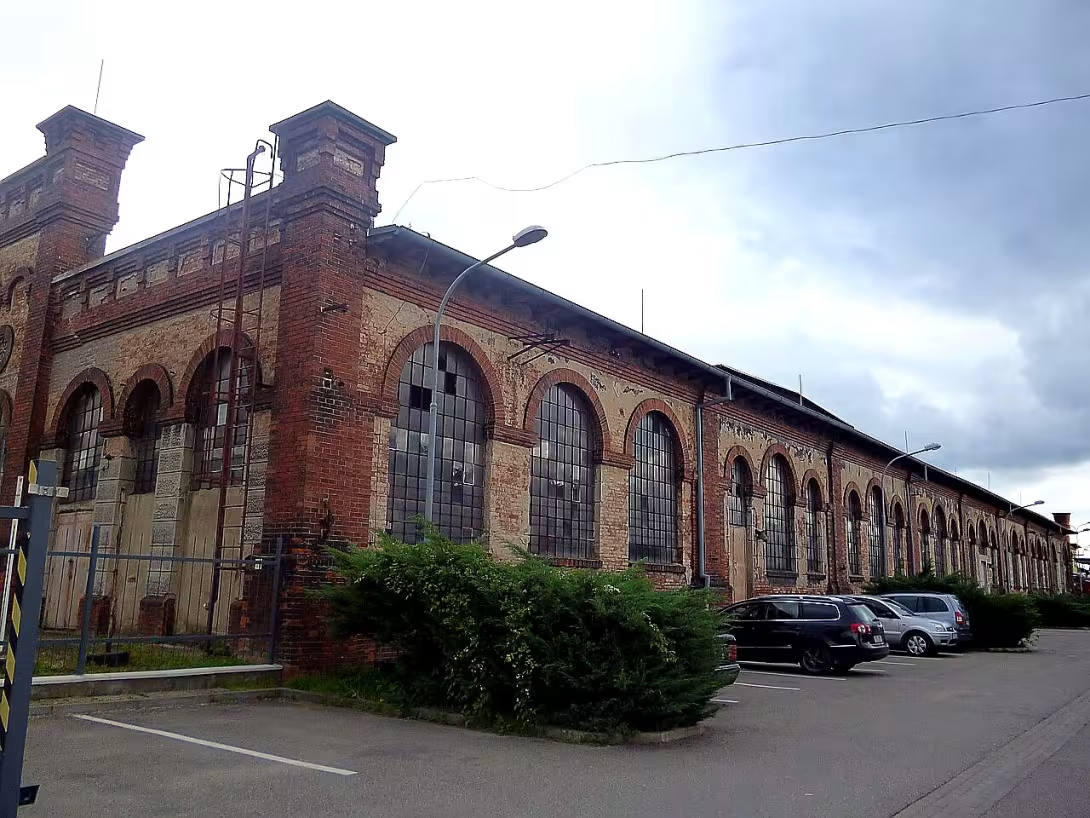
The town abattoir in Brno is a large area in part Trnitá, which was established at the end of the 19th century. The complex includes 12 buildings in an area of approximately 32 hectares. This is an important example of industrial heritage, which has been protected historically since 2016.
The original slaughterhouse at the site of today's Dornych Trade Center was demolished in 1868. Subsequently, new buildings with a meat market were built on the right bank of Svitavy in 1872 to 1877. Due to the expansion of the city, the current, larger complex in Masná Street was established at the end of the 19th century, located south of the original complex behind the railway line.
The buildings are carried out in a historic style with a coat made of unbraided, double-coloured brick. The roofs are flat with original riveted steel roofs. The facades show a rich breakdown with moldings and attics. The northern part of the area off the street Slaughter consists of smaller administrative buildings. It was built by builder Franz Ruschk until 1899 according to the designs of Ottokar Burghart and Ferdinand Abt. The dominant is a northeastern connecting hall in Masná Street. Her oversized middle ship provided lighting and ventilation. It is accompanied by cold rooms, machinery room, boiler room, stables, buildings for defeats and water tower, which forms the height dominant of the complex.
Between 1905 and 1909, a cattle market was built between the main hall and the Svitavou River. The construction was designed as a basilical tripod with an elevated middle boat. The construction took place under the supervision of Josef Nebehosteny and was probably based on the design of George Osthoff. In the 1920s, other buildings were created on the west side of Masná Street, most important of which is the Meat Exchange building designed by Bohuslav Fuchs.
The area had high capacity during its flowering. Before World War I, up to 90,000 pigs were slaughtered annually. The processed meat was exported to Vienna, Budapest and Bratislava. Logistically, the complex was connected to the line between Brno and the Sovereign using a tractor. The tragic clue in the history of the building is the Second World War. The area served as a gathering place for the transport of Roma families to Nazi extermination camps.
The operation of slaughterhouses was completed in the 1990s following unsuccessful privatisation. The buildings subsequently remained unused for several years before they were taken over by Brno Communications a.s. The repairs took place between 1998 and 2004. They removed non-original extensions and the halls were adapted for storage of sprinkler materials for winter maintenance of roads. In 2004 the reconstruction of the administrative buildings in the street Slaughter, including the reconstruction of facades, was completed. The cattle market today serves as a parking lot.
The building represents a unique set of technical constructions from the period of industrialization. It is a valuable testimony about the urban development of Brno and its economic history. From the point of view of architecture and industrial heritage is worth a visit.
Historical milestones
- 1899
- Completion of construction of smaller administrative buildings in the northern part of the complex.
- 1905
- The beginning of construction of the Dobytchí Market building.
- 2016
- Declaration of most of the area of the former slaughterhouses for cultural monument.
Architectural development
The buildings have a walled coat made of double-coloured brick and flat roofs with riveted steel roofs. In the years 1905- 1909 the Dobytčí market building with basilical tripod was built. In the years 1998- 2004, there were repairs and modifications of the premises for the storage of sprinkler materials.
Historical events
During World War II, the area served as a gathering place for the transport of Roma families to Nazi extermination camps. In the 1990s, the operation of slaughterhouses was terminated.
Owners
currently Brno Communications a.s.
Points of interest
- The area was established at the end of the 19th century and contains twelve buildings on an area of approximately 32 hectares. - Before World War I, up to 90,000 pigs were slaughtered each year and the meat was exported to Vienna, Budapest and Bratislava. - During World War II, the area served as a gathering place for the transport of Roma families to extermination camps. - The height of the complex is the water tower. - At present, the cattle market serves as a parking lot.
Guide
Show guide text
This text was created by artificial intelligence and has not been editorially reviewed. It may contain inaccuracies.
Welcome to the Brno part Trnitá. You are standing in front of the site of the former city abattoir, a place that connects the industrial power of the last century with a silent testimony to history. Now, if you look around you, you will see an extensive complex that dominates the surrounding landscape with its size and power. It is a space that will amaze you with its width at first glance because it extends over an area of approximately thirty hectares. In front of you are the buildings that tell the story of the time when the city of Brno became the modern centre of trade and craft.
Let's stop together to see how this space came into being and why it's here at all. At the end of the nineteenth century it was necessary to create a place that could effectively handle the processing of meat for the whole of Brno and surrounding areas. Construction started gradually. If you look at the northern part of the compound, you'll see the buildings that were completed first in the year one thousand eight hundred ninety-nine. They were mainly smaller administrative buildings that served as the brains of the entire operation. Later, in the year one thousand and nine hundred and five, the construction of another significant part that we know as the Conquest Market began. The whole project was not the work of one person, but the result of cooperation between several architects, such as Ottokar Burghart, Ferdinand himself Ferdinand Abt, Josef Nebehosteny, Georg Osthoff or Bohuslav Fuchs. Together, they designed a space which was intended primarily to be functional but also representative.
Now pay attention to the architecture itself and what you see right in front of your eyes. Notice the surface of the walls. The buildings are built from unbraided brick, which gives them the typical red shade and raw, industrial character. This style, which is called historic, was very popular at the time because it associated modern construction techniques with elements from the past. Take a look at the dominant connecting hall, which connects individual parts of the complex, and remember to look up to the water tower, which stands out over the surrounding buildings. The whole complex consists of twelve buildings, each of which had its exact function, from the market to the administrative offices. Feel the atmosphere of this place, where thousands of animals and hundreds of people used to move, and where every brick detail shows the precision of the then building twa.
When we think about what happened here, we have to realize how huge traffic was. Before World War I, these places were the real heart of the mass industry. Imagine there were up to 90,000 pigs slaughtered every year. These are figures that today sound unimaginable, but at that time it meant that Brno was a key hub for Central Europe. The meat from these slaughterhouses was not exported only to the Brno shops, but it travelled much further. The roads from Trnit led to large metropolis such as Vienna, Budapest and Bratislava. Brno acted here as an important supplier, which brought considerable wealth and recognition in the food industry.
However, the history of this place is not just about trade and industry. If we stop and think about the fate of the people who were here, we'll come across a much darker chapter. During World War II, the site stopped serving its original purpose. The buildings that were designed for economic use have become a gathering ground for the transport of Roma families. It is a painful reminder of how functional spaces can be misused for persecution and suffering. So you are standing in a place that carries two totally different worlds: a world of economic boom and a world of deep human tragedy. It is this duplicity that makes slaughterhouses a place that deserves deep respect.
You may be wondering why this compound is protected today. In two thousand sixteen, most buildings were declared a cultural monument. This means that the state recognized their unique value, not only in terms of architecture, but also in terms of city history. It is fascinating to think that the space that was primarily intended for butchery and meat trade has become a monument to national significance. It is a reminder of when the city grew into a modern metropolis and when industrial architecture defined the appearance of urban districts.
Let us now slowly finish this part of our journey. Take one last look at those red brick walls and the vast space around you. City abattoir in Brno is a place where practical practice meets art and prosperity with pain. It's the space that teaches us how the city has changed over the past 100 years.
I ask you now to further explore the premises. Go through the peace of the surrounding building, see the silence that today reigns where the work once was boiling, and let yourself be guided by your own curiosity. If you are interested in the history of Brno and its industrial architecture, I recommend stopping at other monuments in this part of town. Thank you for your attention and I wish you a pleasant rest of the day to discover the secrets of Brno.
Tips for visitors
The best time to visit is late spring or autumn, when the colors of the surrounding nature are the most striking in contrast to red brick buildings. The area is extensive, therefore we recommend shoes suitable for walking on unpaved surfaces.
For photo lovers are the most interesting details of industrial architecture from the end of the nineteenth century. The best light for building images is shortly before sunset, when brick walls gain a warm tone.
In addition to the slaughterhouses themselves, we recommend a short walk to the Svitava River or the Meat Exchange building, which are located in close proximity and complements the atmosphere of this place.
Families with children appreciate the space for movement within a large area where children can discover the history of the old town and monitor the flow of the nearby river.
Frequently asked questions
Can the monument be visited?
We have not verified whether this monument is accessible. Please ask the owner or operator, or the local municipal office.
Where is the monument?
Location: Trnitá. The map on this page shows the exact spot.
Why is the monument protected?
It is listed in the Central List of Cultural Monuments of the Czech Republic as a cultural monument (register no. 1000161679).
Businesses nearby
Do you run a restaurant, accommodation, shop, museum, rental, wellness or other visitor service near this monument? Show yourself directly to the people heading to it — this is how they will see you in the app and on the web:
Events nearby


Zdroj akcí: otevřená data měst a obcí ČR (Národní katalog otevřených dat) a kalendář akcí Národního památkového ústavu.
Nearby
Řeka Svitava, budova Masné burzy.
Accommodation nearby
Trips and activities nearby
Guided tours, tickets and activities nearby from GetYourGuide
Affiliate link: if you buy from the partner, we may receive a commission. The price for you does not change.
Search tours and activities →Themed route
Here is the design of the thematic route:
1. Meat Exchange (Building) - The walk begins at this historic building, which is closely related to the meat trade. 2. City abattoir (monument) - The main destination of the trip, where one can admire the architecture and history of the Brno butchery. 3. The river Svitava (water flow) - A short walk along the water, which served as a natural artery for transportation and drainage in the industrial district.
Seasonal recommendations
In the spring, the surroundings awaken to life and the young greenery softens the appearance of historical walls. Light is soft and pleasant in this period, which helps to observe the details of the construction. We recommend light but laminated clothing and a visit in the morning when the air is the cleanest.
Summer brings sharp sun and high temperatures that can highlight the texture of old materials. The atmosphere is hot and there are more people around for holidays. It is advisable to choose breathable substances, a sun hat and look for the time of a short day to avoid the greatest heat.
The autumn of nature in the surroundings is colored in golden and brown tones, which is consistent with the historical character of the place. The light is drier and creates a melancholy mood. It's practical to wear a waterproof jacket and tight shoes because the surfaces can be wet and slippery.
Zimą dominates the cold and short days that the object covers up much earlier. If the snow attacks, the whole area gets a quiet and dreamy look. Hot clothes, thermo-mats and high-quality hats are essential, and it is best to attach a visit to the noon hours when there is the most daylight.
Visualizations and artistic views

The visualisations are generated by artificial intelligence and serve as inspiration.
Photos from the area
Real photos taken near the monument


Zdroj a licence jsou uvedeny u každého snímku.
Tips from visitors
No tips yet. Be the first!
Log in and add your tip.
Sources and literature
Photos: Henta / CC BY-SA 3.0 — Wikimedia Commons. The author and licence also appear when you hover over the image.
Faktickým podkladem tohoto textu byl článek na Wikipedii, jehož autory jsou přispěvatelé Wikipedie. Článek je dostupný pod licencí CC BY-SA 4.0.
Location on the map
More monuments – Trnitá
Show all in the municipality
Příběhy a pověsti
Legendy, pověsti a příběhy spjaté s touto památkou
Fotografie návštěvníků
Zatím žádné fotografie. Buďte první, kdo přidá fotografii z návštěvy!
Log in a přidejte svou fotografii nebo hodnoťte.
Za ověřenou návštěvu v aplikaci získáte víc bodů — poznáme podle GPS, že jste na místě.
Reviews and comments