






Městské opevnění (Horažďovice) Town walls
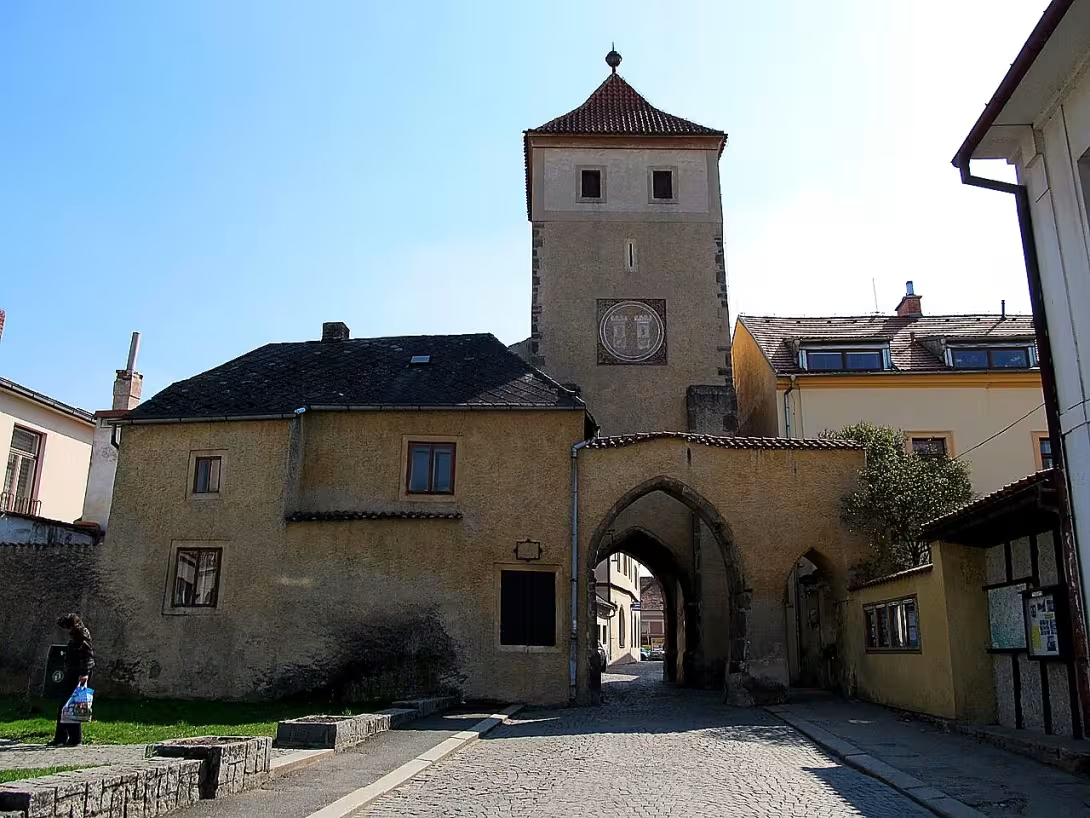
The town fortifications in Horadějovice in the Pilsen region represent a partially preserved system of medieval walls and moats, which were founded in the thirteenth century. The original fortification preserved long sections of the main and park walls, moat, Prague Gate and the lower gate torso. This whole defense system is protected as a cultural monument. The historical core of the city has an irregular plan of 6.5 hectares.
The process of turning the village into a city took place in the first decade of the second half of the 13th century. The construction of the city fortifications is documented in 1279, when Bavarian II from Strakonice was digging the ditch, but the work could start after 1260. At that time there was a transformation of Czech settlements into fortified cities. Then the fourteenth and fifteenth centuries marked the political conflicts between noble generations and monarchs, leading to frequent siege. The south and west side of the city protected the valley of Otava. In the north, the terrain in front of the city walls rises, and in the north-west part of the castle was built in the 13th century.
The foundation of the walls dates back to the 13th century. The main wall was originally 100 to 120 centimetres wide, but a significant part of the wall was later reinforced to 200 centimetres. At a height of about four metres, he led the castle gallery. The towers or bastions were apparently unique and until now only a half-circle torso has been preserved inside an open tower on the east side of the city. In the period of Pohusite there is likely to have been an expansion of the outer fence or the park wall. It reaches a width of seven to eleven meters and closes a wall between 65 and 80 centimeters wide. Its face is oblique and passes vertically into the trench escarpa, which has been preserved mainly in the south and partly in the east and north at a width of 12 to 15 metres. The moat is broken through the slit firing points between 3.5 and 5.5 metres apart, which complement square shot holes in the southwest. The wall is amplified inside by open prism bastions spread at distances between 45 and 50 meters. They stand in front of the wall by 3.5 to 4.5 metres and their forehead measures about seven metres.
The best preserved city gate is the Prague Gate, which consists of a prism tower with a plan of 6 × 6 meters. A portal leads to the original flat-ceiling passage from the outside. There used to be three flat-ceiling floors above it, with a fourth floor with a needle roof of younger origin. The passage closed the trapdoor and the preserved beam for fixing the door dates back to the beginning of the eighteenth century. The adjacent sections of the walls connect to the front of the tower, from whose first floor the original entrance to the gallery runs. At the same time with the tower was built the front gate with a portal 5.5 meters in front of the main gate. Archaeological research has demonstrated the secondary installation of the portal by the easter drawbridge. On the outside of the ditch, a five-sided branching object with a smaller security house protected access. The ground floor of the Lower Gate was preserved on the southeast edge of the city, also called the Pachenská. This was probably created at the same time as the main wall was amplified, has a floor plan of 7,5 × 9 meters and both its portals were closed only by the doors. From the same period as the Lower Gate probably comes a smaller gate in the south wall.
The Bavarians of Strakonice were the owners of the city until the first decade of the 15th century. Then the owners became lords of Hradec and before 1459 acquired the city Racek z Kocova. In 1307 the city besieged the army of Rudolf of Habsburg, because Bavor III. ze Strakonic supported King Henry of Korutan; These clothes ended in surrender. The walls were first mentioned in writing in 1318. In 1399 the city was allegedly besieged again, as Breenek of Strakonice was one of the opponents of King Václav IV. At the beginning of the Hussite wars, the town was taken over by the Campaign Union, but in 1427 Menhart II of Hradec managed it again. Since 1475, Racek z Kocova has conducted raids in Bavaria, against the Czech Budejovice and property of the masters of Švamberk and Šternberk. The nobles concerned joined together and surrounded the city in the autumn of 1477. By order of King Vladislav of Jagellonian, the troops from Tábor, Vodňan, Sand, Klatov, Susice and Domažlic helped them. After the year-round siege, the inhabitants gave up for food shortages at the turn of 1477 and 1478.
Today, the preserved parts of the urban fortification form a freely accessible part of the historical core of Horadějovice. They are located in the immediate vicinity of the river Otava and the former castle. Visiting this place offers a direct view of the preserved medieval fortification architecture and allows you to walk in places with history dating back to the thirteenth century.
Historical milestones
- 1279
- Evidence of digging a ditch behind Bavarian II from Strakonice.
- 1318
- First written mention of city walls.
- 1477
- The beginning of the annual siege of the city by allies against the city.
Architectural development
The foundation of the walls dates back to the 13th century, with the main wall being 100 to 200 centimetres thick. In the period of Pohusite there could have been an extension of the outer fence or park wall. The current form includes various types of gates and towers, including the prism Prague Gate.
Historical events
1279 - digging of the moat behind Bavaria II from Strakonice; 1307 - the siege of the city by the army of Rudolph the Habsburg; 1318 - first written mention of the walls; 1477-1478 - annual siege of the city.
Owners
Bavarians from Strakonice (until the first decade of the 15th century), lords from Hradec (since the 15th century), Racek z Kocova (before 1459).
Points of interest
- The town fortifications in Horadějovice represent a partially preserved system of medieval walls and trenches founded in the thirteenth century. - The construction of the city fortification is documented in 1279, when Bavarian II from Strakonice was digging the ditch, and the work could start after 1260. - The main wall was originally 100 to 120 centimeters wide, but a significant part of the wall was later reinforced up to 200 centimeters and at a height of about four meters led by the fortifications. - The best preserved city gate is the Prague Gate, which consists of a prism tower with a floor plan of 6 × 6 meters. - The ground floor of the Lower Gate, also called Pachenská, was preserved on the southeast edge of the city.
Guide
Show guide text
This text was created by artificial intelligence and has not been editorially reviewed. It may contain inaccuracies.
Welcome to Horlajovice. Now that you've put on your headphones, stop for a moment and just feel the space around you. You're standing outside a place that once formed an impenetrable boundary between the city's safe inner world and the unknown, often dangerous surroundings. In front of you are the remains of the city's fortifications, which are silent witnesses to centuries of history. Look around you. You see the sections of the walls and the trench tracks? It may seem like a mere fragment of old walls to you today, but in times of its greatest glory, this system was a complex military architecture that was responsible for one thing: protecting the people and property of the city from hostile attacks.
Let us now return together in time, deep into the Middle Ages, to understand why these walls were even built. Imagine the 13th century landscape. The cities at the time were not only trade centres, but mainly fortified islands. In Horadnejovice this process was started very soon. Historical records lead us to 1279, when the deep trench digging is documented. This fundamental work was done by Bavor II. ze Strakonic, a powerful nobleman who at that time perceived strategic importance in this area. However, it is very likely that the ambition to secure the city was even greater and the work itself on fortifications could start shortly after 1260. The first official written mention of the walls came in 1318. So notice that what you see today is not the work of one person or one decade, but the result of the gradual construction that took generations.
Now that you know the context of their creation, pay attention to the architecture itself. Look through what remains of the fortifications. The system wasn't easy. It consisted of the main wall that formed the primary line of defense, and the so-called park walls. The park was basically an outer, lower wall that created an additional barrier outside the main wall. This parking wall is a very interesting element today. If you look carefully, you will see the bastion that was used to allow the defenders to shoot at the enemy who tried to approach the walls. Note also the slit firing. These narrow holes were genius in simplicity. The shooter inside was almost safe, while he himself had sufficient view and space to attack the assailants in the ditch.
If you continue your tour, your attention will certainly attract the Prague Gate. The gates were key points in every fortified city. They were checkpoints, myths, but in the event of an attack, the weakest and most guarded points. The Prague Gate still reminds us of the way in which passengers and traders from the capital entered the city. Next to it you can see the lower gate torso. Even though it is now only the rest of its former size, it still tells us the story of how the city breathed and how its approaches were organised. This whole system, from deep moats to high walls, is today protected as a cultural monument, which is a well-deserved recognition of its historical value.
However, the history of these walls is not only about stones and vapors, but above all about people and dramatic events. The names of prominent personalities are associated with this place. In addition to the mentioned Bavarian II of Strakonice, which laid the foundations, Bavor III. ze Strakonic also left a trail. Later, figures like Racek z Kocova or king Vladislav Jagellonský appear in the history of the city. Imagine the tension that must have existed on these streets when powerful men were here.
However, the strongest story that has gone into these walls is 1477. Stop for a moment and try to imagine the atmosphere of that year. The city was surrounded. The allies against the city started a siege that took an incredible year. Imagine that feeling of isolation. The walls they were supposed to protect became the walls of a large prison. Residents saw the enemy behind their walls, heard their threats and had to face a shortage of supplies. It was at times like this that the real value of the parking wall and the shots we talked about showed up. Every foot of the wall was a matter of survival at the time. The siege left a deep mark in the city's memory and showed how crucial the role in the history of the Highlands was played by this fortification.
Now, you might wonder why the walls are being preserved only partially. That's one of the interesting things that happens when you look at old cities. Once the military tactics changed and the invention of firearms made high walls useless or even dangerous, cities began to change. The walls stopped being necessary and became an obstacle to the development of the city. Parts have been removed to create new streets and houses. So what you see today is a rare fragment that survived oblivion and modernization. It's fascinating to think that work on this system could have started in 1260, and we can now touch the surface that remembers the beginning of this city.
Now that you've gone through the basic points of history and architecture, I suggest you continue your walk along the remaining sections of the walls. Try to return in spirit to a time when these walls were high, deep ditches full of water or rubble and guards walked on the walls at regular intervals. Feel the contrast between today's calm and the medieval tension. Watch how the walls intertwine with the modern form of the city and how the spirit of courage and the need for security still persists.
Thank you for coming through the history of the Highlands with me. I hope this view of the city fortification helped you see more than just stones in these old walls. I wish you a pleasant further tour of the city and many other discoveries. Goodbye.
Tips for visitors
A tour of the historic town fortifications in Horadějovice is best planned for the morning hours, when the sunlight ideally illuminates preserved sections of medieval walls and parks. The morning is also usually calmer here, which makes it easier to walk in peace.
You can easily reach the city by car and public transport; parking is possible on reserved weaning areas in the wider city centre, from where it is only a short walk to the walls. Check the exact transport links in the current timetables.
Take a walk along the walls and to the Prague Gate with you fixed shoes because the terrain around the former moat can be uneven. Drinking water is also useful and repellent in warmer months, especially if you go closer to nature.
For photography lovers it offers the best shots of the surroundings of the Prague Gate and the Torza Lower Gate, where the massive medieval fortification excels. Ideal light for wall and tower images is early morning or late afternoon when the sun creates interesting shadows.
Within a 30-minute walk from the city walls, there is the Otava River, which invites you to pleasant beach walks, as well as a mountain castle in the northwest part of the city, which will perfectly complement your historic trip.
Businesses nearby
Do you run a restaurant, accommodation, shop, museum, rental, wellness or other visitor service near this monument? Show yourself directly to the people heading to it — this is how they will see you in the app and on the web:
Events nearby
Zdroj akcí: otevřená data měst a obcí ČR (Národní katalog otevřených dat) a kalendář akcí Národního památkového ústavu.
Nearby
Otava River, a mountain castle in the northwest of town.
Accommodation nearby
Themed route
1.Městské opevnění (Horažďovice) Type: Historical monument Why is it worth a visit: Medieval walls surround the historical core of the city and offer an impressive view of the ingenious defense system of our ancestors. A walk along these ancient walls will carry you to the past.
2. Horahodovic castle Type: Mansion Why is it worth a visit: It is located in the northwest part of the city and forms the natural dominance of the entire area. The historical buildings of the castle are closely related to the development of urban fortifications.
3. River Otava Type: Natural flow Why is it worth a visit: Water flows around Horadějovice complete a picturesque landscape scenery. The river banks offer a quiet environment for relaxation and pleasant walks near the historic centre.
Seasonal recommendations
Spring brings to the urban fortification in Horadnejovice awakening nature, when the surrounding greenery begins to revive ancient stone masonry and the fine spring sun creates extended shadows ideal for shooting details of the fortification. In this period you will meet only the minimum tourists, which guarantees a quiet atmosphere for walking along the walls; We recommend to start in the morning when the air is first fresh and wear fixed shoes, because the terrain can be slippery and wet in the rain.
Summer will play the walls in full force under the clear sky, while lush vegetation in the trenches contrasts with massive stones and the afternoon sun gives the monument a warm, almost southern European atmosphere. Since this is the main tourist season, it is necessary to count on a higher number of visitors, and therefore is the best time for a tour early in the morning or late in the evening when the sun is not so burning; Remember to pack your headgear and plenty of drinking water.
Autumn transforms the surroundings of the Highland fortification into a colourful palette of shades of yellow and red, with morning fog covering historical basties providing a mysterious, melancholy atmosphere. In colder, but still pleasant weather, you will find the minimum of people, which records calm contemplation, but because of often wet and windy weather, it is worth wearing layered clothes, a wind-resistant jacket and solid waterproof shoes.
Winter offers a unique view of the city's walls, especially when snow dusts the landscape, whose whiteness excels beautifully on a dark stone, while early twilight and grey winter days create a quiet and deep atmosphere of old times. Due to the freezing weather and the shortened time of the day, it is best to leave around noon, when it is the hottest outside, and it is absolutely necessary to choose warm winter clothes, hat, gloves and shoes with anti-slip soles due to icy trails.
Visualizations and artistic views

The visualisations are generated by artificial intelligence and serve as inspiration.
Photos from the area
Real photos taken near the monument


Zdroj a licence jsou uvedeny u každého snímku.
Tips from visitors
No tips yet. Be the first!
Log in and add your tip.
Sources and literature
Fotografie: Krabat77 / CC BY-SA 3.0 — Wikimedia Commons. The author and licence also appear when you hover over the image.
Faktickým podkladem tohoto textu byl článek na Wikipedii, jehož autory jsou přispěvatelé Wikipedie. Článek je dostupný pod licencí CC BY-SA 4.0.
Location on the map
More monuments – Horažďovice
Show all in the municipality

Příběhy a pověsti
Legendy, pověsti a příběhy spjaté s touto památkou

Fotografie návštěvníků
Zatím žádné fotografie. Buďte první, kdo přidá fotografii z návštěvy!
Přihlaste se a přidejte svou fotografii nebo hodnoťte.
Za ověřenou návštěvu v aplikaci získáte víc bodů — poznáme podle GPS, že jste na místě.
Reviews and comments